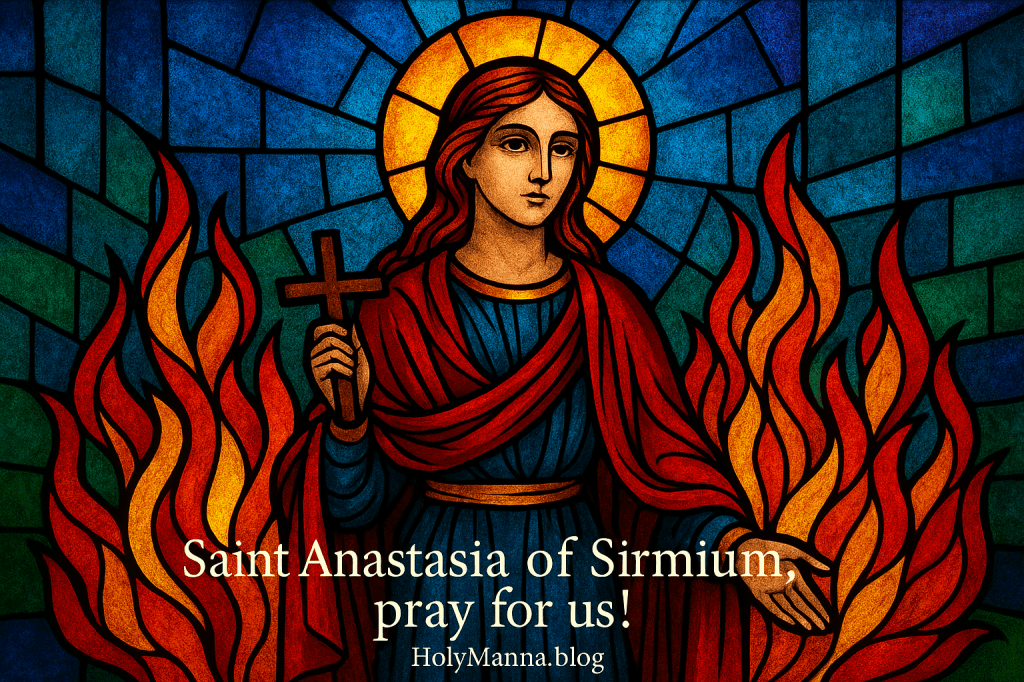
The Fire of Faith in the Midst of Flames
Saint Anastasia of Sirmium is one of those early Christian martyrs whose life may not be recorded in perfect historical detail, yet whose memory shines brightly through the liturgy of the Church. She died around the year 304 during the violent persecution under Emperor Diocletian, who sought to extinguish Christianity through intimidation, torture, and death. Even though time has obscured many aspects of her biography, the Church has never doubted her witness. Her name has been invoked for centuries in the Roman Canon of the Mass, placed lovingly alongside some of the greatest martyrs of the early Church. In the ancient Roman tradition, the second Mass of Christmas Day featured a special commemoration of Saint Anastasia, which beautifully united the joy of Christ’s birth with the witness of a woman who gave everything for Him. Across both East and West she is traditionally called Pharmakolytria, the “Deliverer from Potions,” a title that reflects her reputation as a healer and a protector from physical and spiritual harm. Though no verified spoken quotations from her have survived, her testimony in charity and martyrdom continues to speak powerfully to the Church today.
Quiet Seeds of Faith in a Pagan World
Early Christian sources offer several versions of Saint Anastasia’s background, but together they reveal a woman shaped by faith from her earliest days. Tradition places her birth either in Rome or Sirmium into a noble family with a pagan father named Praetextatus and a Christian mother named Fausta. Following the pattern of many early Christian mothers who practiced their faith quietly in an overwhelmingly pagan society, Fausta secretly baptized Anastasia and gave her a foundation in the teachings of Christ. After her mother’s death, her spiritual formation continued under Saint Chrysogonus, a wise and holy Christian teacher whose guidance helped her faith mature into courageous devotion.
Many early accounts describe Anastasia being forced into marriage with a wealthy pagan named Publius. He was a man who valued status and social conformity, not Christian virtue, and when he discovered her faith and her acts of mercy, he reacted harshly. Tradition holds that he confined, mistreated, and tried to silence her. Even in this painful marriage, Anastasia’s love for Christ grew stronger. When Publius died while traveling on imperial business, Anastasia did not return to a life of luxury or social ambition. Instead, she embraced a deeper simplicity, dedicating herself entirely to serving persecuted Christians, especially those who suffered quietly in prisons.
Deliverer from Potions and Friend of the Prisoners
What distinguishes Saint Anastasia in Christian memory is her intense and courageous compassion for suffering believers. During the Diocletian persecution, countless Christians were imprisoned, tortured, and in many cases poisoned or drugged as part of their punishment. With wisdom, courage, and remarkable resourcefulness, Anastasia used her noble status to gain access to the cells of the imprisoned. She brought food, healing balms, clothing, prayer, and encouragement to those who had been abandoned by the world. She poured out her life in these acts of mercy, often risking her own safety to be a living sign of Christ’s love.
Stories circulated of prisoners recovering through her prayers after being poisoned, beaten, or starved, and it was through these accounts that she became known as Pharmakolytria, a healer who delivered others from physical and spiritual toxins. Her ministry embodied the corporal and spiritual works of mercy described in CCC 2447, becoming a model of Christian charity in its most radical and selfless form. While some saints are remembered for public preaching or miracles witnessed by thousands, Anastasia stands out for the hidden nature of her holiness. She chose to serve in dark cells and underground chambers, places where hope seemed lost. Her life reminds all believers that some of the greatest acts of holiness occur far from admiration or applause and that God works powerfully through quiet, faithful love.
Tested by Chains and Crowned in Flame
As Anastasia’s works of mercy became known, she drew the attention of Roman authorities who fiercely opposed the Christian faith. She was arrested, interrogated, and pressured to renounce Christ and offer sacrifice to pagan gods. These demands were common in the trials of early Christians, and refusing them could mean torture or death. Anastasia refused every offer of compromise and every attempt to coerce her. Her unwavering refusal reflected the spirit of the Beatitude: “Blessed are those who are persecuted for righteousness’ sake, for theirs is the kingdom of heaven.”
Some traditions describe multiple imprisonments, harsh torments, and even failed attempts to drown her. One narrative recalls that she and other Christians were placed on a ship intended to be destroyed at sea, yet they escaped through God’s protection. Eventually, however, she faced her final sentence. In most Western accounts, Anastasia was taken to an island near Sirmium on December 25, bound to stakes, and burned alive. Witnesses described her as calm and prayerful, filled with a peace that no earthly fire could consume. Her martyrdom became a shining symbol of faith that endured even in the face of terrifying death. The Church honors her not because she sought suffering, but because she loved Christ so deeply that no threat, no fear, and no cruelty could turn her heart away from Him.
A Saint Who Heals Across Centuries
After her martyrdom, Christians visited her tomb and experienced extraordinary graces through her intercession. Accounts spread of healings, deliverance from physical ailments, protection from poisoning, and spiritual strength given to those who suffered injustice or captivity. These stories led to her widespread veneration throughout the Christian world. Her relics were later transferred to Constantinople, where a major church was dedicated to her, and eventually some were brought to Zadar in Croatia, where the Cathedral of Saint Anastasia still honors her as its patron. The ancient Roman church known as the titulus Anastasiae also became associated with her, and her feast continued to be observed with solemn reverence.
Her reputation as a healer and a liberator mirrors the Church’s teaching on the communion of saints described in CCC 957, which explains that the saints continue to intercede for Christians on earth, offering help, healing, and companionship through the grace of Christ. Saint Anastasia’s particular mission seems to involve healing what is poisoned, freeing what is bound, and strengthening what is weak. Her life and intercession reveal that holiness is not merely a historical memory, but an active force through which God continues to bless His people.
Let Your Faith Burn Brighter Than the Fire
The story of Saint Anastasia challenges every believer to consider how deeply Christ’s love shapes daily life. She lived in a culture that pressured people to conform, remain silent, and preserve their social standing, yet she chose unwavering fidelity to Christ and courageous compassion toward the suffering. Her example inspires Christians to stand firm in the face of social pressure, ridicule, or any situation where the Gospel may be difficult to live. She reveals that fortitude, described in CCC 1808, is more than toughness. It is a love fueled courage that allows a person to pursue the good even when confronted with danger or sacrifice.
Her ministry to poisoned and imprisoned Christians reminds believers to pay attention to those who feel trapped or forgotten in today’s world. Many people suffer quietly in emotional prisons, harmful patterns, or spiritual confusion. Imitating her example can mean reaching out to someone who is isolated, supporting ministries that serve the vulnerable, or praying boldly for deliverance and healing in the lives of others. Anastasia also shows how personal suffering can be united to Christ, allowing it to become a powerful source of grace. Whether the “fire” is criticism, stress, health struggles, or spiritual dryness, believers can allow God to purify their hearts and strengthen their love, just as He strengthened hers.
Engage with Us!
Share your thoughts and reflections in the comments below.
- How does Saint Anastasia’s courage inspire you to live your faith more boldly today?
- In what ways can you imitate her compassion toward those who are suffering or forgotten?
- What obstacles or fears keep you from fully surrendering your life to Christ, and how can her example help you overcome them?
May every heart be strengthened to live a life of faith that burns brightly with the love and mercy Jesus taught, standing firm in truth and overflowing with compassion.
Saint Anastasia of Sirmium, pray for us!
Follow us on YouTube, Instagram and Facebook for more insights and reflections on living a faith-filled life.

 Holy Manna!
Leave a comment