The Nativity of the Lord (Christmas) Mass at Dawn – Lectionary: 15
Dawn Of Mercy
Christmas at dawn feels different. The night is fading, the world is still quiet, and the first light slowly pushes back the darkness. That is exactly what these readings do together. They show the moment when the kindness of God does not just stay as an idea but appears in history in the tiny, fragile body of a Child. Through this Child, God takes a people who felt forgotten and names them redeemed, cared for, and never abandoned again.
In Isaiah 62:11-12, God speaks to a people who have known exile, shame, and disappointment. Zion had seen foreign armies, ruined walls, and the painful feeling that maybe God had moved on. Into that wound, the Lord proclaims to the ends of the earth that salvation is not a vague hope but a Person. The prophet announces, “See, your savior comes! See, his reward is with him, his recompense before him.” Then he reveals the new identity God gives his people. They will be called “The Holy People, The Redeemed of the Lord”, and the city will be known as “Cared For, A City Not Forsaken.” The Christmas mystery is already there. God does not simply repair circumstances. God renames hearts and restores dignity.
Psalm 97 takes that promise and stretches it to a cosmic level. The psalm declares that “The Lord is king; let the earth rejoice”, and even the distant islands are invited into this joy. The heavens proclaim his justice, and “all peoples see his glory.” When Psalm 97 says, “Light dawns for the just, and gladness for the honest of heart”, it gives language to what Christmas dawn really is. The birth of Jesus is not just a sweet story. It is the rise of a new light that exposes evil, consoles the broken, and fills those who cling to God with a deep, steady joy.
The second reading, Titus 3:4-7, pulls back the curtain and explains what is happening in the manger at a spiritual level. Saint Paul writes that “when the kindness and generous love of God our savior appeared”, salvation did not come because people finally got their act together. It came “not because of any righteous deeds we had done but because of his mercy.” Through Jesus Christ, believers receive “the bath of rebirth and renewal by the holy Spirit”, are justified by grace, and become heirs in hope of eternal life. Christmas is not just the beginning of a story about a baby. It is the beginning of a new creation. God steps into human history to pour out mercy and to make sinners into sons and daughters who inherit eternal life.
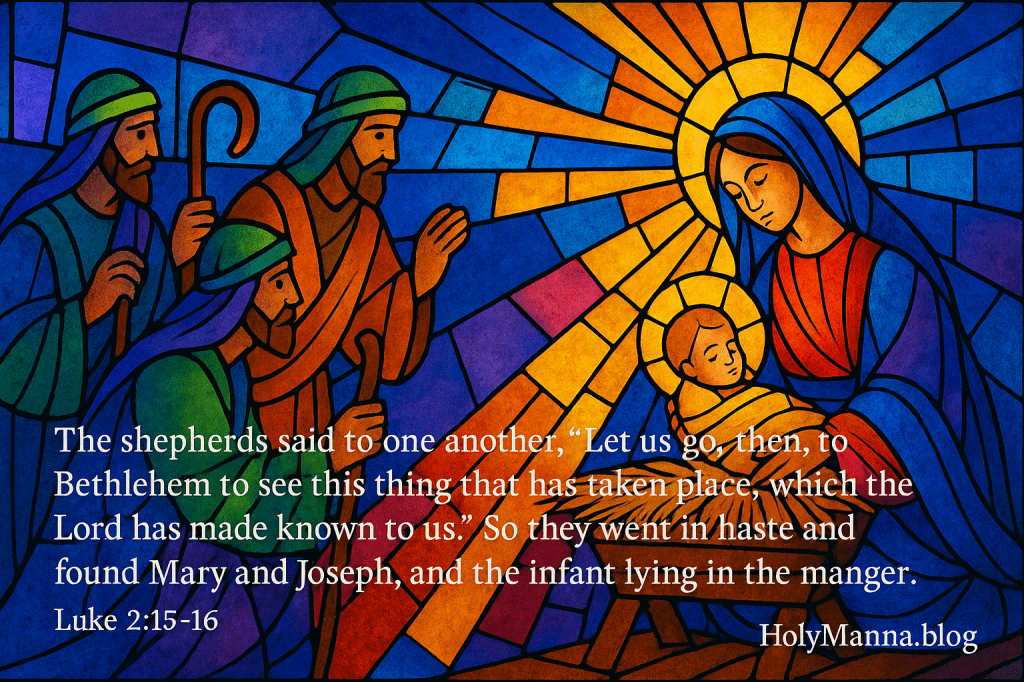
Then Luke 2:15-20 gives the concrete scene that holds all of this together. Shepherds are out in the fields, people on the margins who usually live unnoticed. After the angels depart, they say, “Let us go, then, to Bethlehem to see this thing that has taken place, which the Lord has made known to us.” They go in haste, they find Mary and Joseph and the infant lying in the manger, and they become the first evangelists. “When they saw this, they made known the message that had been told them about this child.” Everyone who hears is amazed. Mary, in a quieter and deeper mode, “kept all these things, reflecting on them in her heart.” The shepherds return to their ordinary lives, but nothing is ordinary anymore because they are “glorifying and praising God for all they had heard and seen, just as it had been told to them.”
Taken together, these readings reveal a single thread. At Christmas dawn, God’s merciful love appears in Jesus. A people once marked by exile and shame are renamed as holy, redeemed, and cared for. The King whose justice makes the earth rejoice is the same Child lying in the manger. Through him, according to Titus 3:4-7, believers receive rebirth, renewal, and the hope of eternal life. The right response looks like the shepherds and like Mary. Some are called to run in haste, speak boldly, and praise loudly. Others are invited to receive quietly and ponder deeply. Both are part of the right way to welcome the Savior who turns forsakenness into communion and darkness into dawn. How is the Lord inviting your heart today to move from feeling forgotten to living as one who is redeemed and cared for by the Child of Bethlehem?
First Reading – Isaiah 62:11-12
From Forsaken To Cherished
This prophecy from Isaiah 62:11-12 speaks to Israel after exile, when the people had tasted defeat, humiliation, and the feeling of being abandoned by God. Into that history of ruins and wounded identity, the Lord sends a public proclamation to the ends of the earth. The message is simple and world changing. A Savior is coming, and this Savior will not only restore fortunes but also restore names, dignity, and belonging.
This fits perfectly with the Christmas dawn theme. The Child in the manger is the fulfillment of this promise. God does not leave his people identified by their past sins, failures, or disasters. Through the coming of the Savior, the people are renamed as holy, redeemed, and cared for. What began as a word of hope to a broken city becomes the lived reality of every Christian who finds a new identity in Christ.
Isaiah 62:11-12 – New American Bible (Revised Edition)
11 The Lord has proclaimed
to the ends of the earth:
Say to daughter Zion,
“See, your savior comes!
See, his reward is with him,
his recompense before him.”
12 They shall be called “The Holy People,”
“The Redeemed of the Lord.”
And you shall be called “Cared For,”
“A City Not Forsaken.”
Detailed Exegesis
Verse 11 – “See, your savior comes! See, his reward is with him, his recompense before him.”
The Lord commands Zion to look and recognize that salvation is not an idea but a Person who comes. The word “savior” points to one who rescues, restores, and vindicates. The mention of “reward” and “recompense” shows that this Savior brings both justice and mercy. There is a sense of procession, almost like a king entering his city with gifts for his people. In the light of Christmas, this verse points directly toward Jesus arriving in humility yet carrying the riches of grace.
Verse 12 – “They shall be called ‘The Holy People,’ ‘The Redeemed of the Lord’ … ‘Cared For,’ ‘A City Not Forsaken.’”
Here the focus shifts from what God does to who the people become. New names signal a new identity. “The Holy People” means a people set apart for God, belonging to him in a special way. “The Redeemed of the Lord” highlights that their freedom and dignity come from God’s saving action, not from their own strength. The titles “Cared For” and “A City Not Forsaken” directly heal the wounds of abandonment and shame. The Lord publicly declares that his people are not forgotten, not overlooked, and not disposable. In Christ, this word extends to every baptized soul.
Teachings
This reading prepares hearts for the mystery of the Incarnation described in the Catechism of the Catholic Church. The Catechism teaches that the Son of God became man to reconcile sinners with the Father. CCC 457 states: “The Word became flesh for us in order to save us by reconciling us with God.” The promise of a Savior in Isaiah 62 finds its full meaning in Jesus Christ, whose coming is the definitive act of reconciliation.
The language of being redeemed and not forsaken echoes the Catechism’s teaching on divine adoption. CCC 1996 explains: “Our justification comes from the grace of God. Grace is favor, the free and undeserved help that God gives us.” The people are called “The Redeemed of the Lord” precisely because their new identity is pure grace. It is not payment for good behavior but a gift rooted in God’s mercy.
Saint Augustine often spoke about God’s initiative in seeking his people. In Confessions, he famously prayed: “You called, you shouted, and you broke through my deafness.” That same divine initiative is at work in Isaiah 62. God does not wait for a perfect people. God moves first, calls first, and renames first. The Savior comes into a history marked by sin and exile and turns it into a story of holiness and care.
Reflection
This reading speaks directly to anyone who has ever felt forgotten, used, or defined by past sins. God’s word tells the people who they truly are in his eyes. The same God wants to speak those names over every heart today. In Christ, believers are not mainly failures, disappointments, or survivors. They are holy, redeemed, cared for, and not forsaken.
A very practical response is to let God’s names weigh more than the labels that come from sin, shame, or other people’s judgments. That can mean returning to Confession, spending time in quiet prayer with this passage, or even repeating these names throughout the day as a kind of spiritual anchor. It is also an invitation to see others this way and to treat them as people God desires to redeem and care for.
Where has the heart started to believe that it is forsaken or forgotten by God?
What would it look like today to live as someone who is truly “redeemed of the Lord” and “cared for”?
Who in daily life needs to be reminded, through concrete kindness, that God has not forsaken them?
Responsorial Psalm – Psalm 97:1, 6, 11-12
The King Whose Light Breaks The Night
Psalm 97 is a royal hymn that proclaims the Lord as King over all creation. It was likely prayed in Israel’s worship when the people celebrated God’s kingship and his victory over idols and injustice. In a world surrounded by pagan nations and false gods, this psalm reminded Israel that the God of Abraham is not just a local deity but the true King whose glory fills heaven and earth. On Christmas at dawn, this psalm becomes a powerful soundtrack for the mystery of the Nativity. The Child in the manger is the King whom Psalm 97 celebrates. His birth is the rising of the true light which makes the earth rejoice, fulfills the promise to a people once forsaken, and matches the grace described in Titus 3:4-7, where the kindness and generous love of God appear in Jesus Christ.
Psalm 97:1, 6, 11-12 – New American Bible (Revised Edition)
The Divine Ruler of All
1 The Lord is king; let the earth rejoice;
let the many islands be glad.6 The heavens proclaim his justice;
all peoples see his glory.11 Light dawns for the just,
and gladness for the honest of heart.
12 Rejoice in the Lord, you just,
and give thanks at the remembrance of his holiness.
Detailed Exegesis
Verse 1 – “The Lord is king; let the earth rejoice; let the many islands be glad.”
This verse announces the central truth of the psalm. God reigns. The joy is not limited to Israel. The whole earth and even the distant islands are invited to rejoice. In the light of Christmas, this points to the universal reach of Christ’s kingship. The King born in Bethlehem is not only King of one nation but of all peoples. His rule brings true joy rather than fear. This fits the theme of a people who were once forsaken being drawn into a joy that stretches to the ends of the earth, just as Isaiah 62:11 announces a message proclaimed to all nations.
Verse 6 – “The heavens proclaim his justice; all peoples see his glory.”
Here creation itself becomes a preacher. The heavens proclaim the justice of God. His glory is not hidden but visible to all who have eyes to see. At Christmas, this justice and glory appear in a surprising form. The glory of God shines not only in thunder or fire but in the humility of the manger. In Christ, justice is revealed as mercy that comes close, heals, and saves. The line “all peoples see his glory” hints at the universality of salvation, which the Church recognizes in the inclusion of the Gentiles and in the mission to all nations.
Verse 11 – “Light dawns for the just, and gladness for the honest of heart.”
This verse captures the feel of Christmas dawn. Light does not explode violently. It gently dawns. It touches those who are just and honest of heart, meaning those who turn to God with sincerity and humility. The dawn of light is a classic biblical image for salvation. In the context of today’s readings, this line matches the description in Titus 3:4-7 of God’s mercy appearing and renewing hearts. The gladness promised here is not shallow excitement. It is the deep joy of knowing that God has come close and that darkness does not have the final word.
Verse 12 – “Rejoice in the Lord, you just, and give thanks at the remembrance of his holiness.”
The psalm ends by calling the just to rejoice and give thanks. Joy and gratitude are the right responses to the holiness of God, which is his burning love and faithfulness. Remembering his holiness means calling to mind who God truly is and what God has done. At Christmas, believers remember not an abstract quality but a concrete event. The holy God has entered history as a Child, fulfilling the promises of Isaiah 62 and pouring out grace as Titus describes. The psalm invites hearts to respond with praise rather than indifference.
Teachings
The Church sees in royal psalms like Psalm 97 a prophetic hint of Christ the King. The Catechism of the Catholic Church teaches that the coming of Christ is the decisive revelation of God’s kingship and mercy. CCC 457 says: “The Word became flesh for us in order to save us by reconciling us with God.” The joy and light described in Psalm 97 become concrete in the Incarnation, where God’s justice is shown not only in judgment but in a saving mission.
The psalm’s focus on light and joy connects deeply with the teaching on grace and justification. CCC 1996 states: “Our justification comes from the grace of God. Grace is favor, the free and undeserved help that God gives us.” When Psalm 97 proclaims that light dawns for the just, it echoes the reality that any true justice in human hearts is the fruit of God’s grace. The dawn of light is the dawn of grace poured into souls by the Holy Spirit through Christ.
Saint Leo the Great, preaching on Christmas, expressed this same mystery when he said: “Christian, remember your dignity.” The King whose birth is celebrated at Christmas lifts believers into a new dignity as sons and daughters of God. The joy and gladness in Psalm 97 reflect the inner change that happens when people receive that dignity and live under the reign of Christ rather than under fear or sin.
Reflection
This psalm invites a very concrete response. If the Lord truly is King, and if his light has dawned in Christ, then life cannot be lived the same way as before. Daily choices, conversations, and priorities either line up with his reign or quietly resist it. Rejoicing in the Lord is not just an emotion. It is a decision to trust God’s rule even when circumstances are hard and when darkness seems thick.
A helpful practice is to begin the day by acknowledging Christ as King and asking for the grace to walk in his light. That might look like a simple morning prayer, a moment of thanksgiving before work, or a quiet remembrance of his presence when anxiety starts to rise. Gladness for the honest of heart grows when people bring struggles and sins into the light in Confession, choose honesty in relationships, and refuse to live double lives.
This psalm also challenges believers to become signs of light and gladness for others. If the heavens proclaim God’s justice, then Christian lives should reflect that justice and mercy in the way they treat the poor, forgive enemies, and serve family and community.
What areas of life still feel like night and need the light of Christ the King to dawn more fully?
How can joy in the Lord become a daily habit rather than just a holiday feeling that fades after Christmas?
Who around you needs to see the gladness of someone who truly believes that the Lord is King and that his light has already begun to shine?
Second Reading – Titus 3:4-7
Mercy Appears And Makes Us Heirs
Titus 3:4-7 comes from a short pastoral letter where Saint Paul is teaching a young bishop how to form Christian communities in a pagan world. The Cretan culture around them was known for dishonesty and moral confusion, yet Paul does not start with lectures about trying harder. He starts with the sheer surprise of God’s mercy appearing in Christ. On Christmas at dawn, this passage fits perfectly with the theme of the Savior who comes to a people once forsaken and names them redeemed. Here, the focus is on what God has done from the inside out. In Jesus, the kindness and generous love of God break into history, not as a reward for good behavior but as a free gift that washes, renews, and makes believers heirs of eternal life.
Titus 3:4-7 – New American Bible (Revised Edition)
4 But when the kindness and generous love
of God our savior appeared,
5 not because of any righteous deeds we had done
but because of his mercy,
he saved us through the bath of rebirth
and renewal by the holy Spirit,
6 whom he richly poured out on us
through Jesus Christ our savior,
7 so that we might be justified by his grace
and become heirs in hope of eternal life.
Detailed Exegesis – The Mercy That Appears And Renews
Verse 4 – “But when the kindness and generous love of God our savior appeared”
Paul speaks of a moment in history when something new happened. The “kindness and generous love of God our savior” did not stay hidden or abstract. This love “appeared”, which echoes the language of light dawning in Psalm 97 and the Savior coming in Isaiah 62. At Christmas, that appearance is the birth of Jesus, the visible face of the Father’s mercy. God steps into human history, not as a distant judge but as a Savior whose love can be seen, touched, and heard.
Verse 5 – “not because of any righteous deeds we had done but because of his mercy, he saved us through the bath of rebirth and renewal by the holy Spirit”
This verse makes the logic of salvation crystal clear. It is not a paycheck for good works. It is “not because of any righteous deeds we had done but because of his mercy”. Salvation is rooted in God’s heart, not in human performance. The “bath of rebirth” points to Baptism, where God acts first, washes away sin, and gives new life. The “renewal by the holy Spirit” shows that Christian life is not just a fresh start on the outside but a deep inner transformation. The Spirit renews desires, heals wounds, and shapes a new way of living.
Verse 6 – “whom he richly poured out on us through Jesus Christ our savior”
The “whom” here refers to the Holy Spirit. God does not ration the Spirit. The Spirit is “richly poured out”. That language sounds like overflowing water or oil, not a stingy drizzle. The channel of this outpouring is “Jesus Christ our savior”. Through his life, death, and resurrection, Jesus opens the way for the Spirit to dwell in believers. The same Child laid in a manger will later be the crucified and risen Lord who breathes the Spirit on the Church.
Verse 7 – “so that we might be justified by his grace and become heirs in hope of eternal life.”
Here Paul shows the goal of all this mercy. Believers are “justified by his grace”, which means made right with God as a free gift. This justification is not just a legal stamp. It brings a new status. Christians “become heirs in hope of eternal life.” That is family language. Heirs are children, not outsiders. God does not just tolerate believers. God makes them family and gives them a real inheritance: eternal life with him. On Christmas, that inheritance begins in a hidden way in the crib, where the eternal Son shares human poverty so humans can share divine riches.
Teachings
The Catechism of the Catholic Church uses language very close to this passage when it speaks about the Incarnation and salvation. CCC 457 teaches: “The Word became flesh for us in order to save us by reconciling us with God.” This is exactly what Titus 3:4-7 describes. The kindness and generous love of God appear in Christ so that sinners can be reconciled and justified by grace.
The reference to the “bath of rebirth” and “renewal by the holy Spirit” is a classic baptismal image. CCC 1213 explains: “Holy Baptism is the basis of the whole Christian life, the gateway to life in the Spirit.” Baptism is not a symbol of human effort. It is the moment when this passage is fulfilled personally. God saves, washes, and renews the soul through water and the Holy Spirit.
The teaching on grace is also front and center. CCC 1996 states: “Our justification comes from the grace of God. Grace is favor, the free and undeserved help that God gives us.” This echoes Paul’s words that salvation happens “not because of any righteous deeds we had done but because of his mercy.” Saint Augustine, who knew his own sins well, loved this truth. In one homily he said: “God does not choose us because we are good, but in choosing us he makes us good.” That captures the heart of Titus 3. God’s choice and mercy come first. Holiness grows as a response.
Reflection
This reading challenges believers to stop thinking of Christianity as mainly a self improvement project and to start receiving it as a gift of mercy. If God has already “saved us through the bath of rebirth and renewal by the holy Spirit”, then daily life becomes a response to something that has already begun. That response can look like returning to Baptism in prayer, thanking God for that moment of rebirth, and asking the Spirit to renew what has grown cold or tired.
It also speaks into feelings of unworthiness or shame. Many people carry the quiet lie that they need to clean themselves up before coming to God. This passage turns that upside down. God comes first. God washes first. God renews first. A concrete way to live this is to come honestly to Confession, where baptismal grace is restored, and to approach prayer not as a performance but as time in the presence of a Father who has already called his children heirs.
In relationships and community life, this reading invites a more merciful way of seeing others. If salvation is by grace, then no one is beyond hope, and no one earns their place. That can soften judgment, deepen patience, and make room for the Spirit to work in surprising hearts.
What would change in daily life if the heart really believed that salvation is rooted in God’s mercy and not in personal performance?
How can Baptism and the gift of the Holy Spirit be remembered and thanked for in a concrete way this week?
Who in life needs to be treated less like a project and more like someone whom God desires to make an heir of eternal life?
Holy Gospel – Luke 2:15-20
Shepherds, Mary, And The First Response To The Savior
The Gospel of Luke places the birth of Jesus in real history, during the rule of Caesar Augustus, in a small town that no empire would normally care about. Into that quiet night in Bethlehem, the glory of God breaks in through angels and a message that is first given to shepherds, people who lived on the margins of society. For the Mass at Dawn, this passage shows what happens when the Savior promised in Isaiah 62 and the merciful love described in Titus 3 actually touches real human hearts. The theme of Christmas dawn is here in motion. Light appears, the forgotten are invited, Mary receives and ponders, and the shepherds become joyful witnesses who return to ordinary life changed by what they have seen and heard.
Luke 2:15-20 – New American Bible (Revised Edition)
The Visit of the Shepherds. 15 When the angels went away from them to heaven, the shepherds said to one another, “Let us go, then, to Bethlehem to see this thing that has taken place, which the Lord has made known to us.” 16 So they went in haste and found Mary and Joseph, and the infant lying in the manger. 17 When they saw this, they made known the message that had been told them about this child. 18 All who heard it were amazed by what had been told them by the shepherds. 19 And Mary kept all these things, reflecting on them in her heart. 20 Then the shepherds returned, glorifying and praising God for all they had heard and seen, just as it had been told to them.
Detailed Exegesis – The Night Where Faith Runs, Ponders, And Praises
Verse 15 – “When the angels went away from them to heaven, the shepherds said to one another, ‘Let us go, then, to Bethlehem to see this thing that has taken place, which the Lord has made known to us.’”
The heavenly vision has ended, but the grace does not. The shepherds do not stay frozen where they are. They respond. Their words show faith in action. They believe that the message came from the Lord and they decide to go and see. This is a beautiful picture of how faith works. God reveals, and the human heart chooses to move. At Christmas, the invitation is the same. The Child has come, and now each heart decides whether to stay distant or to go and see.
Verse 16 – “So they went in haste and found Mary and Joseph, and the infant lying in the manger.”
The phrase “went in haste” shows eagerness, not half hearted curiosity. They find exactly what the angel had described. The scene is simple and poor. Mary, Joseph, and a baby in a feeding trough. Yet faith recognizes that this is the Savior, Christ the Lord. The humility of the manger matches the mercy of God described in Titus 3. The King of Psalm 97 does not arrive in visible power, but in hidden vulnerability.
Verse 17 – “When they saw this, they made known the message that had been told them about this child.”
Once they have seen, they cannot keep it to themselves. They repeat the message they had received. This is the pattern of evangelization. No clever marketing, just simple sharing of what God has made known. The shepherds, who were socially insignificant, become the first preachers of the Gospel. The light that dawned for them begins to spread through their words.
Verse 18 – “All who heard it were amazed by what had been told them by the shepherds.”
The reaction of the crowd is amazement. This is often the first effect of the Gospel. People sense that something new and surprising is happening. Amazement alone is not yet faith, but it cracks open the door. Even here, the humble shepherds carry a message that unsettles ordinary expectations. God has chosen to work through the lowly, just as Isaiah 62 promised a new name for a people who felt forsaken.
Verse 19 – “And Mary kept all these things, reflecting on them in her heart.”
Mary receives the same events in a different mode. She does not preach. She keeps and reflects. The Greek suggests a deep, ongoing pondering, like turning events over and fitting them together. Mary models the contemplative side of faith. She holds the mystery of her Child, the angel’s words, the shepherds’ testimony, and lets them sink into her heart. This quiet, interior response is just as important as the shepherds’ active witness.
Verse 20 – “Then the shepherds returned, glorifying and praising God for all they had heard and seen, just as it had been told to them.”
The passage ends with return. They go back to their fields, but their hearts are different. They glorify and praise God because what they heard has been confirmed by what they saw. Everyday work is now filled with worship. This is a key Christmas grace. Life may look the same on the outside, but once the Savior has been encountered, ordinary days can become places of praise.
Teachings
The Catechism of the Catholic Church teaches that the Nativity is the moment when the eternal Son of God truly enters human history in humility. CCC 525 says: “Jesus was born in a humble stable, into a poor family. Simple shepherds were the first witnesses to this event. In this poverty heaven’s glory was made manifest.” This perfectly matches Luke 2:15-20. The glory of heaven shines, not in a palace, but in a manger, and the first to see it are shepherds.
The shepherds’ response also reflects the mission of all the baptized. CCC 900 teaches: “Since, like all the faithful, lay Christians are entrusted by God with the apostolate by virtue of their Baptism and Confirmation, they have the right and duty, individually or grouped in associations, to work so that the divine message of salvation may be known and accepted by all men throughout the earth.” The shepherds show this lay apostolate in its simplest form. They receive the message and then make it known.
Mary’s pondering heart has always been a model for the Church. CCC 2674 says of Mary: “By her maternal charity, she cares for the brethren of her Son, who still journey on earth surrounded by dangers and difficulties.” Her way of keeping and reflecting on the mysteries of Christ in her heart is the pattern for how the Church remembers, prays, and lives the Gospel. The saints have echoed this. Saint John Paul II wrote that Mary is the “star of the new evangelization”, because she unites contemplation and mission. The scene in Luke 2 already shows that unity.
Reflection
This Gospel offers three simple paths for daily life: move toward Christ, ponder the mystery, and praise God in ordinary places. The shepherds invite hearts to stop delaying obedience. Once they hear the Lord’s word, they go in haste. That can inspire quicker generosity in prayer, faster responses to promptings to serve, or less hesitation in turning away from sin.
Mary’s example invites deeper interior life. Taking even a few minutes each day to quietly sit with the Gospel, to repeat the words, and to let them sink into the heart is a way of imitating her. Reflecting on how God has worked in the past makes it easier to recognize how God is working now.
The shepherds returning to their fields while glorifying and praising God points to a very practical spirituality. Work, family duties, and daily responsibilities do not have to be obstacles to holiness. They can become places where gratitude and quiet praise are offered throughout the day. Brief thank you prayers, offering up small frustrations, and remembering the presence of Christ can turn a regular day into a kind of hidden Christmas worship.
Where is the Lord inviting a more immediate response, like the shepherds going in haste to Bethlehem?
How can time be carved out this week to imitate Mary by keeping and reflecting on the mysteries of Christ in the heart?
What would it look like to return to everyday responsibilities while consciously glorifying and praising God for all that has been heard and seen in faith?
Walking in the Light of God
Christmas at dawn wraps all these readings into one simple truth. In Isaiah 62, God promises a Savior who will rename a wounded people as “The Holy People”, “The Redeemed of the Lord”, “Cared For,” and “A City Not Forsaken.” In Psalm 97, that promise looks like light gently rising over the whole earth, as “light dawns for the just, and gladness for the honest of heart.” In Titus 3:4-7, that light becomes very concrete as the “kindness and generous love of God our savior appeared”, saving us “not because of any righteous deeds we had done but because of his mercy.” Finally, in Luke 2:15-20, this mercy has a face, a name, and a place. The shepherds find the Child in the manger, Mary treasures everything in her heart, and ordinary people start praising God because what they heard has become something they can see.
Together, these readings say that God is not distant, cold, or indifferent. God comes close. God takes the first step. God renames hearts that feel forgotten and washes lives that feel too stained. In Baptism, that promise becomes personal as believers are given the bath of rebirth and renewal by the Holy Spirit and become heirs in hope of eternal life. In the manger, that promise becomes visible as the true King arrives in humility so that no one feels too small or too broken to approach him.
The invitation today is to let this truth move from idea to reality. That can mean letting go of the lie that everything depends on personal strength, and instead receiving again the mercy that God has already poured out. It can mean imitating the shepherds by going in haste toward Christ in prayer, in the sacraments, and in acts of charity, rather than staying stuck in spiritual delay. It can also mean imitating Mary by taking time to quietly keep and reflect on how God has already been at work in your story, even in the hardest chapters.
Christmas at dawn is not just about a beautiful liturgy. It is about choosing to live as someone who is truly redeemed and cared for, someone who carries the light of Christ into workplaces, homes, friendships, and hidden struggles. The same God who spoke to Zion, who inspired the psalmist, who breathed through Saint Paul, and who drew shepherds to Bethlehem is speaking now, offering the same mercy and the same new identity.
Where is the Lord inviting you to stop living as someone forsaken and to start living as someone redeemed and cared for by him?
How can time with the Child of Bethlehem become a real priority, not just on Christmas day but in the days that follow?
Who in your life needs to see, through your words and actions, that the light of Christ has truly dawned and that they have not been forgotten by God?
Engage with Us!
Share your reflections in the comments below and let the Word of God speak personally into your life through today’s Christmas readings. Use these questions to pray, ponder, and enter into deeper conversation with the Lord.
- First Reading – Isaiah 62:11-12: Where in your life do you most need to hear God call you “Cared For” and “Not Forsaken”, and what concrete step can you take this week to live more like someone who is truly “The Redeemed of the Lord”?
- Responsorial Psalm – Psalm 97: In what situations does it feel hardest to believe that “The Lord is king; let the earth rejoice”, and how can you invite the light that “dawns for the just” to shine into those specific areas of fear, doubt, or discouragement?
- Second Reading – Titus 3:4-7: How does knowing that God saved you “not because of any righteous deeds we had done but because of his mercy” change the way you see your past, your weaknesses, and your daily efforts to grow in holiness?
- Holy Gospel – Luke 2:15-20: Do you relate more to the shepherds who “went in haste” or to Mary who “kept all these things, reflecting on them in her heart”, and what is one simple way you can respond to Jesus this week with either more eager action or deeper quiet reflection?
May these questions help you walk more closely with Jesus, live a life of faith that is real and joyful, and do everything with the love and mercy he has so generously shown in coming to dwell with us.
Sacred Heart of Jesus, we trust in You!
Immaculate Heart of Mary, pray for us!
Saint Michael the Archangel, defend us in battle!
Follow us on YouTube, Instagram and Facebook for more insights and reflections on living a faith-filled life.

 Holy Manna!
Leave a comment