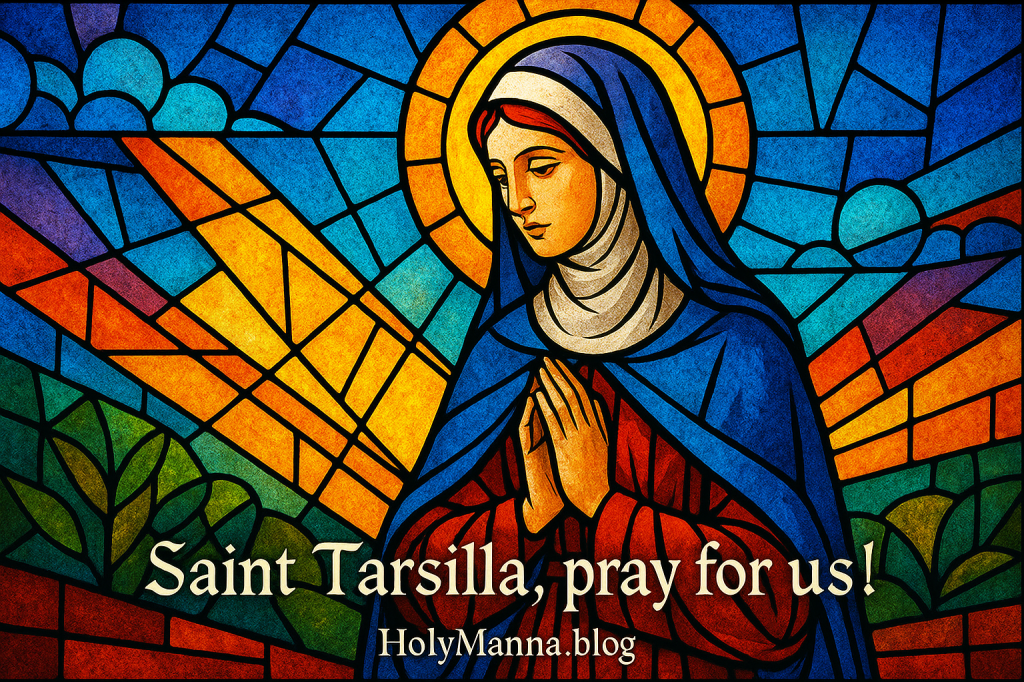
A Quiet Flame in the Heart of Rome
Saint Tarsilla stands as one of the most beautiful reminders that some of the greatest saints in the Church were formed not in monasteries with stone cloisters, but in ordinary homes filled with extraordinary prayer. Living in sixth century Rome as the aunt of Pope Saint Gregory the Great and a relative of Pope Felix III, she chose a life that the world barely noticed, yet God saw and treasured. She embraced prayer, penance, and quiet fidelity, transforming her family home into a kind of small monastery. Her life embodied what the Catechism of the Catholic Church calls a heart that clings to Christ with freedom, purity, and devotion (CCC 922–924). The Church celebrates her feast on December 24, a beautiful sign that her life was a lifelong preparation to welcome the birth of Christ with a heart made radiant through holiness.
Noble Roots and a Radical Yes
Tarsilla was born into the ancient Roman gens Anicia, a noble family known for its influence in both civic and ecclesiastical life. Her brother, the Senator Gordian, owned a prominent residence on the Caelian Hill, and this home would become the center of Tarsilla’s quiet path to sanctity. Gordian later became the father of Pope Saint Gregory the Great, making Tarsilla his beloved aunt and spiritual influence.
Tarsilla grew up alongside her sisters Emiliana and Gordiana. All three felt drawn to consecrate their lives to God in virginity, prayer, and fasting. Inspired by the early desert fathers and the monastic spirit flourishing throughout the Church, they formed a small religious household within their family home. Rather than entering a formal monastery, they offered themselves to God within the world, living the reality described in CCC 924 where consecrated women live fully for Christ while remaining in ordinary surroundings.
Tarsilla was the eldest sister and quickly became the spiritual anchor for the others. Pope Gregory later wrote with deep affection about the holiness that radiated from his aunt and the way she helped Emiliana remain steadfast in their shared vocation. Gordiana eventually abandoned the path, turning back to worldly comforts, and this choice became a sorrow in Tarsilla’s life, yet it never weakened her commitment to Christ. Her whole life reveals that holiness does not always require a dramatic conversion moment. It often comes from daily choices made quietly and faithfully for the Lord.
Knees Like a Camel and a Heart Fixed on Heaven
The spiritual intensity of Saint Tarsilla’s life becomes especially vivid through the details preserved by Pope Saint Gregory. He described how Tarsilla persevered in prayer so constantly that the skin of her knees became hardened, a mark of years spent kneeling before God in humble conversation. Her life was shaped by fasting, abstinence, and unbroken intimacy with the Lord. This echoes the teaching of the Catechism that prayer is a vital and personal relationship with the living and true God (CCC 2558). Her body itself bore the imprint of that relationship.
Gregory praised her for rising to what he called the honor of the highest sanctity because her entire life was marked by continual prayer, self restraint, and an unshakeable sobriety of soul. In his writings, he recounts that she lived with a deep recollection that made her home feel like a holy place. Her life itself became a miracle of grace, a quiet witness to the transforming power of perseverance.
Toward the end of her life she received a remarkable grace that Gregory recounts with awe. Saint Tarsilla was visited in a vision by Pope Saint Felix, her ancestor, who showed her a place prepared for her in heaven and said to her, “Come; I will receive you into this habitation of light.” This vision confirmed the holiness of her long life and strengthened her as she approached her final days. Although she is not known for dramatic signs or public miracles, her daily fidelity stands as a powerful testimony to what sanctity looks like in hiddenness.
Silent Battle and a Glorious Death
Saint Tarsilla’s hardships were not the violent persecutions endured by martyrs, but rather the daily ascetical struggles that demand endurance, humility, and love. She embraced a life of fasting and nightly vigils, and she faced the emotional pain of seeing her sister Gordiana abandon the vocation they had begun together. This sorrow became a quiet share in the suffering of Christ, showing that not all martyrdoms require blood. Some require steadfastness in the face of disappointment, loneliness, and temptation.
Her final days were filled with profound spiritual meaning. After her vision of Pope Felix, she fell ill with fever. Those who gathered around her watched her gaze become fixed, as if she were already seeing realities beyond this world. At the moment of her death she cried out, “Depart! Make room! Jesus is coming!” With these words she surrendered her soul to God on December 24, the eve of the Lord’s Nativity. Her death became a kind of liturgical offering, as if she were stepping into eternity at the very moment the Church prepared to welcome Emmanuel.
The Catechism teaches that perseverance is essential in the journey of faith (CCC 162, 2016), and Saint Tarsilla’s life illustrates this beautifully. She did not waver in her commitment, even when it cost her comfort, reputation, or companionship. Her martyrdom was one of faithfulness, a lifelong offering of her heart and body to God.
Heavenly Invitations and Holy Relics
Saint Tarsilla’s miracles did not end with her final breath. Soon after her death she appeared to her sister Emiliana in a vision and invited her to join her in celebrating the Epiphany in heaven. Emiliana fell ill almost immediately and died on January 5, the eve of the Epiphany, fulfilling the heavenly invitation and reuniting the two sisters who had begun their spiritual journey together. Their deaths, one on the vigil of Christmas and the other on the eve of Epiphany, form a beautiful arc of divine symbolism.
Tradition holds that the relics of Tarsilla, Emiliana, and their mother Saint Silvia were preserved in the Oratory of Saint Andrew on the Caelian Hill, a place deeply tied to the spiritual life of the Gregory family. The Catechism reminds believers that the communion of saints means the good of each member is shared with all (CCC 946–947). Through the preservation and veneration of her relics, Saint Tarsilla continues to share the graces of her holiness with the Church.
Some local traditions honor her as a patron of single laywomen, highlighting the truth that holiness is not reserved for those in formal religious orders. She reveals how profoundly God can work in a simple home filled with prayer, discipline, and love.
Building a Domestic Monastery
Saint Tarsilla’s story invites reflection on how holiness can flourish in the everyday rhythms of life. She did not preach to crowds, found institutions, or travel across continents. She prayed. She fasted. She loved Christ with her whole heart. Her home became a sacred space because her soul had become a sanctuary for God.
Modern Catholics can learn much from her example. The Catechism tells us that consecrated life, even when lived in the world, serves as a sign of the love that moves the Church toward Christ (CCC 922–924). Saint Tarsilla demonstrates that this consecration does not require robes or cloisters, but rather a heart surrendered entirely to God’s will.
One way to imitate her is by cultivating a place of prayer within your own home, even if it is just a small corner with a crucifix and a Bible. Another way is by choosing a simple and consistent form of self denial that reminds the soul to rely on God alone. Her life also encourages believers to persevere in prayer, trusting that God uses even hidden acts of fidelity to transform the world. Her final cry of joyful expectation encourages Catholics to pray for the grace of a holy death, one filled with confident hope in the presence of Jesus.
Saint Tarsilla embodies the truth that holiness grows through constancy, humility, and love. She teaches that God sees every quiet prayer, every small sacrifice, and every moment of obedience. Her life reassures anyone who feels unseen or unnoticed that heaven is paying close attention.
Engage with Us!
Share your thoughts and reflections in the comments below.
- Which detail about Saint Tarsilla’s hidden life spoke most deeply to your heart, and why?
- How is God inviting you to build a little “domestic monastery” in your current state of life?
- What is one concrete step you feel called to take this week to persevere in prayer, chastity, or sacrificial love?
May the example and prayers of Saint Tarsilla strengthen you to live a life of deep faith, steady hope, and generous love, and to do everything with the mercy and tenderness Jesus taught.
Saint Tarsilla, pray for us!
Follow us on YouTube, Instagram and Facebook for more insights and reflections on living a faith-filled life.

 Holy Manna!
Leave a comment