Wednesday of the Fourth Week of Advent – Lectionary: 200
The Dawn of the Promise
The nearness of Christmas has a way of stirring up both longing and restlessness, and into that mix these readings speak a steady truth: God Himself has been preparing a home for His people all along. The story that unfolds in 2 Samuel 7, Psalm 89, and the Canticle of Zechariah in Luke 1:67-79 is one seamless movement of divine faithfulness, stretching from King David to the birth of Jesus, the long awaited Son of David.
In 2 Samuel 7, David is finally settled in his royal palace, enjoying God given rest from his enemies, and his heart wants to do something beautiful for the Lord. He desires to build a house of cedar for the ark of God, a permanent dwelling worthy of divine majesty. Instead, God gently reverses the plan. The Lord reminds David that He is the One who took him from the pasture, defended him from his enemies, and raised him up as king. Then comes the astonishing promise: “The Lord also declares to you that the Lord will make a house for you” and “Your house and your kingdom are firm forever before me; your throne shall be firmly established forever.” The true initiative belongs to God. The lasting house is not primarily a building of stone but a dynasty, a line of kings through whom God will shepherd His people.
Psalm 89 picks up that promise like a song that refuses to fade. It is a royal psalm, probably used in liturgical worship, that recalls and clings to the covenant made with David. The psalmist proclaims, “I have made a covenant with my chosen one; I have sworn to David my servant: I will make your dynasty stand forever and establish your throne through all ages.” In a world where kingdoms rise and fall, God’s mercy and faithfulness are the anchor. This is not just about politics or national security, but about a covenantal relationship where God calls the king His son and commits Himself to a mercy that endures. The people of Israel learned to live in hope that God would remain faithful even when human kings failed.
By the time the Gospel opens in Luke 1, centuries have passed, kingdoms have collapsed, foreign powers have ruled the land, and many hearts have grown weary waiting for God’s promises to be fulfilled. Into that historical and spiritual darkness, an elderly priest named Zechariah is filled with the Holy Spirit and begins to prophesy. His canticle is not just a beautiful poem but a Spirit filled interpretation of history. He blesses God because “He has visited and brought redemption to his people” and “has raised up a horn for our salvation within the house of David his servant.” Zechariah sees that the covenant with David and the oath to Abraham are coming to fulfillment in the child who is about to be born. The “daybreak from on high” is about to visit a world sitting in darkness and the shadow of death, to guide feet into the path of peace.
The Church reads these readings together in the last days of Advent to show that Christ’s birth is not an isolated spiritual event but the climax of a long, faithful story. God promised a house and kingdom to David, sang of that promise through the voice of Israel in Psalm 89, and then fulfilled it in Jesus Christ, descended from David according to the flesh. As CCC 129 reminds, “The New Testament lies hidden in the Old and the Old Testament is unveiled in the New.” The covenant, the king, the house, the mercy, and the dawn all converge in the child whose coming is about to be celebrated. These readings invite every heart to see Christmas not as a sentimental season but as the moment when God’s ancient promise finally breaks like sunrise into human history, so that, rescued from fear, His people might worship Him in holiness and righteousness all their days.
First Reading 2 Samuel 7:1-5, 8-12, 14, 16
God Builds the House, Not David
This passage takes place when King David is finally secure in Jerusalem. He lives in a house of cedar while the ark of God still rests in a tent. In the culture of the ancient Near East, kings often built temples to honor their gods and to show their own strength and stability. David wants to do something similar for the Lord. Instead, God reveals something far deeper. The Lord reminds David that every victory and every promotion came from Him, and then He promises to build a different kind of “house” for David, not of wood or stone, but a lasting dynasty. Within today’s larger Advent theme, this reading shows that God Himself is the architect of salvation. The eternal throne promised to David finds its true fulfillment in Jesus, the Son of David, whose kingdom will never end.
2 Samuel 7:1-5, 8-12, 14, 16 – New American Bible (Revised Edition)
The Oracle of Nathan. 1 After the king had taken up residence in his house, and the Lord had given him rest from his enemies on every side, 2 the king said to Nathan the prophet, “Here I am living in a house of cedar, but the ark of God dwells in a tent!” 3 Nathan answered the king, “Whatever is in your heart, go and do, for the Lord is with you.” 4 But that same night the word of the Lord came to Nathan: 5 Go and tell David my servant, Thus says the Lord: Is it you who would build me a house to dwell in?
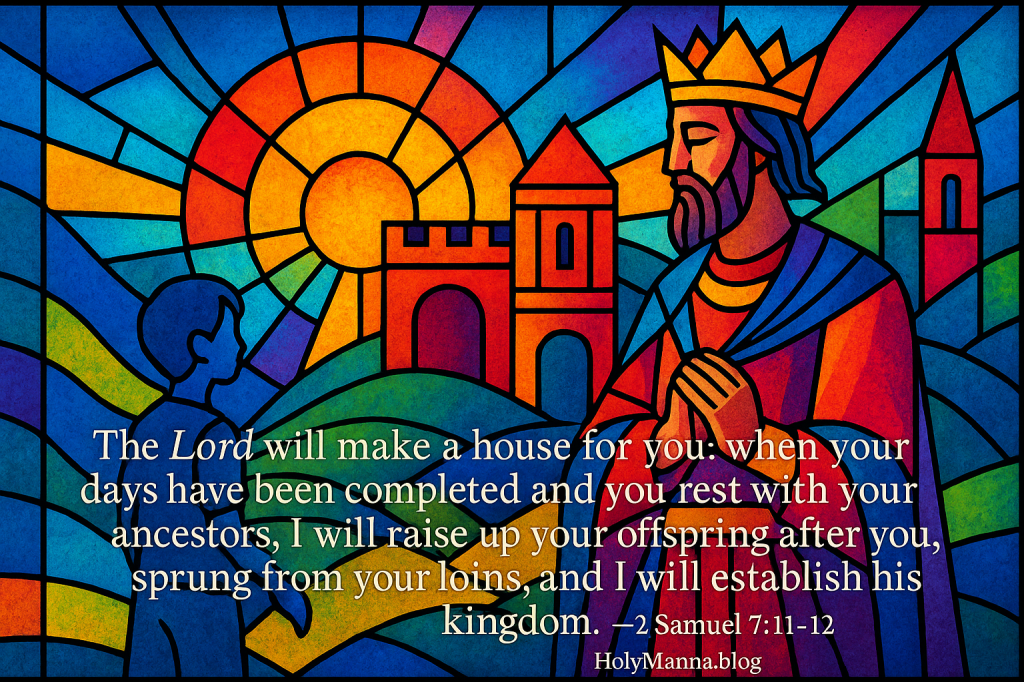
8 Now then, speak thus to my servant David, Thus says the Lord of hosts: I took you from the pasture, from following the flock, to become ruler over my people Israel. 9 I was with you wherever you went, and I cut down all your enemies before you. And I will make your name like that of the greatest on earth. 10 I will assign a place for my people Israel and I will plant them in it to dwell there; they will never again be disturbed, nor shall the wicked ever again oppress them, as they did at the beginning, 11 and from the day when I appointed judges over my people Israel. I will give you rest from all your enemies. Moreover, the Lord also declares to you that the Lord will make a house for you: 12 when your days have been completed and you rest with your ancestors, I will raise up your offspring after you, sprung from your loins, and I will establish his kingdom.
14 I will be a father to him, and he shall be a son to me. If he does wrong, I will reprove him with a human rod and with human punishments;
16 Your house and your kingdom are firm forever before me; your throne shall be firmly established forever.
Detailed Exegesis
Verse 1 “After the king had taken up residence in his house, and the Lord had given him rest from his enemies on every side”
David has achieved stability and peace. This “rest” is a sign of God’s favor, not David’s personal success. It sets the stage for a deeper promise.
Verse 2 “The king said to Nathan the prophet, ‘Here I am living in a house of cedar, but the ark of God dwells in a tent!’”
David’s conscience is stirred. He senses the imbalance between his own comfort and the humble tent of God’s presence, showing a sincere desire to honor the Lord.
Verse 3 “Nathan answered the king, ‘Whatever is in your heart, go and do, for the Lord is with you.’”
Nathan assumes that a good intention must be God’s will. This reminds that even prophets must listen carefully for God’s specific word before confirming a plan.
Verse 4 “But that same night the word of the Lord came to Nathan”
God intervenes quickly. The Lord redirects David’s well meaning plan, reminding that God’s initiative is always primary, even over generous religious projects.
Verse 5 “Go and tell David my servant, Thus says the Lord: Is it you who would build me a house to dwell in?”
God questions David’s assumption. It is not David who will guarantee stability for God, but God who guarantees stability for David. The roles are reversed.
Verse 8 “Now then, speak thus to my servant David, Thus says the Lord of hosts: I took you from the pasture, from following the flock, to become ruler over my people Israel.”
God recalls David’s humble origins as a shepherd. David’s kingship is pure grace. This echoes how God often raises the lowly to serve His plan.
Verse 9 “I was with you wherever you went, and I cut down all your enemies before you. And I will make your name like that of the greatest on earth.”
Past faithfulness guarantees future promises. God has acted in David’s history and now promises an enduring reputation rooted in divine favor, not human glory alone.
Verse 10 “I will assign a place for my people Israel and I will plant them in it to dwell there; they will never again be disturbed, nor shall the wicked ever again oppress them, as they did at the beginning”
God’s promise extends to the whole people. He will “plant” Israel, giving them stability and peace. The planting image hints at long term rootedness in God’s care.
Verse 11 “And from the day when I appointed judges over my people Israel. I will give you rest from all your enemies. Moreover, the Lord also declares to you that the Lord will make a house for you”
God contrasts the unstable time of the judges with the rest He now promises. Instead of David building a house for God, God promises to build a “house” for David, meaning a dynasty.
Verse 12 “When your days have been completed and you rest with your ancestors, I will raise up your offspring after you, sprung from your loins, and I will establish his kingdom.”
The promise reaches beyond David’s life. A descendant will inherit and continue the kingdom. For Christians, this finds its perfection in Christ, the final Son of David.
Verse 14 “I will be a father to him, and he shall be a son to me. If he does wrong, I will reprove him with a human rod and with human punishments”
God speaks of a father son relationship with the Davidic king. Historically this refers to David’s heirs, who can sin and be corrected. In Jesus, this sonship is perfect and without sin in a higher and unique way.
Verse 16 “Your house and your kingdom are firm forever before me; your throne shall be firmly established forever.”
This is the heart of the covenant. God promises an everlasting kingdom. Only in Christ, whose kingdom is not destroyed by death, is this “forever” fully realized.
Teachings
This reading reveals the Davidic covenant, a key stage in salvation history. God binds Himself to David’s line and promises a kingdom that endures. This is not a reward earned by David, but a gift grounded in God’s faithful love. CCC 2579 highlights David’s role as a model of prayer and covenant relationship with God. It teaches that David’s prayer is a faithful response to God’s promise and that he is both king and servant under God’s authority. The Catechism notes that his prayer is marked by trust, thanksgiving, and praise.
The promise of an eternal throne finds its fullness in Jesus. The Church teaches that Christ is the true Son of David and the definitive King of the eternal kingdom. CCC 439 explains that the title “Messiah” or “Christ” includes the expectation of a royal descendant of David who will bring the kingdom of God. In Jesus, this expectation is fulfilled in a way far greater than an earthly political kingdom.
The Fathers of the Church saw this passage as a prophecy of Christ. Saint Augustine often spoke of the “house” of David as pointing forward to Christ and the Church. For Augustine, the eternal kingdom promised to David is realized in the body of Christ that continues through time, the Church, in which Christ reigns as head.
In the context of Advent, this reading shows that Christmas is the arrival of the promised King. The child born in Bethlehem is not a random miracle but the completion of a centuries old covenant. God has been patiently building this “house” through history, guiding Israel and preparing hearts to receive the Savior.
Reflection
This passage invites a very personal question: Am I letting God build the house of my life, or am I trying to control the blueprint myself? David wanted to do something great for God, which was good, but God reminded him that everything begins with divine initiative. The same is true today. God has already taken each believer “from the pasture” in different ways, from places of smallness, weakness, or sin, and has begun a work that He plans to bring to completion.
Practically, this means learning to pray with trust rather than anxiety. Instead of asking how to build a life that looks impressive from the outside, the heart can ask how to be faithful in what God is already doing. It might look like being more present to family, serving in the parish, or remaining faithful in hidden sacrifices. The real greatness lies in allowing God to establish a “house” of holiness within the soul.
It can also encourage perseverance. God’s promise to David stretched beyond his own lifetime. In the same way, many fruits of faithfulness will appear only later, sometimes in the lives of others who come after. Where is God inviting you to trust His long term plan rather than demanding quick results? What would it look like today to let God be the true builder of your heart, your family, and your future?
Responsorial Psalm Psalm 89:2-5, 27, 29
Singing the Covenant That Never Fails
Psalm 89 is a royal and covenant psalm that remembers God’s sworn promise to David and his descendants. It likely arose in a time when Israel needed to cling to God’s fidelity, even when kings failed or the kingdom seemed shaken. In the flow of today’s readings, this psalm becomes the song of the heart that responds to God’s promise in 2 Samuel 7 and prepares for its fulfillment in the house of David proclaimed in Luke 1:67-79. It reminds that God’s mercy and faithfulness are not fragile feelings but firm commitments that stretch through every generation. As Advent draws near to Christmas, this psalm helps hearts praise God not for vague optimism, but for a concrete covenant that finds its fulfillment in Jesus Christ, the Son of David.
Psalm 89:2-5, 27, 29 – New American Bible (Revised Edition)
2 I will sing of your mercy forever, Lord
proclaim your faithfulness through all ages.
3 For I said, “My mercy is established forever;
my faithfulness will stand as long as the heavens.
4 I have made a covenant with my chosen one;
I have sworn to David my servant:
5 I will make your dynasty stand forever
and establish your throne through all ages.”
Selah27 He shall cry to me, ‘You are my father,
my God, the Rock of my salvation!’29 Forever I will maintain my mercy for him;
my covenant with him stands firm.
Detailed Exegesis
Verse 2 “I will sing of your mercy forever, Lord, proclaim your faithfulness through all ages.”
The psalmist chooses to sing of mercy, not momentary success. “Mercy” here is the covenant love of God, His steadfast kindness. “Faithfulness” speaks of His reliability over time. The focus shifts from circumstances to the unchanging character of God, which is crucial when life feels unstable.
Verse 3 “For I said, ‘My mercy is established forever; my faithfulness will stand as long as the heavens.’”
God’s mercy is described as “established,” like a foundation or a building that will not collapse. Comparing His faithfulness to the permanence of the heavens highlights the unshakable nature of His covenant. This matches the promise in 2 Samuel 7 that David’s throne will be firmly established.
Verse 4 “I have made a covenant with my chosen one; I have sworn to David my servant:”
God reminds His people that He bound Himself by an oath. David is “my chosen one” and “my servant,” which shows both dignity and humility. The covenant is not a casual agreement but a solemn, divine commitment. This provides the backbone of Israel’s hope when human leaders fall short.
Verse 5 “I will make your dynasty stand forever and establish your throne through all ages.”
Here the core of the Davidic promise is repeated. A dynasty “forever” and a throne “through all ages” point beyond any single earthly king. For Christians, this verse naturally points toward Christ, whose kingdom is not limited by time or death.
Verse 27 “He shall cry to me, ‘You are my father, my God, the Rock of my salvation!’”
The relationship between God and the Davidic king is portrayed in intimate, familial language. God is Father, God, and Rock, the one who saves and supports. This verse foreshadows the deeper revelation of Jesus as the eternal Son who perfectly calls God His Father and brings salvation.
Verse 29 “Forever I will maintain my mercy for him; my covenant with him stands firm.”
The repetition of “forever” underlines that God’s commitment does not expire. Even when Israel experiences exile or loss, this verse assures that God’s mercy and covenant are not broken. The firmness of this promise rests on God’s character, not human perfection.
Teachings
This psalm teaches that God’s covenant with David is grounded in His own faithful love. The Church views this Davidic promise as a key step in the unfolding of salvation history. CCC 2579 notes that David’s prayer and kingship are rooted in God’s initiative and promise: “David is the king ‘after God’s own heart,’ the shepherd who prays for his people and in their name.” The stability of Israel rests not on political power but on divine fidelity.
The covenant with David is fulfilled in Jesus Christ. CCC 436 explains that the title “Christ” links to the royal hope: “Christ” means “Anointed,” “Messiah.” Jesus is the Christ because God anointed him with the Holy Spirit and power. As the true Son of David, Jesus embodies the everlasting kingship promised in Psalm 89 and 2 Samuel 7.
The psalm’s emphasis on God as Father and Rock also resonates with the New Testament revelation. CCC 239 teaches: “By calling God ‘Father,’ the language of faith indicates two main things: that God is origin of everything and transcendent authority, and that he is at the same time goodness and loving care for all his children.” The language of Psalm 89 prepares hearts to recognize the Father who sends His Son, the “horn of salvation” in the house of David.
Reflection
This psalm invites every believer to ask a simple but challenging question: What shapes the song of the heart, shifting emotions or God’s unchanging covenant love? The psalmist chooses to sing of mercy “forever” and to proclaim faithfulness “through all ages.” That kind of praise is not naïve. It often arises in the midst of difficulty, disappointment, or confusion about how God’s promises will unfold.
In daily life, this might look like consciously recalling God’s past faithfulness when facing new fears. It could mean praying the words of this psalm when anxiety about the future creeps in. Instead of letting negative narratives dominate, the soul can repeat: “Forever I will maintain my mercy for him; my covenant with him stands firm.” This helps anchor identity in the fact that God has claimed His people in Christ and does not abandon His commitments.
There is also a call to personal trust. The king in the psalm cries out, “You are my father, my God, the Rock of my salvation!” Every Christian can echo that trust through Jesus, the Son of David and Son of God. In moments of weakness, the heart can turn to the Father as Rock and salvation rather than leaning only on personal strength or human security.
Where is God asking you to remember His covenant love instead of panicking over present problems? How might your prayer change if you began each day by “singing of His mercy” and naming specific ways He has been faithful in your life?
Holy Gospel Luke 1:67-79
The Dawn Of Salvation In The House Of David
This Gospel gives the Canticle of Zechariah, prayed every morning in the Liturgy of the Hours. It rises out of a very concrete moment in Jewish history. Israel has lived under foreign rule for centuries, clinging to the ancient promises given to Abraham and to David. Zechariah, a priest serving in the Temple, had been struck mute for doubting the angel’s word about the birth of his son John. Now, at John’s birth, his tongue is loosed. Filled with the Holy Spirit, he reads history with new eyes. He sees that God is finally visiting His people, fulfilling the covenant made to Abraham and the royal promise made to David. Within today’s theme, this canticle reveals that the “house” and “throne” promised in 2 Samuel 7 and celebrated in Psalm 89 are reaching their fulfillment. Salvation is not an abstract idea. It is God personally arriving in the Messiah, raising up a horn of salvation in the house of David, freeing His people so they can worship Him without fear and walk the path of peace.
Luke 1:67-79 – New American Bible (Revised Edition)
The Canticle of Zechariah. 67 Then Zechariah his father, filled with the holy Spirit, prophesied, saying:
68 “Blessed be the Lord, the God of Israel,
for he has visited and brought redemption to his people.
69 He has raised up a horn for our salvation
within the house of David his servant,
70 even as he promised through the mouth of his holy prophets from of old:
71 salvation from our enemies and from the hand of all who hate us,
72 to show mercy to our fathers
and to be mindful of his holy covenant
73 and of the oath he swore to Abraham our father,
and to grant us that, 74 rescued from the hand of enemies,
without fear we might worship him 75 in holiness and righteousness
before him all our days.
76 And you, child, will be called prophet of the Most High,
for you will go before the Lord to prepare his ways,
77 to give his people knowledge of salvation
through the forgiveness of their sins,
78 because of the tender mercy of our God
by which the daybreak from on high will visit us
79 to shine on those who sit in darkness and death’s shadow,
to guide our feet into the path of peace.”
Detailed Exegesis
Verse 67 “Then Zechariah his father, filled with the holy Spirit, prophesied, saying:”
The source of this canticle is not human inspiration but the Holy Spirit. Zechariah now speaks as a prophet, interpreting God’s action in history.
Verse 68 “Blessed be the Lord, the God of Israel, for he has visited and brought redemption to his people.”
To say that God has “visited” means He has entered personally into the story of His people. Redemption is already seen as underway, even before Jesus is born, because God’s saving plan is unfolding.
Verse 69 “He has raised up a horn for our salvation within the house of David his servant,”
The “horn” is a biblical image for strength and victorious power. This verse clearly connects salvation to the house of David, echoing the promise in 2 Samuel 7 and Psalm 89.
Verse 70 “even as he promised through the mouth of his holy prophets from of old:”
Zechariah links the present moment to all the prophets. Nothing is random. God is faithful to His word across the centuries.
Verse 71 “salvation from our enemies and from the hand of all who hate us,”
At first glance this sounds political, but it points more deeply to liberation from every force opposed to God’s plan, including sin and the powers of darkness.
Verse 72 “to show mercy to our fathers and to be mindful of his holy covenant”
God’s action now is an expression of covenant mercy. He remembers the promises made to the patriarchs and remains faithful, even if generations have wavered.
Verse 73 “and of the oath he swore to Abraham our father,”
The focus moves back to Genesis. The promise to Abraham that all nations would be blessed through his offspring is now coming to life in Christ.
Verse 74 “and to grant us that, rescued from the hand of enemies, without fear we might worship him”
Salvation has a purpose. God rescues not just to make life easier, but so that His people can worship Him freely, without fear.
Verse 75 “in holiness and righteousness before him all our days.”
True worship is a way of life. Holiness and righteousness are not occasional moments but a daily stance before God.
Verse 76 “And you, child, will be called prophet of the Most High, for you will go before the Lord to prepare his ways,”
Zechariah turns to his son John. John’s mission is to prepare the way for the Lord, which shows that the “Lord” here is not just God in general, but the coming Messiah, Jesus.
Verse 77 “to give his people knowledge of salvation through the forgiveness of their sins,”
John’s preaching will focus on repentance and forgiveness. Salvation is not just external rescue but the healing of the heart through forgiveness.
Verse 78 “because of the tender mercy of our God by which the daybreak from on high will visit us”
The image shifts to dawn. The “daybreak from on high” points to Christ, the light of the world. The reason for this gift is God’s “tender mercy,” a deeply personal and compassionate love.
Verse 79 “to shine on those who sit in darkness and death’s shadow, to guide our feet into the path of peace.”
Jesus comes as light for those in spiritual darkness and under the threat of death. He does not just remove fear. He actively guides feet into a path where peace with God, others, and oneself can become real.
Teachings
This Gospel reveals Jesus as the fulfillment of both the Abrahamic and Davidic covenants. God “visits” His people in the Incarnation. CCC 422 sums this up beautifully: “‘But when the time had fully come, God sent forth his Son, born of woman, born under the law, to redeem those who were under the law, so that we might receive adoption as sons.’ This is ‘the gospel of Jesus Christ, the Son of God’: God has visited his people.” Zechariah’s canticle is almost like the Church’s first Advent hymn to that visit.
The “horn of salvation” in the house of David ties directly to the messianic expectation. CCC 528 explains: “Jesus’ baptism, the wedding at Cana, and the preaching of the kingdom of God all show that the earthly shadows of the Old Covenant are fulfilled in him, the ‘light of the nations.’” The promise to David of an everlasting throne becomes real in Christ, whose kingdom is eternal.
The imagery of light and dawn is central to Christian faith. CCC 1164 notes that the liturgical year circles around the mysteries of Christ, especially His coming as light: “From the time of the apostles, the Church has celebrated the mystery of Christ on a fixed day each week, the day of the Lord, Sunday.” In Advent and Christmas the Church focuses especially on the “daybreak from on high” who shines into the darkness of sin and death.
The mention of forgiveness of sins as the way people receive “knowledge of salvation” shows that the deepest enemy is not Rome or any earthly power, but sin itself. CCC 1847 teaches: “‘God created us without us, but he did not will to save us without us.’ To receive his mercy, we must admit our faults.” John’s role, and later the Church’s mission, is to call people into that honest repentance that opens the heart to the Savior’s light.
Reflection
This Gospel invites a very personal response. Zechariah describes people sitting in darkness and in the shadow of death. That does not only mean physical danger. It also describes the inner places where fear, sin, shame, or confusion keep the heart from living freely before God. The “daybreak from on high” is not just a poetic image. It is Jesus stepping into those exact shadows with real light and real healing.
There is also a clear purpose. God rescues so that His people may worship Him “without fear” in holiness and righteousness. That touches daily life very concretely. It might mean turning away from patterns of sin that keep the conscience restless. It might mean making a good confession and letting the Holy Spirit restore peace. It might mean adopting simple habits of daily prayer and Scripture, so that life becomes an ongoing response of worship, not just a Sunday obligation.
This canticle also highlights the role of John the Baptist as one who prepares the way. Every Christian is invited to play a similar role in the lives of others. Gentle encouragement, honest witness, and patient love can help prepare other hearts to receive Christ more deeply.
Where do you feel like you are still sitting in some kind of darkness or shadow, and how might you invite the “daybreak from on high” into that place today?
What fears still keep you from worshiping and serving God with a free heart, and how is the Lord asking you to bring those fears into His light?
In your family, workplace, or parish, how might you quietly imitate John the Baptist and help prepare the way for someone else to encounter the mercy and peace of Christ?
Walking Into The House Of Peace
Today’s readings draw a single, beautiful line through salvation history. In 2 Samuel 7, God promises David a house and a kingdom that will stand firm forever. In Psalm 89, the believer sings of that same covenant, trusting that God’s mercy and faithfulness do not fail even when everything else feels unstable. In Luke 1:67-79, the promise finally breaks into history as Zechariah proclaims that God has visited His people, raised up a horn of salvation in the house of David, and sent the “daybreak from on high” to guide feet into the path of peace.
Taken together, these passages reveal a God who does not wait for perfect human plans, but who personally builds, sustains, and fulfills His own plan of love. The true “house” God builds is not only a royal dynasty but a people who can worship Him without fear, in holiness and righteousness all their days. That house is ultimately found in Jesus Christ, the Son of David, and in His Body, the Church, where His kingdom is already present and still growing.
The invitation today is simple and profound. Let God be the builder. Let the heart rest more in His covenant faithfulness than in personal control. Allow the light of Christ to reach the hidden places of fear, sin, and discouragement, and let that light shape real decisions, habits of prayer, acts of mercy, and choices for holiness. The God who took David from the pasture, who sustained Israel through generations, and who sent the daybreak from on high is the same God who desires to establish a firm and peaceful dwelling in every soul.
Where might God be asking for deeper trust in His promises rather than anxious striving?
What concrete step can be taken today to let Christ’s light guide the heart more fully into the path of peace?
Engage with Us!
Share your thoughts and prayers in the comments below, because your reflections can strengthen someone else who really needs encouragement today.
- First Reading – 2 Samuel 7:1-5, 8-12, 14, 16: Where do you see God quietly “building the house” of your life, even in ways you did not plan or expect, and how can you respond with more trust and gratitude today?
- Responsorial Psalm – Psalm 89:2-5, 27, 29: When you look back over your life, what concrete moments of God’s mercy and faithfulness can you “sing of forever,” and how might remembering those moments help you face your current struggles with more hope?
- Holy Gospel – Luke 1:67-79: What is one area of darkness, fear, or confusion where you need the “daybreak from on high” to shine right now, and what step can you take this week to let Jesus guide your feet more fully into the path of peace?
May your day be filled with grace, courage, and deep trust in God’s promises. Live your faith with confidence, and let every word, decision, and action be done with the love and mercy that Jesus has taught, so that His light can shine through you into a world that is hungry for hope.
Sacred Heart of Jesus, we trust in You!
Immaculate Heart of Mary, pray for us!
Saint Michael the Archangel, defend us in battle!
Follow us on YouTube, Instagram and Facebook for more insights and reflections on living a faith-filled life.

 Holy Manna!
Leave a comment