A Quiet Light in the Halls of Learning
Saint John of Kanty, also known as Saint John Cantius, stands as one of the most luminous examples of humble holiness in the Church’s history. A priest, theologian, and professor at the University of Kraków, he quietly transformed the lives of students, scholars, and the poor through a combination of deep learning, personal sacrifice, and constant charity. His sanctity did not come from dramatic visions or public miracles but from the faithfulness of a heart fully surrendered to Christ. He is venerated today as the patron of scholars, teachers, and Poland itself. Pope Clement XIII, at his canonization, praised him as a man “distinguished by knowledge and holiness,” whose life strengthened and defended the faith during a time of confusion and intellectual upheaval. In him the Church sees the harmony of intellect and virtue, a kind of radiant integrity that draws souls toward God.
From Village Roots to a Mind on Fire for God
John was born on June 23, 1390, in the small village of Kęty in southern Poland. His parents, Stanisław and Anna, were hardworking and devout, shaping his childhood with the quiet virtues of honesty, prayer, and charity. Even as a boy he displayed a sharp mind and a gentle spirit. These traits led him to the Kraków Academy, where he arrived as a young student ready to learn and determined to serve God. He earned multiple degrees in philosophy and theology, ultimately becoming one of the most respected scholars of his generation. His academic formation coincided with a deepening interior conversion in which he learned to ground intellectual pursuit in prayer and virtue. After ordination, he briefly served in Miechów before being called back to the university as a professor of Sacred Scripture. His life became a living embodiment of The Catechism’s teaching that virtue is “a habitual and firm disposition to do the good” and that each person is called to give “the best of himself” in service to God.
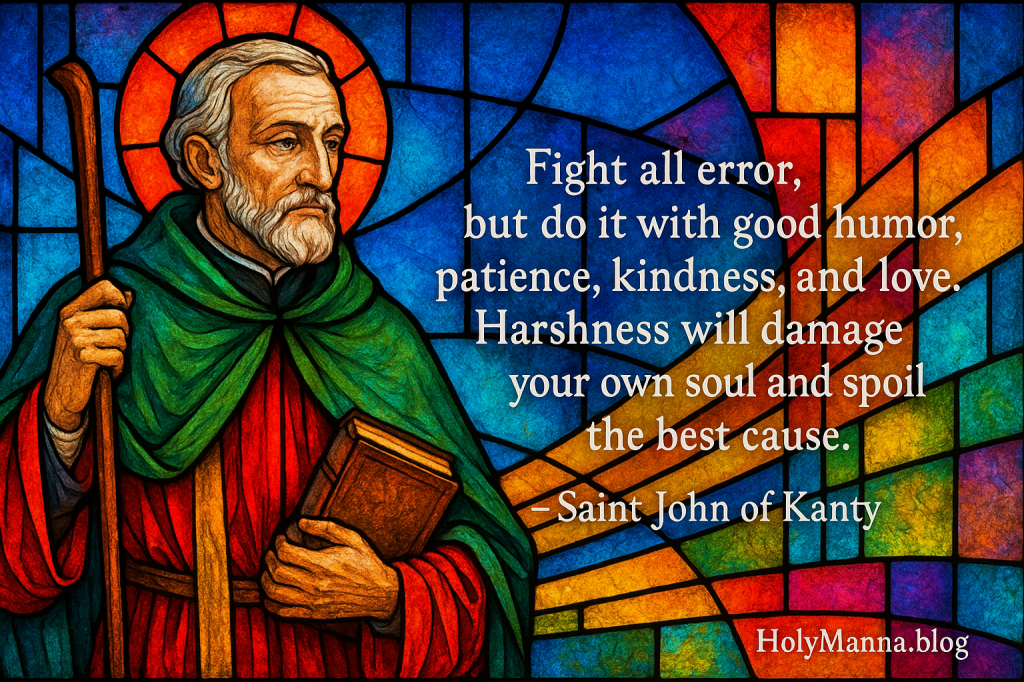
John is remembered especially for his humility, charity, and gentle correction of error. His most famous line captures his entire approach to scholarship and ministry: “Fight all error, but do it with good humor, patience, kindness, and love. Harshness will damage your own soul and spoil the best cause.” In an age of harsh theological debate, his refusal to separate truth from charity made him both respected and beloved.
Classroom, Confessional, and Street: A Life Poured Out
Saint John of Kanty spent most of his life as a professor at the University of Kraków, teaching philosophy, theology, and Sacred Scripture. He believed that teaching was a spiritual work of mercy, and he dedicated his days not only to academic excellence but also to the moral and spiritual formation of his students. He often copied texts of Scripture and theological commentaries by hand so that others could study them. Students remembered him as both a brilliant thinker and a spiritual father whose joy and holiness inspired them to pursue truth with integrity.
John embraced a life of ascetic simplicity. He ate no meat, slept very little, and often chose the floor instead of a bed. Yet he radiated joy and warmth. He lived strictly with himself but with great mercy toward others. He constantly practiced the corporal and spiritual works of mercy described in The Catechism. Those who came to his door found not only food and clothing, but also compassionate counsel, patient listening, and fatherly blessing.
His generosity became the stuff of holy legend. Many stories tell of him giving away his cloak, his shoes, his meals, or whatever he had on hand to anyone in need. One day, after giving his own supper to a beggar, he returned to the refectory and found his plate miraculously refilled. Another time, after robbers assaulted him on the road, he offered them words of forgiveness and prayer. Moved by his peace, they returned what they had taken and asked for his blessing. His charity was the kind that multiplied because it was rooted not in anxiety but in trust that God always provides.
Saint John also undertook several pilgrimages to Rome and at least one to Jerusalem. These journeys were not escapes from his work but expressions of devotion. On the road he prayed, fasted, met the poor, and offered everything he had to God. Pilgrimage became for him a way to unite his scholarly mind with a pilgrim’s heart.
Hidden Crosses and the Martyrdom of Daily Fidelity
Even with his great virtue, Saint John of Kanty experienced trials that tested his humility and perseverance. At one point, due to jealousy and slander from fellow academics, he was removed from his university position and reassigned to a struggling parish. This moment could have easily produced resentment. Instead, he accepted the humiliation quietly and poured himself into parish ministry. The parishioners initially responded with suspicion and hostility, but his patience and gentleness gradually won them over. Eventually, when he was called back to Kraków, he returned not triumphant but purified, even more humble than before.
John lived what The Catechism describes as the virtue of fortitude, the strength that ensures firmness in difficulties and fidelity in pursuing the good. His hardships were not bloody martyrdom, but they were real crosses that shaped him into a saint. He offered everything without complaint, following Christ who said that anyone who wishes to be His disciple must take up his cross daily. He also lived by a simple maxim expressed in Latin: “Avoid causing trouble, since making peace again is not easy. Avoid speaking ill, since taking back words is very hard.” This reflects his lifelong habit of seeking harmony, speaking truth without cruelty, and living in peace with all.
Graces Multiplied: Miracles at His Tomb and Beyond
When Saint John of Kanty died on December 24, 1473, the people of Kraków mourned him deeply. His body was placed in Saint Anne’s Church, where students, professors, the poor, and pilgrims soon began to pray at his tomb. Reports of healings, conversions, and answered prayers multiplied. Those who suffered from blindness, paralysis, or chronic illness found relief through his intercession. Others spoke of interior miracles: reconciled families, renewed vocations, and restored peace of conscience. His reputation for holiness spread far beyond Poland, eventually leading to his beatification in 1676 and canonization in 1767.
His tomb remains a place of pilgrimage to this day. Students still kneel before his relics seeking wisdom and peace of mind during exams. Scholars and teachers ask for clarity of thought, integrity, and humility. The faithful come to ask for the grace to live simple, generous, and honest lives. His legacy continues because the holiness he lived is the holiness every Christian is called to imitate.
Walking the Slow Path of Humble Holiness
Saint John of Kanty’s life offers lessons that are not flashy but enduring. He shows how to unite intellect and devotion, reminding Christians that loving God with the mind is part of the great commandment. He demonstrates the beauty of concrete charity and the power of seeing every person as Christ sees them. He teaches that truth must always be spoken with love, and that even correction loses its force when separated from compassion. Above all, he models the patient endurance that transforms ordinary life into a pilgrimage toward Heaven.
His witness raises a profound question for every believer: How might God be asking me to live my vocation with the same humility, charity, and quiet courage that Saint John of Kanty lived his? The answer can be found in the small daily choices to forgive quickly, to give generously, to speak gently, to study diligently, and to embrace trials with trust rather than bitterness. His life proves that holiness is not about perfection in the eyes of others but about faithfulness in the eyes of God.
Engage with Us!
We would love to hear your thoughts and reflections in the comments below. Here are some questions to guide deeper reflection.
- Where might God be inviting greater humility or gentleness in your daily interactions?
- How can the example of Saint John of Kanty inspire more generous charity toward the poor in your own life?
- What virtues do you see in him that you most desire to grow in during this season of your spiritual journey?
May you be encouraged today to live boldly in faith, rooted in truth, and overflowing with the love and mercy that Jesus taught us.
Saint John of Kanty, pray for us!
Follow us on YouTube, Instagram and Facebook for more insights and reflections on living a faith-filled life.

 Holy Manna!
Leave a comment