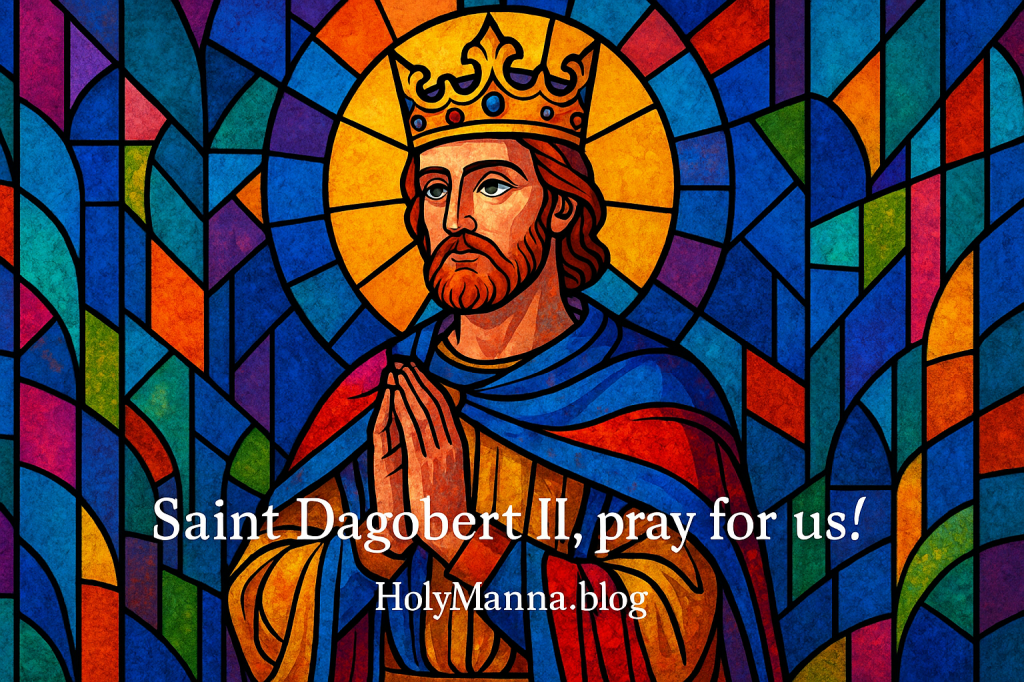
A Hidden King and a Martyr’s Crown
Saint Dagobert II may not be widely known today, but his story quietly reveals how God works through complicated moments in history. He was a Merovingian king of the Franks, ruler of Austrasia in the late seventh century, and later venerated as a martyr by the Church. His life threads together royal responsibility, political betrayal, deep suffering, and the quiet shaping hand of divine providence. The Catechism reminds believers that the saints form a single communion held together by Christ (CCC 946–959), and Dagobert fits beautifully into that great tapestry. Though history remembers him through fragmented records, the Church has recognized him as a witness of faith whose endurance and unjust death reflect a martyr’s heart grounded in Christ.
From Royal Cradle to Monastic Cell in Ireland
Dagobert II was born around the year 650 as the son of King Sigebert III of Austrasia. The Merovingian kings traditionally wore long hair as a sign of royal authority. When Dagobert’s father died and the powerful mayor of the palace, Grimoald, sought to place his own son on the throne, the infant prince was seized, tonsured, and declared unfit for kingship. Cutting his hair was far more than a symbolic gesture. It was the stripping away of his royal identity.
The child who should have grown up in a palace was instead sent away under ecclesial supervision, eventually reaching Ireland. There he lived within the life of the monastery, surrounded by prayer, Scripture, and the ascetical rhythm of Christian brotherhood. Though the details of his formation are sparse, tradition consistently presents him as being raised in monastic discipline rather than royal privilege. This formative period in Ireland would deeply shape the man he later became: not merely a king restored by political necessity, but a man strengthened through years of humble Christian formation.
A Short Reign with Eternal Consequences
After years of exile, Dagobert’s life took another dramatic turn. When King Childeric II was assassinated in 675, Austrasia fell into political turmoil. Some nobles, remembering that the rightful heir still lived, called for Dagobert’s return. He was brought back from exile, escorted by ecclesiastical allies, and restored as king of Austrasia in 676.
Although his reign lasted only a few years, it revealed a ruler who sought to bring order to a fractured kingdom. He negotiated a treaty with the Lombards, attempted to stabilize relations among the Frankish territories, and oversaw the minting of gold coinage bearing his name, echoing the Byzantine tradition of the cross potent. His presence offered a brief moment of hope after years of instability.
The historical record does not preserve miracles from his earthly life the way it does for many saints. Yet the arc of Dagobert’s story suggests a quieter kind of providential miracle. He survived political execution as an infant, grew in faith in a distant land, returned through a web of improbable circumstances, and regained the throne that had been stolen from him. His life teaches that God often works not through dramatic signs, but through endurance, restoration, and quiet fidelity.
Betrayal in the Forest and a Martyr’s Death
Dagobert’s return to the throne did not end the political struggles that plagued the Frankish kingdoms. His restoration threatened entrenched powers, and those who opposed him began to conspire. Around December 23, 679, while on a hunting expedition near Stenay, Dagobert was ambushed and killed.
Medieval traditions describe his assassination as a violent betrayal orchestrated by nobles who feared his influence and wished to consolidate their own control. Some accounts suggest that even ecclesiastical figures may have silently supported the plot. His death was unjust, cowardly, and carried out far from the public eye. Yet the Church eventually recognized it as martyrdom. He was a baptized Christian king killed unjustly while fulfilling his vocation in a kingdom marked by violence and intrigue. In the eyes of early Christians, such a death bore the marks of a martyr, one who witnessed to Christ by enduring suffering without abandoning his faith or identity.
According to The Catechism, martyrdom is the supreme witness to the truth of the faith, even when its immediate circumstances are shaped by political forces rather than explicit religious persecution (CCC 2473–2474). Dagobert’s death reflected a world resistant to righteousness and truth. His blood became a testament to a life shaped more by the monastery than the throne.
A Quiet Cult in Stenay and Beyond
After his death, Dagobert’s memory did not fade. By the ninth century he was already venerated as a martyr in the region of the Ardennes. His tomb became a place of prayer, and Christians sought his intercession as a royal saint who had suffered unjustly. Tradition eventually located his burial at Stenay, where devotion grew steadily over time.
In 872 his relics were solemnly translated to a newly built basilica dedicated in his honor. A community of canons was established there, showing that his cult had taken deep root. Over time, the basilica passed into the care of Benedictine monks, who continued the liturgical and devotional life surrounding the saint. Even after wars and religious conflicts damaged the site, devotion persisted in various forms. His feast was kept on December 23 in local calendars, and his memory has survived through centuries of both reverence and obscurity.
Although specific recorded miracles after his death are not well preserved, the existence of his cult, the translation of his relics, and the enduring veneration at Stenay testify to generations of Christians who saw Saint Dagobert as a powerful intercessor and a model of steadfastness in suffering.
Learning to Trust God in Seasons of Exile
Saint Dagobert II’s story speaks powerfully to anyone who has ever experienced a season of exile. He lived through injustice, displacement, and betrayal, yet God used each of those painful moments to shape him into a man capable of bearing royal responsibility with humility. His life shows how God often uses the very experiences we resist to transform our hearts.
His example invites believers to reflect on their own hardships. Times of uncertainty or exile can become places of purification when united to Christ. Dagobert also challenges Christians to pray for those who lead, since positions of authority often place people in morally complex situations. He encourages solidarity with those who suffer injustice today, whether political, social, or spiritual.
Above all, his life demonstrates that holiness does not always shine through extraordinary miracles. Sometimes it is revealed through quiet perseverance, through fidelity in adversity, and through suffering endured with faith. Dagobert’s witness reminds the Church that no life is forgotten by God, and that even hidden saints contribute to the beauty and strength of the Body of Christ.
Engage With Us!
If you’d like, share your thoughts or reflections below.
- Which part of Saint Dagobert II’s life resonates most with your own journey of faith?
- Have you ever experienced a season of exile, spiritually, emotionally, or socially, where you had to trust God without knowing the outcome?
- What does martyrdom mean to you in a modern context, and how can the suffering of saints like Dagobert inspire your daily walk with Christ?
- In what ways can Christians pray for or support those who suffer injustice or displacement in our world today?
May the example of Saint Dagobert II strengthen your resolve to trust in God’s providence, remain faithful in suffering, and act with justice, love, and mercy in every part of life, just as Jesus taught.
Saint Dagobert II, pray for us!
Follow us on YouTube, Instagram and Facebook for more insights and reflections on living a faith-filled life.

 Holy Manna!
Leave a comment