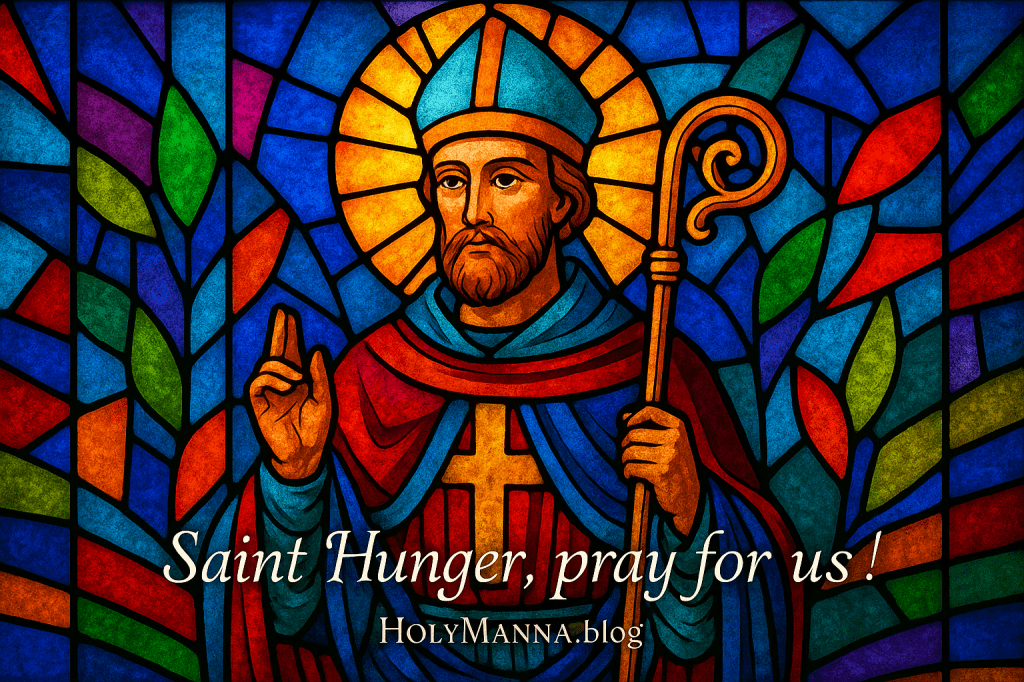
A Shepherd of Fidelity in a Time of Fire and Steel
Saint Hunger of Utrecht, also known as Hungerus Frisus, stands as a quiet yet powerful witness of faithfulness during the ninth century, a time marked by Viking invasions, shifting political alliances, and moral confusion among rulers. His feast day is celebrated on December 22, fittingly placed in the heart of Advent, when the Church meditates on perseverance and hope. Though the historical record preserves only a modest number of details about his life, those details reveal a shepherd whose fidelity continues to echo through the centuries.
Hunger is honored in both the Catholic Church and the Eastern Orthodox tradition, which speaks to the universal respect his holiness earned. While he left no surviving writings or recorded speeches and no verified quotations have come down to us, his enduring legacy rests in the strength of his actions. He refused to stretch God’s law for political ease, he refused to use his position for family gain, and he refused to abandon his clergy even when forced into exile. In a world that often rewards ambition and visibility, Saint Hunger reminds the faithful that quiet courage and steadfast truthfulness can be among the most powerful evangelical tools given to the Church.
Formed by Monastic Life and Called to a Difficult Diocese
Although the details of Hunger’s early life are sparse, he was born around the year 800 in the region of Frisia, in what is now the Netherlands. At some point he entered religious life as a Benedictine monk. This means his character and spirituality were shaped by the monastic rhythm of prayer, Scripture, humility, and stability. The Benedictine way of life places Christ at the center of daily living, forming men who lead not through force but through quiet discipline and charity.
Before becoming a bishop, Hunger served as a canon in Utrecht, gaining experience in the governance and pastoral life of the Church. When the previous bishop died, the episcopal seat was first offered to his influential nephew Craft. Craft declined, concerned about the danger of the increasing Norman raids that targeted wealthy churches. The clergy then turned to Hunger, whose holiness, humility, and reliability made him a natural choice. His acceptance of the episcopacy carried none of the ambition that sometimes colored ecclesiastical appointments in that era. He received the office as a burden of love rather than a ladder of privilege.
Known for integrity, Hunger refused to engage in nepotism at a time when family advantage often shaped Church leadership. His commitment to purity of governance demonstrated his desire to protect the Church from corruption while guiding his flock with a clean conscience. His life as bishop reflects a man fully rooted in the life of the Church, ready to bear whatever trials came for the sake of Christ.
Exile, Vikings, and the Quiet Miracle of Pastoral Courage
Saint Hunger’s episcopate unfolded under the dark shadow of Norman invasions. Early in his tenure, he maintained a cautious peace with Rorik of Dorestad, a local Viking leader who had even undergone baptism. However, peace during that era was fragile. As violence escalated and Utrecht became unsafe, Hunger made the sacrificial decision to lead his clergy and faithful into exile.
Around 858 he moved his clerical community to Sint Odiliënberg. Later he relocated to Prüm and then to Deventer. Through all these forced migrations, Hunger continued to serve as bishop of Utrecht even while physically separated from his diocese. This was not a temporary retreat but a long and difficult season of wandering, which required patience, courage, and unwavering trust in God’s providence.
There are no recorded miracles from his earthly life, yet the endurance of his pastoral care is itself a profound testimony of grace. Hunger shepherded a displaced flock, celebrated the sacraments under precarious conditions, and protected the continuity of the Church during a time when many leaders chose safety or political convenience. His life reminds modern believers that sanctity is often found not in dramatic moments but in the steady choice to remain faithful in one’s vocation despite uncertainty and suffering.
Between a King and the Cross
One of the defining moments of Saint Hunger’s life involved King Lothair II of Lotharingia, who sought to set aside his lawful wife Teutberga in order to marry another woman, Waldrada. The king desired a male heir and hoped political pressure would force the Church to approve his plan. Hunger, rooted in Scripture and in the teaching handed down from the apostles, firmly defended the validity and permanence of the original marriage.
The Church teaches in The Catechism that “the matrimonial covenant, by which a man and a woman establish between themselves a partnership of the whole of life, is by its nature indissoluble” and that “the Lord Jesus insisted on the original intention of the Creator who willed that marriage be indissoluble” (The Catechism, 1601 and 1614). Although these words were written centuries after Hunger’s time, they summarize exactly the truth he defended.
His opposition placed him at odds with royal power, yet he refused to compromise. Even as political pressure intensified and even as exile continued, he chose fidelity over convenience. His witness stands as a powerful example for all ages. Upholding God’s law is never about cold legalism but about protecting the dignity of marriage and the souls of all involved. Hunger’s courage in this conflict highlights a heart shaped by charity, truth, and deep pastoral concern.
A Saint Remembered More for Fidelity Than for Marvels
Saint Hunger died far from Utrecht in the abbey of Prüm in the year 866 after years of pastoral exile. He left behind no dramatic healing stories, no visions, and no spectacular shrine filled with posthumous miracles. His holiness was recognized because of the enduring testimony of his life, which reflected the Gospel with clarity and constancy in a time of cultural and political chaos.
His relics were honored, and devotion to him spread within the Low Countries and beyond. He is remembered not for extraordinary signs but for the quiet power of fidelity. The Church’s recognition of his sanctity across centuries and across Christian traditions reveals just how deeply his life touched the faithful. Holiness is not measured by spectacle but by steadfast love of God and neighbor, and Hunger lived that truth to the very end.
How Saint Hunger Speaks to Hearts Today
The life of Saint Hunger offers a timely message for the modern world. He lived in a society shaken by violence, unstable leadership, and moral confusion, and yet he remained grounded in the truth of the Gospel. His example encourages Catholics today to defend the dignity of marriage and family life with courage and compassion, to resist the temptation to use positions of influence for personal gain, and to trust God even when life feels uncertain or disorienting.
Believers who feel spiritually displaced or who struggle to remain faithful in a culture that often opposes Christian values can find strength in Hunger’s perseverance. He did not choose the ease of silence or the comfort of compromise. Instead, he lived his vocation with a shepherd’s heart, caring for his people even when it cost him safety and stability.
Saint Hunger reminds the Church that holiness does not depend on dramatic moments but on everyday choices made with integrity. The faithful are invited to imitate his quiet courage by speaking the truth with love, standing firm in Christian doctrine, living with humility, and trusting that Christ remains present and victorious even when the world appears unsettled.
Engage with Us!
Share your thoughts and reflections below.
- How does Saint Hunger’s courage in defending Christian marriage inspire you to stand firm in your own convictions today?
- What parts of his perseverance during exile remind you of moments in your own life when God called you to remain faithful in uncertainty?
- How can you live the “quiet miracle of fidelity” in your family, workplace, or parish this week?
May the life of Saint Hunger inspire every heart to remain faithful, to love generously, and to trust Jesus in every circumstance. Live each day with the mercy, courage, and hope that Christ has taught through His Church and through the saints who walked before us.
Saint Hunger, pray for us!
Follow us on YouTube, Instagram and Facebook for more insights and reflections on living a faith-filled life.

 Holy Manna!
Leave a comment