Monday of the Fourth Week of Advent – Lectionary: 198
Lifted From the Lowly Place
Some of the most important moves of God in salvation history begin in places that feel small, hidden, and overlooked. That is exactly what shines through in today’s readings from 1 Samuel 1:24-28, 1 Samuel 2:1-8, and Luke 1:46-56 for Monday of the Fourth Week of Advent.
The figure of Hannah stands at a crucial turning point in Israel’s story. She is a woman who knew the ache of barrenness in a culture where children were seen as a visible sign of God’s favor. After years of tears and humiliation, God answers her prayer with the gift of Samuel. Yet the heart of Hannah’s faith is not just that she receives a son, but that she offers him back: “I prayed for this child, and the Lord granted my request. Now I, in turn, give him to the Lord” in 1 Samuel 1:27-28. Her response shows that the gifts of God are never meant to be clutched tightly, but consecrated freely.
From that gift back to God flows the song in 1 Samuel 2:1-8, where Hannah proclaims a God who reverses fortunes. The strong are broken, the weak are armed with strength, the well fed are brought low, and the hungry are satisfied. The Lord is revealed as the One who “raises the needy from the dust; from the ash heap lifts up the poor” in 1 Samuel 2:8. This is not just poetic language. It is a snapshot of how God acts in history, humbling the proud and lifting the lowly, turning human expectations upside down.
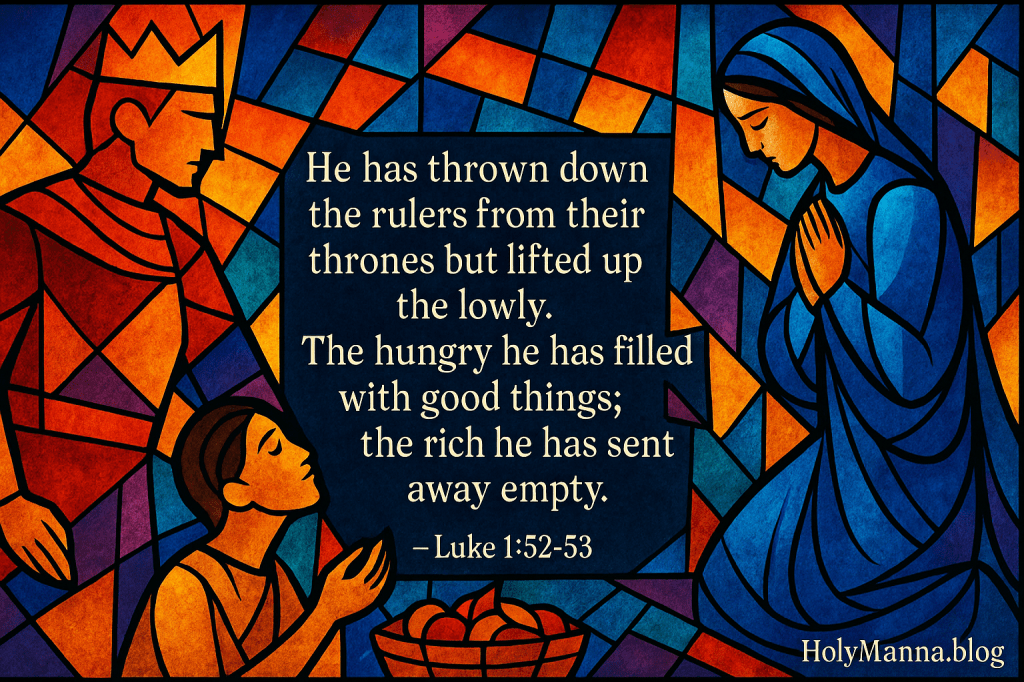
In the Gospel, Mary takes up this same melody and brings it to its fulfillment in the Magnificat of Luke 1:46-56. The young virgin of Nazareth, socially insignificant in the eyes of the world, becomes the Mother of God. Her song is soaked in the language and spirit of Hannah: “He has thrown down the rulers from their thrones but lifted up the lowly. The hungry he has filled with good things; the rich he has sent away empty” in Luke 1:52-53. The God who answered Hannah’s cry is the same God who looks upon Mary’s lowliness and, through her, remembers His promises to Abraham and his descendants forever. As CCC 722 teaches, the Holy Spirit prepared Mary through grace to become the dwelling place of the Son of God, and her Magnificat becomes the Church’s song of praise for God’s saving reversals.
Taken together, these readings reveal a central Advent theme: God sees the hidden, humble places of the human heart, pours out unexpected gifts, and then invites a response of total surrender and praise. In Hannah and Mary, the Church sees two women who receive life, rejoice in God’s mercy, and then hand everything back to Him for His glory and His plan. Where are the hidden and lowly places in your life that God may be quietly preparing to raise up and use for something far greater than you can see right now?
First Reading – 1 Samuel 1:24-28
Given Back to the Giver
This scene in 1 Samuel 1:24-28 sits at a key moment in Israel’s history, right before the rise of the great prophet Samuel. In ancient Israel, children were seen as a visible sign of blessing, and barrenness often carried social shame and deep personal grief. Hannah has already poured out her soul before the Lord, received the miraculous gift of a son, and now comes to the sanctuary at Shiloh to do something stunning in that culture: she offers this long awaited child back to God in total trust.
This reading fits the day’s theme by showing how God remembers the lowly and then invites a response of radical surrender. Just as Hannah’s offering prepares the way for Samuel’s prophetic mission, it points forward to Mary’s fiat in Luke 1:46-56. God lifts the humble, fills their arms, and then uses their surrendered gifts for a much larger plan of salvation.
1 Samuel 1:24-28 – New American Bible (Revised Edition)
Hannah Presents Samuel to the Lord. 24 Once he was weaned, she brought him up with her, along with a three-year-old bull, an ephah of flour, and a skin of wine, and presented him at the house of the Lord in Shiloh. 25 After they had slaughtered the bull, they brought the child to Eli. 26 Then Hannah spoke up: “Excuse me, my lord! As you live, my lord, I am the woman who stood here near you, praying to the Lord. 27 I prayed for this child, and the Lord granted my request. 28 Now I, in turn, give him to the Lord; as long as he lives, he shall be dedicated to the Lord.” Then they worshiped there before the Lord.
Detailed Exegesis
Verse 24 – “Once he was weaned, she brought him up with her…”
Once Samuel is old enough to live away from home, Hannah travels to Shiloh with substantial offerings, including a young bull, flour, and wine. The generosity of the sacrifice shows real gratitude. This is not a minimal gesture. It is a costly, public act that acknowledges that Samuel’s life belongs first to God, not to his parents.
Verse 25 – “After they had slaughtered the bull, they brought the child to Eli.”
The sacrifice is completed, and Samuel is physically brought before the priest Eli. The sequence matters. Worship, sacrifice, and then offering of the child reveal that this dedication is an act of liturgical worship, not just a private family decision. Samuel’s life becomes bound to the worship of the Lord from the beginning.
Verse 26 – “As you live, my lord, I am the woman who stood here near you, praying…”
Hannah respectfully reminds Eli of their earlier encounter when she had prayed in anguish. She is not boasting about her answered prayer. Instead, she is witnessing to the faithfulness of God who listened when she appeared powerless. Her words quietly model the humility and honesty of someone who remembers where the journey started, in tears and apparent barrenness.
Verse 27 – “I prayed for this child, and the Lord granted my request…”
This short confession is at the heart of the passage. The child is presented as a pure gift. Hannah refuses to see Samuel as her possession or her achievement. The Lord has heard and responded freely. The focus stays on divine generosity, not on human effort or merit.
Verse 28 – “Now I, in turn, give him to the Lord; as long as he lives, he shall be dedicated…”
Here the reading reaches its climax. The same child who was begged for in tears is now freely surrendered. Hannah’s response shows that true gratitude moves beyond words into a concrete gift of self and of what is most precious. The final note of worship before the Lord signals that this is not a loss, but a joyful entrusting of Samuel to God’s plan.
Teachings
This reading highlights a core spiritual pattern: everything comes from God, and true faith offers everything back. The Catechism teaches that adoration is the first attitude of the believer. CCC 2628 explains that adoration is expressed in the recognition of the absolute greatness of God and the humble acknowledgment of the creature. In Hannah’s act, this attitude appears in a concrete way. She receives life from God and responds with worship and surrender.
Hannah’s dedication of Samuel also anticipates the call to consecration found throughout Scripture and Catholic tradition. The boy Samuel, set apart from childhood, foreshadows how God continues to raise up those who are offered to Him in trust. The pattern echoes in Mary’s fiat and in the religious vocations of the Church. Saint Augustine described this attitude when he wrote that all good things, including loved ones and gifts, find their proper place only when they are loved in God and for God. Hannah lives that truth in action by placing Samuel wholly in the service of the Lord.
Reflection
This reading gently exposes how easy it is to cling tightly to good gifts and quietly see them as personal achievements or security. Hannah’s example invites a different posture. The Christian heart is called to receive every blessing with gratitude and then ask how it can be returned to God for His glory and for the good of others. That might include children, talents, work, time, or even long awaited dreams.
Concrete steps can begin simply. A person can name specific gifts received from God, thank Him for each one, and then deliberately offer those gifts in prayer for His purposes. That can shape how time is used, how relationships are lived, and how career choices are made. Instead of asking, “How can this serve personal comfort,” the question becomes, “How can this serve God and His kingdom.”
Which gifts in your life feel hardest to place in God’s hands right now?
What would it look like, very practically, to entrust those gifts to the Lord the way Hannah entrusts Samuel?
How might God be inviting a deeper freedom that comes from acknowledging that everything received can also be joyfully offered back?
Responsorial Psalm – 1 Samuel 2:1-8
The Song Of The Lifted Lowly
Hannah’s canticle in 1 Samuel 2:1-8 is prayed today as the Responsorial Psalm, and it perfectly echoes the theme of God lifting up the lowly. In the setting of ancient Israel, where fertility, strength, and social standing were seen as signs of favor, Hannah sings about a God who overturns those expectations. The woman who was barren now rejoices because the Lord has acted decisively in her weakness.
This song prepares the heart to hear Mary’s Magnificat in Luke 1:46-56. Both women stand before God not as powerful figures, but as humble servants who have experienced His mercy. Hannah’s praise shows that God sees the hidden suffering of His people, breaks the pride of the arrogant, and raises up those who trust in Him. Her words are a bridge between her own story and the great reversal that God brings to completion in Christ.
1 Samuel 2:1-8 – New American Bible (Revised Edition)
1 And Hannah prayed:
“My heart exults in the Lord,
my horn is exalted by my God.
I have swallowed up my enemies;
I rejoice in your victory.
2 There is no Holy One like the Lord;
there is no Rock like our God.
3 Speak boastfully no longer,
Do not let arrogance issue from your mouths.
For an all-knowing God is the Lord,
a God who weighs actions.4 “The bows of the mighty are broken,
while the tottering gird on strength.
5 The well-fed hire themselves out for bread,
while the hungry no longer have to toil.
The barren wife bears seven sons,
while the mother of many languishes.6 “The Lord puts to death and gives life,
casts down to Sheol and brings up again.
7 The Lord makes poor and makes rich,
humbles, and also exalts.
8 He raises the needy from the dust;
from the ash heap lifts up the poor,
To seat them with nobles
and make a glorious throne their heritage.“For the pillars of the earth are the Lord’s,
and he has set the world upon them.
Detailed Exegesis
Verse 1 – “My heart exults in the Lord, my horn is exalted by my God”
Hannah begins with personal joy that is completely centered on the Lord. The “horn” symbolizes strength and dignity. Her strength does not come from herself, her status, or her new child, but from God who has intervened. Praise shifts the focus from the gift to the Giver.
Verse 2 – “There is no Holy One like the Lord; there is no Rock like our God”
Here she moves from personal experience to a universal confession of faith. God is uniquely holy and utterly reliable, like a rock that does not move. This line anchors her joy in who God is, not just in what He has done for her.
Verse 3 – “Speak boastfully no longer, do not let arrogance issue from your mouths”
Hannah warns the proud, because God is all knowing and weighs actions. This verse reminds the listener that God sees beyond appearances and hears both the cries of the humble and the empty boasting of the arrogant.
Verse 4 – “The bows of the mighty are broken, while the tottering gird on strength”
God reverses human expectations. Those who seemed invincible find their power shattered, while those who could barely stand receive strength. This anticipates the Gospel pattern where the last are first and the weak confound the strong.
Verse 5 – “The well fed hire themselves out for bread, while the hungry no longer have to toil”
Economic security is shown to be fragile when it is not rooted in God. The self-satisfied become needy, while those who trusted God in hunger are satisfied. The line about the barren wife bearing many children shows that God can turn even deep shame into overflowing fruitfulness.
Verse 6 – “The Lord puts to death and gives life, casts down to Sheol and brings up again”
This verse underlines God’s absolute sovereignty over life and death. He is Lord over the grave, which hints toward the hope that God can bring life even out of situations that feel like total loss.
Verse 7 – “The Lord makes poor and makes rich, humbles, and also exalts”
Wealth and status are shown as secondary to God’s will. He can strip them away or bestow them as He chooses. The point is not that God plays randomly with people’s lives, but that no earthly condition is beyond His reach.
Verse 8 – “He raises the needy from the dust; from the ash heap lifts up the poor”
This is the heart of the song and the perfect link to today’s theme. God stoops down to those in the dust and sets them with princes. His mercy does not just comfort the poor in place, it actually lifts them up and gives them a share in His own dignity.
Teachings
Hannah’s canticle is a powerful example of thanksgiving and adoration. The Church teaches that this kind of prayer is essential. CCC 2637 states: “Thanksgiving characterizes the prayer of the Church which, in celebrating the Eucharist, reveals and becomes more fully what it is.” Hannah’s song is a prototype of that thanksgiving. She recognizes that everything, from her child to her restored dignity, comes from the free action of God.
Her words also resonate deeply with the way Christ identifies with the poor and lowly. CCC 544 teaches: “Jesus shares the life of the poor, from the cradle to the cross, he experiences hunger, thirst and privation.” The God who lifts the needy from the dust in Hannah’s time is the same God who comes in poverty at Bethlehem and continues to draw near to those who are small, unseen, or forgotten.
Saint Ambrose and other Fathers of the Church saw in these Old Testament songs a foreshadowing of Mary’s Magnificat. Hannah’s praise does not just belong to her story. It becomes part of the Church’s voice, especially in Advent, as believers await the One who will fully accomplish this great reversal of pride and lowliness.
Reflection
This psalm invites an honest look at where the heart finds its security. Many people trust in strength, success, comfort, or reputation without even noticing it. Hannah’s song gently asks believers to look instead to the God who can break false securities and raise up those who lean on Him.
A practical response can begin with daily thanksgiving for specific ways God has lifted or sustained the heart in low moments. It can continue with a conscious choice to praise God not only when things are going well, but also in times of weakness or uncertainty. This kind of praise opens space for God to work and keeps pride in check.
Where have you seen God quietly lift you from a low or hidden place in your life?
What false sources of security might the Lord be asking you to let go of so that you can stand more firmly on Him as your Rock?
How can your own words, like Hannah’s, become a song that points others to the God who remembers the lowly and raises them up?
Holy Gospel – Luke 1:46-56
Mary’s Song Of The Great Reversal
The Gospel of Luke 1:46-56 presents the Magnificat, Mary’s great hymn of praise. She speaks as a humble young woman from Nazareth in a world that valued power, status, and outward religious prestige. After Gabriel’s announcement and her visit to Elizabeth, Mary responds not with fear or self focus, but with worship. Her song gathers together the entire story of Israel, especially the praises of women like Hannah, and shows that God’s age old promises are coming to fulfillment in her womb.
This passage fits today’s theme perfectly. Hannah’s canticle proclaimed a God who lifts up the lowly and brings down the proud. Mary now sings that the same God has looked upon her lowliness and is acting in a definitive way in history. The child she carries is the climax of God’s mercy, the One through whom the hungry will be filled with good things and the arrogant of mind and heart will be scattered.
Luke 1:46-56 – New American Bible (Revised Edition)
The Canticle of Mary. 46 And Mary said:
“My soul proclaims the greatness of the Lord;
47 my spirit rejoices in God my savior.
48 For he has looked upon his handmaid’s lowliness;
behold, from now on will all ages call me blessed.
49 The Mighty One has done great things for me,
and holy is his name.
50 His mercy is from age to age
to those who fear him.
51 He has shown might with his arm,
dispersed the arrogant of mind and heart.
52 He has thrown down the rulers from their thrones
but lifted up the lowly.
53 The hungry he has filled with good things;
the rich he has sent away empty.
54 He has helped Israel his servant,
remembering his mercy,
55 according to his promise to our fathers,
to Abraham and to his descendants forever.”56 Mary remained with her about three months and then returned to her home.
Detailed Exegesis
Verse 46 – “My soul proclaims the greatness of the Lord”
Mary begins by placing all attention on the Lord. Her inner life, her very soul, becomes a place of proclamation. The focus is not on her own greatness, but on God’s greatness revealed through His action in her.
Verse 47 – “My spirit rejoices in God my savior”
Mary acknowledges God as her savior. She is full of grace, but still a creature redeemed by God. Her joy is rooted not in circumstances alone, but in the saving love of God who has drawn near.
Verse 48 – “For he has looked upon his handmaid’s lowliness; behold, from now on will all ages call me blessed”
She names herself the Lord’s handmaid, a servant in a low and hidden position. God’s gaze on her lowliness is what makes her blessed. From this humble starting point, her role will be remembered by all generations, not because of human fame, but because God chose her.
Verse 49 – “The Mighty One has done great things for me, and holy is his name”
Mary identifies God as “the Mighty One.” The great things in her life, especially the conception of Jesus, are works of divine power and holiness. The holiness of God’s name means that all His actions are pure, faithful, and set apart from human selfishness.
Verse 50 – “His mercy is from age to age to those who fear him”
Here Mary widens the lens. The mercy shown to her is not an isolated event. It is part of God’s enduring fidelity to those who fear Him, meaning those who revere, trust, and obey Him. This connects her personal experience to the entire history of God’s people.
Verse 51 – “He has shown might with his arm, dispersed the arrogant of mind and heart”
God’s “arm” symbolizes His powerful action in history. The arrogant, whose pride begins interiorly “in mind and heart,” are scattered. God’s justice does not merely target external actions. It addresses the inner attitudes that resist Him.
Verse 52 – “He has thrown down the rulers from their thrones but lifted up the lowly”
Mary describes the great reversal at the heart of the Kingdom. Human rulers who cling to power are cast down, while the lowly are raised. This matches Hannah’s song and prepares for Jesus’ teaching that the last will be first.
Verse 53 – “The hungry he has filled with good things; the rich he has sent away empty”
Those who know their need and hunger, both physically and spiritually, receive from God’s abundance. Those who are self-satisfied, represented by “the rich,” go away empty because they do not open themselves to His gifts.
Verse 54 – “He has helped Israel his servant, remembering his mercy”
Mary sings of God’s faithfulness to Israel. To “remember” in biblical language means to act in fidelity to earlier promises. God is not distant or forgetful. He is actively coming to the aid of His people.
Verse 55 – “According to his promise to our fathers, to Abraham and to his descendants forever”
The child in Mary’s womb is the fulfillment of God’s covenant with Abraham. The blessing promised to Abraham’s descendants is now arriving in a definitive way in Christ. Mary’s motherhood is at the heart of God’s plan for all nations.
Verse 56 – “Mary remained with her about three months and then returned to her home”
Mary’s prolonged stay with Elizabeth shows quiet service and solidarity. After this time of shared joy and contemplation, she returns home carrying the hidden Christ, ready to live out her vocation in the ordinary rhythms of life.
Teachings
Mary’s Magnificat is one of the great prayers of the Church. The Catechism teaches that her faith filled “yes” is central to the mystery of Christ. CCC 488 states: “To become the mother of the Savior, Mary ‘was enriched by God with gifts appropriate to such a role.’ The angel Gabriel at the moment of the annunciation salutes her as ‘full of grace.’ In fact, in order for Mary to be able to give the free assent of her faith to the announcement of her vocation, it was necessary that she be wholly borne by God’s grace.” Her song reveals that grace at work in her heart, overflowing in praise.
Mary’s praise also shows how the Holy Spirit prepared her. CCC 722 teaches: “The Holy Spirit prepared Mary by his grace. It was fitting that the mother of him in whom ‘the whole fullness of deity dwells bodily’ should herself be ‘full of grace.’ She was, by sheer grace, conceived without sin as the most humble of creatures, the most capable of welcoming the inexpressible gift of the divine.” The Magnificat is the voice of that humble, grace filled heart.
This hymn is also a model of Christian prayer. CCC 2639 notes: “Praise is the form of prayer which recognizes most immediately that God is God. It lauds God for his own sake and gives him glory, quite beyond what he does, but simply because he is.” Mary praises God for who He is, while also recounting what He has done. Her song becomes part of the Church’s daily prayer, especially in Vespers, so that believers can learn her attitude of joyful humility before God’s mighty works.
Reflection
The Magnificat invites a serious question about where the heart stands in relation to God’s great reversal. The world often celebrates power, control, and self-promotion. Mary celebrates humility, dependence, and the lifting up of the lowly. The Christian who joins her song chooses to stand among the “hungry” and “lowly,” trusting that God will fill and raise up in His time.
A practical response can include daily praise, even in moments that feel small or hidden. The heart can begin by recalling concrete ways God has shown mercy, then speak those blessings back to Him in words of thanks. Another step is to ask honestly where pride, self sufficiency, or quiet arrogance may be resisting God’s work. Mary’s example shows that the path to fruitfulness runs through humility and trust.
Where in your life do you feel most lowly, unseen, or small right now, and how might God be looking on that place with mercy rather than neglect?
In what concrete ways can your daily prayer sound more like Mary’s praise, naming God’s greatness rather than focusing only on problems or fears?
How is the Lord inviting you to stand with the hungry and the lowly in your relationships, your choices, and your use of time and resources, so that your life becomes a quiet echo of the Magnificat?
Let God Lift What You Lay Down
Today’s readings from 1 Samuel 1:24-28, 1 Samuel 2:1-8, and Luke 1:46-56 all circle around one simple but demanding truth: God loves to lift up what is humbly laid down. Hannah receives the son she begged for, then carries him to Shiloh and gives him back entirely to the Lord. Her heart overflows in a song that celebrates a God who breaks the bows of the mighty, fills the hungry, and raises the poor from the dust. Mary, the lowly handmaid, takes up that same melody in the Magnificat as she rejoices in the God who has looked upon her humility and is turning the whole world right side up in her Son.
The pattern is clear. God sees the hidden places, hears the quiet cries, and remembers His promises. He does great things for those who know they cannot save themselves. Yet there is always a response. Hannah brings Samuel to the temple. Mary offers her whole life in that simple fiat that echoes through eternity. Both women show that when God gives a gift, the holiest thing to do is to place it back in His hands and let Him write the story.
This is where the readings land in everyday life. The Lord is not asking for a life of constant anxiety, clutching every blessing in fear. He is inviting a life of trust where every good thing, every talent, every relationship, and every plan can be prayed over and quietly surrendered to His will. That surrender does not erase joy. It multiplies it, because it moves the heart from ownership to stewardship, from control to confidence that God is good and God is near.
A simple path forward can start tonight. Take a moment in prayer and name a few specific gifts that have been received. Thank God out loud for each one. Then offer them back to Him, just as Hannah did with Samuel and as Mary did with her entire future. Ask Him to use those gifts for His glory, for the salvation of souls, and for the holiness of the people entrusted to your care.
Which gift in your life is hardest to place in God’s hands right now?
What would it look like this week to live more like Hannah and Mary, letting praise and surrender shape the way you work, love, and make decisions?
As Advent moves toward Christmas, these readings invite a very concrete response: let God lift what you lay down. When the heart chooses humility, gratitude, and trust, the same God who filled Hannah’s arms and Mary’s womb will quietly fill your life with His presence and His peace.
Engage with Us!
You are invited to share your reflections and graces from today’s readings in the comments below. The stories of Hannah and Mary, and the powerful song of reversal in 1 Samuel 2:1-8, speak into very real places of hope, struggle, and surrender in everyday life. Let these questions help you sit with God’s Word more deeply and encourage one another in faith.
- First Reading – 1 Samuel 1:24-28:
Where do you recognize Hannah’s courage in your own life, especially in those moments when God invites you to “give back” something precious for His purposes? - Responsorial Psalm – 1 Samuel 2:1-8:
In what concrete ways have you seen the Lord “raise the needy from the dust” in your story or in the lives of people around you, and how does that change the way you view your current struggles or blessings? - Holy Gospel – Luke 1:46-56:
What line from Mary’s Magnificat speaks most directly to your heart right now, and how might God be inviting you to echo her humility and trust in a specific situation this week?
As these questions are prayed through and shared, may every reader be strengthened to live a faithful, courageous, and generous life, doing everything with the love and mercy Jesus taught in both His words and His example.
Sacred Heart of Jesus, we trust in You!
Immaculate Heart of Mary, pray for us!
Saint Michael the Archangel, defend us in battle!
Follow us on YouTube, Instagram and Facebook for more insights and reflections on living a faith-filled life.

 Holy Manna!
Leave a comment