A Quiet Giant of the Catholic Reformation
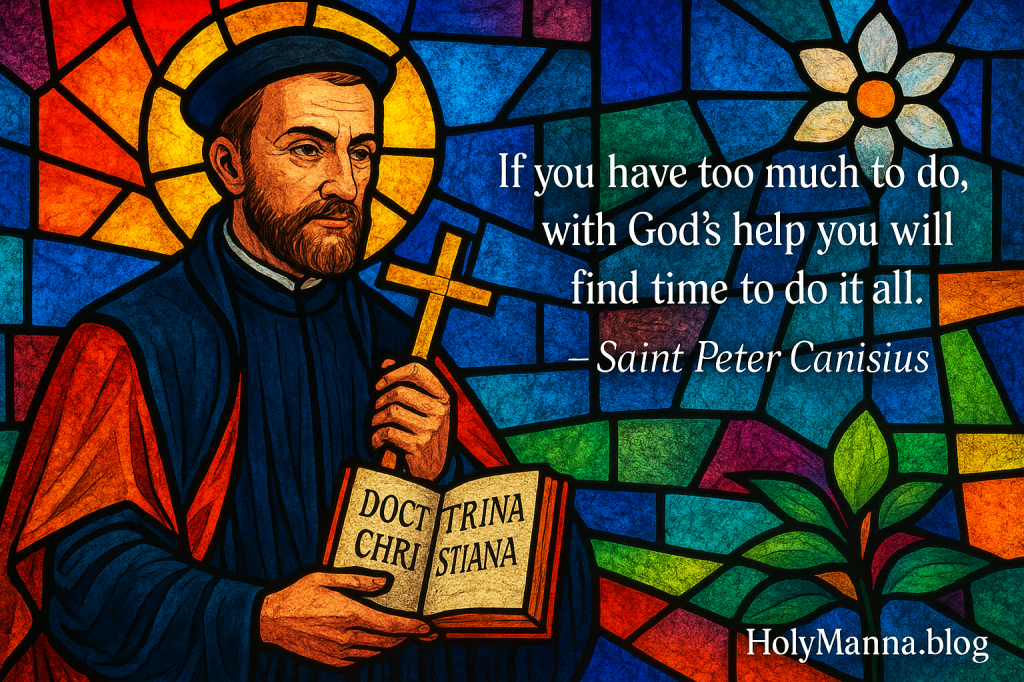
Saint Peter Canisius stands as one of the most influential and steadying forces of the Catholic Reformation. His brilliance, humility, and pastoral zeal helped preserve the faith in German speaking lands during one of the most turbulent eras in Christian history. He is often called the “Second Apostle of Germany,” a title that shows the immense impact of his preaching, teaching, and tireless missionary work. Named a Doctor of the Church in 1925, he remains a model for catechists, scholars, and all who desire to defend the faith with clarity and charity. His famous reassuring line continues to comfort believers today: “If you have too much to do, with God’s help you will find time to do it all.”
Roots in Nijmegen and a Heart Seized by Christ
Peter Canisius was born on May 8, 1521, in Nijmegen to a respected and civic minded family. His father served as mayor, and Peter received a strong Catholic upbringing that prepared him for exceptional academic work. After enrolling at the University of Cologne, he earned a Master of Arts degree at a remarkably young age. Although he once considered marriage or a secular profession, God was preparing him for something much deeper.
During his time at Cologne, he encountered members of the young Society of Jesus, especially Blessed Peter Faber. Inspired by Faber’s holiness and guided by the Spiritual Exercises, he discerned a calling to religious life. He made a private vow of celibacy and eventually entered the Jesuits on his birthday in 1543. His ordination in 1546 brought him quickly into the heart of the Church’s mission, serving as a theologian at the Council of Trent and later becoming one of the most influential teachers in Europe. Peter Canisius is remembered most for his catechisms, which presented Catholic doctrine with clarity and warmth, for his preaching that reawakened countless souls, and for his unwavering Marian devotion expressed in major theological works such as De Maria Virgine Incomparabili. In a spirit deeply aligned with the teaching of CCC 110, he approached Scripture and Tradition with reverence and fidelity, interpreting them within the heart of the Church.
Catechist to a Continent
Saint Peter Canisius’s missionary life brought him across thousands of miles on horseback and foot as he preached, taught, and supported struggling Catholic communities in Germany, Austria, Bohemia, and Switzerland. In a time of immense religious confusion, he believed the key to renewal was solid formation, explaining Catholic teachings in a way that ordinary people could understand. This mission led to the creation of his “Triple Catechism,” beginning with the Summa Doctrinae Christianae in 1555, followed by two shorter catechisms for students and children. These books became some of the most widely read in Europe, translated into multiple languages, and used for generations.
His efforts extended far beyond writing. He founded and reformed Jesuit schools in major European cities, forming clergy and laity who would pass on the Catholic faith to future generations. His love for Mary led him to write extensively about her unique and incomparable role in salvation history, long before several of these teachings were solemnly defined. His words reveal his reverence for the Church’s Tradition: “It behooves us unanimously and inviolably to observe the ecclesiastical traditions, whether codified or simply retained by the customary practice of the Church.” At the same time, he modeled a spirit of charity that spoke directly to the needs of a divided world. He warned Catholics not to use harsh polemics, writing, “With words like these, we do not cure patients, we make them incurable.” He urged instead a Christlike gentleness toward those outside the Church: “It is plainly wrong to meet non Catholics with bitterness or to treat them with discourtesy. For this is nothing else than the reverse of Christ’s example because it breaks the bruised reed and quenches the smoking flax.”
Battles, Fatigue, and the Hidden Martyrdom of Fidelity
Although Saint Peter Canisius did not shed his blood for the faith, his life bore the marks of a daily martyrdom. He entered territories where Catholicism was nearly extinguished, preached amid fierce opposition, and worked to implement the reforms of the Council of Trent in regions with deep political and theological tension. His fidelity often brought misunderstanding, especially from rulers or intellectuals who resisted his efforts to renew Catholic life. At one point, he declined an offer to become Bishop of Vienna, preferring instead to continue his work as a Jesuit missionary and spiritual guide.
His writings show that he understood the cost of discipleship. One of his most challenging statements reflects a desire for integrity rather than superficial conformity: “Better that only a few Catholics should be left, staunch and sincere in their religion, than that they should, remaining many, desire as it were to be in collusion with the Church’s enemies.” In his later years, declining health forced him into a quieter life at the Jesuit college in Fribourg, yet he continued writing, directing souls, and offering his sufferings in what many call a “white martyrdom.” His endurance in faith, patience, and charity reveals a man refined through decades of trials and persistent labor for Christ.
A Saint Whose Voice Echoes After Death
When Saint Peter Canisius died on December 21, 1597, in Fribourg, devotion to him spread quickly. The faithful sought his intercession, and many reported spiritual blessings and healings. His tomb in Fribourg became a place of prayer, where countless believers asked for his help in understanding the faith or finding peace in times of confusion. His catechisms continued to shape Catholic instruction for centuries, and his Marian insights influenced later theological reflection.
His canonization and declaration as a Doctor of the Church in 1925 affirmed what generations of Catholics already knew. Peter Canisius was not simply a historical figure from a troubled time. He was and remains a lasting teacher for the entire Church. His fidelity to Scripture, Tradition, and the teaching authority of the Church mirrors the vision laid out in the Catechism, which calls Christians to embrace the fullness of revealed truth and live it joyfully.
Walking with Saint Peter Canisius Today
Saint Peter Canisius offers modern Catholics a roadmap for living the faith with conviction and compassion. In an age of confusion, division, and competing ideologies, his life teaches that truth must be presented with clarity but always held together with love. His dedication to catechesis reminds believers of the importance of studying the faith, especially through trustworthy sources such as the Catechism of the Catholic Church. His balanced spirit challenges Catholics to avoid extremes, resisting the temptation either to compromise essential truths or to speak them without charity.
His famous line about work and God’s help still encourages students, parents, workers, and clergy: “If you have too much to do, with God’s help you will find time to do it all.” It expresses a deeply Ignatian truth that a heart centered on Christ finds enough grace for every task, every challenge, and every call to serve. Following Saint Peter Canisius today can mean dedicating a small amount of time each week to deepen one’s understanding of the faith, praying the Rosary with confidence in Mary’s intercession, supporting sound Catholic formation in one’s parish, and asking for his guidance when explaining the faith to others. His example reminds the Church that every believer is called not only to know the truth but to share it with the kindness of Christ Himself.
Engage with Us!
Share your thoughts, reflections, or any personal experiences related to Saint Peter Canisius in the comments below.
- What part of Saint Peter Canisius’s life inspires you the most, and why does it speak to your faith journey?
- How can you better combine truth and charity when sharing the faith with others?
- What steps can you take to deepen your understanding of the teachings of the Church, following the example of this great Doctor of the Church?
May these reflections inspire every reader to walk with faith, hope, and steadfast love, doing everything with the mercy and compassion that Jesus taught us.
Saint Peter Canisius, pray for us!
Follow us on YouTube, Instagram and Facebook for more insights and reflections on living a faith-filled life.

 Holy Manna!
Leave a comment