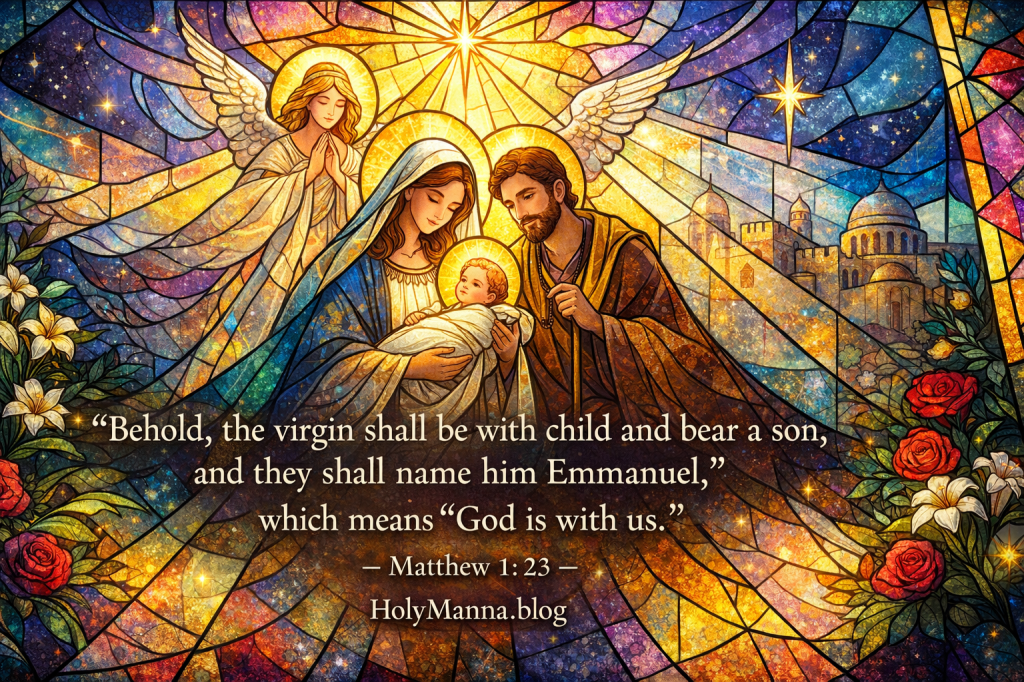
Fourth Sunday of Advent – Lectionary: 10
Emmanuel at the Threshold
Advent reaches its quiet climax with a promise that feels almost too good to be true: “They shall name him Emmanuel, which means ‘God is with us.’” In these readings, the Church gathers centuries of longing, prophecy, and hidden obedience into one simple truth. God is not distant. God draws near in a real Child from the line of David, entering history and entering homes that are ready to receive Him.
In Isaiah 7, the house of David is shaken by fear and political pressure. King Ahaz refuses to trust, yet God still offers a sign: “The young woman, pregnant and about to bear a son, shall name him Emmanuel.” This promise was spoken into a world of fragile kings and looming empires, a reminder that the true security of Israel rests not in alliances but in God dwelling in their midst.
Psalm 24 zooms in on the kind of people who can welcome this King. The psalm asks, “Who may go up the mountain of the Lord? Who can stand in his holy place?” The answer is the one who is “clean of hand and pure of heart, who has not given his soul to useless things.” The gates and ancient portals are told to lift their heads so that the King of glory may enter. The image is royal, but it also feels deeply personal. Are hearts and homes open like those gates, or still closed and guarded by fear or sin?
In Romans 1, the promise to David becomes concrete. Paul speaks of “the gospel about his Son, descended from David according to the flesh” and “established as Son of God in power” through the Resurrection. This Son of David is not only for Israel but for all nations, calling everyone “to belong to Jesus Christ” and “to be holy.” Advent is not just a countdown. It is a summons into a real belonging that reshapes identity and mission.
Finally, The Gospel of Matthew shows what welcoming Emmanuel actually looks like in the life of one man. Joseph faces what looks like betrayal and scandal. Yet in the midst of confusion, the angel tells him not to be afraid and reveals the deeper truth: “For it is through the holy Spirit that this child has been conceived in her.” Joseph responds with quiet, costly obedience. He takes Mary into his home, he names the Child Jesus, and his hidden yes allows the prophecy of Isaiah 7 to be fulfilled in full: “They shall name him Emmanuel.”
Together these readings invite a simple but piercing question in these last days before Christmas: Will Emmanuel simply be a beautiful title heard at Mass, or will God actually be with us in the concrete details of daily life, welcomed by clean hands, a pure heart, and a trusting obedience like Joseph’s?
First Reading – Isaiah 7:10-14
A Promise Spoken Into Fear
King Ahaz stands in a time of political crisis. The kingdom of Judah faces pressure from surrounding enemies, and the royal line of David feels fragile and threatened. Into this climate of fear, God speaks through the prophet Isaiah with a word that reaches far beyond the politics of the eighth century before Christ. The promise of a child called “Emmanuel” is not just a short term reassurance for a nervous king. It becomes a cornerstone of hope that finds its deepest fulfillment in The Gospel of Matthew, where the Church recognizes Jesus as the true Son of David and the living “God with us”.
This reading fits today’s theme by showing that God takes the initiative when human trust fails. Ahaz refuses to ask for a sign, yet God still offers one. The house of David may be anxious and unsteady, but God’s plan for Emmanuel does not depend on royal courage or political genius. It rests entirely on divine faithfulness. In the context of Advent, Isaiah 7:10-14 prepares hearts to recognize that the Child conceived by the Holy Spirit and born of the Virgin Mary is the long awaited sign that God truly dwells with His people.
Isaiah 7:10-14 – New American Bible (Revised Edition)
Emmanuel. 10 Again the Lord spoke to Ahaz: 11 Ask for a sign from the Lord, your God; let it be deep as Sheol, or high as the sky! 12 But Ahaz answered, “I will not ask! I will not tempt the Lord!” 13 Then he said: Listen, house of David! Is it not enough that you weary human beings? Must you also weary my God? 14 Therefore the Lord himself will give you a sign; the young woman, pregnant and about to bear a son, shall name him Emmanuel.
Detailed Exegesis
Verse 10 – “Again the Lord spoke to Ahaz”
This short line reminds the reader that God does not abandon His people after one attempt. Ahaz has already heard prophetic counsel, yet God chooses to speak again. The Lord’s persistence shows divine patience with human weakness and fear. When leadership falters, God continues to reach out and offer guidance.
Verse 11 – “Ask for a sign from the Lord, your God; let it be deep as Sheol, or high as the sky!”
God invites Ahaz to request any sign at all, from the depths to the heights. This is a tender and generous offer. The Lord calls Himself “your God”, stressing covenant relationship even when the king’s faith wavers. The invitation reveals that God is not threatened by honest dependence. Instead of condemning a trembling heart, God encourages trust that dares to lean on divine power.
Verse 12 – “But Ahaz answered, ‘I will not ask! I will not tempt the Lord!’”
On the surface, Ahaz sounds pious, as if he is protecting God’s honor. In reality, this refusal hides unbelief and stubborn self reliance. The language of not wanting to “tempt the Lord” masks a deeper unwillingness to entrust the kingdom to God’s promise. This verse warns that religious sounding excuses can sometimes cover a heart that prefers control over surrender.
Verse 13 – “Then he said: Listen, house of David! Is it not enough that you weary human beings? Must you also weary my God?”
Isaiah answers sharply. The focus shifts from Ahaz as an individual to the entire “house of David”. The prophet exposes how lack of faith in leadership burdens both people and God’s heart. To “weary” God here means to test His patience through ongoing resistance to His will. This verse underlines that unbelief in those responsible for guiding others has serious spiritual consequences for the whole community.
Verse 14 – “Therefore the Lord himself will give you a sign; the young woman, pregnant and about to bear a son, shall name him Emmanuel.”
Even after refusal, God acts: “the Lord himself will give you a sign”. The sign is a child, not an earthquake or a military miracle. The young woman, about to bear a son, becomes the visible pledge that God has not abandoned the line of David. The name “Emmanuel” literally means “God with us”, showing that this child embodies God’s saving presence. In its original setting, this likely pointed to an immediate royal birth that guaranteed God’s ongoing care for Judah. In the fullness of time, the Church sees this verse as a prophetic window into the virginal conception of Jesus Christ, the definitive Emmanuel.
Teachings
This passage stands at the heart of how the Church understands the mystery of Christ’s birth. The Catechism connects Isaiah 7:14 directly to the virginal conception of Jesus. CCC 497 teaches: “The Gospel accounts understand the virginal conception of Jesus as a divine work that surpasses all human understanding and possibility: ‘That which is conceived in her is of the Holy Spirit,’ said the angel to Joseph about Mary his betrothed. The Church sees here the fulfillment of the divine promise given through the prophet Isaiah: ‘Behold, a virgin shall conceive and bear a son.’” This teaching shows that the sign promised to Ahaz reaches beyond his own generation to the Incarnation itself.
The Catechism also situates this prophecy within the broader expectation of the Messiah in the so called Book of Emmanuel. CCC 712 explains: “The characteristics of the awaited Messiah begin to be revealed, above all in the ‘Book of Emmanuel’ (Isa 7–12): especially the announcement of the ‘Immanuel’ (‘God with us’) (Isa 7:14), the victory of the great light (Isa 9:1–6) and the prince of peace (Isa 11:1–9).” Here the Church teaches that this passage is not an isolated verse but part of a larger tapestry in which God promises a king who brings light, peace, and justice.
The Saints echo this awe before the mystery of Emmanuel. Saint Augustine marvels at the humility of the Incarnation with words that fit the spirit of this prophecy: “He by whom all things were made was made among all things, and He the maker of the sun is made under the sun.” The promised child of Isaiah 7 is not just another heir of David but the Creator entering His own creation.
Historically, the prophecy speaks into the Syro Ephraimite crisis, when Judah feared invasion and destruction. Religiously, it reassures that the Davidic covenant still stands despite political chaos. Spiritually, it teaches that God’s answer to fear is not escape but presence. Emmanuel is God choosing to be with His people in the middle of real danger and uncertainty.
Reflection
This reading gently exposes the tension between fear and trust in every disciple. Ahaz hears God’s offer and hides behind pious language instead of leaning on the Lord. Many hearts know that same temptation to appear religious while quietly clinging to self protection and control. The sign God offers, then and now, is not a flashy display but a child named “God with us”, a presence that asks for trust.
In daily life, Emmanuel means that God enters ordinary circumstances, family struggles, spiritual battles, and hidden anxieties. The believer is invited to let go of empty excuses and to welcome God’s initiative. That can start very simply: honest prayer that admits fear, small acts of obedience where God’s will is already clear, and a renewed openness to the sacraments where Christ’s presence is encountered. Instead of demanding custom made proofs, the disciple looks at the Child of Bethlehem, the crucified and risen Lord, and allows that sign to be enough.
Where does fear still block trust in God’s promises right now?
What excuses sound religious on the surface but actually hide a reluctance to surrender?
How can the name Emmanuel, “God with us,” shape choices at home, at work, and in quiet moments of prayer during this final stretch of Advent?
Responsorial Psalm – Psalm 24:1-7, 10
The King Of Glory Seeks A Pure Heart
Psalm 24 comes from a worship setting where the ark of the covenant or the presence of God approaches Mount Zion and the temple. Israel celebrates that everything belongs to the Lord and that entering His presence is not casual but covenantal. The people ask who may ascend the Lord’s mountain and stand in His holy place, and the psalm answers with the language of purity, integrity, and undivided worship.
In the light of today’s theme of Emmanuel, God with us, this psalm shows what kind of heart is ready to welcome the King of glory. The God who owns the earth desires a people with clean hands, pure hearts, and souls that are not given to useless things. As the Church draws near to Christmas, this psalm turns the gaze inward and upward at the same time. The gates of the city lift their heads for the King. Hearts are invited to do the same.
Psalm 24:1-7, 10 – New American Bible (Revised Edition)
The Glory of God in Procession to Zion
1 A psalm of David.
The earth is the Lord’s and all it holds,
the world and those who dwell in it.
2 For he founded it on the seas,
established it over the rivers.3 Who may go up the mountain of the Lord?
Who can stand in his holy place?
4 “The clean of hand and pure of heart,
who has not given his soul to useless things,
what is vain.
5 He will receive blessings from the Lord,
and justice from his saving God.
6 Such is the generation that seeks him,
that seeks the face of the God of Jacob.”
Selah7 Lift up your heads, O gates;
be lifted, you ancient portals,
that the king of glory may enter.10 Who is this king of glory?
The Lord of hosts, he is the king of glory.
Selah
Detailed Exegesis
Verse 1 – “The earth is the Lord’s and all it holds, the world and those who dwell in it.”
This verse establishes God’s absolute sovereignty. Everything belongs to the Lord, not only land and resources but every person. Emmanuel does not enter a neutral space. He comes as rightful King into a world that is already His.
Verse 2 – “For he founded it on the seas, established it over the rivers.”
The psalm recalls creation. God brings order over the chaotic waters and sets the world on firm foundations. The coming of the King of glory is not a small spiritual moment. It is the Creator drawing near to His creation again in mercy.
Verse 3 – “Who may go up the mountain of the Lord? Who can stand in his holy place?”
Here the liturgy becomes a dialogue. The question is not only about priests entering the sanctuary. It is about any worshipper who desires true communion with God. In Advent this sounds like a direct challenge. Who is really ready to stand face to face with Emmanuel?
Verse 4 – “The clean of hand and pure of heart, who has not given his soul to useless things, what is vain.”
The answer focuses on moral and interior purity. Clean hands point to upright actions. A pure heart points to right intention and love. Not giving the soul to useless or empty things warns against idols, addictions, and distractions that steal worship. This verse describes the kind of person who can truly welcome God with us.
Verse 5 – “He will receive blessings from the Lord, and justice from his saving God.”
Those who seek God with integrity do not end up empty handed. God responds with blessing and saving justice. In Emmanuel this blessing becomes personal, since Christ Himself is the gift and the justice of God given to the believer.
Verse 6 – “Such is the generation that seeks him, that seeks the face of the God of Jacob.”
The psalm shifts from an individual to a community. God desires an entire generation that seeks His face. The phrase “face of the God of Jacob” suggests intimacy and covenant memory. In Christ, the Church becomes that generation called to seek the Father’s face in the Son.
Verse 7 – “Lift up your heads, O gates; be lifted, you ancient portals, that the king of glory may enter.”
The city gates are personified and told to open wide. This likely accompanied a liturgical procession with the ark. Spiritually, it calls hearts to open the inner doors to the Lord. In Advent this sounds like an invitation to remove barriers of sin, cynicism, and fear so that Emmanuel may come in.
Verse 10 – “Who is this king of glory? The Lord of hosts, he is the king of glory.”
The psalm ends with a powerful confession. The one who enters is not just a symbolic king. He is the Lord of hosts, commander of heavenly armies. For Christians this title fits Jesus, the humble Child who is at the same time the eternal Lord. Emmanuel is gentle and accessible yet also majestic and all powerful.
Teachings
This psalm echoes the Church’s teaching that God is the Creator and Lord of everything. CCC 293 expresses this clearly: “Scripture and Tradition never cease to teach and celebrate this fundamental truth: ‘The world was made for the glory of God.’” Since the earth belongs to the Lord, worship and moral life cannot be separated.
The Catechism also teaches that the desire to seek the face of God is written into every human heart. CCC 27 states: “The desire for God is written in the human heart, because man is created by God and for God.” Psalm 24:6 describes exactly this: a generation that seeks God’s face. The psalm gives language to that deep inner longing and shows that holiness is not just rule keeping but a relationship of seeking.
Purity of heart is central in the teaching of Jesus and the Church. CCC 2518 teaches: “The sixth beatitude proclaims, ‘Blessed are the pure in heart, for they shall see God.’” Psalm 24 prepares for this by linking seeing God’s face with clean hands and a pure heart. The believer is reminded that access to God is a gift, yet one that calls for moral conversion and interior simplicity.
Saint Augustine reflects on this kind of purity when he says: “Love God, and do what you will.” The point is not that anything goes but that a heart that truly loves God will act in a way that pleases Him. A pure heart is one that is not split between God and useless things but centered on Him.
The image of gates lifting their heads for the King of glory has often been applied to the mystery of the Incarnation and the Ascension. Liturgically, the Church hears these verses as Christ enters the world at His birth and as He enters heaven gloriously. In each case, the response is the same. Heaven and earth are called to open themselves to the Lord of glory.
Reflection
This psalm quietly asks whether hearts and lives actually look like a place where the King of glory would feel at home. Clean hands and a pure heart do not describe perfection but a sincere desire to live honestly before God. That can mean confessing sin instead of hiding it, choosing truth over comfortable lies, and slowly letting go of habits that give the soul to useless things, especially during Advent.
Practically, the believer can let this psalm shape daily prayer. It can be helpful to start the day by repeating, “The earth is the Lord’s and all it holds.” This can reframe work, family life, and responsibilities as part of God’s domain rather than private territory. It can also be powerful to ask before a choice or temptation, Does this draw the heart toward the King of glory, or does it give my soul to something useless?
What are some “useless things” that drain attention, affection, or energy away from God right now?
In what concrete ways can hands become “cleaner” this week through honesty, charity, or justice?
How can the doors of the heart be opened wider to the presence of Emmanuel in prayer, in the sacraments, and in the people nearby during these final days of Advent?
Second Reading – Romans 1:1-7
The Son Of David Who Claims Our Whole Life
The Letter to the Romans is written to a mixed community of Jewish and Gentile Christians living in the empire’s capital. Paul has not yet visited them, but he writes to present the heart of the gospel and to show that the one God is faithfully bringing His plan to completion in Jesus Christ. In this opening greeting, Paul anchors the good news in the promises made “through his prophets in the holy scriptures” and in the royal line of David. The child promised in Isaiah 7 and hailed in Psalm 24 is now revealed as “Jesus Christ our Lord,” true Son of David and Son of God.
This passage fits today’s theme by showing that Emmanuel is not just a comforting idea. The Son who is “descended from David according to the flesh” and “established as Son of God in power” now calls every nation, including the Christians in Rome, to the “obedience of faith.” The God who is with us also claims us.
Romans 1:1-7 – New American Bible (Revised Edition)
Greeting. 1 Paul, a slave of Christ Jesus, called to be an apostle and set apart for the gospel of God, 2 which he promised previously through his prophets in the holy scriptures, 3 the gospel about his Son, descended from David according to the flesh, 4 but established as Son of God in power according to the spirit of holiness through resurrection from the dead, Jesus Christ our Lord. 5 Through him we have received the grace of apostleship, to bring about the obedience of faith, for the sake of his name, among all the Gentiles, 6 among whom are you also, who are called to belong to Jesus Christ; 7 to all the beloved of God in Rome, called to be holy. Grace to you and peace from God our Father and the Lord Jesus Christ.
Detailed Exegesis
Verse 1 – “Paul, a slave of Christ Jesus, called to be an apostle and set apart for the gospel of God,”
Paul introduces himself with humility and authority. To call himself a slave of Christ Jesus means that his entire identity and freedom now belong to the Lord. He is “set apart” not for a private spirituality but “for the gospel of God.” The good news he carries is God’s initiative, not a human project.
Verse 2 – “which he promised previously through his prophets in the holy scriptures,”
The gospel is not a surprise twist that ignores Israel’s story. It fulfills the promises made in the Old Testament. This links directly with Isaiah 7 and the wider Book of Emmanuel. God’s plan is consistent, patient, and deeply rooted in history.
Verse 3 – “the gospel about his Son, descended from David according to the flesh,”
The good news is about a Person. The Son truly enters human history, takes on our flesh, and steps into the royal line of David. The promise to the house of David is not symbolic. It becomes flesh and blood in Jesus. Emmanuel is both divine and firmly anchored in a real family tree.
Verse 4 – “but established as Son of God in power according to the spirit of holiness through resurrection from the dead, Jesus Christ our Lord.”
Here Paul balances Jesus’ human descent with His divine identity. The Resurrection reveals Him “in power” as the eternal Son of God. The “spirit of holiness” can be understood as the Holy Spirit at work in Christ and in the Church. The title “Jesus Christ our Lord” proclaims that this crucified and risen Son is now the true Lord, above Caesar and every earthly power.
Verse 5 – “Through him we have received the grace of apostleship, to bring about the obedience of faith, for the sake of his name, among all the Gentiles,”
Paul’s mission comes “through him,” through Christ. Grace and mission go together. The goal is “the obedience of faith” among the nations. Faith is not only agreement with doctrines. It is a trusting submission of the whole life to Jesus for the sake of His name.
Verse 6 – “among whom are you also, who are called to belong to Jesus Christ;”
The Christians in Rome are included in this worldwide call. They are “called to belong to Jesus Christ.” Belonging here is deep and personal. Emmanuel means God is with us, but it also means the believer is with Him, claimed as His own.
Verse 7 – “to all the beloved of God in Rome, called to be holy. Grace to you and peace from God our Father and the Lord Jesus Christ.”
Paul names the Christians as “beloved of God” and “called to be holy.” Holiness is not for a few elites. It is the normal vocation of every baptized person. The greeting of “grace” and “peace” flows from the Father and the Lord Jesus Christ, reminding the reader that every step in the Christian life begins with God’s initiative.
Teachings
This passage reflects the Church’s teaching that the gospel is God’s long prepared plan centered on His Son. CCC 422 expresses this beautifully: “‘But when the time had fully come, God sent forth his Son, born of a woman, born under the law,’ so that we might receive adoption as sons.” The Jesus whom Paul preaches is the fulfillment of God’s promises and the One through whom believers become adopted children.
The Catechism also emphasizes that Jesus is both from David and Son of God. CCC 436 explains: “Jesus is the Christ, ‘anointed,’ because he is consecrated by God and anointed by the Holy Spirit in his humanity as head of his people.” The royal title Christ, or Messiah, ties directly back to the promise that a Son of David would reign forever.
Regarding the “obedience of faith,” CCC 143 teaches: “By faith, man completely submits his intellect and his will to God.” Paul is not calling the Romans to a shallow or half hearted belief. He is inviting them into a full surrender of mind and heart to the living Christ.
The universal scope of Paul’s mission echoes the Church’s teaching on the call of all nations. CCC 849 says: “The Church’s mission is to evangelize and to make disciples of all nations.” Paul’s phrase “among all the Gentiles” shows that from the beginning the gospel is meant to reach every people and culture.
Finally, the identity “called to be holy” reflects the universal call to holiness. CCC 2013 states: “All Christians in any state or walk of life are called to the fullness of Christian life and to the perfection of charity.” This line from Romans 1 is not a polite greeting. It is a deep reminder of who believers are in God’s eyes.
Reflection
This reading quietly asks whether faith looks more like an opinion or like “the obedience of faith.” Paul describes Christians as people who belong to Jesus Christ, who receive their identity from His call, not from their job, status, or personal projects. In daily life, that belonging can be lived out by small, steady acts of obedience: keeping God’s commandments, staying faithful to prayer when it feels dry, loving difficult people for the sake of His name, and letting the teachings of the Church shape concrete decisions.
The titles in this passage also offer real consolation. To be “beloved of God” and “called to be holy” means that no one is an accident in the Church. Emmanuel is not just God near humanity in general. He is God near each person, inviting a deeper surrender and a deeper joy. In these final days of Advent, this reading can become a simple prayer: that hearts would move from vague belief to a trusting obedience that actually belongs to Jesus Christ.
What would look different this week if life were lived more consciously as someone “called to belong to Jesus Christ”?
Where is God inviting a concrete “obedience of faith” right now, even if feelings or fears resist it?
How can the truth of being “beloved of God” and “called to be holy” reshape the way work, family life, and personal struggles are approached during this last stretch before Christmas?
Holy Gospel – Matthew 1:18-24
Emmanuel Enters A Home Through Joseph’s Obedience
The Gospel of Matthew opens the infancy narrative with Joseph’s perspective, writing to a community that cares deeply about the promises made to David and the fulfillment of the prophets. In a culture where betrothal was already a binding legal union, Mary’s unexpected pregnancy appears as a devastating scandal. Into that tension, God reveals a much deeper reality. The Child is conceived by the Holy Spirit, He will save His people from their sins, and He fulfills the ancient promise of Isaiah 7:14 as Emmanuel, God with us. This passage shows that the coming of Emmanuel is not just a beautiful idea. It enters the concrete messiness of family, honor, fear, and decision. Joseph’s quiet yes becomes the doorway through which God with us is welcomed into a real home, perfectly fitting today’s theme of Emmanuel and the obedience of faith.
Matthew 1:18-24 – New American Bible (Revised Edition)
18 Now this is how the birth of Jesus Christ came about. When his mother Mary was betrothed to Joseph, but before they lived together, she was found with child through the holy Spirit. 19 Joseph her husband, since he was a righteous man, yet unwilling to expose her to shame, decided to divorce her quietly. 20 Such was his intention when, behold, the angel of the Lord appeared to him in a dream and said, “Joseph, son of David, do not be afraid to take Mary your wife into your home. For it is through the holy Spirit that this child has been conceived in her. 21 She will bear a son and you are to name him Jesus, because he will save his people from their sins.” 22 All this took place to fulfill what the Lord had said through the prophet:
23 “Behold, the virgin shall be with child and bear a son,
and they shall name him Emmanuel,”which means “God is with us.” 24 When Joseph awoke, he did as the angel of the Lord had commanded him and took his wife into his home.
Detailed Exegesis
Verse 18 – “Now this is how the birth of Jesus Christ came about. When his mother Mary was betrothed to Joseph, but before they lived together, she was found with child through the holy Spirit.”
Matthew sets the scene clearly. Mary and Joseph are already legally bound, yet have not begun to live together. The pregnancy appears to be human infidelity, but the evangelist immediately reveals the truth. The Child is “through the holy Spirit”, which highlights the divine initiative and prepares for the mystery of the virginal conception.
Verse 19 – “Joseph her husband, since he was a righteous man, yet unwilling to expose her to shame, decided to divorce her quietly.”
Joseph is described as “a righteous man”, which means he is faithful to the Law and also merciful. He chooses a path that respects the law but protects Mary’s dignity. This verse shows a heart that refuses to humiliate or destroy, even when deeply wounded.
Verse 20 – “Such was his intention when, behold, the angel of the Lord appeared to him in a dream and said, ‘Joseph, son of David, do not be afraid to take Mary your wife into your home. For it is through the holy Spirit that this child has been conceived in her.’”
God interrupts Joseph’s plan. The angel addresses him as “son of David”, tying him directly to the royal line and to the promise of a Davidic heir. The command “do not be afraid” invites Joseph to trust a divine work that surpasses human understanding. The angel confirms that the Child’s conception is fully the work of the Holy Spirit, not sin.
Verse 21 – “She will bear a son and you are to name him Jesus, because he will save his people from their sins.”
Joseph receives a mission. He is to name the Child “Jesus”, which means “Yahweh saves”. By naming Him, Joseph legally adopts Jesus into the Davidic line. The purpose of this Child is stated plainly. He will save His people from their sins, going deeper than political rescue into the heart of the human problem.
Verse 22 – “All this took place to fulfill what the Lord had said through the prophet:”
Matthew pauses to show that these events are not random. They unfold “to fulfill what the Lord had said”, stressing that God is faithful to the promises spoken in Isaiah. The coming of Jesus is the completion of a long prepared plan.
Verse 23 – “‘Behold, the virgin shall be with child and bear a son, and they shall name him Emmanuel,’ which means ‘God is with us.’”
Matthew quotes Isaiah 7:14 and applies it directly to Jesus. The virgin, Mary, bears a Son who is Emmanuel. The name “God is with us” expresses the core mystery of the Incarnation. God has entered human history personally and visibly in this Child.
Verse 24 – “When Joseph awoke, he did as the angel of the Lord had commanded him and took his wife into his home.”
Joseph responds without recorded words, only action. He obeys. He takes Mary into his home and accepts the Child. His obedience allows Emmanuel to dwell in his house and gives Jesus a legal place in the line of David. Joseph becomes a model of the obedience of faith that the other readings describe.
Teachings
The Church reads this passage as a key witness to the virginal conception and the identity of Jesus. CCC 497 teaches: “The Gospel accounts understand the virginal conception of Jesus as a divine work that surpasses all human understanding and possibility: ‘That which is conceived in her is of the Holy Spirit,’ said the angel to Joseph about Mary his betrothed. The Church sees here the fulfillment of the divine promise given through the prophet Isaiah: ‘Behold, a virgin shall conceive and bear a son.’” This directly links Matthew 1 with Isaiah 7 and shows that Emmanuel is the fruit of God’s sovereign initiative.
The title Christ and the identity of Jesus as Son of David are central. CCC 436 explains: “Jesus is the Christ, ‘anointed,’ because he is consecrated by God and anointed by the Holy Spirit in his humanity as head of his people Israel and of mankind as a whole. But the Messiah’s kingly dignity was to be manifested only in the paschal mystery of his death and Resurrection.” The Child who enters Joseph’s home as Emmanuel is the true anointed King whose mission will unfold in the cross and Resurrection.
Mary’s role in this mystery is also highlighted by the Church. CCC 494 states: “At the announcement that she would give birth to ‘the Son of the Most High’ without knowing man, by the power of the Holy Spirit, Mary responded with the obedience of faith, certain that ‘with God nothing will be impossible’: ‘Behold, I am the handmaid of the Lord; let it be [done] to me according to your word.’ Thus, giving her consent to God’s word, Mary becomes the mother of Jesus.” While Matthew 1 focuses on Joseph, it assumes Mary’s earlier yes, so that Joseph’s obedience and Mary’s obedience together welcome Emmanuel.
The presence of the angel shows the involvement of heaven in the coming of Christ. CCC 333 teaches: “From the Incarnation to the Ascension, the life of the Word incarnate is surrounded by the adoration and service of angels.” Joseph’s dream is not a private imagination. It is part of this heavenly ministry that protects and announces the coming of the Savior.
Saint Bernard of Clairvaux once reflected on the mystery of God’s closeness in Christ with words that echo the name Emmanuel. He wrote that in Jesus “God has made himself little so that man might understand him.” The Child in Mary’s womb and in Joseph’s home is the humility of God made visible.
Reflection
This Gospel invites a very concrete question. Emmanuel wants to enter not only a church building but real homes, relationships, and fears. Joseph shows what it looks like when someone lets God rewrite a painful story with divine meaning. His plans collapse, his reputation is at risk, yet he listens, trusts, and acts. The result is that God with us lives under his roof.
In daily life, this can mean bringing confusing or painful situations to prayer and letting God speak through His word and the Church, rather than reacting only from emotion or pride. It can look like choosing mercy over revenge when someone seems to have hurt or betrayed, just as Joseph chose not to expose Mary to shame. It also means honoring Jesus by obeying His commands in very ordinary things, since each act of obedience opens the heart a little wider to Emmanuel.
Where might God be inviting a “Joseph like” obedience right now, especially in an area that feels confusing, unfair, or painful?
What fears are keeping the heart from fully welcoming Emmanuel into family life, work, or personal struggles?
How can the example of Joseph’s quiet, strong yes inspire a more trusting and concrete response to God’s will during these final days before Christmas?
Opening The Door To Emmanuel
Emmanuel is not just a title heard at Mass. Today’s readings show that Emmanuel is a Person who steps into real history, real fear, and real homes. In Isaiah 7 God promises a sign to a wavering house of David: “The young woman, pregnant and about to bear a son, shall name him Emmanuel.” In Psalm 24 the question is asked, “Who may go up the mountain of the Lord?” and the answer points to “the clean of hand and pure of heart, who has not given his soul to useless things.” In Romans 1 this promised Son appears clearly as “descended from David according to the flesh” and “established as Son of God in power”, calling believers “to belong to Jesus Christ.” Finally, in The Gospel of Matthew, Joseph’s quiet yes allows this Child to be named “Jesus”, who “will save his people from their sins”, and to be revealed as “Emmanuel, which means ‘God is with us.’”
Taken together, the readings paint a simple but demanding picture. God is faithful to His promises, even when human leaders hesitate or hearts are afraid. God draws near as Emmanuel, but He asks for something real in return. He looks for clean hands, a pure heart, and an obedience of faith like Joseph’s. The Lord owns the earth and all it holds, yet He waits to be welcomed into hearts and homes with trust instead of excuses.
A concrete response can start very small. It might look like a sincere act of repentance, a decision to step away from a useless habit, or a quiet moment of prayer inviting Jesus into a specific fear or situation. It might be a simple, honest line prayed from the heart, like “Lord, you are with us. Teach my heart to belong to you.”
What fears or habits are keeping the soul tied to “useless things” instead of opening fully to Emmanuel?
Where is God asking for Joseph like obedience, not just feelings or words, but a real step of trust?
How can the days leading up to Christmas become less about rushing and more about making room for the King of glory to enter?
The Child promised, the King of glory, and the Lord who calls every believer to holiness is the same Jesus who wants to be with His people today. Let hearts, schedules, and homes lift their heads so that Emmanuel may enter and stay.
Engage with Us!
Share your thoughts and prayers in the comments below. This space is meant to be a little corner of the internet where hearts can wrestle with God’s word together and encourage one another in faith. Use the questions below as a guide for your own reflection or as a way to start a deeper conversation with others.
- First Reading – Isaiah 7:10-14
Where do you see yourself in Ahaz’s story, especially in those moments when you sound religious on the outside but struggle to trust God on the inside?
How does the promise of “Emmanuel”, God with us, challenge the way fear and control show up in daily decisions right now? - Responsorial Psalm – Psalm 24:1-7, 10
What are some “useless things” that quietly pull your heart away from God’s presence and keep your soul distracted from the King of glory?
If the gates and doors of your heart could speak, would they be open wide to the Lord, or closed and guarded by worry, sin, or busyness? - Second Reading – Romans 1:1-7
What would change this week if life were truly lived as someone “called to belong to Jesus Christ” and not just as someone who believes in Him from a distance?
In what concrete area is God inviting a deeper “obedience of faith”, even if it stretches comfort, plans, or pride? - Holy Gospel – Matthew 1:18-24
Where is God asking for a Joseph like response, a quiet yes that trusts Him even when circumstances feel confusing, unfair, or painful?
How can Joseph’s example of protecting Mary from shame and welcoming Emmanuel into his home shape the way you treat the vulnerable and the people closest to you?
May these questions lead to honest conversations with God and with one another. Keep choosing a life of faith, letting every thought, word, and action be done with the love and mercy that Jesus taught, so that Emmanuel, God with us, can be seen in the way life is actually lived.
Sacred Heart of Jesus, we trust in You!
Immaculate Heart of Mary, pray for us!
Saint Michael the Archangel, defend us in battle!
Follow us on YouTube, Instagram and Facebook for more insights and reflections on living a faith-filled life.

 Holy Manna!
Leave a comment