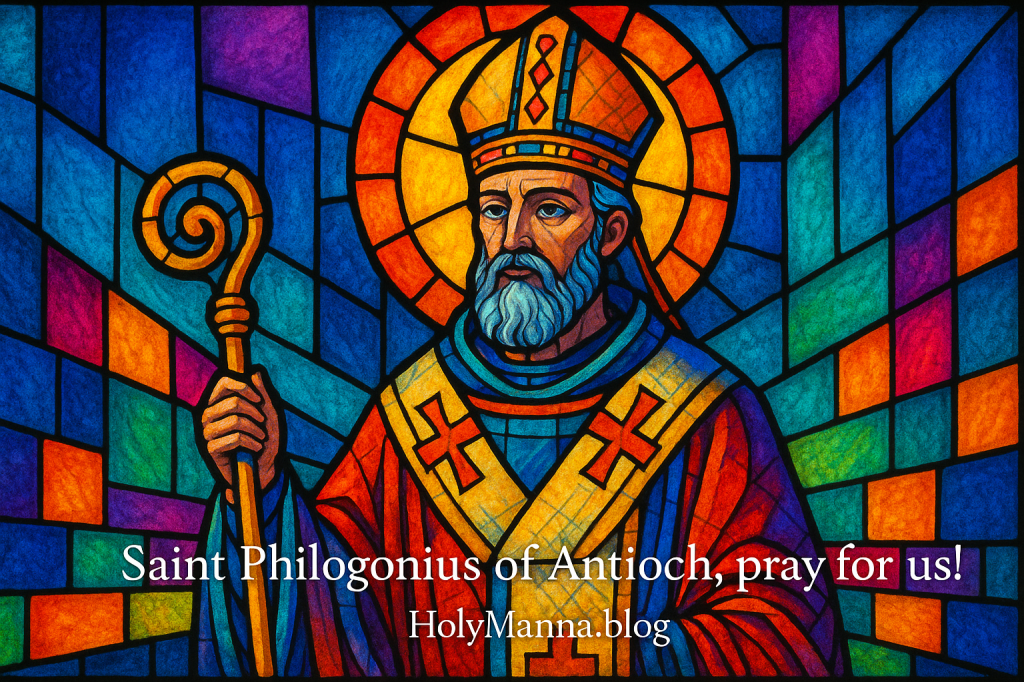
Shepherd of Orthodoxy in a Time of Fire
Saint Philogonius of Antioch stands as one of the early Church’s most dependable defenders of orthodoxy, even if his name is not as universally known today. As Patriarch of Antioch in the early fourth century, he guided one of Christianity’s greatest centers during a period marked by intense persecution from the Roman Empire and rising doctrinal confusion within the Church. His leadership, humility, and unwavering commitment to the divinity of Jesus Christ helped steady Christians at a pivotal moment that would soon lead to the First Council of Nicaea. His influence radiated far beyond his lifetime as later saints looked back on him as a model bishop whose character bolstered the faith of an entire region.
From Courtroom Advocate to Shepherd of Souls
Born in Antioch in the late third century, Philogonius began his life in the bustling civic world of legal advocacy. Ancient accounts describe him as a brilliant lawyer admired for both skill and integrity. He was not known for tricks or manipulation, but for judgments rooted in justice and compassion. Long before he ever wore episcopal vestments, he was already quietly defending widows, orphans, and the vulnerable in the courts. This natural sense of justice prepared him for the pastoral responsibilities God would later entrust to him.
He married and had a daughter, and he lived a sincere Christian life as a layman immersed in a large cosmopolitan city. After the death of his wife, he embraced a more ascetical and prayerful lifestyle, deepening his commitment to God. His reputation for holiness grew so strong that, when the bishopric of Antioch became vacant sometime between 314 and 318, clergy and laity alike insisted that Philogonius be chosen as their new bishop. It was an uncommon appointment because he had not previously served as a priest, yet his virtue, wisdom, and faith made him the obvious choice. His election reflected the trust the faithful had in him and the recognition that genuine holiness and sound judgment were the marks of a true shepherd.
As bishop and patriarch, Philogonius proved to be a loving father to his flock. He taught the faith with clarity, encouraged the faithful with tenderness, and embodied the very pastoral charity expected of the successors of the apostles. His legal training, far from being left behind, became a powerful tool for the Church as he confronted doctrinal confusion with the precision of a truth loving advocate.
Guarding the Flock in an Age of Heresy
Philogonius’ episcopal ministry unfolded during a time of immense challenge for the Church. Externally, Roman authorities such as Maximinus Daia and Licinius attempted to suppress the Christian faith. Internally, the Church faced an even more dangerous threat: the Arian heresy, which claimed that Jesus Christ was not eternal and not equal to the Father, but a created being. This teaching struck at the core of Christian belief about salvation and the nature of God.
Philogonius stood firmly with Saint Alexander of Alexandria in rejecting these false teachings and defending the Church’s perennial faith that Jesus Christ is true God and true man. This is the same truth proclaimed in The Catechism, which affirms that Christ is “consubstantial with the Father” and truly divine. Philogonius recognized that if Christ were not fully God, then humanity could not be redeemed, and the Gospel would collapse into a mere moral philosophy rather than the revelation of God incarnate.
Although some historical accounts suggested he may have participated in early councils leading up to Nicaea, clearer evidence shows that he died shortly before the Council convened in 325. Still, his defense of the faith in Antioch helped prepare the wider Church to stand firm when the bishops formally condemned Arianism and professed the true divinity of Christ. His strongest legacy was not found in miracles recorded during life, but in the miracle of his courage, theological clarity, and consistency in shepherding a confused flock back to the truth.
Confessor in the Furnace of Persecution
Philogonius lived through the final waves of Roman persecution before Christianity gained legal recognition. Under the emperors Maximinus Daia and Licinius, Christians endured imprisonment, property seizure, and violent repression. Tradition holds that Philogonius himself suffered for the faith, earning the title of Confessor, a term used for those who endured severe trials for Christ without shedding their blood.
It is believed that Philogonius was imprisoned during these persecutions and remained faithful despite pressure to compromise. His endurance strengthened the Christians of Antioch, who saw in him a living witness to the truth he preached. Whether he died just after the persecutions or during the early years of Church peace, his final years were marked by the scars of the trials he had faced. His steadfastness demonstrated that a bishop must not only teach the faith but also suffer with his people, offering hope in the midst of danger.
A Bishop Whose Memory Healed Wounds
After his death around 322 or 324, Philogonius’ sanctity was recognized immediately. His relics were venerated in Antioch, and his feast was celebrated on December 20. The most remarkable tribute came from Saint John Chrysostom, who preached a homily in his honor decades later. Chrysostom praised him as a radiant light in a dark era, a shepherd whose life inspired the faithful long after his passing. In that homily, Chrysostom connected Philogonius’ unwavering defense of Christ’s divinity with the anticipation of Christmas, reminding the faithful that Philogonius had spent his life guarding the truth of the Incarnation.
His tomb became a place of prayer, and pilgrims sought his intercession for healing and guidance. Even without long lists of recorded miracles, the spiritual fruit of his memory and the devotion of generations testified to his holiness. In the early centuries, the greatest miracles were often the conversions, healings of heart, and strengthening of faith that came through saints like Philogonius, whose lives remained powerful sermons long after their deaths.
Living the Courage of Philogonius Today
The life of Saint Philogonius speaks clearly to every Christian seeking holiness in the middle of ordinary responsibilities. Before he was a bishop, he was a husband, a father, and a hardworking professional. He lived his vocation faithfully and used his natural abilities to serve others. This mirrors the teaching of The Catechism, which reminds the laity that they are called to shape the secular world according to God’s plan by living out virtue with consistency and courage.
Philogonius’ witness is especially needed today in a culture marked by confusion about truth and increasing discomfort with firm Christian conviction. He teaches that fidelity to doctrine is not rigid or unloving, but an act of charity. He shows that the truth about Christ matters profoundly and that defending it with clarity and tenderness is part of every Christian’s mission. He invites believers to deepen their understanding of Scripture and the teachings of the Church, to remain close to the sacraments, and to support their local pastors with prayer and encouragement.
Philogonius also challenges Christians to look around their communities and identify those whom society overlooks. Just as he defended the vulnerable in the courtroom and guided the spiritually confused in the Church, modern believers can use their talents, influence, and stability to lift up those in need. His life demonstrates that holiness grows when faith and charity meet in ordinary daily choices.
Saint Philogonius ultimately reminds the Church that holiness is not found in avoiding conflict, but in remaining faithful to Christ in the midst of it. His life is a call to cultivate courage, resilience, and deep trust in Jesus, who strengthens every disciple who seeks to walk in truth.
Engage with Us!
Share your thoughts and reflections about Saint Philogonius in the comments below.
- Where is God inviting you to stand more boldly for truth in your daily life?
- How can Saint Philogonius’ example inspire you to respond with both courage and charity when your faith is challenged?
- What natural gifts or talents might God be asking you to use more intentionally for the good of the Church?
- How does the story of early Church defenders strengthen your own confidence in the teachings of the Catholic faith?
May God give you strength to live with conviction, tenderness, and fidelity, doing everything with the love and mercy that Jesus teaches.
Saint Philogonius of Antioch, pray for us!
Follow us on YouTube, Instagram and Facebook for more insights and reflections on living a faith-filled life.

 Holy Manna!
Leave a comment