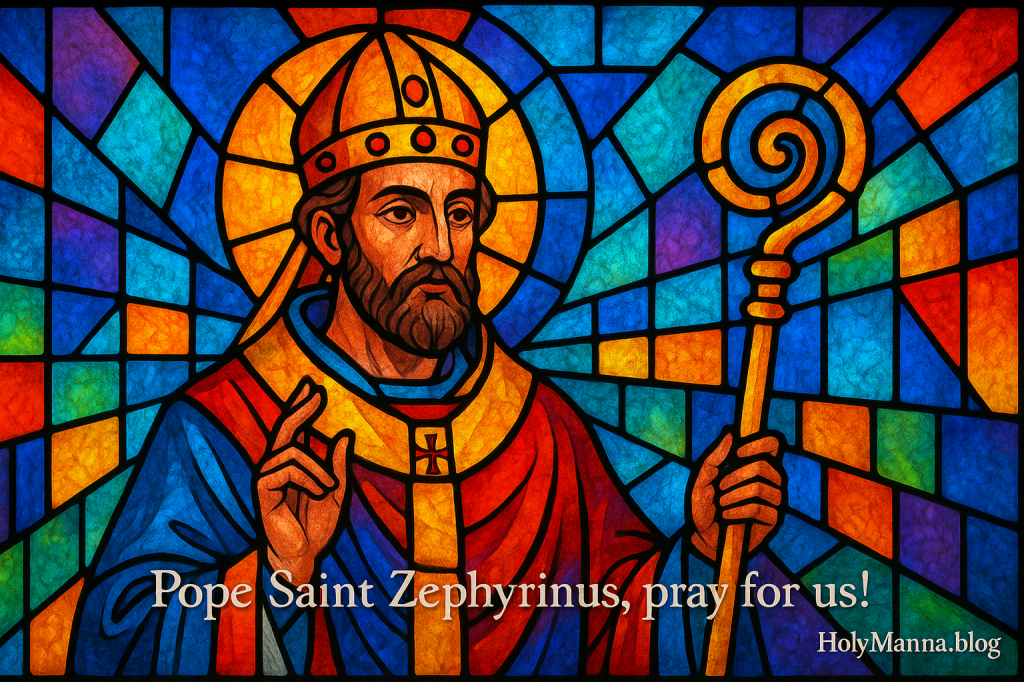
A Hidden Giant of the Early Church
Pope Saint Zephyrinus stands as one of the quiet giants of early Christianity, a man whose holiness did not rest in eloquent writings or dramatic miracles but in steadfast fidelity to the truth during one of the most turbulent eras of the Church’s history. Serving as Bishop of Rome from around the years 198 or 199 until his death in 217, he shepherded the faithful through a time marked by intense Roman persecution and deep internal doctrinal conflict. These external and internal storms could have torn the Christian community apart, yet Zephyrinus preserved unity, defended the divinity of Christ, and upheld the apostolic faith with remarkable humility. Although criticized by some of his contemporaries for simplicity, the Church remembers him as a pastor who offered stability, clarity, and spiritual fatherhood at a moment when believers desperately needed it. Butler later wrote of him as “the support and comfort of the distressed flock”, a testimony to the strength and gentleness with which he guided the early Church.
A Roman Son Formed in the Shadow of the Empire
Zephyrinus was born in Rome, the center of imperial power, at a time when Christianity was still viewed with suspicion and often treated as a crime. Ancient sources such as the Liber Pontificalis identify his father as Habundius, which suggests that he came from a modest but respectable Roman family. The world he grew up in was full of danger for Christians, yet also full of the courageous witness of martyrs and the wisdom handed down by those who had known the apostles. Growing up in this environment shaped him into a believer deeply committed to Christ and the unity of His Church.
When Pope Victor I died, Zephyrinus was chosen as his successor. This placed upon him the enormous responsibility of defending the faith and guiding the community in Rome during an age of severe pressure. Externally, Christians faced escalating persecution under the emperors Septimius Severus and Caracalla. Internally, the Church was shaken by doctrinal confusion, especially regarding the nature of Christ and the Trinity. Zephyrinus soon became known primarily for his unwavering defense of the apostolic teaching that Jesus Christ is true God and true man and that the Father, the Son, and the Holy Spirit are distinct Persons sharing one divine nature. These truths, which the Church later articulated so clearly in the Catechism of the Catholic Church, were under heavy attack during his lifetime, yet he never wavered in safeguarding them.
Holding the Line on Who Jesus Really Is
The daily work of Pope Saint Zephyrinus was marked by spiritual discernment and pastoral courage. He governed the Church at a time when heretical movements were not only common but intellectually sophisticated, appealing to many Christians who sought simple philosophical explanations for the mysteries of God’s nature. One of the major threats of the time was Adoptionism, promoted by thinkers such as Theodotus the Tanner, who claimed that Jesus was a mere man adopted by God. Another major threat was Modalism, taught by figures like Noetus and Sabellius, who insisted so strongly on the oneness of God that they erased the real distinction between the Persons of the Trinity. These teachings directly contradicted what the Church professes and what Scripture reveals, such as in The Gospel of John, where Jesus speaks of His unity with the Father while also speaking to Him as a distinct Person.
Zephyrinus opposed these errors firmly, although not through written treatises. Instead, he relied on the apostolic tradition and on wise advisors, particularly his deacon Callixtus, the future pope, whom he entrusted with major responsibilities, including oversight of the newly organized cemetery on the Appian Way. This cemetery eventually became known as the Catacombs of Callixtus and served as a sacred resting place for popes, martyrs, and countless Christians.
Although not remembered for working miraculous signs, Zephyrinus performed what could be called the miracle of perseverance. He remained unwavering in defending the truth at a time when many voices loudly distorted it. This spiritual steadiness allowed the Church to maintain doctrinal unity in an era of confusion. According to tradition, he also encouraged greater reverence for the Eucharist, and some sources say he promoted the use of more precious chalices during the celebration of the Holy Mass, reflecting the Church’s belief in the Real Presence of Christ.
Storms From Emperors and From Within the Church
Persecution intensified during Zephyrinus’s pontificate. The emperor Septimius Severus launched what many called the fifth persecution against Christians, and countless believers were arrested, tortured, or executed. As the leader of the Christian community in Rome, Zephyrinus carried the burden of supporting the faithful, encouraging confessors, caring for widows and orphans, and strengthening the community’s resolve. His leadership became a source of comfort for believers who were facing frightening trials.
He also endured painful challenges from within the Church. Hippolytus, a brilliant priest and theologian, strongly opposed Zephyrinus and later Callixtus because he believed they were too lenient toward repentant sinners. His attacks became so forceful that Hippolytus eventually separated from the Church and became the first antipope. Zephyrinus, however, never repaid criticism with anger. His pastoral heart remained focused on unity and mercy. One early story tells of a confessor named Natalius who fell into heresy and later, through a series of dreams urging repentance, returned to beg forgiveness. Zephyrinus welcomed him back with compassion after a period of penance, reflecting the heart of the Good Shepherd who rejoices over the lost sheep that returns.
Although earlier centuries sometimes listed Zephyrinus as a martyr, today he is honored as a confessor who suffered deeply for the faith but likely died a natural death in the year 217. His courage in enduring suffering, misunderstanding, and constant pressure remains a powerful witness to the resilience of faith.
Resting Among the Martyrs
After his death, Pope Saint Zephyrinus was buried in the cemetery he had entrusted to Callixtus. This sacred place holds the tombs of many early popes and martyrs and has become one of the most significant Christian archaeological sites in Rome. Pilgrims who walk its underground passages today encounter the memory of men and women who lived the faith with extraordinary courage, and among them rests Zephyrinus, the humble shepherd who guided the Church during one of its most trying seasons. His intercession has long been sought by the faithful who desire steadfastness, clarity, and unity in times of confusion.
While no famous miracles are recorded after his death, his memory continues to inspire Christians who face spiritual challenges. He reminds the faithful that holiness is often found in quiet endurance and in steady loyalty to the truth, even when no one seems to notice.
Quiet Fidelity in a Noisy World
The life of Pope Saint Zephyrinus offers a powerful example for believers today. He lived in a world filled with confusion about God, hostility toward Christians, and intellectual pride that tried to reshape the Gospel into something more palatable. Yet Zephyrinus stayed grounded in the apostolic faith. He did not seek to innovate the truth but to preserve it. He did not meet conflict with aggression but with conviction and charity. He did not allow the complexity of theological debates to overshadow the simplicity of the Gospel he was called to protect.
His life challenges modern Catholics to strengthen their understanding of the faith, especially regarding the divinity of Christ and the mystery of the Holy Trinity. It also encourages believers to practice mercy toward those who return after straying, just as Zephyrinus did with Natalius. His example invites Catholics to support one another in suffering, to pray for the leaders of the Church who carry heavy responsibilities, and to remain faithful in the face of cultural pressure.
In a world that often values attention-grabbing personalities, Pope Saint Zephyrinus reminds everyone that real holiness often grows quietly in hearts that choose faithfulness day after day. God continues to work through humility, perseverance, and love, just as He did through this early pope who defended the truth with steady devotion.
Engage with Us!
Share your thoughts and reflections in the comments below.
- How does the humble and steady leadership of Pope Saint Zephyrinus inspire your own practice of faith, especially when facing confusion or pressure?
- Where in your life is God inviting you to stand firm in truth with patience and charity?
- How can you cultivate unity in your family, parish, or community following the example of early Church shepherds?
May the life of Pope Saint Zephyrinus encourage all believers to hold fast to the faith, trust in the guidance of the Holy Spirit, and live every day with the love and mercy Jesus taught.
Pope Saint Zephyrinus, pray for us!
Follow us on YouTube, Instagram and Facebook for more insights and reflections on living a faith-filled life.

 Holy Manna!
Leave a comment