Saturday of the Third Week of Advent – Lectionary: 196
Opening the Gates of the Heart
There is a quiet but urgent question running through today’s readings: Will the heart let God come close, or keep Him at a distance?
In Isaiah 7:10-14, King Ahaz stands in the face of political fear and spiritual crisis. God offers him a sign as high as the sky, but Ahaz hides behind a pious excuse. Into that fearful refusal, God still promises “the young woman, pregnant and about to bear a son, shall name him Emmanuel”. The house of David will not be abandoned. God Himself will draw near.
Psalm 24 sounds like an ancient entrance procession into the Temple, asking who may stand before the Lord. The answer is not the powerful or the impressive, but “the clean of hand and pure of heart”. Then comes the great Advent cry to the gates of the city and the gates of the soul: “Lift up your heads, O gates, that the king of glory may enter”.
In Luke 1:26-38, that King of Glory does not enter with armies, but through the humble “yes” of a virgin in Nazareth. Mary listens, questions honestly, and then surrenders completely: “Behold, I am the handmaid of the Lord. May it be done to me according to your word.” She is everything Ahaz was not. She is the pure heart of Psalm 24 who becomes the living gate through which Emmanuel enters the world.
These readings together invite a simple, searching reflection: Where has fear or discouragement made the heart more like Ahaz than like Mary, and how can the soul open again so that Emmanuel, the King of Glory, may truly enter this Advent?
First Reading – Isaiah 7:10-14
Emmanuel in the Midst of Fear
This reading comes from a moment of serious crisis in the kingdom of Judah. King Ahaz faces real military threats, and his instinct is to rely on political alliances instead of trusting God. In Isaiah 7, the prophet is sent to assure the fearful king that the Lord Himself will protect the house of David. God invites Ahaz to ask for a sign as deep as Sheol or as high as the sky, not to entertain curiosity, but to strengthen faith. Ahaz refuses, hiding behind a mask of religious language, and Isaiah responds with the famous prophecy of Emmanuel.
This passage fits perfectly with today’s theme of welcoming God’s nearness rather than closing the heart in fear. Even when human leaders refuse to trust, God remains faithful. The promise of “Emmanuel”, which means “God with us”, points beyond Ahaz’s situation to the coming of Jesus Christ, the true Son of David whose kingdom cannot be shaken. As the Gospel shows Mary saying yes to this same promise, Isaiah 7:10-14 reveals how God prepares the world to receive the King of Glory long before Bethlehem.
Isaiah 7:10-14 – New American Bible (Revised Edition)
Emmanuel. 10 Again the Lord spoke to Ahaz: 11 Ask for a sign from the Lord, your God; let it be deep as Sheol, or high as the sky! 12 But Ahaz answered, “I will not ask! I will not tempt the Lord!” 13 Then he said: Listen, house of David! Is it not enough that you weary human beings? Must you also weary my God? 14 Therefore the Lord himself will give you a sign; the young woman, pregnant and about to bear a son, shall name him Emmanuel.
Detailed Exegesis
Verse 10 – “Again the Lord spoke to Ahaz”.
God does not give up easily on His people. Ahaz is not a model king, yet the Lord still speaks into his fear and confusion. This shows that divine initiative precedes human response. God moves toward His people even when their faith is weak.
Verse 11 – “Ask for a sign from the Lord, your God; let it be deep as Sheol, or high as the sky!”
The Lord invites Ahaz to request a sign without limit. The language of depth and height shows that nothing is beyond God’s reach. A sign here is meant to anchor trust, not to satisfy curiosity. It reveals God’s fatherly patience with a hesitant and fearful heart.
Verse 12 – “But Ahaz answered, ‘I will not ask! I will not tempt the Lord!’”
On the surface, Ahaz sounds pious, but this refusal masks a lack of faith. He does not want to entrust the kingdom to God because his hope is in political schemes. The wording recalls Deuteronomy 6:16, but unlike true obedience, this is a selective use of Scripture that avoids real conversion.
Verse 13 – “Then he said: Listen, house of David! Is it not enough that you weary human beings? Must you also weary my God?”
Isaiah exposes the deeper issue. Ahaz’s mistrust does not only burden people; it offends God. By addressing the “house of David,” Isaiah widens the view beyond this one king to the whole dynastic line. The problem is not just poor leadership. It is a crisis of faith in God’s covenant promises to David.
Verse 14 – “Therefore the Lord himself will give you a sign; the young woman, pregnant and about to bear a son, shall name him Emmanuel.”
Since Ahaz refuses, God gives a sign on His own initiative. The focus shifts from the king’s unfaithfulness to God’s unshakable fidelity. The prophecy speaks of a young woman bearing a son named Emmanuel, signaling that God Himself will dwell with His people. In the light of The Gospel of Luke 1:26-38, the Church recognizes this as a profound prophecy of the virginal conception of Christ and the fulfillment of the Davidic promise in Jesus, the true King whose kingdom will have no end.
Teachings
This reading stands at the heart of the Church’s understanding of Christ’s identity and the mystery of the Incarnation. The promise of Emmanuel reveals that salvation is not just God helping from a distance, but God truly coming to dwell with His people. The Catechism teaches in CCC 711 that the Spirit gradually unveiled the coming of Christ through the prophets, especially through the promise of Emmanuel and the announcement of a new and everlasting covenant. The messianic hope of Israel is rooted in these kinds of prophecies, which prepare for the coming of Jesus as the Son of David and Son of God.
Regarding the child who will be called Emmanuel, the Church sees in this prophecy a foreshadowing of the virginal conception of Jesus. CCC 497 explains that the Gospels present the conception of Jesus as a divine work of the Holy Spirit, not the result of human seed, so that He is truly the Son of God in His humanity. This deepens the meaning of the name Emmanuel, because in Christ, God is literally with humanity in flesh and blood.
The Fathers of the Church often united this passage with the Annunciation. Saint Irenaeus, for example, saw Mary as the obedient Virgin through whom God fulfills the promise made through Isaiah, in contrast to the disobedience and distrust that marked earlier moments in Israel’s history. The promise given to the failing house of David finds its perfect response in Mary’s faithful heart, which opens the door for the King of Glory to enter the world.
Reflection
This reading invites a very honest spiritual question: Where is the heart more like Ahaz than like Mary? Ahaz is afraid, calculating, and reluctant to trust God with real control. He uses religious language while keeping his security in human plans. Many believers know what this feels like. There can be areas of life where trust in God is spoken out loud, yet the heart clings tightly to self-protection, hidden fears, and backup plans that leave little room for real faith.
At the same time, the promise of Emmanuel reminds every soul that God does not wait for perfect trust before coming near. He steps into messy, compromised situations and offers a deeper sign of His presence. The call is to respond by opening the gates of the heart with renewed confidence. That can look very simple and concrete. A person can choose to bring a specific fear into prayer, admit the hesitation, and ask Jesus to be Emmanuel in that exact concern. A believer can choose small acts of trust, like obeying a difficult teaching of the Church, forgiving someone who has caused real pain, or accepting a new responsibility that feels bigger than personal strength.
These verses encourage a movement away from calculated self-reliance and toward surrendered confidence in God’s promises. Where has fear been disguised as caution or false piety? What concrete step of trust can be taken today in response to the God who promises to be Emmanuel? How can the heart make room for this King of Glory as Advent moves closer to Christmas?
Responsorial Psalm – Psalm 24:1-7, 10
Opening the Gates to the King of Glory
Psalm 24 likely comes from a liturgical procession into the Temple in Jerusalem, where the people recognize that the God who created everything is now drawing near to dwell among them. In the context of Advent and the promise of Emmanuel from Isaiah 7:10-14, this psalm becomes a powerful preparation of the heart. It shows that the God who comes is not a distant idea, but the true King of Glory who desires clean hands, pure hearts, and open gates. This fits today’s theme perfectly: God draws close in Christ, and the human response is to welcome Him with inner purity and joyful reverence.
Psalm 24:1-7, 10 – New American Bible (Revised Edition)
The Glory of God in Procession to Zion
1 A psalm of David.
The earth is the Lord’s and all it holds,
the world and those who dwell in it.
2 For he founded it on the seas,
established it over the rivers.3 Who may go up the mountain of the Lord?
Who can stand in his holy place?
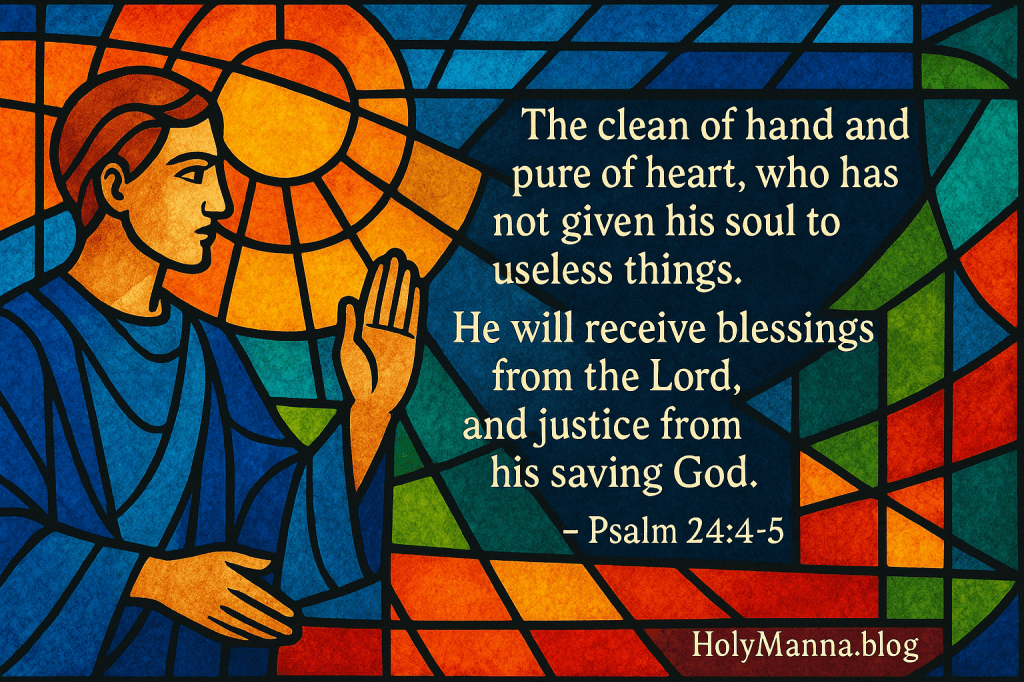
4 “The clean of hand and pure of heart,
who has not given his soul to useless things,
what is vain.
5 He will receive blessings from the Lord,
and justice from his saving God.
6 Such is the generation that seeks him,
that seeks the face of the God of Jacob.”
Selah7 Lift up your heads, O gates;
be lifted, you ancient portals,
that the king of glory may enter.10 Who is this king of glory?
The Lord of hosts, he is the king of glory.
Selah
Detailed Exegesis
Verse 1 – “The earth is the Lord’s and all it holds, the world and those who dwell in it.”
Everything belongs to God. Creation is not neutral territory. It is His house. This verse reminds every listener that life, possessions, and even personal plans are not ultimately owned, but received.
Verse 2 – “For he founded it on the seas, established it over the rivers.”
The psalm recalls God as Creator who brings order out of chaos. Seas and rivers often symbolize unstable forces. The Lord’s power over them shows that nothing in creation stands outside His rule, which prepares the way to see Him as King of Glory.
Verse 3 – “Who may go up the mountain of the Lord? Who can stand in his holy place?”
The question moves from creation to worship. Mount Zion and the Temple are seen as the meeting place of heaven and earth. The psalm asks who is worthy to stand before such a holy God. This sets up a moral and spiritual examination of the heart.
Verse 4 – “The clean of hand and pure of heart, who has not given his soul to useless things, what is vain.”
The answer focuses on integrity. Clean hands point to righteous actions. A pure heart points to interior sincerity. Avoiding “useless things” means rejecting idols and empty pursuits. True worship demands a life that is both morally upright and inwardly undivided.
Verse 5 – “He will receive blessings from the Lord, and justice from his saving God.”
Those who seek God with clean hands and pure hearts are not left empty. They receive blessings and the gift of God’s saving justice. This is not just external reward, but the grace that sets a person right with God.
Verse 6 – “Such is the generation that seeks him, that seeks the face of the God of Jacob.”
The psalm describes a people marked by desire for God’s face. Seeking the face of God means longing for His presence and favor, not just His gifts. It is a prophetic picture of a renewed generation, hungry for holiness and intimacy with the Lord.
Verse 7 – “Lift up your heads, O gates; be lifted, you ancient portals, that the king of glory may enter.”
The scene shifts to the city gates. The royal King approaches, and the gates are told to open wide. Spiritually, this can be heard as an appeal to the human heart: lift up your head, open the inner doors, and allow God to enter with all His majesty.
Verse 10 – “Who is this king of glory? The Lord of hosts, he is the king of glory.”
The psalm ends with a responsive cry. The King is identified as the Lord of hosts, the God who commands the armies of heaven. In light of Luke 1:26-38, this King of Glory is the same Lord who comes humbly in the womb of the Virgin Mary and desires to reign forever over the house of Jacob.
Teachings
This psalm shows that worship is never only external. It demands an interior conversion. The Catechism reminds the faithful in CCC 2559: “Prayer is the raising of one’s mind and heart to God or the requesting of good things from God.” Clean hands and a pure heart describe a life that is truly raised toward God and not enslaved to “useless things.”
The universal claim of God over all creation in Psalm 24:1 echoes the teaching of CCC 301: “With creation, God does not abandon his creatures to themselves. He not only gives them being and existence, but also, and at every moment, upholds and sustains them in being.” The King of Glory is not an occasional visitor. He is the One who sustains every moment of existence and yet chooses to come in a special way in the Incarnation.
The longing to “seek the face” of God shows up throughout the spiritual tradition. Many saints speak of this desire as the driving force of holiness. Saint Augustine famously expressed this restlessness toward God when he wrote that the human heart is restless until it rests in Him. This psalm gives language to that same desire and frames it as the mark of a whole generation.
In the liturgical life of the Church, Psalm 24 resonates with Advent. The call to open the gates and let the King of Glory enter points directly to the coming of Christ. The Catechism teaches in CCC 522: “The coming of God’s Son to earth is an event of such immensity that God willed to prepare for it over centuries.” This psalm is part of that preparation, forming hearts that are ready to receive Emmanuel with reverence and joy.
Reflection
This psalm quietly asks a very direct question: What kind of heart is the King of Glory walking toward right now? The Lord already owns the earth and everything in it, but He waits to be welcomed freely into the inner temple of the soul. Clean hands and a pure heart are not about perfection, but about sincerity and real conversion.
A believer can respond by examining daily habits and priorities. Are there “useless things” that soak up time, attention, and affection, while God receives leftovers? A simple step is to choose one concrete area to purify. That might be the way the phone is used, the way conversations are steered, or the way hidden sins are justified. Another step is to consciously “lift up the gates” each morning with a short prayer that invites Jesus to rule over the thoughts, decisions, and relationships of the day.
What would it look like if the heart truly lived as if “the earth is the Lord’s and all it holds”? Where is God asking for cleaner hands or a more undivided heart? How can the soul open more fully this Advent so that the King of Glory finds not a closed fortress, but a ready, joyful welcome?
Holy Gospel – Luke 1:26-38
Mary’s Fiat: How God Enters When the Heart Says Yes
This Gospel presents the Annunciation, one of the most important moments in salvation history. In a small town in Galilee, far from centers of power, the angel Gabriel is sent to a virgin named Mary, betrothed to Joseph of the house of David. Everything about this scene fulfills the promises hinted at in Isaiah 7:10-14: God will give a sign, a son will be born, and He will truly be Emmanuel, God with us. Religiously, this moment is the beginning of the Incarnation in time. Historically and culturally, it happens in an ordinary Jewish home under Roman occupation, where a humble young woman receives the greatest invitation ever given to a human being. In this simple setting, the eternal Son of God enters the world through the free “yes” of Mary. This fits today’s theme perfectly. God comes close, and the decisive question is how the human heart responds.
Luke 1:26-38 – New American Bible (Revised Edition)
26 In the sixth month, the angel Gabriel was sent from God to a town of Galilee called Nazareth, 27 to a virgin betrothed to a man named Joseph, of the house of David, and the virgin’s name was Mary. 28 And coming to her, he said, “Hail, favored one! The Lord is with you.” 29 But she was greatly troubled at what was said and pondered what sort of greeting this might be. 30 Then the angel said to her, “Do not be afraid, Mary, for you have found favor with God. 31 Behold, you will conceive in your womb and bear a son, and you shall name him Jesus. 32 He will be great and will be called Son of the Most High, and the Lord God will give him the throne of David his father, 33 and he will rule over the house of Jacob forever, and of his kingdom there will be no end.” 34 But Mary said to the angel, “How can this be, since I have no relations with a man?” 35 And the angel said to her in reply, “The holy Spirit will come upon you, and the power of the Most High will overshadow you. Therefore the child to be born will be called holy, the Son of God. 36 And behold, Elizabeth, your relative, has also conceived a son in her old age, and this is the sixth month for her who was called barren; 37 for nothing will be impossible for God.” 38 Mary said, “Behold, I am the handmaid of the Lord. May it be done to me according to your word.” Then the angel departed from her.
Detailed Exegesis
Verse 26 – “In the sixth month, the angel Gabriel was sent from God to a town of Galilee called Nazareth,”
The “sixth month” refers to Elizabeth’s pregnancy, connecting John the Baptist’s mission with Jesus from the start. Gabriel is sent by God, showing that this is entirely God’s initiative. Nazareth, a small and overlooked town, becomes the place where the greatest message in history is delivered.
Verse 27 – “to a virgin betrothed to a man named Joseph, of the house of David, and the virgin’s name was Mary.”
Mary is a virgin and yet betrothed, which in Jewish culture is a legally binding step before living together. Joseph belongs to the house of David, which fulfills the promise that the Messiah would come from David’s line. Mary stands at the intersection of God’s promises and human history.
Verse 28 – “And coming to her, he said, ‘Hail, favored one! The Lord is with you.’”
Gabriel greets Mary with a title rather than just a name. “Favored one” points to a unique grace given by God. “The Lord is with you” signals that God’s presence rests on her in a special way, which prepares for Emmanuel, God with us, dwelling in her womb.
Verse 29 – “But she was greatly troubled at what was said and pondered what sort of greeting this might be.”
Mary is not naive or superficial. She is troubled and ponders, which shows a reflective, discerning heart. Her reaction is not disbelief, but a serious openness that takes God’s word seriously and seeks to understand.
Verse 30 – “Then the angel said to her, ‘Do not be afraid, Mary, for you have found favor with God.’”
Gabriel addresses her by name and reassures her. Fear is the normal human reaction in front of divine mystery. The angel’s words show that God’s call is rooted in grace. Mary has found favor, not because of her achievements, but because of God’s loving choice.
Verse 31 – “Behold, you will conceive in your womb and bear a son, and you shall name him Jesus.”
The message becomes concrete. Mary will conceive and bear a real child. The name “Jesus” means “God saves.” The mission and identity of the child are revealed together. This is not just a special baby. This is the Savior.
Verse 32 – “He will be great and will be called Son of the Most High, and the Lord God will give him the throne of David his father,”
The child’s greatness is not only moral. He is the “Son of the Most High,” a divine title. The throne of David shows that He is the long awaited Messiah. This directly answers the promise given to the house of David in Isaiah 7.
Verse 33 – “and he will rule over the house of Jacob forever, and of his kingdom there will be no end.”
This kingdom is not temporary. It is eternal. The rule over the house of Jacob means He fulfills God’s covenant with Israel. The kingdom without end points to His divine kingship, which no earthly power can overthrow.
Verse 34 – “But Mary said to the angel, ‘How can this be, since I have no relations with a man?’”
Mary’s question is honest and logical. She knows she has preserved her virginity. Her question is not doubt like Zechariah’s, but a desire to understand how God’s plan will unfold while she remains faithful to her state of life.
Verse 35 – “And the angel said to her in reply, ‘The holy Spirit will come upon you, and the power of the Most High will overshadow you. Therefore the child to be born will be called holy, the Son of God.’”
The conception will be entirely God’s work. The language of “overshadow” recalls the presence of God over the Ark of the Covenant. Mary becomes the living Ark, and the child is truly the Son of God. His holiness flows from His divine origin.
Verse 36 – “And behold, Elizabeth, your relative, has also conceived a son in her old age, and this is the sixth month for her who was called barren;”
Gabriel offers Elizabeth’s pregnancy as a sign. The one who was barren now carries life. God’s power has already broken through human limits in Mary’s own family. This strengthens Mary’s trust.
Verse 37 – “for nothing will be impossible for God.”
This short line is a key to the whole scene. Human limitations, biological barriers, and worldly expectations do not bind God. If He has promised, He can and will accomplish it.
Verse 38 – “Mary said, ‘Behold, I am the handmaid of the Lord. May it be done to me according to your word.’ Then the angel departed from her.”
Mary responds with total surrender and humble service. She accepts her identity as “handmaid” and consents to God’s plan. With this fiat, the Word becomes flesh in her womb. Her free yes opens the gate for Emmanuel, the King of Glory, to enter the world.
Teachings
The Church sees the Annunciation as the beginning of the Incarnation in time. CCC 484 teaches: “The Annunciation to Mary inaugurates ‘the fullness of time’, the time of the fulfillment of God’s promises and preparations.” What God hinted through the prophets, especially in Isaiah 7:14, now takes shape in a real woman’s life.
Regarding Mary’s role, CCC 494 says: “As Saint Irenaeus says, ‘Being obedient she became the cause of salvation for herself and for the whole human race.’ Hence not a few of the early Fathers gladly assert in their preaching: ‘The knot of Eve’s disobedience was untied by Mary’s obedience.’” Mary’s fiat is not a passive acceptance. It is an active cooperation that reverses the damage done by Eve’s distrust.
The virginal conception is central to this passage. CCC 497 explains: “The Gospel accounts understand the virginal conception of Jesus as a divine work that surpasses all human understanding and possibility.” The yes of Mary and the overshadowing of the Holy Spirit show that salvation is entirely God’s gift, yet humbly received through a human heart.
The Church also recognizes Mary as the model of faith and prayer. CCC 2617 teaches: “Mary’s prayer is revealed to us at the dawning of the fullness of time. Before the incarnation of the Son of God, and before the outpouring of the Holy Spirit, her prayer cooperates in a unique way with the Father’s plan of loving kindness.” Her dialogue with Gabriel reveals what trusting, listening, and obedient faith looks like in real time.
Reflection
This Gospel invites a personal and very practical question: What does a real yes to God look like right now? Mary’s yes is not abstract. It affects her body, her reputation, her plans, and her future. She accepts uncertainty, risk, and misunderstanding because she trusts that God is faithful.
In daily life, that same pattern can play out in smaller but very real ways. There might be a call to deeper purity, to forgiveness, to a new responsibility in family or parish, or to a quieter hidden sacrifice. Often the first reaction is the same as Mary’s. The heart wonders, “How can this be?” The Lord gently repeats, “Nothing will be impossible for God.”
A concrete response can start with simple steps. A person can bring one specific fear or objection to God in prayer and speak it honestly, just as Mary did. Then, like her, the heart can choose to say, with sincerity, “May it be done to me according to your word.” That might mean trusting Church teaching when it is hard, persevering in a vocation that feels heavy, or taking one new step in generosity or chastity or prayer when comfort pushes the other way.
Where is God inviting a deeper yes that feels costly or confusing? What would it look like to respond as a handmaid or servant of the Lord instead of the manager of one’s own life? How might this Advent change if each day began with Mary’s words on the lips and in the heart: “Behold, I am the handmaid of the Lord. May it be done to me according to your word”?
Opening the Heart to Emmanuel
Today’s readings trace a single movement of grace. In Isaiah 7:10-14, God promises “Emmanuel” to a fearful and hesitant king. In Psalm 24, the cry rises up: “Lift up your heads, O gates, that the king of glory may enter”. In Luke 1:26-38, that King of Glory comes quietly into Nazareth, and Mary’s “May it be done to me according to your word” opens the door for God Himself to dwell with His people.
The message is simple and demanding. God is not far. He is already drawing near. The real question is whether the heart hides like Ahaz, or seeks like the generation of Psalm 24, or says a costly yes like Mary. Emmanuel is given, but each soul must decide whether to welcome Him with clean hands, a pure heart, and real trust.
This Advent is a chance to let that yes become more concrete. A believer can choose one area of fear, one hidden attachment, or one act of obedience and lay it before the Lord with honest prayer. What gate of the heart needs to be lifted so that the King of Glory may enter more fully? What step of trust can be taken today so that Emmanuel is not just a title, but a lived reality in daily life?
May every day leading up to Christmas become a quiet rehearsal of Mary’s words, until they belong not only on the lips, but deep within the heart: “Behold, I am the handmaid of the Lord. May it be done to me according to your word.”
Engage with Us!
Share your thoughts and experiences in the comments below, especially where these readings touch your real life right now. Let this be a space where hearts encourage each other to welcome Emmanuel more deeply.
- In Isaiah 7:10-14, where God promises “Emmanuel”, how is God inviting your heart to move from fear or self reliance toward deeper trust in His presence and His plan?
- Looking at Psalm 24, what might “clean hands” and a “pure heart” look like in your current season of life, and what “useless things” might God be asking you to let go of so the King of Glory can enter more fully?
- In Luke 1:26-38, which part of Mary’s response moves you the most today, and what would it look like in concrete terms to echo her “May it be done to me according to your word” in one specific area of your life?
May every reflection lead to real action, so that daily choices, conversations, and hidden sacrifices are shaped by living faith. May hearts, homes, and communities be filled with the love and mercy Jesus taught, so that everything is done for the glory of God and the good of others.
Sacred Heart of Jesus, we trust in You!
Immaculate Heart of Mary, pray for us!
Saint Michael the Archangel, defend us in battle!
Follow us on YouTube, Instagram and Facebook for more insights and reflections on living a faith-filled life.

 Holy Manna!
Leave a comment