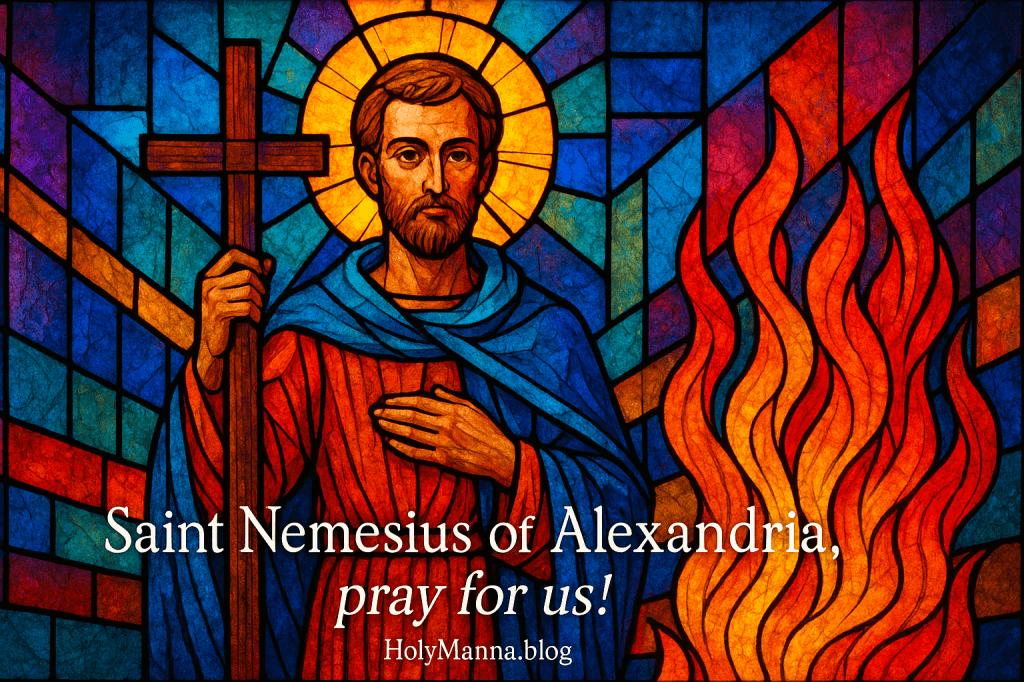
Hidden Fire of Justice
Saint Nemesius of Alexandria is a striking example of quiet courage in the face of injustice and violent persecution. He lived during the third century in Alexandria, Egypt, a time when followers of Jesus were repeatedly targeted by imperial campaigns aimed at suppressing the Christian faith. His martyrdom unfolded during the persecution under Emperor Decius around the year 250, a period when Christians were required by law to offer pagan sacrifices and obtain certificates proving their compliance. Nemesius refused such actions because they contradicted his faith in Christ.
What sets Nemesius apart is the deeply symbolic nature of his death. Although innocent of any wrongdoing, he was condemned to die among thieves. His execution mirrored the Passion of the Lord, who hung upon the Cross between two criminals. Nemesius did not leave behind sermons or writings, but his death became a visible proclamation of the truth that “If we suffer with him, we shall also be glorified with him.” His story invites believers today to trust that God’s judgment stands above human injustice and that fidelity to Christ bears fruit even when the cost is great.
Quiet Beginnings in a Tumultuous City
Very little is known about the early life of Saint Nemesius. Information about his parents, occupation, or upbringing has not survived. What is certain is that he grew up in Alexandria, one of the most culturally vibrant and religiously diverse cities of the ancient world. The Christian community in Alexandria was intellectually rich and spiritually active, shaped by great teachers and apologists. Yet it was also frequently attacked during imperial persecutions. Christians lived under the constant threat of suspicion, denunciation, and violence.
Nemesius is not known for a dramatic personal conversion. Instead, his life reflects a steady and unwavering discipleship. His fidelity to Christ was revealed most clearly when he was unjustly accused of robbery. After proving his innocence to the judge, he openly professed his Christian faith. This confession, rather than the false accusation, became the true reason for his condemnation. His willingness to speak the truth without fear shows the depth of his devotion and the strength of his conscience. He became known not for public preaching but for a faith that endured pressure, interrogation, and the looming threat of death.
Everyday Holiness in an Age of Pressure
During a time when many believers were tempted to compromise their faith to avoid punishment, Nemesius chose to remain steadfast. Under Emperor Decius, Christians could save themselves by offering incense to the Roman gods or by obtaining falsified certificates stating they had done so. Some yielded to this pressure, but others persevered with remarkable courage. Nemesius belonged to this second group. His holiness was not displayed through dramatic miracles or missionary journeys but through the quiet fidelity of a man who chose Christ over safety, reputation, and even life.
The Catechism teaches that The Catechism 2473: “Martyrdom is the supreme witness given to the truth of the faith.” Nemesius’ witness demonstrates that holiness is often found in ordinary acts of courage. In his perseverance, he revealed the grace of fortitude working in his soul, the same virtue the Catechism describes as ensuring firmness in difficulties and constancy in the pursuit of the good. He lived his faith with integrity, allowing God’s strength to shine through his weaknesses and trials. His example encourages believers today to view their own struggles not as obstacles, but as opportunities for grace.
Accused, Acquitted, Condemned: Sharing Christ’s Cross
The defining moment of Nemesius’ life began when he was arrested on the false charge of theft. He stood before the judge, demonstrated his innocence, and cleared himself of all accusations. Yet instead of receiving freedom, he was interrogated about his Christian identity. When he boldly professed his faith, the officials condemned him, twisting justice to serve the empire’s hostility toward Christians. This injustice reflects what Scripture teaches: “For one is approved if, mindful of God, he endures pain while suffering unjustly.” (1 Peter 2:19)
Nemesius was subjected to torture and severe punishment, inflicted more harshly than upon the actual criminals. After enduring repeated torment, he was sentenced to be burned alive with thieves and robbers. His executioners intended this to be a humiliation, placing him among criminals to mock his faith. Yet this very arrangement made his death a powerful reflection of the Crucifixion. The Savior Himself was crucified between two thieves, and Nemesius followed that same path of innocent suffering. His martyrdom teaches that God transforms injustice into glory and that every act of faithfulness draws believers deeper into the mystery of Christ’s Cross.
A Name Remembered in the Martyrology of the Church
No physical miracles are recorded after the death of Saint Nemesius. There are no surviving relics or famous shrines associated with him. Yet the quiet miracle of his legacy is that his name and testimony were preserved by the Church. He was remembered by the Christian historian Eusebius, who documented his martyrdom in the Ecclesiastical History, and his name was later included in the Roman Martyrology. These records ensured that his courage would be honored in Christian memory, allowing his faith to strengthen believers in every century.
Through this remembrance, God continues to work. The example of the martyrs has always been a source of grace. When the faithful read about Nemesius, they draw strength from his integrity, his trust in God’s justice, and his refusal to deny Christ under pressure. His silent example becomes a spiritual beacon for anyone who feels misunderstood or unjustly treated. The Church teaches that the saints intercede for the faithful, and Nemesius’ life inspires hope in God’s faithful love, even in the face of adversity.
Learning to Trust God When Treated Unfairly
The life of Saint Nemesius offers a meaningful invitation to every Christian. Many people know the pain of being misjudged, misunderstood, or unfairly accused. Nemesius shows that such moments can become opportunities for deeper trust in God. His example reminds believers that God sees clearly what others misunderstand and that no act of fidelity goes unnoticed in heaven. How might his example reshape the way unfair situations are faced today?
The Catechism teaches that fortitude is the virtue that gives firmness in difficulties and constancy in the pursuit of the good. Nemesius embodied this virtue to the fullest. His example encourages Christians to remain calm and rooted in truth when facing trials, to let patience replace resentment, and to surrender the pain of injustice to Christ, who suffered more deeply than anyone. This can take practical forms in daily life. A believer may choose to pray rather than retaliate, to turn to the sacraments for strength, or to reflect on whether God is inviting a peaceful response instead of defensiveness. Nemesius shows that holiness grows in the hidden places of the heart when trust is placed fully in the Lord.
Engage with Us!
Share your thoughts and reflections in the comments below.
- How does the innocence and patience of Saint Nemesius challenge you in moments when you feel misunderstood or unfairly judged?
- What injustices in your life could become opportunities for deeper trust in God’s providence?
- How might you practice quiet, steadfast faith in situations where defending yourself feels tempting but God invites you to surrender?
May Saint Nemesius inspire a deeper courage and a firmer trust in God’s justice. Live boldly in faith and choose the love and mercy Jesus taught in every moment.
Saint Nemesius of Alexandria, pray for us!
Follow us on YouTube, Instagram and Facebook for more insights and reflections on living a faith-filled life.

 Holy Manna!
Leave a comment