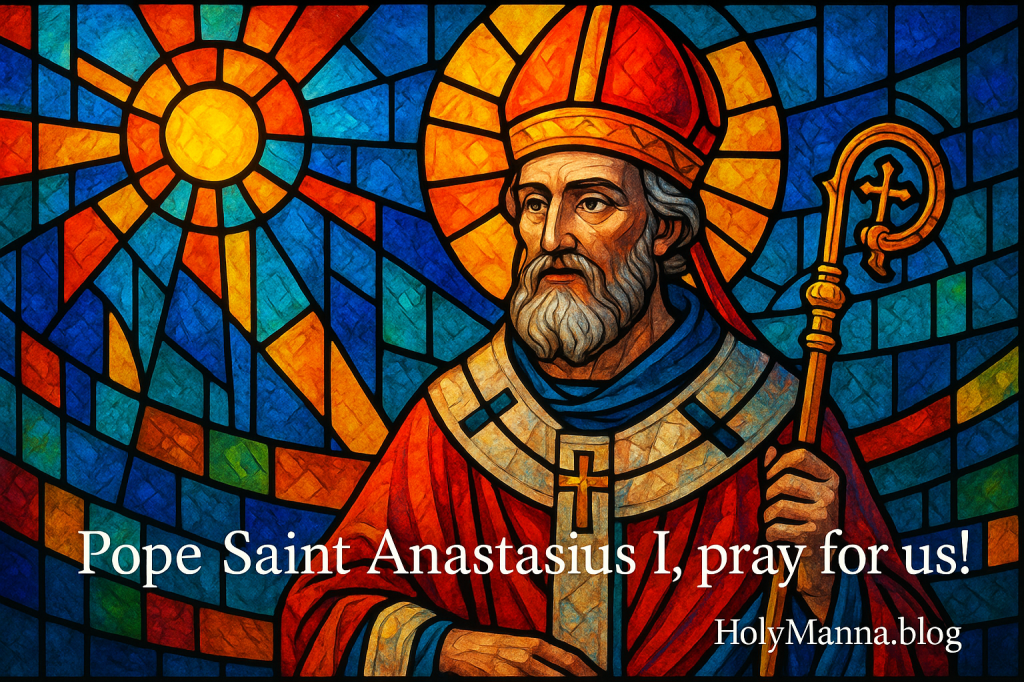
Shepherd of Truth in Turbulent Times
Pope Saint Anastasius I stands as a quiet yet steady pillar of early Church history, guiding the faithful during a period marked by theological confusion and cultural change. Serving as Bishop of Rome from 399 to 401, he is remembered especially for his response to the controversial writings of Origen as well as his pastoral humility and deep reverence for the Gospel. Saint Jerome, who knew him personally, praised him as “a man of great holiness who was rich in his poverty”, a testimony that reveals both his interior simplicity and his spiritual strength. Though his pontificate was brief, his clarity and fidelity helped stabilize the Church at a moment when doctrinal unity was desperately needed.
A Hidden Roman Prepared for the Chair of Peter
Very little is recorded about the childhood of Anastasius, which often signals a life marked by humility rather than public recognition. He was born in Rome, the son of a man named Maximus, and was formed within the Christian community during a time when the faith was transitioning from persecution into public acceptance. Later traditions suggest he may have been a widower and father to a son who became Pope Innocent I, although some scholars believe Jerome’s reference to Innocent as his “son” was spiritual rather than biological. Whatever the case, Anastasius lived a life shaped much more by devotion than by worldly ambition.
His election to the papacy placed him at the center of the Origenist controversy just as new Latin translations of Origen’s works were spreading confusion among clergy and theologians. Bishops across the Mediterranean world turned to the Bishop of Rome for guidance. Anastasius approached the challenge with prayer, careful discernment, and a deep sense of responsibility to guard the deposit of faith. His leadership did not rely on political maneuvering but on pastoral wisdom, theological grounding, and a heart committed to serving Christ and his Church.
Guardian of Orthodoxy and Reverence
The defining moment of Pope Anastasius’s pontificate came as he discerned how to address the growing disputes surrounding Origen’s writings. Although Origen contributed significantly to early Christian theology, some of his speculative ideas, such as the pre existence of souls and the eventual restoration of all things, raised serious concerns. After receiving warnings from other bishops and reviewing the writings with clergy in Rome, Anastasius concluded that portions of the work attributed to Origen were not safe guides for the faithful. He therefore censured the questionable teachings, helping protect the Church from doctrinal confusion. This action embodied the role described in the Catechism of the Catholic Church, which teaches that the pastors of the Church are authentic teachers endowed with Christ’s authority to preserve the integrity of the faith.
His pastoral concern extended beyond doctrine. Anastasius implemented measures to ensure that priests coming into Rome had proper letters of recommendation, which protected the community from untested clergy. He also encouraged Christians in North Africa as they combated the Donatist movement, a schism that falsely claimed the sacraments were invalid when administered by sinners. His support helped reinforce the Church’s constant teaching that the grace of a sacrament depends on Christ, not on the perfection of the minister.
His love for the Gospel also shaped liturgical life. He instructed the faithful to stand when the Gospel was proclaimed and encouraged clergy to bow their heads in reverence. This simple gesture expressed a profound truth highlighted in the Catechism: that in the words of Scripture, God lovingly speaks to his children. Though no dramatic miracles are recorded from his lifetime, his holiness shone in the spiritual clarity, unity, and reverence he inspired throughout the Church.
Carrying the Cross of Confusion and Division
Although Anastasius did not face physical persecution, he endured a different kind of suffering. He carried the heavy burden of theological conflict at a time when the Church was divided by complex debates that ordinary believers found difficult to understand. The Origenist controversy had stirred bitterness between clergy and theological schools, and the Donatist movement continued to fracture communities in North Africa. Anastasius faced these challenges with a spirit of patience, humility, and courage, striving to maintain unity without compromising truth.
He lived during a turbulent era in the Roman Empire as well, with rising threats from barbarian invasions and political instability. This pressure heightened the importance of strong, steady spiritual leadership. Even when dealing with topics that were intricately philosophical, he kept his focus on the spiritual wellbeing of the faithful. His quiet endurance can be seen as a form of interior martyrdom, a daily dying to oneself for the sake of Christ’s flock. Anastasius died in Rome on December 19, 401, and tradition holds that he was buried near his successor, Pope Innocent I, forming a beautiful image of continuity and spiritual fatherhood within the Church.
A Legacy That Keeps Guarding the Church
Unlike many other canonized saints, Pope Anastasius does not have a long list of miracles documented after his death. Instead, his lasting legacy is found in the doctrinal stability and liturgical reverence he strengthened in the Church. His censure of dangerous theological ideas helped preserve the Christian understanding of the resurrection, human freedom, and the seriousness of eternal destiny. His encouragement in North Africa helped protect the Church from the long term damage of Donatism. His liturgical directives shaped the posture of respect still shown at every Mass when the Gospel is proclaimed.
In this way, the spiritual fruit of his papacy continues quietly through the centuries. Every time the faithful stand in reverence to hear the words of Jesus in the Gospel, the legacy of Anastasius remains alive. Every time the Church relies confidently on the sacraments, even when administered by imperfect ministers, the doctrinal clarity he supported bears fruit. His holiness did not produce dramatic signs, yet it fortified the Church with strength that continues to nourish believers today.
Learning to Love Truth the Way Anastasius Did
Pope Saint Anastasius I offers a powerful example for anyone living in an age where confusion often overshadows clarity. His life shows that holiness is not always marked by dramatic events. Sometimes it is found in steady fidelity, quiet courage, and charity rooted deeply in truth. His example affirms the teaching found in the Catechism, which states that all doctrine ultimately aims toward the love that never ends. Anastasius defended doctrine not for the sake of winning arguments but for the sake of protecting the faithful from being misled.
His reverence for the Gospel challenges modern believers to approach Scripture with the same awe and openness. Standing attentively during the Gospel at Mass, spending time reading Scripture each day, or meditating on a passage in silence are ways to follow his lead and allow God’s Word to shape the heart. His poverty of spirit encourages a detachment from worldly concerns and a focus on what truly matters. Saint Jerome’s line describing him as “rich in his poverty” invites reflection on the kind of wealth that lasts.
His life offers practical lessons for daily living. A Christian today can emulate him by studying the faith more intentionally, defending the truth with patience and charity, and cultivating reverence for God’s Word. He shows that even a short life of leadership can leave a profound and lasting mark when it is anchored in Christ.
Engage with Us!
Share your thoughts and reflections in the comments below.
- Where in your own life is God calling you to stand firmly for truth with humility and love?
- How does Pope Anastasius’s faithfulness in the face of theological confusion inspire your own spiritual journey?
- What small daily practices can help you grow in fidelity to the Gospel and the teachings of the Church?
May God give each of us the grace to live with clarity, courage, and charity, doing everything with the love and mercy Jesus taught us.
Pope Saint Anastasius I, pray for us!
Follow us on YouTube, Instagram and Facebook for more insights and reflections on living a faith-filled life.

 Holy Manna!
Leave a comment