Friday of the Third Week of Advent – Lectionary: 195
Conceived in Barrenness, Chosen from the Womb
Sometimes the quiet ache in the human heart is not loud rebellion, but long waiting. Today’s readings sit right in that space where hopes seem delayed, bodies feel inadequate, and the future looks painfully ordinary. Into that very place, God steps in and writes a story of unexpected life, hidden preparation, and sacred calling that begins long before anyone can see it.
In Judges 13, Israel is in one of its darkest cycles. The people are under the power of the Philistines, and spiritually they are drifting. Into this bleak backdrop, God chooses a nameless, barren woman from the clan of Dan and promises a son. Samson will be consecrated as a Nazirite from the womb, set apart through concrete signs like no wine, no unclean food, and no razor touching his head. The Lord does not wait for ideal circumstances or perfect people. He moves directly into barrenness and begins salvation there. The first reading shows that God not only gives life, but also gives mission. The child is not just a blessing to his parents. He is a chosen instrument for the deliverance of God’s people.
Psalm 71 responds with the voice of someone who recognizes that God’s care did not begin in adulthood or even in conscious faith. It goes all the way back to the womb. The psalmist can say, “From my mother’s womb you are my strength” and “You are my hope, Lord; my trust, God, from my youth.” In other words, God’s initiative comes first. Before abilities, achievements, or spiritual maturity, there is a God who upholds, teaches, and saves. The psalm turns this awareness into praise and testimony. “I will speak of the mighty works of the Lord; O God, I will tell of your singular justice.” Knowing that life and vocation begin in God’s heart, not in human strength, naturally overflows into public praise.
Then Luke 1 brings all of this to a new level in the story of Zechariah and Elizabeth. They are described as righteous and blameless in the sight of God, yet they carry the deep and painful wound of childlessness in a culture where fertility was seen as a blessing and infertility as disgrace. Into that pain, in the days of Herod, an angel appears in the sanctuary and declares that their prayer has been heard. John will be born to a barren, elderly couple and, like Samson, he will drink no wine or strong drink and will be filled with the Holy Spirit from his mother’s womb. He is not only a miracle child, but a prophet with a mission. He will come “in the spirit and power of Elijah” to “prepare a people fit for the Lord.” Even Zechariah’s temporary silence becomes a sign that God’s word will be fulfilled in God’s time, not according to human timelines or probabilities.
Taken together, these readings reveal a single, Advent-soaked theme: God loves to bring forth life, holiness, and mission right in the places that feel barren, late, or forgotten. He consecrates His servants from the womb. He prepares vocations in hidden ways long before others recognize them. He turns personal disgrace into a stage for His glory. As the Church moves closer to Christmas, these passages invite every heart to let God into the barren spaces and to trust that His timing, His promises, and His plan are already at work, even when nothing seems to be happening on the surface.
First Reading – Judges 13:2-7, 24-25
Conceived in Barrenness, Marked for Mission
In Judges 13, Israel lives under Philistine oppression and spiritual confusion. God does not begin renewal with an army or a king. He begins with a hidden couple from Zorah, a barren woman, and a promise whispered by an angel. Samson’s story opens as a pattern that will echo later in salvation history and points directly into today’s Advent theme. God brings life and vocation out of barrenness, and He consecrates His servants from the womb for a mission that is far bigger than their parents’ personal hopes. This reading prepares the heart to see that what looks like failure or delay in human eyes can be the very soil where God plants a deliverer.
Judges 13:2-7, 24-25 – New American Bible (Revised Edition)
2 There was a certain man from Zorah, of the clan of the Danites, whose name was Manoah. His wife was barren and had borne no children. 3 An angel of the Lord appeared to the woman and said to her: Though you are barren and have had no children, you will conceive and bear a son. 4 Now, then, be careful to drink no wine or beer and to eat nothing unclean, 5 for you will conceive and bear a son. No razor shall touch his head, for the boy is to be a nazirite for God from the womb. It is he who will begin to save Israel from the power of the Philistines.
6 The woman went and told her husband, “A man of God came to me; he had the appearance of an angel of God, fearsome indeed. I did not ask him where he came from, nor did he tell me his name. 7 But he said to me, ‘You will conceive and bear a son. So drink no wine or beer, and eat nothing unclean. For the boy shall be a nazirite for God from the womb, until the day of his death.’”
24 The woman bore a son and named him Samson, and when the boy grew up the Lord blessed him. 25 The spirit of the Lord came upon him for the first time in Mahaneh-dan, between Zorah and Eshtaol.
Detailed Exegesis
Verse 2 “There was a certain man from Zorah, of the clan of the Danites, whose name was Manoah. His wife was barren and had borne no children.”
The scene opens in the territory of Dan, a smaller tribe often overshadowed by others. The focus falls quickly not on Manoah’s strength, but on his wife’s barrenness. In the ancient world, infertility carried deep social shame and was seen as a sign of disgrace. Scripture repeatedly shows that God loves to work right there. Think of Sarah, Rebekah, Rachel, and later Elizabeth. This verse sets up a classic biblical pattern. Where human power runs out, God’s initiative begins.
Verse 3 “An angel of the Lord appeared to the woman and said to her Though you are barren and have had no children, you will conceive and bear a son.”
God addresses her exact wound. The angel does not skip over her barrenness but names it and then reverses it. The child is pure gift, not the result of better planning or effort. This already hints that Samson’s life will belong to God in a special way. His existence itself is a sign that the Lord has not abandoned His people.
Verse 4 “Now, then, be careful to drink no wine or beer and to eat nothing unclean,”
The woman is drawn into the consecration of her son through her own behavior during pregnancy. The Nazirite style restrictions begin even before birth. God involves her cooperation in the child’s holiness. Grace is first, but human response matters. There is already a call to live differently because God is at work.
Verse 5 “for you will conceive and bear a son. No razor shall touch his head, for the boy is to be a nazirite for God from the womb. It is he who will begin to save Israel from the power of the Philistines.”
The angel repeats the promise and adds details. The uncut hair is a visible sign of a Nazirite, someone dedicated to God in a special way. Crucially, this consecration is not temporary. It is from the womb. The child’s life is defined by a mission that precedes his own choices. The verse also clarifies that Samson will not finish the whole work of deliverance. He will “begin” to save Israel. This keeps the focus on God’s long plan, not on one hero.
Verse 6 “The woman went and told her husband, ‘A man of God came to me he had the appearance of an angel of God, fearsome indeed. I did not ask him where he came from, nor did he tell me his name.’”
She recognizes something divine but describes him as a “man of God.” That shows both faith and partial understanding. The fearsome appearance fits many angelic encounters in Scripture. Her lack of questions emphasizes that this event is sheer gift. She receives the message in simplicity and then shares it with her husband.
Verse 7 “‘But he said to me, “You will conceive and bear a son. So drink no wine or beer, and eat nothing unclean. For the boy shall be a nazirite for God from the womb, until the day of his death.”’”
She faithfully repeats the instructions and mission. The phrase “until the day of his death” shows that Samson’s consecration is lifelong. His identity is not just “our child” but “God’s servant.” The mother’s recounting underlines that vocation is not a vague idea. It has concrete boundaries, disciplines, and a clear purpose.
Verse 24 “The woman bore a son and named him Samson, and when the boy grew up the Lord blessed him.”
The promise becomes reality. The child is born and is named Samson, likely related to “sun,” hinting at light and strength. The text highlights that the Lord blessed him as he grew. His life does not start with his later failures but with God’s blessing and favor. Grace stands at the beginning of his story.
Verse 25 “The spirit of the Lord came upon him for the first time in Mahaneh dan, between Zorah and Eshtaol.”
The Spirit of the Lord begins to stir Samson in a specific place, on the borderlands of his tribe’s territory. This shows that his strength is not simply natural. It flows from the Spirit. It also reminds the reader that God is at work not only in the temple or in obvious holy spaces, but in camps and border regions where conflict is real. Samson’s calling becomes visible because the Spirit moves.
Teachings
This reading reveals how God’s providence shapes lives and history from the very beginning. The Catechism teaches that divine providence is real and personal. CCC 303 reminds believers that “God cares for all, from the least things to the great events of the world and its history.” Samson’s conception, his mother’s diet, and his uncut hair might seem like small details, but they are woven into God’s larger plan to begin freeing Israel from oppression.
Samson’s consecration from the womb also points toward a deeper pattern in salvation history. God often prepares key figures through miraculous or unlikely births, eventually leading to the Birth of Christ. CCC 488 teaches about God’s initiative in salvation, stating that “God sent forth his Son, but to prepare a body for him, he wanted the free cooperation of a creature.” While that paragraph directly concerns Mary, the pattern is visible earlier in Scripture. God calls ordinary people into cooperation with His plan, often starting with mothers who receive a child as pure gift and promise.
The Nazirite consecration highlights that holiness is both gift and task. Samson is set apart by God, yet practical disciplines are required. This mirrors the sacramental life. In Baptism, believers are consecrated and claimed by God, but that grace calls for a way of life. The Lord marks His people, then invites them to live out that mark in body and soul.
Saint Augustine captures this balance between grace and cooperation in a famous line “God, who created you without you, will not save you without you.” (St. Augustine, Sermon 169). Samson’s story shows that God acts first, especially in barren and impossible situations, but then involves human obedience in the unfolding of His plan.
Reflection
This reading speaks strongly to anyone who has places in life that feel barren, delayed, or disappointing. God does not wait for perfect conditions. He moves right into the hurt, the unanswered prayer, and the hidden shame, and He plants something new. The way God works with Samson’s parents encourages trust that no situation is beyond His reach.
There is also a call to recognize that vocation is not random. Just as Samson was set apart from the womb, every Christian is consecrated in Baptism and called to a mission that is not self invented. That mission might not look spectacular like Samson’s strength, but it is just as real. Daily choices about what enters the mind, heart, and body can either support or undermine that consecration.
This passage also invites gratitude for the hidden work of God’s Spirit. Samson does not make himself strong. The Spirit of the Lord “comes upon” him. In the same way, growth in virtue, courage in trials, and faith in suffering are signs that the Spirit is moving even when circumstances feel heavy.
Where does life feel barren or stuck right now?
How might God be preparing a hidden mission in that exact area of weakness or disappointment?
What concrete choices can be made, like Samson’s mother, to live more intentionally as someone already consecrated to God?
Let this reading encourage a deeper trust in God’s timing, a renewed sense of personal vocation, and a quieter confidence that the Lord’s Spirit is already at work, even if the results are not visible yet.
Responsorial Psalm – Psalm 71:3-6, 8, 16-17
From the Womb to Old Age, God Is Our Rock
Psalm 71 gives a voice to someone who has walked with God from youth into older age and can now look back and see that God’s faithfulness stretches all the way to the womb. In the context of today’s readings, this psalm responds perfectly to the stories of Samson and John the Baptist. Both were set apart from the womb, and here the psalmist proclaims that God has been a rock, refuge, and teacher since the very beginning of life. This prayer becomes the answer of the Church to the theme of God bringing forth life and mission out of barrenness and weakness. It teaches that every vocation, every story of salvation, rests on God’s steady fidelity, not on human strength.
Psalm 71:3-6, 8, 16-17 – New American Bible (Revised Edition)
3 Be my rock of refuge,
my stronghold to give me safety;
for you are my rock and fortress.
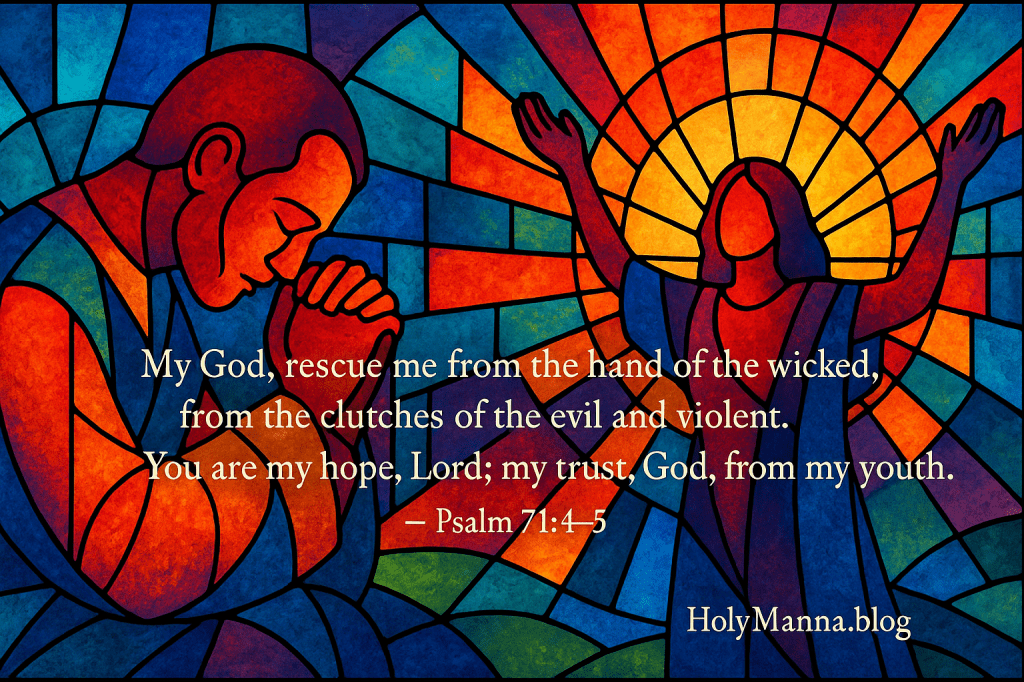
4 My God, rescue me from the hand of the wicked,
from the clutches of the evil and violent.
5 You are my hope, Lord;
my trust, God, from my youth.
6 On you I have depended since birth;
from my mother’s womb you are my strength;
my hope in you never wavers.8 My mouth shall be filled with your praise,
shall sing your glory every day.16 I will speak of the mighty works of the Lord;
O God, I will tell of your singular justice.17 God, you have taught me from my youth;
to this day I proclaim your wondrous deeds.
Detailed Exegesis
Verse 3 “Be my rock of refuge, my stronghold to give me safety for you are my rock and fortress.”
The psalmist asks God to be a rock and stronghold, using images of security, walls, and stability. In a world that feels fragile and dangerous, God is not just a comforting idea. He is a fortress that actually protects. This fits the theme of today’s readings, where God steps into vulnerable, barren situations and becomes the only sure ground.
Verse 4 “My God, rescue me from the hand of the wicked, from the clutches of the evil and violent.”
There is no pretending that life is easy. The psalmist knows that evil and violence are real. The prayer is honest. It names the threat and runs straight to God for rescue. Just as Israel needed deliverance from the Philistines in Judges 13, every soul needs God’s intervention against forces that are stronger than personal willpower.
Verse 5 “You are my hope, Lord my trust, God, from my youth.”
Hope and trust are not new feelings here. They go back to youth. This echoes the stories of children like Samson and John, whose lives were claimed by God early. It also mirrors the Christian life, where Baptism and early faith formation plant trust in God long before full understanding. Hope here is not optimism. It is a steady leaning on God’s character.
Verse 6 “On you I have depended since birth from my mother’s womb you are my strength my hope in you never wavers.”
This verse brings the theme into sharp focus. The psalmist recognizes that dependence on God did not begin at some later conversion moment. It goes all the way back to the womb. That line connects deeply with today’s readings, where Samson and John are filled, called, and set apart before birth. Every human life is sustained by God from its first moment, whether recognized or not.
Verse 8 “My mouth shall be filled with your praise, shall sing your glory every day.”
Awareness of God’s constant care naturally turns into praise. The heart that knows it has been held from the womb cannot stay silent. This verse shows that praise is not just a liturgical duty but a joyful overflow. Each day becomes an opportunity to declare that God has been faithful from the beginning.
Verse 16 “I will speak of the mighty works of the Lord O God, I will tell of your singular justice.”
The psalmist moves from private praise to public testimony. God’s “mighty works” and “singular justice” are not meant to be kept quiet. This connects to the missions of Samson and John, whose lives were meant to show God’s power and justice to the people. A life touched by God from the womb becomes a life that publicly speaks of God’s deeds.
Verse 17 “God, you have taught me from my youth to this day I proclaim your wondrous deeds.”
The psalm closes this section by linking lifelong formation with ongoing proclamation. God has been the true teacher from youth, and that teaching turns into proclamation. The pattern is clear. God initiates, teaches, and sustains, then the believer proclaims. This is the rhythm of vocation. It matches John’s role in Luke 1, where he is filled with the Holy Spirit from the womb to prepare a people for the Lord.
Teachings
This psalm highlights the doctrine of divine providence and the virtue of hope. The Catechism teaches in CCC 2090 that Christian hope is “the confident expectation of divine blessing and the beatific vision of God it is also the fear of offending God’s love and of incurring punishment.” The psalmist embodies this hope by trusting God as rock, refuge, and teacher from youth to old age.
The psalm also illustrates God’s fatherly care over the entire span of life. CCC 302 explains that “Creation has its own goodness and proper perfection, but it did not spring forth complete from the hands of the Creator. The universe was created ‘in a state of journeying’ toward an ultimate perfection yet to be attained, to which God has destined it.” In a similar way, the psalmist’s life is on a journey. God supplies strength from the womb and continues to teach and sustain across time.
There is also a strong connection to the Church’s understanding of life as sacred from conception. While Psalm 71 speaks poetically, the Church sees in such language a deep truth. God knows, loves, and strengthens each person from the womb. CCC 2270 states clearly that “Human life must be respected and protected absolutely from the moment of conception. From the first moment of his existence, a human being must be recognized as having the rights of a person.” The psalmist’s line “from my mother’s womb you are my strength” resonates with this teaching. God is already at work in hidden, developing life.
Saint John Paul II frequently reflected on the theme of God’s faithful presence through the years. In one of his homilies, he noted that the believer can look back and see that “nothing is mere coincidence in the life of those who trust in God’s love.” That insight matches the psalm perfectly. What might look like random events or long stretches of waiting are, in reality, held within the hands of a faithful Father.
Reflection
This psalm offers a powerful way to pray in seasons that feel uncertain, tired, or spiritually dry. It reminds the heart that God’s care has never been absent, even when it has gone unnoticed. From the first moment in the womb to the present day, God has been rock, refuge, and teacher.
One practical step is to make this psalm a personal prayer in moments of anxiety. Slowly repeating lines like “Be my rock of refuge, my stronghold to give me safety” can shift attention away from fear and back to God’s strength. Another step is to remember specific moments when God has rescued, guided, or taught, and to turn those memories into simple praise, just as the psalmist does.
There is also a challenge here. The psalmist not only trusts and praises. He speaks of God’s mighty works and wondrous deeds. That means sharing with others how God has been faithful, especially in weak or barren seasons. Quiet witness in family, friendships, and parish life can be a modern echo of this psalm.
Where has God been a rock and refuge in the past, even if that was only clear later on?
What would it look like to depend on God today with the same trust expressed in this psalm?
How might this be a moment to move from silent gratitude to open praise and testimony about God’s “wondrous deeds”?
Let this psalm shape the way the heart looks at its own story. From the womb to this very day, God has been present, steady, and strong.
Holy Gospel Luke 1:5-25
When God Breaks the Silence of Barren Hearts
Luke 1:5 25 opens the Gospel story with an elderly, childless couple and a people longing for God to act. Zechariah and Elizabeth live in the days of Herod, a tense and spiritually heavy time for Israel. They are righteous and faithful, yet carry the deep wound of barrenness, which in their culture meant shame and a sense of being forgotten. Right there, in the heart of worship at the Temple, God sends the angel Gabriel to announce the birth of John, the forerunner of the Messiah. This scene fits perfectly with today’s theme. God brings life and mission out of apparent hopelessness, consecrates His servants from the womb, and fulfills His promises in His own time, even when human hearts struggle to believe.
Luke 1:5-25 – New American Bible (Revised Edition)
Announcement of the Birth of John. 5 In the days of Herod, King of Judea, there was a priest named Zechariah of the priestly division of Abijah; his wife was from the daughters of Aaron, and her name was Elizabeth. 6 Both were righteous in the eyes of God, observing all the commandments and ordinances of the Lord blamelessly. 7 But they had no child, because Elizabeth was barren and both were advanced in years. 8 Once when he was serving as priest in his division’s turn before God, 9 according to the practice of the priestly service, he was chosen by lot to enter the sanctuary of the Lord to burn incense. 10 Then, when the whole assembly of the people was praying outside at the hour of the incense offering, 11 the angel of the Lord appeared to him, standing at the right of the altar of incense. 12 Zechariah was troubled by what he saw, and fear came upon him. 13 But the angel said to him, “Do not be afraid, Zechariah, because your prayer has been heard. Your wife Elizabeth will bear you a son, and you shall name him John. 14 And you will have joy and gladness, and many will rejoice at his birth, 15 for he will be great in the sight of [the] Lord. He will drink neither wine nor strong drink. He will be filled with the holy Spirit even from his mother’s womb, 16 and he will turn many of the children of Israel to the Lord their God. 17 He will go before him in the spirit and power of Elijah to turn the hearts of fathers toward children and the disobedient to the understanding of the righteous, to prepare a people fit for the Lord.” 18 Then Zechariah said to the angel, “How shall I know this? For I am an old man, and my wife is advanced in years.” 19 And the angel said to him in reply, “I am Gabriel, who stand before God. I was sent to speak to you and to announce to you this good news. 20 But now you will be speechless and unable to talk until the day these things take place, because you did not believe my words, which will be fulfilled at their proper time.”
21 Meanwhile the people were waiting for Zechariah and were amazed that he stayed so long in the sanctuary. 22 But when he came out, he was unable to speak to them, and they realized that he had seen a vision in the sanctuary. He was gesturing to them but remained mute. 23 Then, when his days of ministry were completed, he went home. 24 After this time his wife Elizabeth conceived, and she went into seclusion for five months, saying, 25 “So has the Lord done for me at a time when he has seen fit to take away my disgrace before others.”
Detailed Exegesis
Verse 5 “In the days of Herod, King of Judea, there was a priest named Zechariah of the priestly division of Abijah his wife was from the daughters of Aaron, and her name was Elizabeth.”
Luke sets the story in real history and introduces a priestly couple with strong religious roots. Their lineage underlines that what is about to happen is deeply connected to God’s covenant with Israel.
Verse 6 “Both were righteous in the eyes of God, observing all the commandments and ordinances of the Lord blamelessly.”
They are not punished sinners. They are faithful and obedient. This shows that suffering and delayed hopes do not always mean God’s disfavor.
Verse 7 “But they had no child, because Elizabeth was barren and both were advanced in years.”
Their pain is named clearly. In a culture that prized children as a sign of blessing, this would be a heavy burden. The verse echoes Old Testament stories where God acts through barren women, preparing the reader for a new work of grace.
Verse 8 “Once when he was serving as priest in his division’s turn before God,”
Zechariah is doing his normal priestly duty. God enters the ordinary rhythm of worship, not just extraordinary moments.
Verse 9 “according to the practice of the priestly service, he was chosen by lot to enter the sanctuary of the Lord to burn incense.”
Being chosen by lot for this offering was a rare privilege. Behind the random lot is God’s providence arranging a personal encounter.
Verse 10 “Then, when the whole assembly of the people was praying outside at the hour of the incense offering,”
The scene is communal and liturgical. The people are praying, incense rises, and God responds. This shows the power of the Church gathered in prayer.
Verse 11 “the angel of the Lord appeared to him, standing at the right of the altar of incense.”
The right side symbolizes favor and blessing. God’s messenger appears exactly where sacrifice and prayer rise, connecting liturgy with revelation.
Verse 12 “Zechariah was troubled by what he saw, and fear came upon him.”
His reaction is very human. Encounters with the divine often begin with fear, which God then transforms into faith.
Verse 13 “But the angel said to him, ‘Do not be afraid, Zechariah, because your prayer has been heard. Your wife Elizabeth will bear you a son, and you shall name him John.’”
Gabriel reveals that God has heard his prayer, likely long offered and perhaps long thought unanswered. The name John means “God is gracious,” which sums up the whole message.
Verse 14 “And you will have joy and gladness, and many will rejoice at his birth,”
This child is not only a private blessing. His coming will be a source of joy for many. Vocation always overflows beyond the individual.
Verse 15 “for he will be great in the sight of the Lord. He will drink neither wine nor strong drink. He will be filled with the holy Spirit even from his mother’s womb,”
Like Samson, John will live a form of consecration and abstinence. Being filled with the Holy Spirit from the womb shows that God’s call and grace begin before birth.
Verse 16 “and he will turn many of the children of Israel to the Lord their God.”
John’s mission is one of conversion. He will call hearts back to God, preparing the way for deeper reconciliation.
Verse 17 “He will go before him in the spirit and power of Elijah to turn the hearts of fathers toward children and the disobedient to the understanding of the righteous, to prepare a people fit for the Lord.”
Gabriel connects John to Malachi and the prophetic tradition. John will be the bridge between the old covenant and the coming of Christ, shaping a people ready to receive the Lord.
Verse 18 “Then Zechariah said to the angel, ‘How shall I know this? For I am an old man, and my wife is advanced in years.’”
Zechariah looks at his age and his wife’s age more than at God’s power. His question comes from doubt, not simple curiosity. This shows how easily human weakness resists hope.
Verse 19 “And the angel said to him in reply, ‘I am Gabriel, who stand before God. I was sent to speak to you and to announce to you this good news.’”
Gabriel reminds Zechariah of the authority of the message. These words come from the presence of God Himself. The Gospel begins as sheer gift, not human invention.
Verse 20 “But now you will be speechless and unable to talk until the day these things take place, because you did not believe my words, which will be fulfilled at their proper time.”
His silence is both a consequence and a sign. It underlines the seriousness of unbelief, but it also creates space for deeper listening and reflection while God’s promise quietly unfolds.
Verse 21 “Meanwhile the people were waiting for Zechariah and were amazed that he stayed so long in the sanctuary.”
The people sense that something unusual is happening. God’s action in one person’s life often has ripple effects in the wider community.
Verse 22 “But when he came out, he was unable to speak to them, and they realized that he had seen a vision in the sanctuary. He was gesturing to them but remained mute.”
His muteness becomes a visible sign that God has intervened. Sometimes God’s work in a soul is first seen in changed behavior rather than many words.
Verse 23 “Then, when his days of ministry were completed, he went home.”
Zechariah quietly returns home. God’s great works often unfold in the ordinary setting of family life, not only in sacred spaces.
Verse 24 “After this time his wife Elizabeth conceived, and she went into seclusion for five months, saying,”
The promise becomes real in Elizabeth’s body. Her seclusion suggests a time of humble, hidden gratitude and contemplation.
Verse 25 “‘So has the Lord done for me at a time when he has seen fit to take away my disgrace before others.’”
Elizabeth recognizes that the Lord has personally seen her and lifted her shame. Her joy is deeply personal, yet it is part of God’s wider plan of salvation.
Teachings
This passage reveals that God’s saving plan is both personal and cosmic. The Catechism teaches that John the Baptist is the immediate precursor of the Lord. CCC 523 says, “St John the Baptist is the Lord’s immediate precursor or forerunner, sent to prepare his way. ‘Prophet of the Most High’, John surpasses all the prophets, of whom he is the last. He inaugurates the Gospel, already from his mother’s womb welcomes the coming of Christ, and rejoices in being ‘the friend of the bridegroom’ whom he points out as ‘the Lamb of God, who takes away the sin of the world.’” John’s conception and vocation from the womb fit exactly with today’s theme of God preparing missions in hidden ways long before human recognition.
The role of Gabriel also shows how God communicates His plan. CCC 332 teaches, “Angels are servants and messengers of God. Because they ‘always behold the face of my Father who is in heaven’ they are the ‘mighty ones who do his word, hearkening to the voice of his word.’” Gabriel stands before God and brings a message that carries divine authority. This encourages trust in God’s revealed word, even when it stretches human imagination.
Zechariah’s doubt and imposed silence illustrate the seriousness of faith. CCC 2088 explains that “The first commandment requires us to nourish and protect our faith with prudence and vigilance, and to reject everything that is opposed to it. There are various ways of sinning against faith. Voluntary doubt about the faith disregards or refuses to hold as true what God has revealed and the Church proposes for belief.” Zechariah’s struggle is understandable, but God uses his silence as a kind of spiritual correction and preparation, leading him later to a powerful proclamation when John is born.
Finally, Elizabeth’s joy in having her disgrace removed points to God’s desire to heal shame. This anticipates the deeper healing Jesus will bring through forgiveness and adoption as children of God.
Reflection
This Gospel speaks directly to seasons of waiting, disappointment, and quiet suffering. Zechariah and Elizabeth show that it is possible to be faithful, to pray, and still feel the sting of unanswered desires. Yet God has not forgotten them. At the right time, He not only gives them a child, He draws them into the front line of His plan of salvation.
There is also a gentle challenge here. When God’s promises seem impossible, it can be easy to respond with doubt, like Zechariah. His silence invites a different response, a willingness to listen more, talk less, and let God work even when the timeline is confusing. Elizabeth’s hidden months of pregnancy can inspire a more contemplative approach to the gifts and movements of God that are not ready to be displayed yet.
This passage invites trust that God sees personal wounds and shame. He can take what feels like lifelong disgrace and turn it into a place of grace and mission. Like John, every Christian has a calling to help prepare a people fit for the Lord, starting with conversion in one’s own heart and home.
Where might there be a quiet disappointment in life that feels a lot like Zechariah and Elizabeth’s long wait for a child?
How is God inviting deeper trust in His word, even when circumstances seem to contradict it?
What hidden work of God in the heart or family needs more silent gratitude and less anxious talking today?
Let this Gospel encourage a deeper hope in God’s timing, a renewed openness to His word, and a willingness to let Him turn barren places into beginnings of something new.
When Barrenness Becomes the Starting Line
Today’s readings trace a beautiful arc. A barren woman in Judges 13 receives a promise that her son Samson will begin to save Israel. The psalmist in Psalm 71 looks back and recognizes that God has been strength _“from my mother’s womb” and rock through every season. In Luke 1, an aged, childless couple, Zechariah and Elizabeth, are drawn into the heart of salvation history when John the Baptist is conceived and consecrated from the womb to prepare a people fit for the Lord.
Together, these passages show a God who loves to step into places that feel late, empty, or forgotten and quietly plant life, mission, and hope. Vocation does not start when someone finally feels ready. It begins in the mystery of God’s choice, often long before it can be seen, and it unfolds according to His timing, not human schedules. The Spirit moves in hidden ways, from the womb to old age, from the temple to the home, from silence to proclamation.
This day invites every heart to let God into the “barren” spaces that feel stuck or disappointing. Those areas are not spiritual dead ends. They can be starting lines for grace. Like Samson and John, every baptized Christian is set apart for God and called to bear witness in a unique way. Hope is not naïve positivity. It is trust that God is already at work, even when emotions still feel dry and circumstances still look impossible.
Where does life feel barren or delayed right now?
How might God be quietly preparing a new mission in that very place?
What small, concrete step can be taken today to trust His timing and live more intentionally as someone consecrated to Him?
Let this be a day to hand those hidden aches to the Lord, to ask for the grace to trust His promises, and to allow His Spirit to turn silent disappointment into the beginning of a new story of faithfulness and joy.
Engage with Us!
Share your reflections in the comments below and help build a space where hearts encourage one another in hope and trust in God’s plan. Use these questions to pray, journal, or start a conversation with others.
- First Reading Judges 13:2 7, 24 25
Where do you see “barren” or powerless areas in your life right now, and how might God be inviting you to trust that He can begin something new there, just as He did with Samson’s mother?
What would it look like for you to live more consciously as someone “set apart” for God, the way Samson was a Nazirite from the womb? - Responsorial Psalm Psalm 71:3 6, 8, 16 17
If you look back over your life, where can you recognize that God has been your rock and refuge, even if you did not see it clearly at the time?
How can you let your mouth be “filled with praise” today in a simple, concrete way, so that you speak more often of God’s “wondrous deeds”? - Holy Gospel Luke 1:5 25
In what areas do you feel most like Zechariah and Elizabeth, waiting for something that seems delayed or impossible, and how is God calling you to deeper trust instead of discouragement?
What “hidden” work of God in your heart or family can you quietly treasure and protect right now, the way Elizabeth received her pregnancy in seclusion and gratitude?
May these questions help you listen more closely to the Lord, trust His timing, and live each day with the faith, love, and mercy that Jesus has taught, so that every choice becomes a small act of love offered back to Him.
Sacred Heart of Jesus, we trust in You!
Immaculate Heart of Mary, pray for us!
Saint Michael the Archangel, defend us in battle!
Follow us on YouTube, Instagram and Facebook for more insights and reflections on living a faith-filled life.

 Holy Manna!
Leave a comment