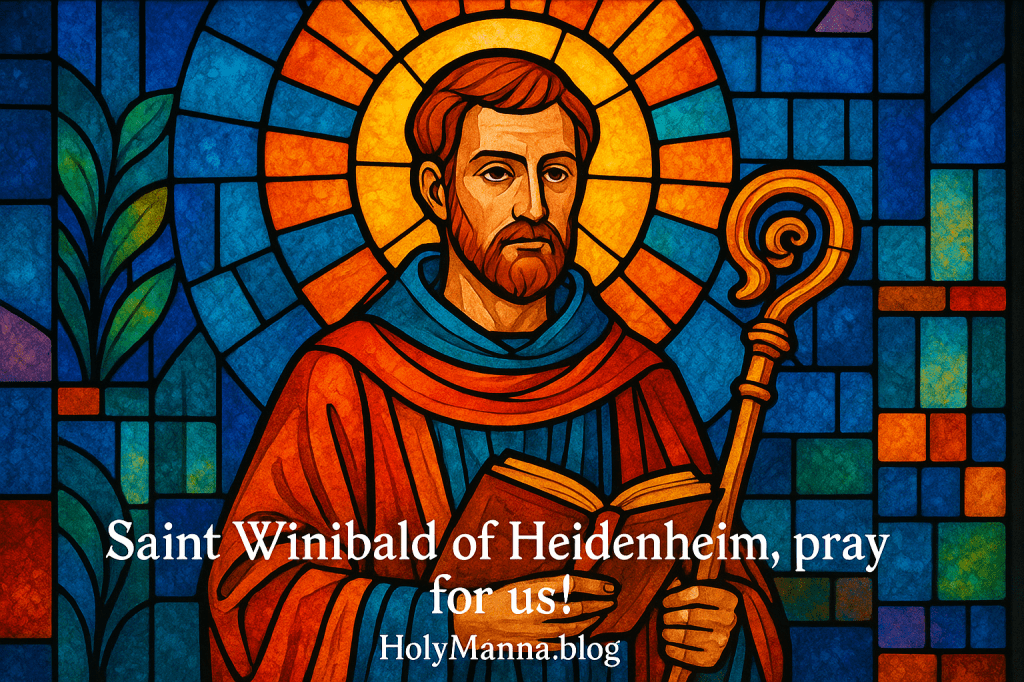
A Pilgrim of Holiness and Builder of Monastic Light
Saint Winibald of Heidenheim stands as one of the great figures of early English missionary history, shaped by a family of extraordinary sanctity and evangelizing zeal. Born around 701 in Wessex, he was the son of the saintly Richard the Pilgrim and the brother of Saints Willibald and Walburga. Winibald is remembered as an English Benedictine monk, a missionary to Germany, and the founder and first abbot of the monastery at Heidenheim. His legacy endures through his unwavering fidelity to the Gospel, his dedication to monastic discipline, and his quiet but powerful role in strengthening the foundations of Christianity in Southern Germany. His life reminds the faithful that sanctity often blooms through perseverance, humility, and the courage to follow God into the unknown.
The Long Road Toward Conversion and Purpose
Winibald’s early years were marked by faith and family devotion. Inspired by the growing missionary movement among Anglo Saxon Christians, his father Richard undertook a pilgrimage to Rome with both Winibald and Willibald. While traveling, Winibald fell gravely ill and was forced to remain at Lucca for a time. This season of suffering deepened his trust in God and shaped his understanding of discipleship as something forged through weakness and surrender rather than personal strength alone.
After his recovery, Winibald completed the pilgrimage to Rome, where he dedicated himself to a monastic life. He studied, prayed, and immersed himself in the discipline of community life. Eventually, he answered the call of his uncle, Saint Boniface, the great apostle to the Germans. Boniface invited Winibald and Willibald to join him in missionary work on the continent. Winibald accepted with a spirit of obedience and missionary passion, becoming essential to Boniface’s efforts to bring stability, fidelity, and structure to the growing Christian communities of Bavaria and Franconia.
Winibald is best known for founding the double monastery of Heidenheim, which later became a center for learning, prayer, and evangelization. His sister Saint Walburga would eventually oversee the women’s side of the community, creating a family legacy of holiness that still influences Christian devotion today.
A Life of Steadfast Leadership and Quiet Miracles
As abbot of Heidenheim, Winibald lived a life that blended the practical demands of leadership with the spiritual demands of ascetic discipline. His monastery became a beacon of stability in a region still experiencing religious confusion, cultural division, and the tensions of tribal politics. Under his guidance, the monks practiced strict Benedictine observance, welcomed travelers, taught the faith, copied manuscripts, and cultivated both the land and the minds of their students.
Historical sources describe Winibald as a man of deep humility, gentle strength, and unshakable patience. Although few specific miracles from his lifetime are recorded in detail, testimonies from the early community describe his holiness as manifest in the healing counsel he offered, the peace he brought to troubled hearts, and the spiritual protection felt under his leadership. His entire life became a living sign of God’s grace working through ordinary perseverance rather than dramatic spectacles.
Trials, Illness, and the Cross He Carried to the End
Winibald knew the cost of discipleship and frequently suffered from physical weakness. His early illness during the pilgrimage never fully left him, and he endured chronic sickness throughout his adult life. Instead of allowing this to discourage him, he embraced his limitations as a path of union with Christ. His example shows that holiness is not reserved for the strong but is often perfected through endurance of suffering.
He did not die a martyr, but he carried a long interior martyrdom through obedience, sickness, and the tireless work of building up the Church in a foreign land. Winibald died on December 18, 761, surrounded by his community, leaving behind a flourishing monastery and a legacy of fidelity that would continue to shape the region for centuries.
The Echoes of Holiness After His Passing
After his death, Saint Winibald’s tomb became a source of devotion and miraculous grace. The faithful of Heidenheim and surrounding regions visited his resting place seeking healing, protection, and spiritual favor. Reports of answered prayers spread among the people, and his spiritual authority only increased as stories circulated about cures and interventions attributed to his intercession.
The monastery of Heidenheim, later overseen by his sister Saint Walburga, became a famous pilgrimage site. Walburga’s own miracles, including the miraculous oil that flowed from her relics, drew even more attention to the holy family and preserved Winibald’s memory in both liturgy and local devotion. To this day, the legacy of Heidenheim continues to bear witness to the sanctity that began with Winibald’s father Richard and blossomed through the missionary lives of Winibald, Willibald, and Walburga.
Walking the Pilgrimage With Saint Winibald
Saint Winibald’s life teaches the beauty of perseverance amid weakness, obedience to God’s will even when the road seems precarious, and the quiet power of faith lived faithfully day after day. His example invites Christians to see their own illnesses, disappointments, and limitations not as obstacles but as instruments of holiness. His monastic work reminds believers that sanctity grows in community, in prayer, in discipline, and in the willingness to build up the Church with whatever gifts God provides.
His journey from Wessex to Italy and then to Germany mirrors the spiritual pilgrimage every soul undertakes. His trust in Christ shines as a reminder that God guides each step, even through seasons of uncertainty.
How is the Lord calling hearts today to a deeper stability, a deeper obedience, and a deeper missionary spirit, following the footsteps of Saint Winibald?
Engage with Us!
Share your thoughts and reflections in the comments below.
- What part of Saint Winibald’s life speaks most powerfully to your own spiritual journey?
- How does his perseverance through illness challenge or inspire your understanding of holiness?
- What concrete steps can you take this week to build up the Church in the same spirit of quiet devotion and courage that he embodied?
May every reader be encouraged to live a life rooted in prayer, strengthened by faith, and shaped by the love and mercy that Jesus taught. Let every step be taken with confidence in God’s grace and a readiness to serve Him in all things.
Saint Winibald of Heidenheim, pray for us!
Follow us on YouTube, Instagram and Facebook for more insights and reflections on living a faith-filled life.

 Holy Manna!
Leave a comment