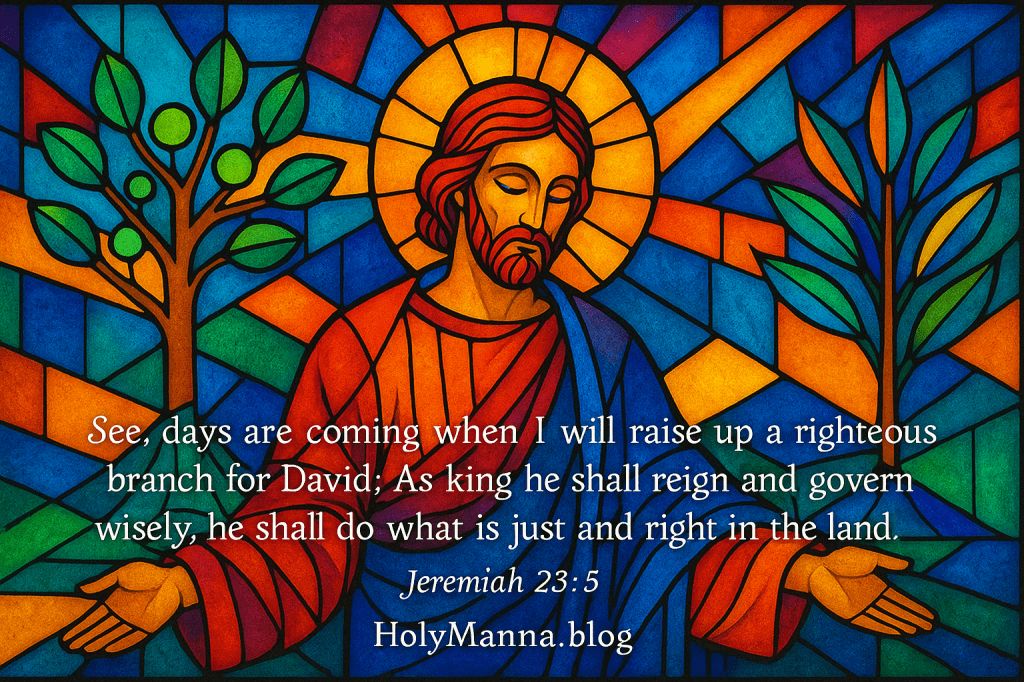
Thursday of the Third Week of Advent – Lectionary: 194
The Just King Who Comes Close
There is a quiet moment in every heart during Advent when the question rises almost without words: Who is really in control, and can he be trusted with everything that feels uncertain? Today’s readings answer that question by revealing a King who is both utterly just and astonishingly close, a Lord who does not stay far away from human mess but steps right into it and takes a name like “The Lord our justice” and “Emmanuel”, “God is with us.”
In Jeremiah 23:5-8, the prophet speaks into a time of political failure, corruption, and exile. The kings from the line of David had largely failed to shepherd the people. Jerusalem had fallen, and many Israelites were scattered in foreign lands. Into that chaos, God promises a righteous descendant of David, a true king who will “reign and govern wisely” and “do what is just and right in the land”. This is not just a promise of better leadership. It is the promise of a new kind of exodus, a deliverance so great that people will talk about it even more than the rescue from Egypt, because God will bring his scattered people home and let them live in security on their own soil.
Psalm 72 picks up that hope and turns it into a prayer. It asks God to pour his own justice into the king, so that he can rule like God rules. The ideal king in this psalm defends the oppressed, listens to the cry of the poor, and has a heart that notices the ones who have no one else to help them. He rescues, he shows pity, he saves lives. The blessing at the end of the psalm points to something bigger than any earthly ruler. Only God can truly fill the earth with glory, and yet God wants to do this through a king who reflects his heart. This sets the stage for a Messiah who is not just a political leader but the very presence of God’s justice and mercy in human form.
Then Matthew 1:18-25 quietly reveals how this promise finally comes to life. The scene is not a throne room but a small home and a troubled heart. Joseph is called a righteous man, which means he takes God’s law seriously, but he also refuses to expose Mary to shame. In the middle of his confusion, the angel speaks into his fear: “Do not be afraid to take Mary your wife into your home” and commands him to name the child Jesus, “because he will save his people from their sins.” The child is not only from the line of David through Joseph, he is the fulfillment of the ancient prophecy from The Gospel of Matthew quoting Isaiah: “They shall name him Emmanuel”, which means “God is with us.” The righteous branch promised by Jeremiah and the just king prayed for in Psalm 72 take flesh in this baby, entrusted to the quiet obedience of Joseph.
Together, these readings invite a very concrete reflection in the middle of Advent. God does not answer the longing for justice only by fixing external systems. He begins by coming close, by entering human history as a child, by healing the deepest slavery which is sin, and by raising up a King who rules from a cross before he rules in glory. Where is there a need to trust that this same King is both just and near in the middle of present fears, confusion, or exile like situations in life today?
First Reading – Jeremiah 23:5-8
A Righteous King and a New Kind of Exodus
Jeremiah 23:5-8 comes from a dark and unstable moment in Israel’s history. The kingdom of Judah had suffered weak and often corrupt kings from the line of David. The people had experienced invasion, exile, and deep disappointment in their leaders. Jeremiah speaks into this collapse of human authority with a bold promise from God himself. God will not abandon the covenant with David. Instead, God will raise up a true son of David, a righteous king who will finally reflect God’s own heart. This king will not only restore justice within the land. He will bring about a new and greater deliverance, so powerful that it will overshadow even the memory of the Exodus from Egypt.
In light of today’s Advent theme, this reading points directly toward the Messiah who reigns with perfect justice and comes close as Emmanuel. The promise of a righteous branch for David sets the stage for the Gospel revelation of Jesus as the son of David and the one who truly embodies the name “The Lord our justice.” This passage invites readers to see that God’s answer to injustice, fear, and scattered lives is not simply a better system but a holy King who restores, gathers, and saves.
Jeremiah 23:5-8 – New American Bible (Revised Edition)
5 See, days are coming—oracle of the Lord—
when I will raise up a righteous branch for David;
As king he shall reign and govern wisely,
he shall do what is just and right in the land.
6 In his days Judah shall be saved,
Israel shall dwell in security.
This is the name to be given him:
“The Lord our justice.”7 Therefore, the days are coming—oracle of the Lord—when they shall no longer say, “As the Lord lives, who brought the Israelites out of the land of Egypt”; 8 but rather, “As the Lord lives, who brought the descendants of the house of Israel up from the land of the north”—and from all the lands to which I banished them; they shall again live on their own soil.
Detailed Exegesis
Verse 5 – “See, days are coming, oracle of the Lord, when I will raise up a righteous branch for David; As king he shall reign and govern wisely, he shall do what is just and right in the land.”
This verse opens with a prophetic formula that signals a future intervention of God in history. The phrase “days are coming” points to a time when God will act decisively. The “righteous branch for David” is an image of new life springing from what looks like a dead or cut down tree. The house of David seems ruined by unfaithful kings, yet God promises a fresh shoot that is truly righteous. This is a messianic prophecy that Christians recognize as fulfilled in Christ, the descendant of David who rules with perfect wisdom and justice. The description that this king will “do what is just and right in the land” emphasizes that his rule is not based on military strength or politics alone but on moral integrity and faithfulness to God’s law. In him, justice is not an idea but a lived reality.
Verse 6 – “In his days Judah shall be saved, Israel shall dwell in security. This is the name to be given him: ‘The Lord our justice.’”
Here the fruits of the messianic reign are described in terms of salvation and security. The names Judah and Israel recall the divided kingdoms, suggesting a reunification and a healed people under one true shepherd. To say that “Judah shall be saved” and “Israel shall dwell in security” points beyond mere political stability. It hints at a deeper, holistic peace that includes right relationship with God. The title given to this promised figure, “The Lord our justice”, is deeply significant. It indicates that the justice which the people long for does not come primarily from human effort but from the Lord himself. Christians see in this title a foreshadowing of Jesus Christ, who does not only teach about justice but becomes justice itself for believers, especially through his saving death and resurrection.
Verse 7 – “Therefore, the days are coming, oracle of the Lord, when they shall no longer say, ‘As the Lord lives, who brought the Israelites out of the land of Egypt’;”
This verse compares the future work of God with the foundational saving event of the Old Testament, the Exodus. Swearing by “As the Lord lives, who brought the Israelites out of the land of Egypt” recalls how central the Exodus was to Israel’s identity. God is the one who liberates from slavery and leads the people into a covenant relationship. Yet Jeremiah proclaims that something even greater is coming. The people will no longer define God only by the old rescue from Egypt. Instead, a new act of salvation will be so astonishing that it becomes the primary reference point for how they speak about the living God. This prepares the way for the Christian understanding of Christ’s Paschal Mystery as the definitive new Exodus, where humanity is freed from the deeper bondage of sin.
Verse 8 – “but rather, ‘As the Lord lives, who brought the descendants of the house of Israel up from the land of the north’ and from all the lands to which I banished them; they shall again live on their own soil.”
This final verse clarifies the new saving act. The “land of the north” refers especially to the regions of exile, such as Babylon, where many Israelites had been deported. The people who were scattered because of sin and judgment will be gathered again. God will reverse their humiliation and restore them to their own land. The promise “they shall again live on their own soil” expresses more than real estate. It expresses restoration of identity, worship, and covenant life in God’s presence. For Christians, this restoration points forward to the gathering of all nations into the Church and ultimately to the eternal homeland prepared in Christ. The new Exodus is not simply a geographical return but a spiritual homecoming in the Kingdom of God.
Teachings
This reading finds its deepest fulfillment in Jesus Christ, the son of David. The Church recognizes that the messianic hope expressed in Jeremiah 23:5-8 is realized in the person and mission of Jesus. The Catechism of the Catholic Church teaches in CCC 522: “The coming of God’s Son to earth is an event of such immensity that God willed to prepare for it over centuries.” This prophetic promise of a righteous branch is part of that long preparation, forming the heart of Israel’s messianic expectation.
In CCC 439, The Catechism explains that the title “Son of David” is a clear Messianic title which expresses the kingship of Christ recognized by the people. Although the full paragraph is longer, the central idea is that Jesus is acknowledged as the promised King from David’s line, the one in whom Israel’s hope for a just ruler is fulfilled. This connects directly to Jeremiah’s vision of a king who “reigns and governs wisely” and does “what is just and right in the land.”
The title “The Lord our justice” also resonates with the Church’s teaching that Christ is the one who justifies. According to CCC 1992, justification comes from the grace of God through the Passion of Christ and is received through faith and Baptism. While the catechetical text is longer, the essence is that true justice before God is not self produced. It is a gift poured out in Christ, who makes believers righteous by uniting them to his own holiness.
The Fathers and Doctors of the Church often saw these Old Testament promises as a foreshadowing of the Paschal Mystery. Saint Augustine, for example, frequently spoke of Christ as the true king who reigns from the wood of the Cross. The Cross is the throne where God’s justice and mercy meet perfectly. A ruler who rescues from exile and restores to the land finds its ultimate expression in Christ leading souls from the exile of sin into the life of grace. The new Exodus is not simply escape from political powers. It is deliverance from the kingdom of darkness into the Kingdom of the beloved Son, as described in Colossians 1:13.
In Advent, the Church prays with these prophecies not only as memories but as living realities. Believers wait for the full manifestation of the Kingdom, where the just King will return in glory. At the same time, the King already reigns sacramentally in the Church and in the hearts of those who allow him to rule their lives. The promise that “they shall again live on their own soil” can be read spiritually as the promise that hearts will find their true home in God’s grace and truth.
Reflection
This reading speaks powerfully into experiences of disappointment with leaders, instability in society, and the sense of being scattered interiorly. Jeremiah reminds readers that God’s answer is not despair but the raising up of a righteous King. Christ is that King. The question becomes very personal: is he allowed to reign and govern wisely in the concrete details of daily life, or is he kept at a distance as only a religious idea?
To live under “The Lord our justice” means allowing Christ to define what justice looks like in relationships, decisions, and priorities. It means refusing to build identity only on career, politics, or external security, and instead rooting identity in belonging to the King who saves. This can look like choosing honesty when dishonesty would be easier, defending someone who is overlooked or mistreated, or making time for prayer when busyness pushes God to the margins.
The promise of a new Exodus also speaks to anyone who feels exiled in some way. There can be exile from peace because of anxiety, exile from holiness because of a recurring sin, or exile from hope because of past wounds. Jeremiah’s prophecy assures believers that God sees those scattered places and desires to gather and restore. The just King is not indifferent. He comes to bring back what has been lost and to plant feet again on firm ground.
A very practical response to this reading is to ask the Lord to show where his justice needs to be welcomed more deeply. That could mean examining conscience about how others are treated, especially the weak and vulnerable, since the just King always defends the poor and the oppressed. It could mean asking for the grace to trust God’s timing rather than trying to control everything.
Where is there a sense of inner exile that needs to be brought to the King who gathers and restores?
What area of life most needs to be placed under the rule of “The Lord our justice” today, rather than under fear, pride, or resentment?
How can concrete choices in the coming days reflect a deeper trust that Christ, the righteous branch of David, truly reigns and truly knows what is just and right in every situation?
Responsorial Psalm – Psalm 72:1-2, 7, 12-13, 18-19
The Heart Of The King Who Looks Like God
Psalm 72 is a royal psalm traditionally associated with Solomon, the son of David, and with the ideal Davidic king. In the world of ancient Israel, the king was not meant to be a distant ruler obsessed with power. The king was called to be a shepherd who defended the weak, upheld justice, and reflected the character of God for the people. Psalm 72 is not just a nice prayer for good government. It is a prophetic portrait of what true kingship looks like when it is modeled on the heart of the Lord.
In the context of Advent and today’s readings, this psalm fits perfectly with the promise in Jeremiah 23:5-8 of a righteous branch from David who will do what is just and right, and with the Gospel of Matthew showing Jesus as the son of David and Emmanuel. The psalm shows that the greatest mark of the true king is not wealth, military strength, or outward success. The true king defends the poor, hears the cry of the oppressed, and becomes a channel of God’s blessing for the whole earth. This prepares hearts to recognize Christ as the King whose throne is the Cross and whose crown is love for the small and forgotten.
Psalm 72:1-2, 7, 12-13, 18-19 – New American Bible (Revised Edition)
A Prayer for the King
1 Of Solomon.
2 O God, give your judgment to the king;
your justice to the king’s son;
That he may govern your people with justice,
your oppressed with right judgment,7 That abundance may flourish in his days,
great bounty, till the moon be no more.12 For he rescues the poor when they cry out,
the oppressed who have no one to help.
13 He shows pity to the needy and the poor
and saves the lives of the poor.18 Blessed be the Lord God, the God of Israel,
who alone does wonderful deeds.
19 Blessed be his glorious name forever;
may he fill all the earth with his glory.
Amen and amen.
Detailed Exegesis
Verse 1-2 – “O God, give your judgment to the king; your justice to the king’s son; That he may govern your people with justice, your oppressed with right judgment,”
This opening prayer asks God to share his own way of seeing and judging with the king. Human rulers naturally tend toward self interest, but this king is meant to judge as God judges. The phrase “your justice to the king’s son” suggests a transmission of divine wisdom down the royal line, again pointing to the Davidic dynasty. The purpose of this gift is clear. The king is to “govern your people with justice” and care especially for “your oppressed” with “right judgment.” Justice in the biblical sense is not cold legalism. It means restoring right relationships, defending those who are wronged, and protecting the vulnerable. This verse already hints that any ruler who ignores the oppressed cannot claim to reflect God’s heart.
Verse 7 – “That abundance may flourish in his days, great bounty, till the moon be no more.”
This verse moves from justice to blessing. When the king rules with God’s justice, the result is not misery but flourishing. The image of “abundance” and “great bounty” suggests both material and spiritual fruitfulness. The phrase “till the moon be no more” points to a reign that is meant to be lasting and stable, not just a brief moment of success. Ultimately, only the reign of Christ can fulfill this fully, since every earthly king is limited and mortal. In Christ’s Kingdom, the fruitfulness is not just economic prosperity but the growth of holiness, charity, and true peace.
Verse 12 – “For he rescues the poor when they cry out, the oppressed who have no one to help.”
Here the psalm gets very concrete. The ideal king is defined by how he responds to the cry of the poor and the helpless. Those who “have no one to help” are exactly the ones who most matter to this king. He is not embarrassed by their need and does not see them as a burden. The verb “rescues” shows real action, not just sympathy. For Christians, this verse points directly to Jesus, who listens to the blind, the lepers, the sinners, and the broken, and steps into their situation with healing and mercy. It also reveals that any claim to follow Christ without caring about the poor contradicts the very kingship this psalm celebrates.
Verse 13 – “He shows pity to the needy and the poor and saves the lives of the poor.”
This verse repeats and deepens the theme. The king’s heart is marked by “pity”, which in biblical language is not shallow sentiment but deep compassion that moves him to act. He does not just improve conditions. He “saves the lives of the poor.” This can include rescue from physical danger, economic oppression, and spiritual despair. In Christ, this becomes radical. Jesus literally lays down his life to save not only the materially poor but also the spiritually poor, those trapped in sin and death. The psalm’s vision is fully realized when the King saves by giving his own life.
Verse 18 – “Blessed be the Lord God, the God of Israel, who alone does wonderful deeds.”
The psalm now shifts from talking about the king to blessing the Lord himself. This makes it clear that any goodness in the king is a reflection of God’s work. The phrase “who alone does wonderful deeds” reminds the community that miracles of justice, mercy, and rescue are ultimately the work of God. Even the best human ruler is an instrument. This keeps the focus on divine action and prevents idolatry of any human leader. In the context of Advent, this verse invites praise for the ultimate wonderful deed: the Incarnation of the Son of God.
Verse 19 – “Blessed be his glorious name forever; may he fill all the earth with his glory. Amen and amen.”
The final verse expands the horizon. The prayer is not only for Israel but for the whole earth. The desire that God “fill all the earth with his glory” points to a universal mission. The kingship envisioned in Psalm 72 is not narrow or tribal. It ultimately reaches to all nations. In Christ, this becomes the Great Commission and the worldwide mission of the Church. The repeated “Amen and amen” seals the prayer with strong agreement and faith.
Teachings
Psalm 72 has always been read in the Church as a messianic psalm that points to Jesus Christ. The ideal king described here is fully realized in him and only in him. The Church’s teaching on Christ’s love for the poor and the mission of believers flows from this vision.
The Catechism of the Catholic Church in CCC 544 teaches: “The kingdom belongs to the poor and lowly, which means those who have accepted it with humble hearts.” This captures the same spirit as Psalm 72, where the king is especially close to those who are lowly, oppressed, and in need. Christ’s Kingdom has a special place for those who know they cannot save themselves and cry out for help.
CCC 2448 also states: “In its various forms, material deprivation, unjust oppression, physical and psychological illness and death, human misery is the obvious sign of the inherited condition of frailty and need for salvation in which man finds himself as a consequence of original sin.” The psalm’s focus on the poor and oppressed connects directly with this teaching. The misery of the poor is not just a social problem. It is a sign of the fallen condition of humanity and a call to cooperate with the saving mission of the King who rescues.
Saint John Paul II often emphasized the “preferential love for the poor” as rooted in the Gospel and in Christ’s own heart. While his writings are extensive, a constant theme is that the way a society treats the poor is a measure of its fidelity to the Kingdom of God. That lines up directly with Psalm 72, where the king’s justice is proven by his care for those who have no one else to defend them.
Theologically, this psalm also supports the understanding of Christ as King of the universe, a title highlighted in the solemnity of Our Lord Jesus Christ, King of the Universe. His kingship is not abstract. It is expressed concretely in mercy, in listening to those who cry out, and in bringing God’s glory to every corner of the earth. The vision of the earth filled with the Lord’s glory in Psalm 72:19 hints at the ultimate fulfillment in the new heavens and new earth, where Christ will be all in all.
Reflection
This psalm challenges believers to examine how the poor, the needy, and the oppressed are seen and treated in ordinary life. If the heart of the ideal king is measured by compassion for those who have no one to help them, then the heart of anyone who serves this King must be measured the same way. It is very easy to admire Christ as a beautiful spiritual figure and at the same time ignore the people who cry out for help just a few steps away. Psalm 72 does not allow that disconnect.
The words about the king rescuing the poor and saving their lives invite a very practical response. That could mean supporting someone going through financial struggle, listening deeply to a friend who feels alone, or volunteering in a ministry that serves those on the margins. It can also mean examining any prejudices or fears toward the poor or the broken, and asking the Lord to replace them with his own tenderness.
At the same time, many readers may feel spiritually poor themselves. There are moments when the heart feels like one of those who “have no one to help”, overwhelmed by sin, stress, or loneliness. This psalm is a reminder that the King of Advent hears the cry of the heart and does not stay distant. The same King who rescues the poor is ready to step into the confusion and fear of each day with real grace and real help.
A daily practice flowing from this psalm could be a simple prayer every morning, asking the Lord for his eyes to see the poor and oppressed in daily interactions, and for the courage to respond in some small concrete way. Love for the poor starts in the heart and then moves into action.
Who are the “poor” and “oppressed” that most need to be noticed and helped in the ordinary rhythm of life right now?
Where is there spiritual poverty or loneliness inside that needs to be brought honestly to the King who rescues those who cry out?
What practical step can be taken this week to let the justice and compassion of Christ’s Kingdom shape how time, money, and attention are spent?
Holy Gospel – Matthew 1:18-25
Emmanuel Enters The Mess Of Real Life
The Gospel of Matthew opens the infancy narrative by shifting from a royal genealogy of David’s line to a very concrete family crisis. The setting is first century Jewish culture, where betrothal was more serious than modern engagement and already carried legal weight. A betrothed couple was considered truly bound, even before living together, and infidelity at this stage could bring deep shame and severe consequences. Into this fragile situation, Mary is found with child through the Holy Spirit, and Joseph must decide what to do.
Religiously, this passage stands at the crossroads of prophecy and fulfillment. The promises in Jeremiah 23 of a righteous branch from David and the hope of a king who embodies God’s justice are being realized in a hidden way. The child conceived in Mary is the true Son of David, and Joseph’s legal acceptance of the child secures that Davidic lineage. At the same time, The Gospel of Matthew explicitly connects this event with the prophecy quoted from Isaiah: the virgin shall conceive and bear a son called Emmanuel, which means “God is with us.”
Culturally, Joseph is a working man with a real dilemma. He is described as righteous, which in biblical language means faithful to God’s law and covenant. Yet his righteousness is not harsh or cold. He refuses to expose Mary to shame. God chooses this kind of man to be the guardian of the Messiah and the spouse of Mary. In today’s Advent theme, this Gospel shows how the just King promised in Jeremiah and portrayed in Psalm 72 quietly enters the world through the trusting obedience of Joseph. The mighty plan of salvation unfolds not in a palace but in a home where one man listens to God in the middle of fear and confusion.
Matthew 1:18-25 – New American Bible (Revised Edition)
18 Now this is how the birth of Jesus Christ came about. When his mother Mary was betrothed to Joseph, but before they lived together, she was found with child through the holy Spirit. 19 Joseph her husband, since he was a righteous man, yet unwilling to expose her to shame, decided to divorce her quietly. 20 Such was his intention when, behold, the angel of the Lord appeared to him in a dream and said, “Joseph, son of David, do not be afraid to take Mary your wife into your home. For it is through the holy Spirit that this child has been conceived in her. 21 She will bear a son and you are to name him Jesus, because he will save his people from their sins.” 22 All this took place to fulfill what the Lord had said through the prophet:
23 “Behold, the virgin shall be with child and bear a son,
and they shall name him Emmanuel,”which means “God is with us.” 24 When Joseph awoke, he did as the angel of the Lord had commanded him and took his wife into his home. 25 He had no relations with her until she bore a son, and he named him Jesus.
Detailed Exegesis
Verse 18 – “Now this is how the birth of Jesus Christ came about. When his mother Mary was betrothed to Joseph, but before they lived together, she was found with child through the holy Spirit.”
This verse sets the scene and immediately introduces tension. Mary and Joseph are already bound by betrothal, which was a firm legal commitment in Jewish custom. The phrase “before they lived together” underlines that the conception is not from human relations. The child is “through the holy Spirit”, which signals a completely unique divine action. The title “Jesus Christ” already hints at his identity as Messiah. For readers, this verse shows that God’s saving plan enters real human relationships, with all their vulnerability, in a way that surpasses ordinary expectations.
Verse 19 – “Joseph her husband, since he was a righteous man, yet unwilling to expose her to shame, decided to divorce her quietly.”
Joseph is called “a righteous man”, meaning he is faithful to the law and to God. Faced with what appears to be infidelity, the law would allow a public denunciation. Instead, Joseph chooses mercy. He plans a quiet separation to protect Mary from disgrace. The Church has long reflected on what Joseph understood at this moment, but the key point in the text is that his righteousness includes compassion. He does not cling to his rights. He prefers to suffer loss rather than expose Mary. This anticipates the kind of justice that the Messiah will bring, a justice that is always filled with mercy.
Verse 20 – “Such was his intention when, behold, the angel of the Lord appeared to him in a dream and said, ‘Joseph, son of David, do not be afraid to take Mary your wife into your home. For it is through the holy Spirit that this child has been conceived in her.’”
God intervenes precisely when Joseph has made his painful decision. The address “Joseph, son of David” is crucial. It reminds the reader of the genealogy that has just been given and shows that Joseph stands in the royal line. By calling him son of David, the angel is indicating that his decision about Mary will have messianic consequences. The command “do not be afraid” is a typical divine reassurance in Scripture. Joseph is invited to trust God’s plan even when it overturns natural expectations. The affirmation that the child is conceived “through the holy Spirit” confirms Mary’s innocence and reveals that something entirely new is happening: God is acting in a direct and unique way to bring the Savior into the world.
Verse 21 – “She will bear a son and you are to name him Jesus, because he will save his people from their sins.”
Here the mission and identity of the child are revealed. Joseph is entrusted with the act of naming, which in biblical culture signifies legal paternity and responsibility. The name “Jesus” comes from a form of the Hebrew name Yeshua, meaning “The Lord saves” or “The Lord is salvation.” The angel explains the name: he “will save his people from their sins.” This is key for the whole Gospel. The primary mission of the Messiah is not to overthrow Rome or to solve political problems first, but to free people from the deeper slavery of sin. The new Exodus promised in Jeremiah is centered in this forgiveness and inner liberation.
Verse 22-23 – “All this took place to fulfill what the Lord had said through the prophet: ‘Behold, the virgin shall be with child and bear a son, and they shall name him Emmanuel,’ which means ‘God is with us.’”
These verses show The Gospel of Matthew’s characteristic way of reading the Old Testament. Events in Christ’s life are not random. They fulfill what God already spoke through the prophets. The citation from Isaiah reveals that this birth is the moment when God’s promise comes to its deepest meaning. The title “Emmanuel”, translated as “God is with us”, declares that in this child, God is present in a new and definitive way. The Lord who rescued Israel in the first Exodus now comes personally in the flesh. The just King is not simply God’s representative. He is God present with his people.
Verse 24 – “When Joseph awoke, he did as the angel of the Lord had commanded him and took his wife into his home.”
Joseph’s response is simple and total. There is no recorded speech, only action. He “did as the angel of the Lord had commanded” and took Mary into his home. This obedience secures Jesus’ place in the line of David, since Joseph, as legal father, passes on his Davidic lineage. Joseph’s silent obedience becomes a model of faith. He allows God’s word to reshape his plans, his reputation, and his future. The just King enters the world through the yes of a quiet carpenter who trusts more in God’s voice than in his own calculations.
Verse 25 – “He had no relations with her until she bore a son, and he named him Jesus.”
This verse affirms both the virginal conception and Joseph’s obedience to the angel’s command. The expression about not having relations “until she bore a son” in biblical language does not necessarily imply anything about later events. Catholic tradition, reflected in The Catechism of the Catholic Church, holds that Mary remained ever virgin. The important points in the text are that the conception is clearly not from Joseph and that Joseph fulfills his role by naming the child “Jesus.” By naming the child, Joseph publicly accepts him and completes the legal act that firmly places Jesus in the Davidic line.
Teachings
This passage is foundational for Catholic teaching on the Incarnation, the virginal conception, the role of Joseph, and the meaning of the name and mission of Jesus. The Catechism of the Catholic Church teaches that the grace of God’s Son’s coming is so immense that God prepared it over centuries through the prophets, which includes prophecies like the one cited from Isaiah and the promises to David.
Regarding the name and mission of Jesus, CCC 430 explains that the name Jesus means “God saves,” and that this name expresses both his identity and his mission as the one who will save his people from their sins. The catechetical text emphasizes that in Jesus, God acts definitively to reconcile humanity to himself.
On the virginal conception, CCC 485 teaches that the Holy Spirit is at work in the conception of Jesus and that the Father’s eternal Son takes on a human nature in the womb of the Virgin Mary. The conception of Jesus is a unique work of God, and the human fatherhood of Joseph is legal and protective rather than biological.
CCC 497 notes that the infancy narratives in The Gospel of Matthew and The Gospel of Luke agree in affirming the virginal conception of Jesus and view it as a work of God that surpasses human understanding. The Church has always confessed that Jesus was conceived by the power of the Holy Spirit without human seed, which highlights the free initiative of God in the work of salvation.
The role of Joseph is also important in Catholic teaching. CCC 532 reflects on the hidden life of Jesus in Nazareth and mentions Joseph’s obedient faith. Joseph’s silence in the Gospel is not emptiness. It is filled with listening and trust. He guards the mystery entrusted to him and lives his vocation as husband of Mary and legal father of Jesus with humble fidelity.
The title Emmanuel is central to Christian faith. It proclaims that in Christ, God is truly with humanity, not only in a symbolic way but personally and bodily. The Fathers of the Church loved this title. Saint John Chrysostom, for example, pointed out that God draws near in such a way that human beings can approach him without fear, because he comes as a child and as Savior. Emmanuel means that God enters human history and human homes, not only temples and thrones.
This Gospel, read in Advent, anchors hope not in wishful thinking but in the concrete mystery of the Word made flesh. The just King promised in prophecy is the same one who is present in the sacraments and in the life of the Church. His presence is not distant. Emmanuel is truly with believers, especially in moments that feel confusing or painful, just as he was with Joseph in his moment of crisis.
Reflection
This passage invites a very personal response. The story is not only about an ancient couple in a faraway culture. It is about how God chooses to enter lives today, often in ways that disrupt plans, unsettle expectations, and stretch trust. Joseph’s experience shows that holiness does not mean an easy life. It means listening and responding when God speaks in the middle of confusion.
Joseph had every reason to feel hurt, afraid, and unsure. Yet when he encountered the word of God, he allowed that word to redefine the situation. He did not cling to his own interpretation. He surrendered his fear and took Mary into his home. That act of obedience, quiet and hidden, became part of the foundation of salvation history. The just King entered the world because a man trusted God more than his own understanding.
In daily life, there are many places where God may be asking for a similar kind of trust. Relationships can become complicated. Plans can fall apart. Sudden changes can leave hearts unsettled. The Gospel suggests that Emmanuel is found precisely there, not outside those situations but in the middle of them. The question is whether hearts will respond like Joseph, with a readiness to listen, to let go of fear, and to act in faith even when the full picture is not clear.
Welcoming Emmanuel can look like choosing faithfulness in a difficult vocation, persevering in prayer when answers seem delayed, or accepting a cross with trust that God is at work in it. It can also look like defending someone’s dignity, as Joseph defended Mary’s, even when it costs something in terms of comfort or reputation. The presence of God is not just a warm feeling. It is a reality that shapes choices.
Prayerfully asking for the grace of Joseph’s obedience can be a very concrete Advent practice. This means asking for ears that are open to God’s voice in Scripture, in the Church, and in the quiet movements of conscience. It means asking for courage to step forward in trust when God invites a sacrifice, a change, or a deeper commitment.
Where is there a situation right now that feels confusing or painful, where God might be quietly saying, “Do not be afraid”?
What would it look like to take a concrete “Joseph step” of obedience, even if it feels small, in response to God’s word?
How can Emmanuel, God with us, be welcomed more consciously into the ordinary rhythms of home, work, relationships, and hidden struggles today?
Welcoming The Just King Into Real Life
The readings for today draw a single, powerful picture of who God is and how he chooses to come close. Jeremiah 23 promises a righteous branch from David, a king who will “reign and govern wisely” and “do what is just and right in the land”, a Lord so faithful that people will remember his saving work as a new and greater Exodus. Psalm 72 opens that promise up like a window, showing the heart of this king who rescues the poor when they cry out, who shows pity to the needy, and who fills the earth with the glory of God by the way he loves the weak and the forgotten. Then The Gospel of Matthew quietly reveals that this king has a name and a face. His name is Jesus, the one who “will save his people from their sins” and who is called “Emmanuel”, “God is with us.”
All of this comes together in a very concrete way. The just King does not appear first in a courtroom or on a battlefield. He enters a small home in Nazareth, entrusted to a virgin who has said yes to God and to a carpenter named Joseph who chooses mercy over pride and obedience over fear. Through Joseph’s silent but courageous decision to take Mary into his home and to name the child Jesus, the promise to David and the hope of Israel become a living reality. The God who once led his people out of Egypt now comes to lead hearts out of sin, fear, and inner exile by being present in the middle of ordinary life.
Today’s message invites a response on two levels. On the one hand, it calls for deeper trust in Christ as “The Lord our justice”, the only one who can truly set things right, heal what is broken, and gather what is scattered. On the other hand, it calls for a more concrete imitation of his heart, especially in how the poor, the weak, and the vulnerable are seen and treated. The King who listens to the cry of the poor and who steps into Joseph’s confusion with the words “Do not be afraid” is the same King who wants to step into the messy parts of every life today.
A simple but powerful Advent call to action is this: let this just and merciful King reign more fully in the real situations that usually feel off limits to God. That might mean inviting him into a strained relationship, into anxiety about the future, into hidden shame, or into patterns of selfishness that feel hard to surrender. It also means asking for his eyes to see those around who are spiritually or materially poor and for the courage to respond with real, practical love.
Where is there a place of inner exile, confusion, or fear that needs to be opened to Emmanuel, God with us, instead of being handled alone?
Who are the “poor” and “forgotten” in the current season of life, and what concrete step of mercy can reflect the heart of the King from Psalm 72?
How can the quiet obedience of Saint Joseph become a model for saying yes to God’s will, even when it disrupts personal plans or comfort?
The just King has already come, and he is coming again. These readings invite a deeper Advent prayer: that his justice, his mercy, and his presence would move from the page of Scripture into the very center of the heart, the home, and the daily choices that shape real life.
Engage with Us!
Share your reflections in the comments below and join in the conversation as the community prays and grows together through the Word of God. Use the questions below as a guide for deeper meditation and meaningful discussion.
- For Jeremiah 23:5-8: Where is there an area of life that needs to be placed under the reign of “The Lord our justice” rather than under fear or self reliance?
- For Psalm 72: How is the Lord inviting a more compassionate response toward the poor, the forgotten, or the spiritually weary in daily interactions this week?
- For Matthew 1:18-25: What part of Joseph’s courage, humility, or obedience most challenges the heart, and how might Emmanuel be inviting a similar act of trust today?
May these questions lead to genuine transformation, courageous love, and a renewed desire to live every moment with the mercy and tenderness that Jesus taught, allowing his presence to guide each thought, word, and action.
Sacred Heart of Jesus, we trust in You!
Immaculate Heart of Mary, pray for us!
Saint Michael the Archangel, defend us in battle!
Follow us on YouTube, Instagram and Facebook for more insights and reflections on living a faith-filled life.

 Holy Manna!
Leave a comment