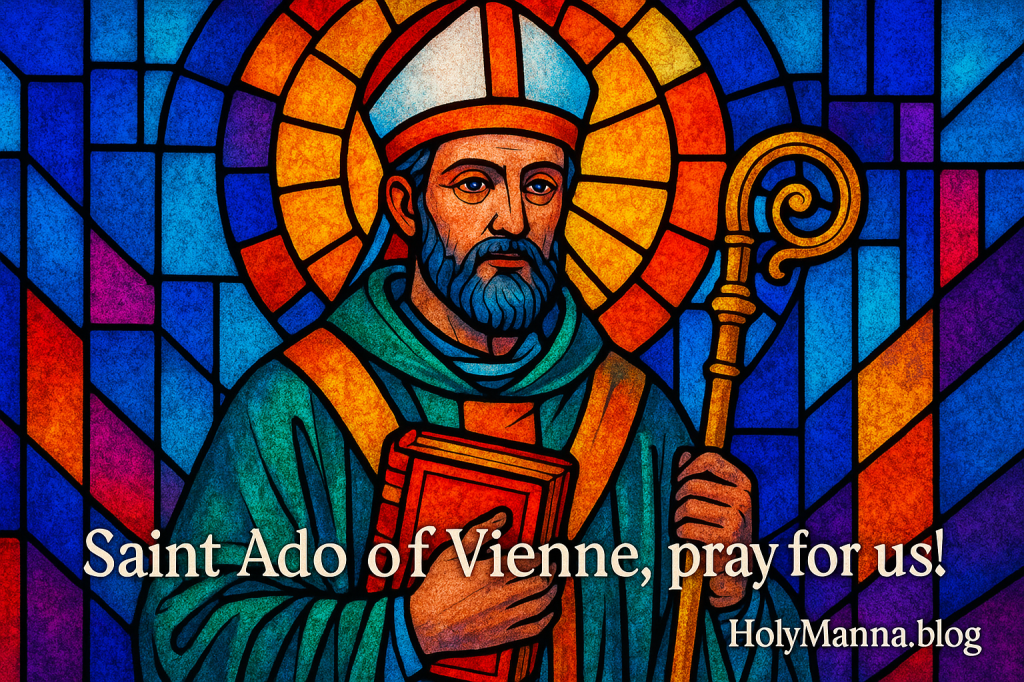
A Shepherd of Truth and a Guardian of Sacred Memory
Saint Ado of Vienne stands as one of the great scholarly bishops of the ninth century, a man who gave his life to preserving the memory of the saints while shepherding his flock during turbulent and politically charged times. Known especially for his remarkable contribution to sacred tradition through the composition of a universal martyrology, he helped safeguard the Church’s collective memory at a time when Europe needed clarity, unity, and doctrinal stability. His life shows what happens when humility, discipline, and scholarship are joined to deep pastoral charity. Ado is revered not only as a faithful archbishop but also as a guardian of the Communion of Saints whose work continues to bless the Church today.
Growing in Faith Amid Hardship
Ado was born around the year 800 in Sens, a city in northern France that was already rich with Christian history. As a boy he entered the local monastery, where he received a thorough monastic and classical education. His heart was shaped early by liturgical prayer, the chanting of psalms, and the study of sacred writings. This environment prepared him well for the intellectual and moral rigor that would later define his ministry.
Although raised within the Catholic faith, Ado’s spiritual depth matured through hardship. Early in his monastic formation, he encountered serious resistance and injustice from local leadership. When reform-minded monks tried to restore proper discipline to their abbey, Ado was mistreated and forced to leave. Rather than abandon his vocation, he turned this humiliation into an opportunity for growth. He journeyed to Prüm in Germany, one of the most respected Benedictine abbeys of the era, where he was embraced, formed, and eventually ordained. This period marked a profound deepening of his commitment to learning and holiness.
Ado’s reputation for virtue and scholarship grew quickly. His monastic superiors recognized a man both disciplined in prayer and exceptionally gifted in historical writing. Over the years he became widely known for his commitment to preserving authentic Christian memory, a passion that would soon shape the entire Church.
A Scholar Bishop and Keeper of Sacred Memory
Ado’s life took a decisive turn in 860 when he was appointed Archbishop of Vienne, a historically significant see in southeastern France. As archbishop he governed with integrity, courage, and a profound zeal for orthodoxy. These were years of uncertainty in the Carolingian Empire, marked by political tension, invasions, and theological confusion. Ado stood firm in defending Church teaching and ensuring that clergy and laity alike were rooted in the apostolic faith.
He is best known for his monumental work, the Martyrologium, a universal martyrology that brought together historical accounts of saints from Scripture, antiquity, and the early medieval world. Instead of relying on rumor or legend, Ado sought rigor, accuracy, and fidelity to authentic tradition. His work became an essential resource for the Church’s liturgical calendar and devotional life, helping future generations remember the sacrifices and holiness of countless men and women.
Ado’s commitment to truth made him a light in a time of confusion. His careful documentation of Christian witnesses preserved the Church’s collective memory and enriched its liturgy. Although no historically verified miracles are attributed to him during life, his preservation of the saints’ miracles and holy deeds became a miracle of spiritual stewardship in its own right. He ensured that future generations would not lose their connection to the early martyrs whose courage shaped Christian identity. This alone makes him an enduring model for bishops, scholars, and all who desire to hand on the faith with integrity.
Enduring Trials with Steadfast Faith
Ado faced difficult political pressures during his episcopacy. The nobles of the region frequently fought among themselves, and external powers attempted to manipulate ecclesiastical offices for political gain. Ado’s refusal to compromise the Church’s teachings or allow his diocese to be dominated by political factions put him in frequent conflict with the powerful. Despite these pressures, he remained faithful to Christ and the Church, modeling what the Catechism teaches about the pastoral office: “Bishops… are authentic teachers of the apostolic faith endowed with the authority of Christ” (Catechism of the Catholic Church, 888).
His endurance was not marked by dramatic escapes or miraculous protection but by the quiet heroism of fidelity. He never abandoned his flock, never compromised the truth, and never wavered in his care for the poor. His daily life became an act of martyrdom of the heart, a steady offering of himself in the service of God’s people.
Ado died on December 16, 875, after a lifetime of service, writing, prayer, and pastoral leadership. His death was peaceful but carried the weight of a life poured out completely for the Gospel.
A Legacy That Sparked Devotion
Although there are no physical miracles recorded after Ado’s death, his martyrology itself became a spiritual miracle for the Church. By gathering, preserving, and organizing the testimonies of martyrs and saints across centuries, he shaped Christian prayer for generations. His work influenced later martyrologies, including those used in the medieval, Tridentine, and modern Roman liturgies.
Veneration of Saint Ado developed quickly, especially in Sens, Prüm, and Vienne. His tomb became a place of quiet prayer for those seeking wisdom, clarity, or encouragement in their vocation. Monks, scholars, and clergy invoked his intercession as they worked to teach or write faithfully about the faith. His feast day on December 16 invites the faithful to remember the importance of preserving truth and guarding sacred memory, especially in times of cultural confusion.
A Life Formed by Truth and Courage
Saint Ado of Vienne teaches the value of perseverance when misunderstood, mistreated, or discouraged. His life shows that holiness often forms in quiet fidelity rather than dramatic displays. His devotion to preserving the memory of the saints challenges modern believers to root themselves in Catholic tradition and rely on the wisdom handed down through Scripture, the Catechism, the Fathers, and the martyrs.
His example invites every Christian to cultivate disciplined prayer, intellectual curiosity, and moral courage. Ado demonstrates that knowledge and holiness are not opposites but companions. He reminds the Church that truth must be safeguarded with humility and lived with love.
How might a believer today grow in fidelity to the Church’s teaching? How might one serve the Body of Christ not only through outward action but also through study, memory, and prayer?
Engage with Us!
Share your thoughts and reflections on Saint Ado of Vienne in the comments below.
- How does Saint Ado’s dedication to truth and historical fidelity challenge the way you approach your own spiritual formation?
- Where is Christ calling you to greater perseverance in times of misunderstanding or difficulty?
- What can you do to root your life more deeply in the wisdom and tradition of the Church that Saint Ado helped preserve?
May this holy archbishop inspire all to live with courage, fidelity, and love, and to do everything with the mercy and truth that Jesus taught.
Saint Ado of Vienne, pray for us!
Follow us on YouTube, Instagram and Facebook for more insights and reflections on living a faith-filled life.

 Holy Manna!
Leave a comment