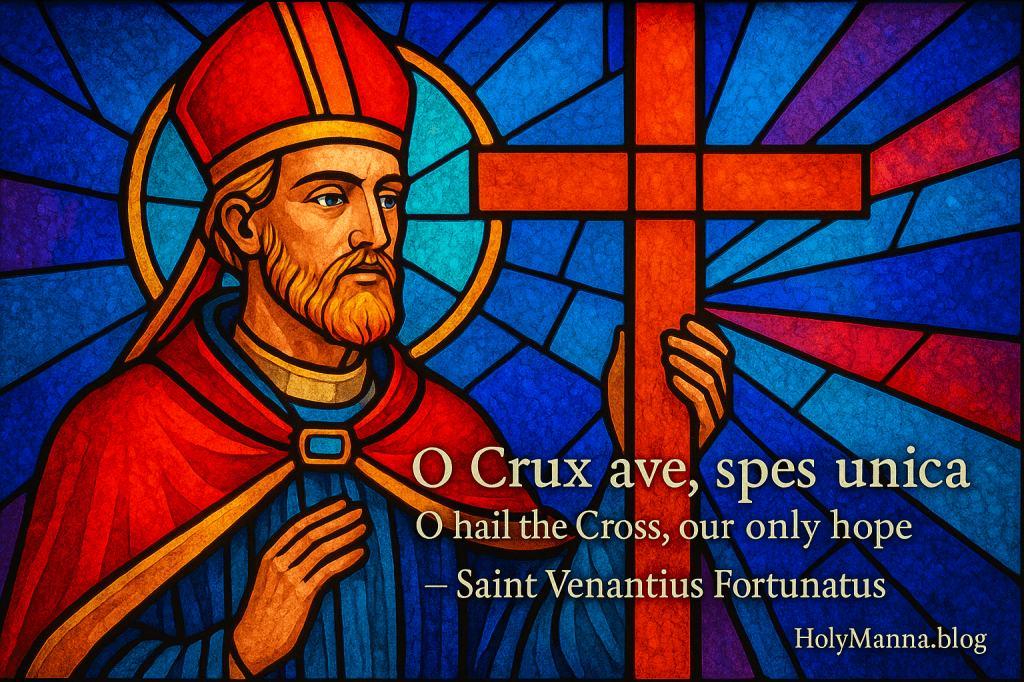
Bishop, Poet, and Defender of the Cross
A Voice That Sang Christ into a Wounded World
Saint Venantius Fortunatus stands as one of the most influential Christian poets of antiquity, a man whose words have shaped Catholic worship for more than fourteen centuries. Best known for writing the beloved hymns “Vexilla Regis” and “Pange Lingua Gloriosi Proelium Certaminis”, Fortunatus gave the Church some of its most enduring liturgical treasures. As a bishop, friend of saints, and defender of orthodox faith, he lived during a time of political upheaval and spiritual confusion. Yet he chose to respond with beauty, clarity, and devotion to Christ crucified. His legacy reveals how the Holy Spirit uses poetry, friendship, and pastoral care to strengthen the faith of an entire people.
A Journey Guided by Providence
Venantius Fortunatus was born around 530 in Treviso, a small city in northern Italy. His family ensured he received an excellent education in classical literature and rhetoric, which prepared him for the life of a scholar and poet. A turning point came when he suffered from a severe eye ailment that threatened his sight. After praying for healing through the intercession of Saint Martin of Tours, he recovered. In thanksgiving, he made a pilgrimage to the saint’s shrine in Gaul. This journey changed the course of his life.
While in Gaul, Fortunatus encountered a land wounded by war and political instability after the fall of the Roman Empire. Instead of returning home, he settled there, sensing God’s call to serve a Church in need of renewed faith and unity. He became close friends with two extraordinary saints, Saint Radegund and Saint Gregory of Tours, and eventually was ordained a priest. He is most remembered for his poetic brilliance, pastoral kindness, and the ways he infused Christian worship with theological beauty that still echoes through the liturgy today.
The Poet Who Gave the Church Its Hymns of Glory
Fortunatus lived a life deeply immersed in the mysteries of Christ. His writings draw from Scripture, the Fathers of the Church, and profound Eucharistic devotion. His hymn “Vexilla Regis”, composed for the arrival of a relic of the True Cross in Poitiers, proclaims the triumph of Christ through His sacrifice. He wrote, “O Crux ave, spes unica” meaning “O hail the Cross, our only hope.” These words later became one of the most cherished refrains in Christian tradition.
His “Pange Lingua” is another masterpiece honoring the Cross and Christ’s saving Passion. This should not be confused with Saint Thomas Aquinas’s Eucharistic hymn of the same title; Fortunatus’s version predates it by seven centuries. His works were not abstract poems but expressions of the living faith he nurtured in the communities he served. His pastoral reputation grew, and eventually he was elected Bishop of Poitiers around 599.
While no miracles during his life are formally recorded in the style of canonized miracle accounts, his influence on souls, his healing from Saint Martin’s intercession, and the spiritual fruits of his poetry reveal a man whose faith touched countless lives.
Persevering Through Turbulence and Spiritual Trial
Fortunatus lived during a chaotic era marked by political fractures, doctrinal disputes, and the slow rebuilding of Christian culture after the collapse of Roman authority. Bishops were often caught between warring kingdoms and theological controversies. Fortunatus navigated these tensions with humility, clarity, and unwavering fidelity to the Church.
His hardships were not marked by dramatic persecution but by the constant strain of shepherding a fragile Church through instability. He endured the emotional burden of ministering to a suffering population, comforting the poor, advocating for peace, and strengthening the faith of his flock. His writings often reflect the longing for unity and healing in a divided land, which he answered by proclaiming Christ’s Cross as the true anchor of hope.
His title as a confessor saint reflects a life of virtue lived in perseverance rather than martyrdom. He died around 600 or 610, remembered not as a political figure but as a bishop who used beauty to bind up the wounds of his people.
A Legacy That Blossomed After His Death
After his death, the impact of Fortunatus’s work only grew stronger. His hymns became woven into the liturgy of the Western Church. During Holy Week, “Vexilla Regis” still resounds as one of the most solemn and ancient hymns of the Passion. His writings also preserved the memory of other saints and served as invaluable historical texts for later generations.
Churches and monasteries in France treasured his relics, and his memory was honored especially in Poitiers, where he had served as bishop. His intercession continued to inspire poets, musicians, theologians, and ordinary believers who found in his words a pathway into the mystery of Christ’s love.
Letting the Cross Be Our Only Hope
Saint Venantius Fortunatus teaches that evangelization thrives when truth is joined to beauty. His hymns invite believers to gaze upon the Cross not with fear but with hope. His friendships with saints remind us that holiness grows in community. His pastoral life encourages steady, faithful service even when the world feels uncertain or turbulent.
His example challenges readers to cultivate beauty in their own discipleship, whether through prayer, creativity, friendship, or acts of mercy. When life becomes heavy or confusing, returning to the Cross brings clarity. Fortunatus’s words echo across the ages, reminding every soul that Christ’s sacrifice is not a symbol of defeat but the fountain of everlasting joy.
Engage with Us!
Share your thoughts and reflections in the comments below.
- How does Saint Venantius Fortunatus’s devotion to the Cross encourage you to find hope in Christ during difficult moments?
- What gifts has God given you that could be used to bring beauty, healing, or clarity to others?
- How can you allow friendships and community to strengthen your spiritual life, as Fortunatus did with other saints?
May you live each day with deeper faith, anchored in the love and mercy Jesus taught, and may the Cross always be your hope and your strength.
Saint Venantius Fortunatus, pray for us!
Follow us on YouTube, Instagram and Facebook for more insights and reflections on living a faith-filled life.

 Holy Manna!
Leave a comment