Third Sunday of Advent – Lectionary: 7
Joy That Grows In The Waiting
Sometimes the heart feels like a desert that has forgotten how to bloom, yet the promise of God quietly whispers that joy is already on the way.
The readings for this Third Sunday of Advent, traditionally called Gaudete Sunday, are soaked in this kind of hope filled joy. The Church pauses in the middle of Advent to rejoice, not because every problem has been solved, but because “the coming of the Lord is at hand” as James 5:8 says. The liturgy shifts slightly today. Priests may wear rose colored vestments, and the tone leans toward rejoicing. This is not shallow positivity. It is the deep joy that comes from knowing that God is already at work, even when circumstances still feel dark, uncertain, or unfinished.
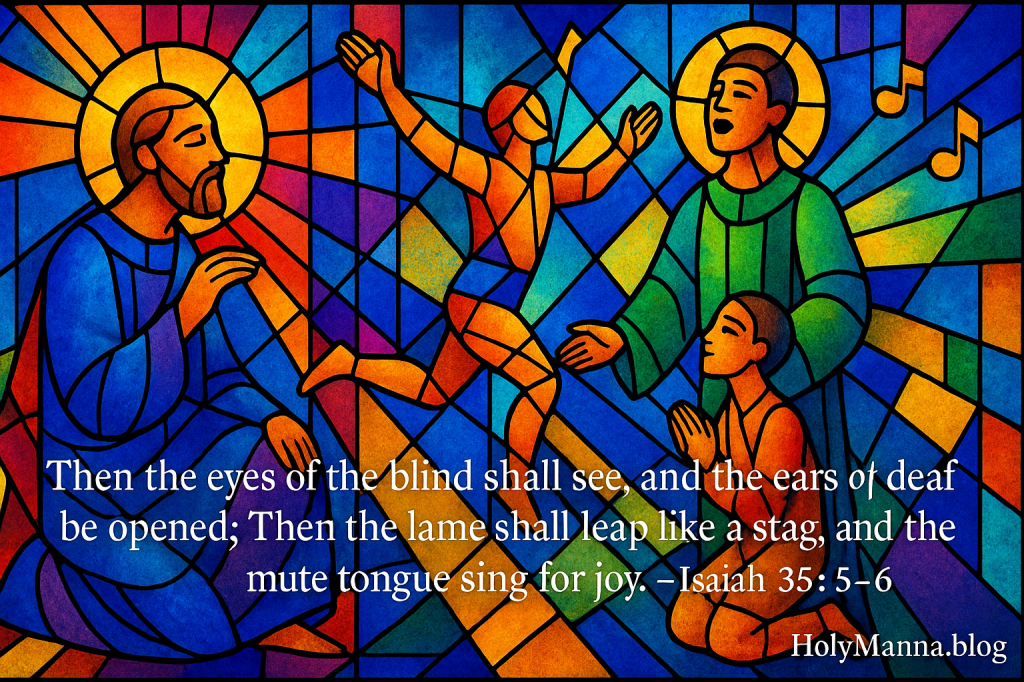
In Isaiah 35:1-6, 10, Israel hears a promise in a time marked by fear, weakness, and exile. The prophet announces that the wilderness will bloom, the weak will be strengthened, and the fearful are told: “Be strong, do not fear! Here is your God, he comes with vindication; with divine recompense he comes to save you”. This is the language of total reversal. The blind see, the deaf hear, the lame leap, and the mute sing. It is a vision of God visiting his people with healing and justice, transforming desolation into a place of life and joy.
The responsorial psalm, Psalm 146:6-10, takes that same promise and puts it into praise. God is praised as the creator who “keeps faith forever”, “secures justice for the oppressed”, “gives bread to the hungry”, and “sets prisoners free”. This is not a distant deity. This is a Lord who moves toward the broken, the poor, the forgotten, and the bowed down. The God who will come in judgment is the same God who lifts up and defends the vulnerable.
Then James 5:7-10 pulls this hope into the real tension of daily life. Early Christians were facing trials, misunderstandings, and delays. James does not offer an escape from hardship. Instead, he calls believers to a steady, mature patience: “See how the farmer waits for the precious fruit of the earth, being patient with it until it receives the early and the late rains”. The image of the farmer reminds the heart that God is not late. His timing is like a growing season. The seed is in the ground, the fruit is coming, and the invitation is to keep hearts firm and free of grumbling while the Lord’s coming draws near.
In the Holy Gospel, Matthew 11:2-11, all of these threads converge in Jesus. John the Baptist sits in prison and sends a question that echoes many anxious hearts: “Are you the one who is to come, or should we look for another”. Jesus answers not with theory but with evidence: “the blind regain their sight, the lame walk, lepers are cleansed, the deaf hear, the dead are raised, and the poor have the good news proclaimed to them” as Matthew 11:5 records. He is literally fulfilling the signs promised in Isaiah 35 and reflected in Psalm 146. At the same time, John remains in chains, which shows that God’s Kingdom is truly breaking in, yet not fully revealed. This tension is the space where Advent faith lives.
A central theme shines through all of today’s readings. God is already at work bringing healing, justice, and joy, yet his people are invited to wait with firm, patient hearts. The desert will bloom. The oppressed will be lifted. The blind will see. Christ is the proof that the promise is real, even when life still feels unfinished. Will the heart dare to rejoice in the middle of the waiting, trusting that the Lord who has begun his work will bring it to completion?
First Reading – Isaiah 35:1-6, 10
From Desert Desolation To Joyful Return
Isaiah speaks into a world marked by threat, instability, and spiritual dryness. The people of Israel faced the looming power of empires and the pain of exile. Into that fear filled landscape, Isaiah 35:1-6, 10 offers a breathtaking vision of restoration. God promises that the wilderness will become a garden, that weak hands will be strengthened, and that fearful hearts will be reassured. This prophecy looks ahead to the coming of the Messiah, who will heal, restore, and lead the ransomed back to Zion in joy. For this Third Sunday of Advent, these words echo the central theme of joyful hope in the midst of waiting. The reading prepares the heart to recognize that in Jesus, the signs Isaiah foretold begin to unfold, even while the full fulfillment is still on the horizon.
Isaiah 35:1-6 – New American Bible (Revised Edition)
Israel’s Deliverance
1 The wilderness and the parched land will exult;
the Arabah will rejoice and bloom;
2 Like the crocus it shall bloom abundantly,
and rejoice with joyful song.
The glory of Lebanon will be given to it,
the splendor of Carmel and Sharon;
They will see the glory of the Lord,
the splendor of our God.
3 Strengthen hands that are feeble,
make firm knees that are weak,
4 Say to the fearful of heart:
Be strong, do not fear!
Here is your God,
he comes with vindication;
With divine recompense
he comes to save you.
5 Then the eyes of the blind shall see,
and the ears of the deaf be opened;
6 Then the lame shall leap like a stag,
and the mute tongue sing for joy.
For waters will burst forth in the wilderness,
and streams in the Arabah.
Detailed Exegesis
Verse 1 – “The wilderness and the parched land will exult; the Arabah will rejoice and bloom”.
Isaiah begins with the image of a wasteland bursting into life. The wilderness represents not only physical desolation but also spiritual dryness and exile. God’s saving action does not just improve things slightly. It transforms the most barren places into sites of rejoicing. The mention of the Arabah, a dry desert region, highlights how radical this change is. Where there was no life, God brings beauty, fruitfulness, and joy. This points ultimately to the renewal brought by Christ in the soul and in creation itself.
Verse 2 – “It shall bloom abundantly and rejoice with joyful song; the glory of Lebanon will be given to it”.
Here the prophet deepens the image. The desert does not just sprout a few plants. It blooms abundantly and sings for joy. References to Lebanon, Carmel, and Sharon call to mind regions known for their fertility and beauty in ancient Israel. God does not give minimal blessings. He shares the richness of his own glory. The line “They will see the glory of the Lord, the splendor of our God” signals that this transformation is ultimately about God revealing himself. The true gift is not just a better environment but a deeper encounter with the living God.
Verse 3 – “Strengthen hands that are feeble, make firm knees that are weak”.
The tone shifts from description to exhortation. God’s promise is meant to move the community to action. Those whose hands have grown tired in doing good, and whose knees shake under the weight of trials, are called to be strengthened. This echoes the Church’s call in Advent to encourage one another and to build up the weak in faith. The community is not invited to passive waiting. It is invited to mutual support, courage, and renewed perseverance in light of God’s coming.
Verse 4 – “Say to the fearful of heart: Be strong, do not fear! Here is your God”.
This verse goes straight to the interior battle. Fearful hearts are addressed directly. The command “Be strong, do not fear” is not a shallow pep talk. It is grounded in a concrete reason: “Here is your God, he comes with vindication; with divine recompense he comes to save you”. God will set things right. He will vindicate his people and respond to injustice. This is both comforting and sobering. It brings hope to the oppressed and a reminder of judgment to the wicked. In Advent, this speaks to the second coming of Christ and his final victory, while also pointing to his first coming in humility.
Verse 5 – “Then the eyes of the blind shall be opened, the ears of the deaf be cleared”.
Now the prophecy names specific signs of the Messianic age. The opening of blind eyes and deaf ears is not only physical healing but also a symbol of spiritual awakening. Those who could not see God’s work or hear his word will be enlightened and made receptive. In the Holy Gospel of Matthew 11:2-11, Jesus cites these very signs to show John the Baptist that he is indeed the One who was to come. This verse is like a lens through which the Church reads the miracles of Christ.
Verse 6 – “Then the lame shall leap like a stag, the tongue of the mute shall sing”.
The lame do not simply walk. They leap like a stag. The mute do not merely speak. They sing. God’s healing is abundant and joyful. The verse continues with the image “waters will burst forth in the wilderness, and streams in the Arabah”, which again points to the Holy Spirit and the life of grace flowing into the driest corners of the human heart. In Christ, sacraments like Baptism and the Eucharist become those life giving streams that turn spiritual deserts into places of praise.
Verse 10 – “The ransomed of the Lord shall return and enter Zion singing, crowned with everlasting joy”.
The passage ends with a vision of homecoming. The ransomed are those redeemed by God’s saving action. They return to Zion, which represents not only Jerusalem but the fullness of communion with God. They are crowned with everlasting joy. Sorrow and mourning flee away. This is the ultimate horizon of salvation history. In Christian light, it points toward the heavenly Jerusalem described in Revelation, where God wipes away every tear. For Advent, this verse reminds the heart that the story ends not in exile, but in joyful return.
Teachings
This reading sits at the heart of how the Church understands the prophets and their role in preparing for Christ. CCC 711 teaches that the Spirit prepared for the Messiah through the prophets, stating that “In the prophets, the Spirit points out the coming of the Messiah” and the shape of his mission. Isaiah’s vision of healing, justice, and joyful return is a prime example of this.
The Catechism also explains that Jesus fulfills these prophecies through both word and deed. In CCC 1503, the Church teaches that “Christ’s whole life was a healing” and that he “came to heal the whole man, soul and body”. The signs listed in Isaiah 35 align closely with the miracles of Jesus, especially as seen in the Holy Gospel of Matthew 11:5.
The Church’s teaching on hope resonates strongly with this passage. CCC 1820 describes Christian hope as trusting that God will give the grace needed to reach eternal life and that this hope “responds to the aspiration to happiness which God has placed in the heart of every man”. The promise that the ransomed will enter Zion crowned with everlasting joy speaks directly to this supernatural hope.
The care for the poor, the weak, and the oppressed, which is implied in the strengthening of feeble hands and fearful hearts, connects with CCC 2448, where the Church explains that “in its various forms material deprivation, unjust oppression, physical and psychological illness and death are the obvious signs of the inherited condition of frailty and need for salvation”. God’s response to these conditions is his saving action, which the prophets announce and Christ fulfills.
Saints and Fathers of the Church have also seen in these images the promise of the new life of grace. Saint Gregory the Great reflected that the miracles of Christ, such as giving sight to the blind and speech to the mute, symbolize the opening of the soul to faith. When Christ heals, he is not only removing physical limitations. He is restoring the capacity of the human person to know, love, and praise God.
Reflection
This reading speaks powerfully to moments when life feels like a desert. Many hearts carry hidden dryness, disappointment, or fear. Isaiah does not deny the reality of the wilderness. Instead, he announces that God plans to make that very place blossom. Where does life feel most barren right now? Where do hope and joy feel far away? These are the places God wants to visit with his grace.
The call to strengthen feeble hands and firm up weak knees invites concrete choices. This might look like returning to daily prayer when discouragement has settled in, going back to the sacrament of Reconciliation after a long time away, or reaching out to someone who is struggling instead of withdrawing. God’s promise is meant to move believers into action that reflects trust in his coming.
The command to speak to fearful hearts, “Be strong, do not fear! Here is your God”, challenges the habit of letting anxiety have the last word. What would it look like to answer fear with God’s promises instead of replaying worst case scenarios? One practical step is to memorize a short line from this reading and repeat it in moments of stress, letting God’s word re frame inner dialogue.
The signs of healing named in the prophecy also invite deeper faith in Christ’s presence in the sacraments and in the Church. The blind seeing and the lame leaping can be seen today when people move from confusion to faith, from slavery to sin into the freedom of grace. Where is Christ already turning small parts of the desert into a garden in daily life? Gratitude for those small blooms can strengthen hope for areas that still feel dry.
Finally, the image of the ransomed returning to Zion crowned with everlasting joy reminds every believer that the story of salvation ends in homecoming, not exile. Even when trials continue, the Christian walks toward a definitive joy that cannot be taken away. How might daily choices change if the heart truly believed that everlasting joy is the final destination? What habits, sins, or fears would lose some of their power if the eyes stayed fixed on that promised return to the Father’s house?
In this Third Sunday of Advent, Isaiah’s vision invites the soul to let God speak into its deserts, to trust his promise of healing and return, and to walk forward with a heart that chooses hope filled joy while waiting for the Lord.
Responsorial Psalm – Psalm 146:6-10
Singing Hope To The God Who Never Forgets
Psalm 146:6-10 is a hymn of praise that likely arose in the post exilic period, when Israel was learning to trust God again after the trauma of exile and the humbling of earthly powers. Instead of placing confidence in kings or human strength, this psalm fixes the heart on the Lord who created everything and who personally defends the poor, the stranger, the orphan, and the widow. It is liturgical poetry that teaches theology. God is not praised in vague terms. He is acclaimed as the One who actually acts in history for the weak and the oppressed.
Within the theme of this Third Sunday of Advent, the psalm becomes a response of joy filled trust. Isaiah 35 has just announced that God will come to save, heal, and restore. The psalm answers with praise for the God who already behaves this way. The same Lord who “keeps faith forever” in Psalm 146 is the One whose coming James 5 urges believers to await with patience. The concrete mercy described here prepares the heart to recognize in Jesus the visible face of this faithful God who reigns forever.
Psalm 146:6-10 – New American Bible (Revised Edition)
6 The maker of heaven and earth,
the seas and all that is in them,
Who keeps faith forever,
7 secures justice for the oppressed,
who gives bread to the hungry.
The Lord sets prisoners free;
8 the Lord gives sight to the blind.
The Lord raises up those who are bowed down;
the Lord loves the righteous.
9 The Lord protects the resident alien,
comes to the aid of the orphan and the widow,
but thwarts the way of the wicked.
10 The Lord shall reign forever,
your God, Zion, through all generations!
Hallelujah!
Detailed Exegesis
Verse 6 – “The maker of heaven and earth, the seas and all that is in them, who keeps faith forever”.
The psalmist begins with creation. God is not a local tribal deity. He is the creator of heaven, earth, the sea, and everything in them. This is a direct challenge to any temptation to trust purely human power. If the Lord made all things, then he has authority over history and over every situation. The title “who keeps faith forever” reveals his covenant love. He is not only powerful. He is faithful to his promises. In the context of Advent, this line reminds believers that the God who promised a Messiah and the renewal of creation is absolutely trustworthy, both in the first coming of Christ and in the promise of his return.
Verse 7 – “Secures justice for the oppressed, who gives bread to the hungry. The Lord sets prisoners free”.
Here the psalm moves from who God is to what God does. The verbs are concrete. God secures justice. God gives bread. God sets prisoners free. This is a portrait of the Lord as defender of the vulnerable. The oppressed in Israel’s world included those crushed by corrupt leaders, unjust courts, or foreign powers. To say God secures justice means that he does not ignore these wrongs forever. The hungry are not only a spiritual symbol. They are real people without daily bread, and God’s care for them anticipates the way Jesus will feed the crowds and identify himself as the Bread of Life. Prisoners include those physically jailed as well as those enslaved in various forms of bondage. When this verse is prayed in the light of Christ, it calls to mind his mission *“to proclaim liberty to captives” as foretold in Isaiah 61 and fulfilled in his ministry.
Verse 8 – “The Lord gives sight to the blind. The Lord raises up those who are bowed down; the Lord loves the righteous”.
This verse echoes the signs listed in Isaiah 35 and named explicitly by Jesus in Matthew 11:5. Sight for the blind is both literal and symbolic. God restores physical vision and also grants spiritual understanding. Those who are bowed down under burdens, whether of oppression, grief, or guilt, are raised up by the tender power of God. The phrase “the Lord loves the righteous” shows that God’s mercy does not cancel the call to holiness. He is especially close to those who live in fidelity to his covenant. In the light of the Gospel, this verse points to Christ’s healings and his lifting up of sinners who humble themselves before him.
Verse 9 – “The Lord protects the resident alien, comes to the aid of the orphan and the widow, but thwarts the way of the wicked”.
This line goes straight to the heart of Old Testament social teaching. The resident alien, the orphan, and the widow were the most vulnerable people in ancient Israel. They lacked land, legal protection, and often family support. God repeatedly commands Israel in The Torah to care for them because Israel once knew what it was to be enslaved foreigners in Egypt. Here the psalm says God himself protects and supports them. At the same time, “thwarts the way of the wicked” shows that injustice will not prosper indefinitely. God actively frustrates the plans of those who exploit the weak. In the Advent context, this verse strengthens confidence that God sees every injustice and that his coming will bring a definitive setting right of all things.
Verse 10 – “The Lord shall reign forever, your God, Zion, through all generations! Hallelujah!”.
The psalm closes with a proclamation of God’s eternal kingship. Earthly rulers rise and fall. Policies change. Empires collapse. The Lord’s reign, however, endures through all generations. Addressing Zion highlights the special relationship between God and his people. He is not only the cosmic creator. He is “your God”, intimately involved with his chosen ones. The final “Hallelujah!” is a shout of praise that gathers everything said before into joyful worship. For Advent, this verse looks toward the eternal kingdom fully revealed when Christ returns in glory, while already present now in the Church and in every heart that lives under God’s loving rule.
Teachings
The Catechism of the Catholic Church confirms this picture of God as both Creator and faithful covenant partner. CCC 268 teaches that “Of all the divine attributes, only God’s omnipotence is named in the Creed” and that his power is universal and loving. The psalm captures this by moving from God as maker of heaven and earth to God as defender of the oppressed. His power is never cold or detached. It is always used in love.
The Church also emphasizes God’s special love for the poor and vulnerable. CCC 2448 explains that “In its various forms material deprivation, unjust oppression, physical and psychological illness and death are the obvious signs of the inherited condition of frailty and need for salvation”. The psalm lists those very conditions and shows that God leans toward people who suffer them. The Catechism goes on to affirm that “the Church’s love for the poor is a part of her constant tradition”, which flows directly from the heart of Christ and from texts like Psalm 146.
The miracles of Christ are also interpreted in this light. CCC 549 states that “By freeing some individuals from the earthly evils of hunger, injustice, illness and death, Jesus performed messianic signs”. When the psalm proclaims that the Lord gives sight to the blind, raises the bowed down, and sets prisoners free, these lines find their concrete embodiment in the healing and liberating ministry of Jesus. His works are the visible proof that Israel’s God truly reigns with justice and mercy.
The Church’s teaching on divine providence resonates strongly here. CCC 303 affirms that “The witness of Scripture is unanimous that the solicitude of divine providence is concrete and immediate; God cares for all, from the least things to the great events of the world and its history”. The psalm is a sung testimony of that providence. It praises a God who is involved in the lives of orphans, widows, strangers, and prisoners, and who also governs the destiny of nations and generations.
The saints echo this psalmic trust. Saint Teresa of Calcutta often insisted that Jesus is found in the distressing disguise of the poor. Her life was a living commentary on verses that celebrate God’s care for the hungry, the oppressed, and the forgotten. Saint John Chrysostom taught that neglect of the poor is an offense against Christ himself. Their witness shows how the praise of Psalm 146 should move believers into concrete works of mercy that reflect the heart of God.
Reflection
This psalm offers a powerful exam of conscience. It invites a shift from anxiety about human powers to deep trust in the Lord who reigns forever. So much of daily stress comes from trying to control situations or from putting too much hope in systems, leaders, or personal plans. What changes when the heart really believes that the maker of heaven and earth is also the One who keeps faith forever? This belief is not an excuse for passivity. It becomes the foundation for courageous action and peaceful endurance.
The tenderness of God toward the oppressed, the hungry, the prisoner, the stranger, the orphan, and the widow also calls for imitation. Is there anyone in life right now who is bowed down, overlooked, or burdened, whom God might be inviting a person to support in a concrete way? This might look like visiting someone who is lonely, giving generously to those in need, defending someone who is being treated unjustly, or simply taking time to listen to a person who feels invisible. When believers act in these ways, they allow the Lord to love the lowly through them.
Praying this psalm in Advent can also heal the image of God in the heart. Some people secretly imagine God as distant, harsh, or indifferent. Psalm 146 paints a very different portrait. The Lord is the One who feeds, frees, heals, lifts, protects, and reigns forever with justice. Which line of this psalm most challenges the way God is seen deep down inside? Which line brings the most comfort? Returning to that verse during the week and repeating it slowly before God can open space for deeper trust.
Finally, the closing shout “The Lord shall reign forever” points beyond the ups and downs of this life to the unshakable kingdom that Christ will fully reveal at his coming. How might everyday choices look different if the heart remembered, especially in stressful or unfair situations, that God’s reign of justice and mercy has the final word? Allowing that truth to sink in can turn complaints into praise and fear into steady hope, which is exactly the kind of joyful patience this Third Sunday of Advent invites.
Second Reading – James 5:7-10
Growing Steady Hearts in a Restless World
The Letter of James was written to early Christians who were scattered, pressured, and tempted to lose heart. They faced persecution from outside and tensions within their own communities. In that setting, James 5:7-10 calls believers to a mature patience that is not passive resignation but active trust in the Lord who is near. The image of the farmer waiting for the precious fruit would have made immediate sense in an agrarian culture that depended on rain, seasons, and a rhythm that could not be rushed.
For this Third Sunday of Advent, this passage fits perfectly with the theme of joyful hope in the midst of waiting. Isaiah 35 has promised that God will come to save and restore. Psalm 146 has praised the Lord who defends the lowly and keeps faith forever. Now James turns directly to the daily grind of Christian life and basically says that hearts must be formed to wait for that faithful God with steady courage, without turning on each other or forgetting that the Judge is at the door. It is a call to live Advent not just as a season on the calendar but as a spiritual attitude that marks every day.
James 5:7-10 – New American Bible (Revised Edition)
Patience and Oaths. 7 Be patient, therefore, brothers, until the coming of the Lord. See how the farmer waits for the precious fruit of the earth, being patient with it until it receives the early and the late rains. 8 You too must be patient. Make your hearts firm, because the coming of the Lord is at hand. 9 Do not complain, brothers, about one another, that you may not be judged. Behold, the Judge is standing before the gates. 10 Take as an example of hardship and patience, brothers, the prophets who spoke in the name of the Lord.
Detailed Exegesis
Verse 7 – “Be patient, therefore, brothers, until the coming of the Lord. See how the farmer waits for the precious fruit of the earth, being patient with it until it receives the early and the late rains.”
James begins with a direct command: “Be patient”. The word here carries the sense of long suffering endurance, the ability to remain firm under pressure without giving up or lashing out. The reason given is “until the coming of the Lord”. The horizon of Christian patience is not vague optimism. It is the sure return of Christ in glory and his definitive judgment and restoration.
The example of the farmer would hit home for James’s audience. A farmer can plow, sow, and tend, but cannot control the rain. The mention of “early and late rains” refers to the seasonal rains in the land of Israel that made harvest possible. Just as the farmer trusts the rhythm God built into creation, so believers are called to trust God’s timing in their lives. The fruit is called “precious”, which suggests that what God is growing in the soul and in history is worth the wait. The image invites believers to see their trials as part of a slow, meaningful growth rather than pointless frustration.
Verse 8 – “You too must be patient. Make your hearts firm, because the coming of the Lord is at hand.”
Here James applies the image directly. The community is told again to be patient, but this time he adds “Make your hearts firm”. The heart in biblical language is the center of the person, where thoughts, choices, desires, and faith all come together. A firm heart is one that is rooted in God, not tossed around by emotions or circumstances.
The motivation is repeated and intensified: “the coming of the Lord is at hand”. Early Christians lived with a strong awareness that Christ could return at any time. The Church today still professes this truth in every Mass when it looks for his coming in glory. This line does not mean predicting dates. It means living with a constant readiness and urgency, knowing that life and history are moving toward a real encounter with the Lord.
Verse 9 – “Do not complain, brothers, about one another, that you may not be judged. Behold, the Judge is standing before the gates.”
James now moves from attitude to behavior within the community. Complaining about one another is a very human temptation when stress, delay, or suffering press in. Instead of turning to God in trust, people often turn on each other in criticism, gossip, or resentment. James warns that this pattern is not harmless. It opens the door to judgment.
The striking image “the Judge is standing before the gates” makes the presence of Christ very vivid. He is not a distant observer. He is at the threshold, listening to how his brothers and sisters speak about one another. This echoes the Lord’s own teaching in the Holy Gospels that people will give an account for every careless word. It also fits with the Advent focus on preparing for the Lord’s coming by examining the heart and seeking reconciliation, not only with God but within the Christian community.
Verse 10 – “Take as an example of hardship and patience, brothers, the prophets who spoke in the name of the Lord.”
Finally, James points to role models. The prophets of the Old Testament spoke God’s word faithfully, often at great personal cost. They faced rejection, ridicule, persecution, and sometimes even death. Yet they remained steadfast in their mission. To “take them as an example” means to look at their lives and draw strength from their witness.
This verse links directly back to Isaiah 35, which is one of those prophetic promises of restoration. Isaiah and the other prophets had to trust God’s word even when circumstances looked the opposite of hopeful. In the same way, Christians are called to hold on to God’s promises and keep living and speaking the truth, even when results seem slow or suffering increases. Their patience is not passive but prophetic, rooted in the conviction that the Lord is faithful.
Teachings
The Catechism speaks clearly about Christian hope in a way that matches James’s teaching. CCC 1820 explains that “Christian hope unfolds from the beginning of Jesus’ preaching in the proclamation of the beatitudes” and that it “keeps man from discouragement” and “sustains him during times of abandonment”. This is exactly what James 5:7-10 encourages: a hope filled patience that keeps believers from giving in to discouragement while they wait for the coming of the Lord.
The reality of judgment is also at the heart of this passage. The line “the Judge is standing before the gates” points to Christ as the one who will judge the living and the dead. The Catechism teaches that “The Last Judgment will come when Christ returns in glory” and that “then through his Son Jesus Christ he will pronounce the final word on all history”. Knowing this is meant to inspire both holy fear and confident trust, not a paralyzing dread.
James’s warning against complaining about one another ties into the Church’s teaching on the sins of the tongue and the call to fraternal charity. The Catechism explains that speaking unjustly against others, detraction, calumny, and rash judgment all wound charity and destroy the reputation of neighbors. The command “Do not complain, brothers, about one another” is a practical way of guarding against these sins and preparing for the Lord’s coming with a purified heart and community.
The example of the prophets echoes the Church’s understanding of the saints as models of perseverance. CCC 828 teaches that the saints are “witnesses who have preceded us into the kingdom” and who “share in the living tradition of prayer by the example of their lives”. The prophets belong to this great cloud of witnesses. Their patient endurance under hardship shows what it looks like to live with hearts firmly anchored in God’s promises.
Saint Augustine often spoke about the tension between the present trials of life and the future joy promised by God. He described the Christian as someone who walks through this world as a pilgrim, enduring hardships with hope because a better homeland is prepared. This captures the spirit of James’s call. Patience is not naïve denial of pain. It is a supernatural virtue that holds fast to God’s faithfulness in the middle of pain.
Reflection
This reading goes straight to the places where everyday impatience shows up: in waiting for change, in dealing with difficult people, in carrying long term burdens, and in facing situations that seem stuck. Advent is about waiting for the Lord, but real life is full of other kinds of waiting. Where does impatience show up most strongly right now? In family tensions, at work, in spiritual growth, or in dealing with personal weakness? Naming those places honestly before God is the first step.
The image of the farmer offers a simple but challenging invitation. The farmer does what can be done and leaves what cannot be controlled in God’s hands. That might mean staying faithful to daily prayer even when it feels dry, showing up for Sunday Mass even when distractions are strong, or continuing to love a difficult person without seeing immediate results. What would it look like to live today as a spiritual farmer, trusting that God is growing something precious through this season?
James also presses on the habit of complaining about others. This hits home in a culture where criticism, sarcasm, and venting are almost expected. It may help to pause before speaking and silently ask, Is what is about to be said building up this person or tearing them down? One concrete practice could be choosing one relationship and making a deliberate effort to speak words of blessing instead of complaint for a week.
Keeping in mind that “the Judge is standing before the gates” can sound intimidating, but it can also be deeply freeing. Christ sees every injustice suffered, every hidden act of love, and every small choice to trust him. How might attitudes change if the heart remembered several times a day that the Lord is near, listening, and ready to strengthen those who call on him?
Finally, looking to the prophets as examples invites a fresh love for Scripture and for the stories of those who endured before. Reading Isaiah, Jeremiah, or another prophet slowly, or reflecting on a favorite saint who endured hardship with hope, can encourage perseverance. Is there a particular prophet or saint whose story speaks to the season of life right now? Bringing that witness into prayer can help hearts grow firm, so that waiting for the Lord becomes not an empty delay but a quiet Advent revolution in trust, courage, and charity.
Holy Gospel – Matthew 11:2-11
Meeting The Real Messiah In The Middle Of Our Doubts
In The Gospel of Matthew 11:2-11, John the Baptist is in prison, and the mood has shifted. The fiery prophet who announced judgment and called for repentance now sits in confinement, hearing secondhand about Jesus. The Messiah’s mission does not look like the dramatic political upheaval many expected. Instead, reports come of healings, preaching, and mercy toward the poor.
Into this tension, John sends a question that feels very human: “Are you the one who is to come, or should we look for another?”. Jesus answers by pointing to the works that fulfill Isaiah 35 and Psalm 146: the blind see, the lame walk, and the poor receive good news. Then he turns to the crowd and reveals John’s true greatness as the promised messenger who prepares the way.
For this Third Sunday of Advent, this Gospel pulls together the theme of joyful hope in waiting. God’s promises are being fulfilled in Jesus, but in a way that requires faith, humility, and a willingness to let go of false expectations. The Messiah has truly come, yet many hearts still wrestle with doubt, confusion, and disappointment. This passage shows that even those closest to God can struggle, but Christ meets that struggle with signs of mercy and a blessing for those who do not stumble over him.
Matthew 11:2-11 – New American Bible (Revised Edition)
The Messengers from John the Baptist. 2 When John heard in prison of the works of the Messiah, he sent his disciples to him 3 with this question, “Are you the one who is to come, or should we look for another?” 4 Jesus said to them in reply, “Go and tell John what you hear and see: 5 the blind regain their sight, the lame walk, lepers are cleansed, the deaf hear, the dead are raised, and the poor have the good news proclaimed to them. 6 And blessed is the one who takes no offense at me.”
Jesus’ Testimony to John. 7 As they were going off, Jesus began to speak to the crowds about John, “What did you go out to the desert to see? A reed swayed by the wind? 8 Then what did you go out to see? Someone dressed in fine clothing? Those who wear fine clothing are in royal palaces. 9 Then why did you go out? To see a prophet? Yes, I tell you, and more than a prophet. 10 This is the one about whom it is written:
‘Behold, I am sending my messenger ahead of you;
he will prepare your way before you.’11 Amen, I say to you, among those born of women there has been none greater than John the Baptist; yet the least in the kingdom of heaven is greater than he.
Detailed Exegesis
Verse 2 – “When John heard in prison of the works of the Messiah, he sent his disciples to him”.
John is now in prison for speaking the truth to Herod. His confinement contrasts sharply with the freedom and movement of Jesus’s ministry. The phrase “works of the Messiah” suggests that John understands Jesus in messianic terms, yet something about what he hears raises questions. This shows that intense suffering can shake even a prophet’s clarity, and it prepares the ground for the question that follows.
Verse 3 – “Are you the one who is to come, or should we look for another?”.
John’s question, delivered through his disciples, echoes Israel’s longing for the promised one. “The one who is to come” recalls the awaited Messiah described in the prophets. John is not turning away from God. He is seeking confirmation in a moment of darkness. This reveals that honest questioning can be part of faith, especially when plans or expectations collapse.
Verse 4 – “Jesus said to them in reply, ‘Go and tell John what you hear and see’”.
Jesus does not give a simple yes or no. He points John back to concrete evidence and to the fulfillment of Scripture: “what you hear and see”. Faith is not blind optimism. It rests on what God has actually done in history. In sending John’s disciples back as witnesses, Jesus also strengthens the bond between John’s mission and his own.
Verse 5 – “The blind regain their sight, the lame walk, lepers are cleansed, the deaf hear, the dead are raised, and the poor have the good news proclaimed to them.”
This verse is the heart of Jesus’s answer. Each sign echoes Isaiah 35 and Psalm 146. The blind seeing, the lame walking, and the deaf hearing are direct fulfillments of the messianic promises. Lepers are cleansed, the dead raised, and the poor receive the Gospel, showing that Jesus’s mission touches every kind of human misery. These are not random miracles. They are the signature of the Messiah, proving that the Kingdom of God is breaking in through deeds of mercy and power.
Verse 6 – “And blessed is the one who takes no offense at me.”
Jesus pronounces a beatitude on those who do not stumble over him. His style of Messiahship does not match political or nationalistic expectations. Some are scandalized by his humility, his mercy toward sinners, or his refusal to be a worldly liberator. To “take no offense” means to accept Jesus as he truly is, not as one wishes him to be. This blessing reaches directly into John’s prison and into every heart tempted to doubt because God’s plans look different than expected.
Verse 7 – “As they were going off, Jesus began to speak to the crowds about John, ‘What did you go out to the desert to see? A reed swayed by the wind?’”
Once John’s disciples leave, Jesus defends John’s reputation before the crowd. He asks rhetorical questions to highlight John’s strength. A reed swayed by the wind would be someone weak, easily influenced, or afraid to speak the truth. John is the opposite. He is firm, courageous, and faithful, even in chains. This shows Jesus’s loyalty to his prophet and reminds the crowd that apparent doubt does not erase John’s integrity.
Verse 8 – “Then what did you go out to see? Someone dressed in fine clothing? Those who wear fine clothing are in royal palaces.”
Jesus continues by contrasting John with the luxury of the powerful. John lived in radical simplicity, wearing camel’s hair and eating locusts and wild honey. He did not belong to royal courts. His authority came from God, not from status or wealth. This underlines the prophetic pattern: God often speaks through those who are poor in the world’s eyes but rich in holiness.
Verse 9 – “Then why did you go out? To see a prophet? Yes, I tell you, and more than a prophet.”
Here Jesus confirms John’s identity. The people went to see a prophet, and Jesus says yes, but even more. John stands at the hinge of salvation history. He is the last and greatest of the Old Testament style prophets and the direct forerunner of the Messiah. Calling him “more than a prophet” sets up the scriptural quote that follows.
Verse 10 – “This is the one about whom it is written: ‘Behold, I am sending my messenger ahead of you; he will prepare your way before you.’”
Jesus applies the prophecy to John, likely drawing from Malachi 3:1. John is the messenger sent ahead of the Lord to prepare the way. This confirms that John’s mission and Jesus’s mission are tightly linked. John’s role is to clear obstacles, call to repentance, and point directly to Christ. Even in prison, that identity remains.
Verse 11 – “Amen, I say to you, among those born of women there has been none greater than John the Baptist; yet the least in the kingdom of heaven is greater than he.”
This stunning statement has two parts. First, Jesus gives John the highest praise: among those born of women, no one is greater. John represents the peak of the old covenant. Second, Jesus says that “the least in the kingdom of heaven” is greater. This does not diminish John. It shows the radical newness of life in Christ. To belong to the Kingdom through grace and the indwelling of the Holy Spirit is an even greater gift than the greatest prophetic role before Christ.
Teachings
The Church teaches that the miracles of Jesus are signs that reveal who he is. CCC 548 states that “The signs worked by Jesus attest that the Father has sent him. They invite belief in him”. When Jesus lists healings and good news for the poor in Matthew 11:5, he is doing exactly that, pointing to works that invite faith in his divine mission.
Regarding John the Baptist, CCC 717 explains that “There was a man sent from God, whose name was John”, and that “John was filled with the Holy Spirit even from his mother’s womb”. The Catechism adds that “John is ‘Elijah’ who must come”, preparing the way for the Lord. This lines up with Jesus’s words that John is more than a prophet and the messenger sent ahead.
The beatitude “Blessed is the one who takes no offense at me” connects with the Church’s understanding of faith. CCC 153 teaches that “Faith is a gift of God, a supernatural virtue infused by him”, but also that it is “a free assent to the whole truth that God has revealed”. Accepting Jesus as he reveals himself, rather than as personal preferences imagine him, is a key part of that assent.
The contrast between John and the least in the Kingdom highlights the greatness of the new covenant. CCC 541 states that “To carry out the will of the Father, Christ inaugurated the kingdom of heaven on earth” and “the Church is the seed and beginning of this kingdom”. Being part of this Kingdom through Baptism brings an intimacy with God and a share in divine life that surpasses even the greatest privileges of the old covenant.
Saint John Chrysostom and other Fathers saw in this passage a reminder that external status is not what makes one great in God’s eyes. Holiness and closeness to Christ, even in hidden and humble lives, surpass worldly measures of greatness. The smallest believer who lives in grace and charity participates in the life of the Kingdom in a way that John could only point toward before the Paschal Mystery.
Reflection
This Gospel offers a lot of comfort for anyone who has ever wondered quietly, Lord, are you really here, are you really at work in this? John the Baptist, who leapt in the womb at Jesus’s presence and bravely preached repentance, now wrestles with doubt in a prison cell. His honesty is not condemned. Instead, Jesus responds with signs and a blessing for those who do not stumble over him.
It can be very easy to expect Jesus to act according to personal timelines or ideas. What happens inside when God’s answers come more gently, more slowly, or more mercifully than imagined? One concrete step is to bring those questions to prayer instead of hiding them. Simply repeating John’s words in prayer and then listening for how Jesus might answer through Scripture, the sacraments, or small signs of grace can open the heart to deeper faith.
Jesus’s praise of John’s firmness and simplicity also challenges the search for comfort and status. John did not dress finely or live in palaces. He chose the desert and a life focused on God’s call. Is there any area where comfort, image, or approval has started to matter more than faithfulness to what God is asking? Even a small act of simplicity or sacrifice this week can be a way of preparing the way for the Lord in daily life.
Finally, the line about “the least in the kingdom of heaven” invites gratitude. Through Baptism and the life of grace, even an ordinary believer shares in a gift greater than the greatest privileges before Christ. How might daily life change if the heart remembered often that it already belongs to the Kingdom, that God’s Spirit already dwells within, and that this hidden greatness matters more than any earthly success?
In this Third Sunday of Advent, this Gospel gently teaches that it is possible to be both honest about doubts and steady in hope, to question and still cling to Christ, trusting that his works, his words, and his quiet presence are more than enough proof that he truly is the One who was to come.
Let Your Heart Bloom In The Waiting
The readings of this Third Sunday of Advent weave one clear invitation. Let the heart learn to rejoice while it waits. In Isaiah 35, God promises that deserts will bloom, weak hands will be strengthened, and fearful hearts will hear the words “Be strong, do not fear! Here is your God”. In Psalm 146, the same God is praised as the creator who feeds the hungry, frees prisoners, lifts up those who are bowed down, and gives sight to the blind. This is not a distant deity. This is the Lord who keeps faith forever and bends low to care for the small and forgotten.
Then James 5:7-10 brings that promise right into daily life. The Church is told to be patient like a farmer waiting for precious fruit and to make hearts firm because “the coming of the Lord is at hand”. The answer to frustration, delay, and stress is not despair or complaining. It is steady trust that God is already at work beneath the surface, even when nothing seems to move.
Finally, in Matthew 11:2-11, all of this comes into focus in Jesus. John the Baptist, sitting in prison, sends the question that many hearts secretly carry: “Are you the one who is to come, or should we look for another”. Jesus answers with the very signs Isaiah and the psalm foretold. “The blind regain their sight, the lame walk, lepers are cleansed, the deaf hear, the dead are raised, and the poor have the good news proclaimed to them”. The Kingdom really is breaking in, even though John still remains behind bars. God is faithful, but his plans unfold in ways that stretch expectations and invite deeper faith.
Taken together, these readings call for a specific kind of Advent response. Trust that God can make deserts bloom, and cooperate with that grace through daily prayer, confession when needed, and simple acts of mercy toward those who are bowed down around you. Guard your speech, especially with family and in the parish, choosing encouragement over complaint. Bring honest questions to Jesus, like John did, instead of hiding them or letting them harden into cynicism.
Where does life feel most like a wilderness right now? Where does impatience, fear, or disappointment quietly rule the heart? That is exactly where the Lord wants to speak “Be strong, do not fear”, to plant new hope, and to teach a deeper joy. Let this week of Gaudete be more than rose colored vestments and a lighter mood. Let it be a choice to believe that the Judge who stands at the gates is also the Savior who heals the blind, lifts the lowly, and leads the ransomed home crowned with everlasting joy.
Engage with Us!
Share your reflections in the comments below and let these readings speak into your real life this week.
- First Reading (Isaiah 35:1-6, 10): Where does life feel most like a desert right now, and how can you invite God to “strengthen hands that are feeble” and begin to make that place bloom with hope?
- Responsorial Psalm (Psalm 146:6-10): When you look at the Lord who “secures justice for the oppressed” and “keeps faith forever”, what fear or anxiety do you most need to place into his hands today?
- Second Reading (James 5:7-10): In what concrete situation is God asking you to be patient like the farmer who waits for the “precious fruit of the earth”, and what small step can you take to make your heart more firm in trust?
- Holy Gospel (Matthew 11:2-11): Where do you identify with John’s question “Are you the one who is to come, or should we look for another”, and how is Jesus inviting you to look again at “what you hear and see” of his work in your life?
- Across all the readings: What is one concrete choice you can make this week to move from fear or complaint into praise, gratitude, and quiet confidence in the Lord’s coming?
May your answers lead to a deeper, steady faith, and may every thought, word, and action this week be done with the love and mercy that Jesus has taught and poured into the hearts of his people.
Sacred Heart of Jesus, we trust in You!
Immaculate Heart of Mary, pray for us!
Saint Michael the Archangel, defend us in battle!
Follow us on YouTube, Instagram and Facebook for more insights and reflections on living a faith-filled life.

 Holy Manna!
Leave a comment