A Living Lighthouse Above Constantinople
Saint Daniel the Stylite is one of those saints whose life sounds almost legendary at first, yet the Church remembers him as a real man of heroic holiness. Born around 409 and dying in 493, he became a stylite, a monk who lived for decades atop a pillar as a radical offering of prayer and penance. He is honored in the Eastern Catholic Churches and venerated in the Roman Catholic Church on December 11. His entire life embodies the truth expressed in The Catechism: “The way of perfection passes by way of the Cross.” (CCC 2015). Daniel’s pillar did not separate him from humanity. Instead, it became a visible tower of prayer rising above the spiritual struggles of an empire. Emperors, patriarchs, nobles, soldiers, and ordinary pilgrims traveled to see a thin, weathered monk who stood between heaven and earth, praying for them day and night.
Born of a Mother’s Vow
Daniel was born in the village of Bethara near Samosata in the region of modern Turkey. His parents had been childless for years, and his mother Martha begged God for a son, promising that she would dedicate the child entirely to the Lord if her prayer was granted. God heard her. When Daniel was about five, his parents brought him to a local monastery to fulfill their vow, much like Hannah dedicating young Samuel in The First Book of Samuel. The abbot, wanting God Himself to name the child, asked the boy to pick a liturgical book from before the sanctuary. The one he lifted contained the writings of the Prophet Daniel, and that became the boy’s name.
When Daniel reached twelve years of age, he left home quietly and entered monastic life. The monks received him and clothing him with the monastic habit, soon discovering his deep zeal, obedience, and remarkable discipline. While traveling with his abbot to Antioch, Daniel encountered the famous pillar of Saint Simeon the Stylite. Simeon’s extreme way of life startled the clergy, but young Daniel felt drawn to it. He alone climbed the ladder to receive Simeon’s blessing, who prophesied that Daniel himself would one day endure great trials as a stylite. Daniel later became abbot of his community, but the Holy Spirit was drawing him even deeper into a life of prayer. He entrusted the monastery to new leadership and withdrew to a solitary life near Constantinople where God would complete His work in him.
On The Pillar for the World
Before ascending his pillar, Daniel sought solitude in the ruins of a pagan temple at Anaplus on the Bosphorus. Locals believed the site was haunted by demonic forces, and Daniel spent nights and days in prayer until all disturbances ceased. His holiness attracted attention, sometimes unwanted. Some nearby clergy grew jealous and accused him of heresy. When Daniel was brought before Patriarch Anatolius of Constantinople, his clear and humble confession of the Catholic faith deeply affected the patriarch. Through Daniel’s intercession, Anatolius was healed of a serious illness and became a strong defender of the hermit.
Eventually, Daniel received a vision involving Saint Simeon and the arrival of one of Simeon’s disciples, who brought Daniel a hooded tunic once worn by the great elder. Daniel recognized this as a heavenly sign and followed the call to stylite life. A pillar was erected for him near Constantinople and he began living upon it, later moving to pillars of increasing height until he spent around thirty-three years in this extraordinary vocation. From there he prayed continually for the world. People flocked to him seeking healing, counsel, help in distress, and guidance in their faith. Even emperors sought his advice.
Many miracles are recorded from this period. Those who touched the pillar in faith or received his blessing were healed of illnesses. The daughters of the consul Cyrus were restored to health after Daniel prayed for them. A notorious harlot, sent to deceive and slander him, was instead tormented by a demon and then delivered through his prayer, leading her to repentance. Daniel also warned Constantinople of a coming fire in 465 which tragically occurred after authorities ignored his warning. When the fire devastated the city, Emperor Leo and the people turned to Daniel with repentance, begging him to intercede for mercy.
One of the most striking moments in his life occurred when Patriarch Gennadius ordained Daniel a priest. Daniel refused to allow anyone to climb his ladder, so the patriarch stood below and pronounced the words of ordination, entrusting everything to Christ. Daniel later allowed the ladder to be placed so that he could receive Holy Communion on top of the pillar, suspended quite literally between heaven and earth. Throughout his life Daniel defended the Catholic faith, especially in the controversies surrounding the Council of Chalcedon, and firmly resisted the rising Monophysite heresy. His pillar became a beacon not only of asceticism but of orthodoxy, mercy, spiritual wisdom, and deep fidelity to Christ’s Church.
White Martyrdom In Wind And Snow
Daniel did not die as a bloody martyr. Instead, he lived what tradition later called white martyrdom, the lifelong offering of oneself through sacrifice and suffering for the sake of Christ. The elements battered him relentlessly. On his exposed platform he endured scorching heat, deadly winters, violent winds, and storms that shook the pillar beneath his feet. Snow and ice once covered his body entirely after the wind tore away his clothing. His feet were often covered with ulcers and sores from standing in constant prayer.
He endured slander from jealous clergy, accusations from heretics, and spiritual attacks from the enemy. In one notorious incident, a woman sent to tempt him was tormented by a demon and only freed after Daniel prayed over her. He also confronted imperial power during the usurpation of Basiliscus, who opposed the Council of Chalcedon. After receiving a sign from God, Daniel came down from his pillar, preached the true faith in Hagia Sophia, and led crowds to challenge the emperor. Miraculous signs accompanied this moment of crisis, ultimately leading to Basiliscus’s repentance and restoration of unity within the empire.
Daniel’s suffering was an unbroken yes to Jesus. His life echoes the teaching of The Catechism: “There is no holiness without renunciation and spiritual battle.” (CCC 2015). His daily sacrifices shaped him into a man of immense spiritual authority whose entire existence pointed toward Christ crucified and risen.
A Pillar Even In Death
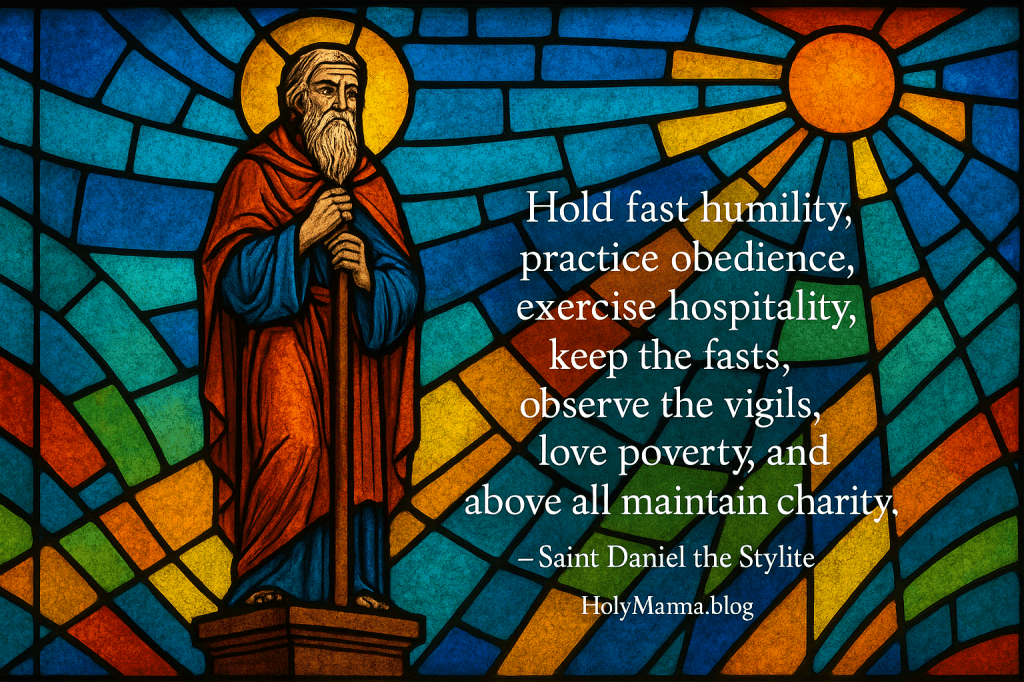
Near the end of his life, Daniel foretold the day of his death. He gathered his disciples at the foot of the pillar and offered them his final exhortation. Among his last recorded teachings is a beautiful summary of Christian life: “Hold fast humility, practice obedience, exercise hospitality, keep the fasts, observe the vigils, love poverty, and above all maintain charity.” After receiving Holy Communion, he peacefully fell asleep in the Lord. At the moment of his passing, a man possessed by a demon was delivered, revealing once again Daniel’s spiritual power.
The emperor ordered a magnificent tomb for him, but Daniel insisted that he be buried beneath the relics of the three young men Ananias, Azarias, and Misael from the Book of Daniel, so that any miracles occurring at his grave would be attributed first to them rather than to himself. Even in death he chose humility. His burial place and the site of his pillar quickly became centers of pilgrimage. Numerous healings and conversions were attributed to his intercession. The Church sees saints like Daniel in light of The Catechism: “The saints in heaven… share in the living tradition of prayer by the example of their lives, the transmission of their writings, and their prayer today.” (CCC 2683). Daniel continues to intercede for those who battle temptation, seek deeper prayer, or struggle to hold fast to Catholic truth.
What A Fifth Century Stylite Says To A Digital Age
At first glance a man who lived atop a pillar for decades may seem distant from the concerns of modern life, but his witness speaks powerfully today. Daniel shows that the universal call to holiness is not an abstract idea. As The Catechism teaches, “All Christians in any state or walk of life are called to the fullness of Christian life and to the perfection of charity.” (CCC 2013). His pillar becomes a symbol of the interior monastery every Christian must construct in the heart, a place set apart for God.
Daniel teaches the importance of carving out time for silence, prayer, and sacramental life. His willingness to embrace the Cross rather than flee from it challenges believers to accept suffering with faith rather than bitterness. His simple prayer before beginning his stylite life captures his spirit of surrender: “I yield Thee glory, Jesus Christ my God, for all the blessings which Thou hast heaped upon me.” That attitude transforms daily trials into occasions of grace. His final exhortations to humility, obedience, charity, and fasting remain just as relevant now as in the fifth century. Above all, Daniel reminds us that love for God and love for the Church cannot be separated. From his pillar he defended Catholic doctrine, supported the faithful, confronted emperors, and interceded tirelessly for the world. His life strengthens modern Christians in the call to witness publicly to Christ with charity and courage.
Engage With Us!
Saint Daniel the Stylite may have stood far above the world physically, but spiritually he stands close to every Christian who longs for holiness. His pillar is gone, yet his example continues to inspire hearts across the centuries. Share your thoughts, insights, and questions in the comments below so that we can learn from each other and deepen our understanding of this remarkable saint.
- Which aspect of Saint Daniel’s life challenges your comfort the most and why?
- What would it look like for you to “build a pillar” in your daily routine, meaning a protected space and time dedicated to God alone?
- Are there areas where fear of suffering or ridicule keeps you from living your faith openly, and how can Saint Daniel’s courage guide you?
- How can fasting, vigils, or small acts of penance be integrated into daily life in a healthy and balanced way?
- Where might God be inviting you to witness more clearly to the truth of the Catholic faith in your home, workplace, or community?
May Saint Daniel the Stylite inspire every reader to love Christ above comfort, cling to the Church with fidelity, and walk each day with courage, humility, and joy. Live boldly in faith and let everything be done with the love and mercy that Jesus has taught us.
Saint Daniel the Stylite, pray for us!
Follow us on Instagram and Facebook for more insights and reflections on living a faith-filled life.

 Holy Manna!
Leave a comment