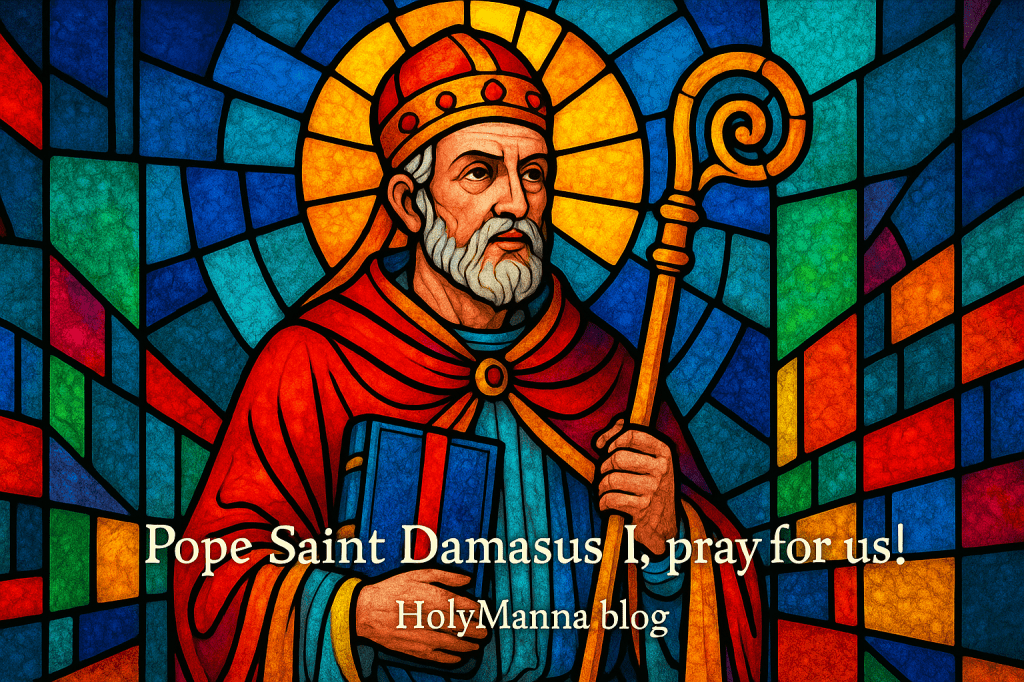
Shepherd of Scripture and Defender of the Martyrs
Pope Saint Damasus I stands at one of the most decisive turning points in Christian history. Serving as Bishop of Rome from 366 to 384, he led the Church as it transitioned from the age of persecution into a time when Christianity emerged into public life across the Roman Empire. He is remembered for defending the true doctrine of Christ during years of heresies, strengthening the authority of the Roman Church, clarifying the biblical canon at the Council of Rome in 382, and commissioning Saint Jerome to produce what became the Latin Vulgate Bible. He also restored the ancient catacombs and composed inscriptions honoring the martyrs, which is why he is venerated today as the patron saint of archaeologists. The Church remembers him as a strong and steady pastor whom God used to protect Scripture, preserve apostolic teaching, and safeguard the memory of those who died for Christ.
Roots in a Divided Empire
Damasus was born around the year 305, either in Rome or in the Roman province of Hispania. His parents, Antonius and Laurentia, were originally from Lusitania in what is now Portugal and western Spain. They later moved to Rome where his father became a priest at the Church of Saint Lawrence. Damasus grew up serving alongside his father in that same church and eventually became a deacon and a priest. This early formation immersed him in the life of the Church during a time when Roman persecutions had ended, but the peace that followed brought new challenges. These challenges included theological disputes, rivalries between bishops, and conflicts involving the imperial court.
Damasus served under Pope Liberius and supported him during the Arian crisis, even accompanying him into exile. After Liberius died in 366, Damasus was elected Bishop of Rome, though his election was contested by a rival group who supported a deacon named Ursinus. This dispute tragically led to violence in Rome and caused deep wounds in the Christian community. Over time, imperial authority recognized Damasus’ legitimacy, and he continued the difficult mission of leading the Church in a turbulent era. Despite controversy and opposition, he would go on to shape how Catholics receive Scripture and remember the martyrs today.
The Bishop Who Guarded the Word
Damasus’ pontificate unfolded amid intense theological conflicts. He worked tirelessly to defend the Nicene faith against heresies such as Apollinarianism, which denied Christ’s full humanity, and Macedonianism, which denied the divinity of the Holy Spirit. His greatest contribution to the universal Church came through the Council of Rome in 382, which issued a list of biblical books that corresponds to the canon later affirmed at the Council of Trent. The Catechism of the Catholic Church teaches that “It was by the apostolic Tradition that the Church discerned which writings are to be included in the list of the sacred books.” (CCC 120). Pope Damasus stands at the center of that historic discernment.
His concern for Scripture did not stop there. He wanted the faithful to hear the Word of God clearly, so he commissioned Saint Jerome to revise and standardize the Latin Scriptures. Jerome later praised him as “an incomparable person, learned in the Scriptures, a virgin doctor of the virgin Church, who loved chastity and heard its praises with pleasure.” This affection and respect between the two saints gave the Church one of its most foundational treasures: the Latin Vulgate, which shaped Western Christianity for over a thousand years.
The Catechism explains that “Sacred Scripture is the speech of God as it is put down in writing under the breath of the Holy Spirit.” (CCC 81). Through the work of Damasus and Jerome, that divine speech reached countless believers in clear and faithful translation. Although historical records do not preserve accounts of dramatic miracles performed personally by Damasus, the lasting effects of his leadership are themselves signs of divine guidance. The clarity of the biblical canon, the preservation of the martyrs’ memory, and the widespread use of the Vulgate bear witness to the grace that shaped his mission.
Steadfast Through Trials
Damasus’ papacy was not free from suffering. His contested election and the violence that surrounded it led rivals to accuse him of serious crimes, including murder, though historians recognize these accusations as politically motivated. He faced opposition from various factions within the Church, as well as the doctrinal chaos that swept through the empire. Arianism still held influence in the East, and the Church at Antioch was divided by schism. Damasus worked to support bishops loyal to the Nicene Creed and to promote unity across the Christian world.
During his lifetime, Emperor Theodosius I issued the famous decree known as De fide Catholica, which recognized Nicene Christianity as the official religion of the empire. Damasus saw the Church move from the shadows of persecution into a new era of public witness. He died on December 11, 384, after eighteen years of service as Bishop of Rome. Although he did not die as a martyr, he is honored as a confessor who endured hardship for the sake of Christ and His Church. In one of his poetic inscriptions, Damasus expressed his hope in the Resurrection with the simple yet profound line: “He, I believe, will make Damasus rise again from the dust.” His words echo the core of Christian hope and reveal the faith that sustained him.
The Hidden Glory After Death
After his death, Damasus was buried near his mother and sister along one of the Roman roads outside the city. Although he had constructed a papal crypt near the tombs of the martyrs, he chose not to be buried among them. His epitaph preserves a beautiful expression of humility and reverence: “I, Damasus, wished to be buried here, but I feared to offend the ashes of these holy ones.” This short inscription reveals his deep love for the martyrs and his awareness of their holiness.
Damasus restored the ancient catacombs, reopened access to the tombs of the martyrs, and carved Latin inscriptions in elegant script to preserve their stories. Many of these inscriptions survive today and offer precious testimony to the early Christian faith. Although detailed miracle accounts after his death are not widely preserved, his spiritual influence continues through the communion of saints. The Catechism teaches that “the communion of saints is the Church” (CCC 946) and that when the Church celebrates the memorials of the saints, “she proposes them to the faithful as examples and through their merits she begs for God’s favors.” (CCC 1173). Pope Saint Damasus I stands among the great pastors who continue to intercede for the Church and guide the faithful toward deeper love for Scripture and for the witness of the martyrs.
Living the Legacy of Pope Saint Damasus I
The life of Pope Saint Damasus I speaks powerfully to Catholics today. He lived in a time of doctrinal confusion and internal division, yet he remained firmly rooted in truth and completely devoted to the Word of God. His example invites believers to immerse themselves in Scripture, not as isolated readers but as members of a Church guided by the Holy Spirit. The Catechism reminds us that Scripture and Tradition together form one sacred deposit of the Word of God and must be received with equal devotion and reverence. His fidelity to the martyrs encourages Catholics to remember those who gave everything for Christ and to let their witness inspire courage in moments of personal struggle. His perseverance during conflict teaches that holiness often grows in the soil of trial and misunderstanding. Above all, his confidence in the Resurrection offers every believer a steady anchor of hope.
Engage with Us
Share your thoughts and reflections in the comments below. Pope Saint Damasus I lived through years of turmoil, yet God used him to give the Church clarity, unity, and a renewed love for Scripture.
- How does learning about the biblical canon deepen your understanding of Scripture as part of the living Tradition of the Church?
- What does the faithfulness of Pope Saint Damasus I teach about staying rooted in truth when the Church faces internal conflict?
- How can devotion to the martyrs strengthen your own courage and trust in Jesus today?
- Where might God be inviting you to grow in love for Sacred Scripture and for the teachings of the Church?
- In what ways can the steadfastness of Pope Saint Damasus I inspire your daily witness to Christ in your home, parish, or workplace?
May the example and prayers of Pope Saint Damasus I encourage you to live a life of faith, to hold fast to the Word of God, and to do everything with the love and mercy that Jesus taught us.
Pope Saint Damasus I, pray for us!
Follow us on Instagram and Facebook for more insights and reflections on living a faith-filled life.

 Holy Manna!
Leave a comment