Wednesday of the Second Week of Advent – Lectionary: 183
Carried by God When Life Feels Too Heavy
Some days the soul feels like it is running on fumes. The to do list is full, the heart is tired, and even spiritual life can feel like one more weight to carry. Into that very place, today’s readings speak with incredible tenderness. Together, Isaiah 40:25-31, Psalm 103:1-4, 8, 10, and Matthew 11:28-30 reveal a God who is not distant or indifferent, but deeply attentive, endlessly strong, and full of mercy toward the weak and worn out.
In The Book of Isaiah, these verses come from a section often called the Book of Consolation, addressed to Israel in a time of exile and disappointment. God’s people felt forgotten and abandoned, convinced that their situation was hidden from the Lord. Into that doubt, God reminds them that He is the Creator of the stars, the One who calls each of them by name, and yet He chooses to focus that power on giving strength to the faint and renewing the hope of those who wait on Him. The image of soaring on eagles’ wings is not about instant escape from problems, but about receiving a supernatural strength that allows the faithful to keep walking when human endurance would have given up long ago.
Psalm 103 then puts this same truth into a song of praise. The psalmist calls the soul to remember who God really is: the One “who pardons all your sins, and heals all your ills,” “who redeems your life from the pit, and crowns you with mercy and compassion.” In a world that often treats people according to performance, success, and image, this psalm anchors the heart in a God who does not deal with His children as their sins deserve. Instead, He moves toward them with patient love, slow to anger and rich in mercy. This sets the spiritual backdrop for understanding the heart of Jesus in the Gospel.
By the time the scene in The Gospel of Matthew unfolds, many in Israel were weighed down by heavy religious expectations and the crushing burdens of life under Roman occupation. When Jesus says, “Come to me, all you who labor and are burdened, and I will give you rest.” He is speaking into a culture where a rabbi’s teaching was known as a “yoke.” Some teachers laid heavy loads on people’s shoulders. Christ, instead, offers His own yoke, which is not the absence of discipleship but the gift of walking in step with a meek and humble Heart. His promise that “my yoke is easy, and my burden light” is not a motivational slogan, but the concrete assurance that He carries what cannot be carried alone.
Taken together in the light of Advent, these readings reveal a single, consoling theme: the all-powerful God chooses to meet human weakness with merciful strength and real rest. The Lord who created the stars, the Lord who forgives and heals, and the Lord who invites the weary to His Heart are one and the same. As the Church waits for Christ’s coming, these passages invite every tired, overburdened soul to stop pretending to be strong enough and to let the living God be the One who renews strength, heals wounds, and carries the weight that feels impossible.
First Reading – Isaiah 40:25-31
The Creator Who Never Gets Tired of the Tired
This passage comes from a section of The Book of Isaiah often called the Book of Consolation, spoken to Israel in a time of exile and deep discouragement. The people had seen their kingdom fall, their temple destroyed, and their identity shaken. Many believed that their suffering meant God had forgotten them. Into that spiritual exhaustion, God speaks through Isaiah and reminds His people who He really is. He is not a small tribal deity limited by borders or politics. He is the Creator of the ends of the earth, the One who calls every star by name, yet bends down to give strength to the weak and hope to the worn out.
In the context of today’s theme, this reading prepares the heart to hear the invitation of Christ in Matthew 11:28-30. The God who never grows weary in Isaiah 40 is the same God who in the Gospel says, “Come to me, all you who labor and are burdened, and I will give you rest.” This first reading reveals that God does not despise human weakness. Instead, He meets it with His own unfailing strength, so that those who hope in Him can keep walking when every natural reason says it is time to collapse.
Isaiah 40:25-31
New American Bible (Revised Edition)
25 To whom can you liken me as an equal?
says the Holy One.
26 Lift up your eyes on high
and see who created these:
He leads out their army and numbers them,
calling them all by name.
By his great might and the strength of his power
not one of them is missing!
27 Why, O Jacob, do you say,
and declare, O Israel,
“My way is hidden from the Lord,
and my right is disregarded by my God”?
28 Do you not know?
Have you not heard?
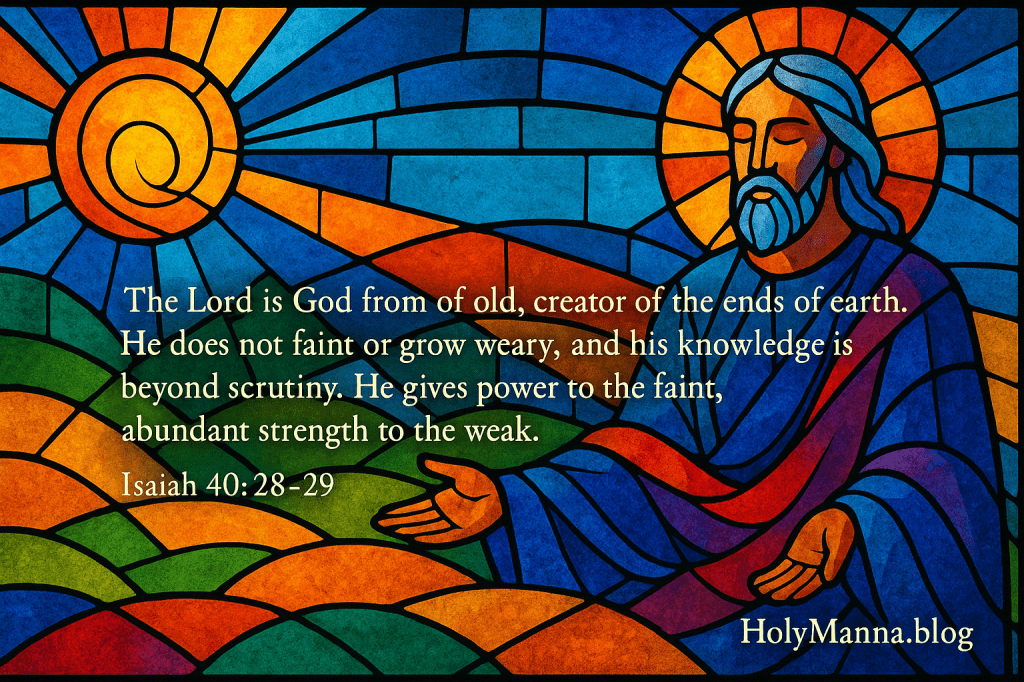
The Lord is God from of old,
creator of the ends of the earth.
He does not faint or grow weary,
and his knowledge is beyond scrutiny.
29 He gives power to the faint,
abundant strength to the weak.
30 Though young men faint and grow weary,
and youths stagger and fall,
31 They that hope in the Lord will renew their strength,
they will soar on eagles’ wings;
They will run and not grow weary,
walk and not grow faint.
Detailed Exegesis
Verse 25 – “To whom can you liken me as an equal? says the Holy One.”
God begins with a rhetorical question that exposes the small images people often have of Him. In a world filled with idols and rival gods, He reminds Israel that no one can be compared to Him. The title “the Holy One” underlines God’s absolute otherness, purity, and majesty. This verse gently confronts every attempt to shrink God down to a distant manager or a powerless spectator. For someone who feels abandoned, God is saying that the problem is not His weakness. The problem is a wounded vision of who He really is.
Verse 26 – “Lift up your eyes on high and see who created these: He leads out their army and numbers them, calling them all by name. By his great might and the strength of his power not one of them is missing!”
Here God invites the people to look up at the night sky. The stars were often seen as symbols of cosmic powers, but Isaiah reminds Israel that God is the One who created them, orders them, and calls each one by name. The image of an army suggests precision and authority, yet it is paired with personal care, since none is missing. If God can keep track of every star, then every child of God is infinitely more known and held. This verse pushes back against the lie that suffering means invisibility. In God’s gaze, no one is forgotten, no story is lost, and no tear is unseen.
Verse 27 – “Why, O Jacob, do you say, and declare, O Israel, ‘My way is hidden from the Lord, and my right is disregarded by my God’?”
This verse directly voices the complaint in the hearts of the people. It is not just physical exile. It is a spiritual crisis. They feel overlooked, unseen, and treated unfairly. God does not silence this complaint. He repeats it back, which shows that He has heard it. The question exposes the gap between their feelings and reality. God’s love does not erase honest struggle, but it invites a deeper trust. The verse names a temptation many believers face in trials: the belief that God has stopped paying attention.
Verse 28 – “Do you not know? Have you not heard? The Lord is God from of old, creator of the ends of the earth. He does not faint or grow weary, and his knowledge is beyond scrutiny.”
The prophet uses a kind of holy reminder: this is not new information. Israel has already received revelation about who God is. The Lord is eternal, the Creator of everything, and His strength is inexhaustible. Where human beings hit limits, God never gets tired or overwhelmed. His knowledge is “beyond scrutiny”, which means He sees the full picture when human perspective is painfully limited. This verse invites a believer to rest in the truth that God knows what He is doing, even when His plan does not make immediate sense.
Verse 29 – “He gives power to the faint, abundant strength to the weak.”
Here the tone becomes especially tender. God’s infinite strength is not abstract. It is deeply personal. Divine power is given precisely to the faint and the weak, not to the self sufficient and proud. The verse reveals the heart of God as a giver of strength, not a critic of weakness. This sets the stage for understanding the gentle heart of Christ in the Gospel. God is not waiting at the finish line to congratulate the strong. God steps into the middle of exhaustion and pours out strength that a human being could never generate alone.
Verse 30 – “Though young men faint and grow weary, and youths stagger and fall,”
In human terms, youth represents energy, capacity, and potential. Yet even the strongest eventually reach the end of their resources. This verse dismantles the illusion that natural vigor is enough to carry a soul through life. Emotional, spiritual, and physical fatigue hit every age and stage. The point is not to shame human limits, but to emphasize that everyone, even the most capable and impressive, needs a strength that comes from beyond themselves.
Verse 31 – “They that hope in the Lord will renew their strength, they will soar on eagles’ wings; they will run and not grow weary, walk and not grow faint.”
This closing promise is one of the most loved lines in Isaiah. The key is the phrase “they that hope in the Lord.” The condition is not perfect performance but trusting expectation. To hope in God is to lean on His character, to wait on His timing, and to surrender to His wisdom. The images that follow show different stages of spiritual life. Sometimes grace feels like soaring, rising above circumstances like an eagle carried by the wind. Sometimes it feels like running without collapsing. Often it simply looks like walking without giving up. The promise is not an escape from all hardship, but a supernatural endurance that keeps a disciple faithful in every season.
Teachings of the Church
The Church teaches that God is both infinitely powerful and intimately involved in creation. CCC 301 explains that God not only created the world but also sustains and directs it at every moment, stating in summary that God holds and governs all things with wisdom and love. This fits perfectly with Isaiah 40:26, where God is shown counting and guiding the stars. If God sustains the universe, then every human life is also sustained by His loving providence.
The theme of divine omnipotence and mercy also appears in CCC 268, which highlights that God shows His almighty power most clearly in mercy and forgiveness. That means the strength promised in Isaiah 40:29 is not cold force. It is merciful strength aimed at healing, lifting, and restoring. When Psalm 103 proclaims that God “pardons all your sins” and “heals all your ills”, it echoes the same truth revealed through Isaiah’s words about renewed strength for those who hope in the Lord.
On the virtue of hope, CCC 2090 teaches that Christian hope is the confident expectation of divine blessing and the beatific vision of God. Hope is not vague optimism. Hope rests on God Himself. That is the spiritual engine of Isaiah 40:31. The promise of running without weariness belongs to those whose confidence is rooted in God’s character, not in their own resilience.
Many saints have lived this passage in dramatic ways. Saint Augustine wrote in Confessions: “You have made us for yourself, O Lord, and our heart is restless until it rests in you.” This famous line captures the same reality as Isaiah’s promise. Human restlessness and fatigue find true renewal only when anchored in God. Saint Thérèse of Lisieux, in her spirituality of littleness, trusted precisely in God’s willingness to stoop down to the weak, often comparing herself to a small child relying entirely on the Father’s arms. That childlike trust reflects what Isaiah 40 describes: not heroic self sufficiency, but radical dependence on a Father whose strength never runs out.
Historically, this passage has comforted generations of believers during persecution, war, and personal loss. In times when the Church has walked through exile like Israel, or when individual Catholics endure hidden suffering, Isaiah 40 has been a reminder that God’s covenant love does not expire when circumstances grow dark. The same God who carried Israel through exile now carries every disciple toward the rest that Christ promises in The Gospel of Matthew.
Reflection
In daily life, this reading speaks directly into experiences of burnout, discouragement, and spiritual dryness. Many believers know what it feels like to pray and secretly think, “My way is hidden from the Lord.” Careers stall, relationships strain, family life becomes heavy, and temptations feel relentless. Into that space, God’s word insists that He has not forgotten a single detail. The Holy One who calls every star by name sees every hidden struggle and every quiet act of fidelity.
Practically, this passage invites a few concrete responses. First, it calls a believer to stop pretending to have limitless strength. Admitting weakness is not failure. It is the doorway through which God’s strength enters. Bringing exhaustion, confusion, and even frustration honestly before God in prayer is a powerful act of trust. Second, it encourages a return to hope. Hope is not a feeling. Hope is a decision to lean again on God’s promises, even when emotions lag behind. Third, it suggests a slow, faithful perseverance. Sometimes grace looks like soaring inspiration, but very often it looks like taking the next small step, trusting that God will supply enough strength for today.
This reading also pairs beautifully with Christ’s words in Matthew 11:28 that invite the weary to come to Him for rest. The God who renews strength in Isaiah 40 does so most fully through Jesus, whose Sacred Heart is meek and humble and who shares the burden with every disciple who accepts His yoke.
For personal prayer, it can be helpful to sit quietly with the question: Where does life feel most exhausting right now, and where is there a need for God’s strength rather than more self effort? Another helpful question is: What would it look like today to hope in the Lord in a very specific situation, rather than give in to despair or self reliance?
By letting these verses sink in, a believer begins to move from anxious striving into a deeper trust that the Lord really can make someone walk and not grow faint, run and not grow weary, and in His time even soar on eagles’ wings.
Responsorial Psalm – Psalm 103:1-4, 8, 10
Remembering Mercy When the Soul Is Worn Out
Psalm 103 is a hymn of personal praise traditionally attributed to David. It reads like the prayer of someone who has seen both sin and suffering, yet has discovered that the deepest truth about God is His mercy. In ancient Israel, praise was not just an emotional response but a decision of faith. The psalmist speaks to his own soul, almost preaching to himself, calling his inner life back to the truth of who God is and what God has done.
In the context of today’s readings, this psalm acts like the heart’s response to what Isaiah 40:25-31 proclaims and what Matthew 11:28-30 promises. Isaiah reveals God as the One who gives strength to the faint. The Gospel shows Jesus inviting the weary to rest in His Heart. Psalm 103 shows what happens when a believer actually remembers this and lets it sink in. The soul begins to bless the Lord, not because life magically becomes easy, but because the mercy of God becomes more real than sin, failure, or exhaustion. This psalm anchors the theme that God’s merciful strength gives true rest to the weary heart that hopes in Him.
Psalm 103:1-4, 8, 10
New American Bible (Revised Edition)
Praise of Divine Goodness
1 Of David.
Bless the Lord, my soul;
all my being, bless his holy name!
2 Bless the Lord, my soul;
and do not forget all his gifts,
3 Who pardons all your sins,
and heals all your ills,
4 Who redeems your life from the pit,
and crowns you with mercy and compassion,
8 Merciful and gracious is the Lord,
slow to anger, abounding in mercy.
10 He has not dealt with us as our sins merit,
nor requited us as our wrongs deserve.
Detailed Exegesis
Verse 1 – “Bless the Lord, my soul; all my being, bless his holy name!”
The psalmist starts by addressing his own soul. This is more than a poetic device. It is a conscious act of self command, urging every part of the person to enter into praise. “All my being” suggests that worship is not meant to be half hearted or purely external. The holy name of God points to His identity, His character, and His covenant love. In a time of weariness, this verse calls the believer to lift the inner gaze away from circumstances and back to the Lord Himself. It echoes God’s call in Isaiah 40:26 to “Lift up your eyes on high and see who created these.”
Verse 2 – “Bless the Lord, my soul; and do not forget all his gifts,”
Forgetfulness is a real spiritual danger. Israel often forgot the Lord’s deeds and fell into fear or rebellion. The psalmist fights this by commanding his soul not to forget. Remembering is a deliberate spiritual discipline. The phrase “all his gifts” opens a door to gratitude, inviting the believer to recall specific ways God has been faithful, from forgiveness and healing to daily providence. When life feels heavy, this verse invites the heart to rehearse God’s goodness instead of replaying fears or resentments.
Verse 3 – “Who pardons all your sins, and heals all your ills,”
Here the psalmist names the first and greatest gift: forgiveness. God does not ignore sin. God pardons it. The word “all” is crucial. There is no category of sin beyond the reach of God’s mercy when a sinner repents. The verse then moves to healing, which can include physical, emotional, and spiritual wounds. The order matters. First God deals with the root problem, which is sin, then He works to heal the damage it has caused. This verse pairs strongly with the rest offered by Christ in The Gospel of Matthew. The heaviest burden on the human heart is not just stress but sin. God’s forgiveness lifts that burden in a way nothing else can.
Verse 4 – “Who redeems your life from the pit, and crowns you with mercy and compassion,”
The “pit” in Scripture often symbolizes death, destruction, or extreme distress. God does not just watch a soul sink into the pit. God steps in to redeem, to buy back, to rescue. The language of “crowns you with mercy and compassion” is royal and intimate. A crown rests on the head and marks identity. Mercy and compassion are not occasional gestures from God. They become like a constant covering over the life of His child. For someone who feels unworthy or ashamed, this verse is a powerful reminder that God’s desire is not to humiliate but to restore dignity.
Verse 8 – “Merciful and gracious is the Lord, slow to anger, abounding in mercy.”
This line echoes God’s self-revelation to Moses in Exodus 34:6. It is one of the core descriptions of who God is throughout the Old Testament. The Lord is not quick tempered, easily offended, or eager to punish. God is patient, giving time for repentance, and overflowing with mercy. The phrase “abounding in mercy” could be heard beside Jesus’ words in Matthew 11:29: “I am meek and humble of heart.” The same gentle heart that offers rest in the Gospel is described here in the language of covenant mercy.
Verse 10 – “He has not dealt with us as our sins merit, nor requited us as our wrongs deserve.”
This verse brings the psalmist to a humble awe. Justice would mean receiving exactly what sins deserve. Instead, God acts with mercy, not by denying justice but by going beyond it. This finds its fullest expression in Christ’s sacrifice on the Cross, where He bears the weight of sin so that believers receive grace instead of condemnation. For the tired soul, especially one burdened by guilt, this verse speaks incredible comfort. God is not keeping a cold scorecard. God is offering a mercy that outruns every failure brought to Him in repentance.
Teachings of the Church
Psalm 103 lines up closely with how the Church understands praise, mercy, and divine patience. Regarding praise, CCC 2639 teaches: “Praise is the form of prayer which recognizes most immediately that God is God. It lauds God for his own sake, gives him glory, quite beyond what he does, but simply because HE IS.” This reflects the psalmist’s call, “Bless the Lord, my soul; all my being, bless his holy name!” Praise is not just thanking God for gifts. It is recognizing and honoring who God is.
On divine mercy, CCC 210 states: “After Israel’s sin, when the people had turned away from God to worship the golden calf, God hears Moses’ prayer of intercession and agrees to walk in the midst of an unfaithful people, thus demonstrating his love. When Moses asks to see his glory, God responds: ‘I will make all my goodness pass before you, and will proclaim before you my name.’ Then the Lord passes before him and proclaims, ‘YHWH, YHWH, a God merciful and gracious, slow to anger, and abounding in steadfast love and faithfulness.’” Psalm 103:8 directly echoes this revelation. The God praised in the psalm is the same God who revealed Himself to Moses as merciful and gracious.
Regarding forgiveness of sins, CCC 1846 teaches: “The Gospel is the revelation in Jesus Christ of God’s mercy to sinners.” This connects beautifully with “Who pardons all your sins” and with Jesus’ invitation to the heavy laden in Matthew 11:28. The Gospel does not just offer advice. It reveals a merciful God who acts to forgive and restore.
The truth that God does not repay according to sins finds a strong echo in CCC 2840: “Now and this is daunting, this outpouring of mercy cannot penetrate our hearts as long as we have not forgiven those who have trespassed against us. Love, like the Body of Christ, is indivisible; we cannot love the God we cannot see if we do not love the brother or sister we do see.” If God has not dealt with believers as their sins deserve, then they are called to imitate that mercy in relationships with others.
The saints also drank deeply from this psalm. Saint John Paul II often returned to themes of divine mercy, especially in his encyclical Dives in Misericordia, where he wrote: “Mercy is love’s second name and the specific manner in which love is revealed and effected vis a vis the reality of the evil that is in the world.” That insight mirrors the movement of Psalm 103: God’s love shows itself precisely in the way He deals with sin and suffering, not by ignoring them but by transforming them in mercy.
Reflection
In everyday life, Psalm 103 is like a spiritual workout for a tired heart. The psalmist does not wait to feel inspired. He tells his soul to bless the Lord and not forget His gifts. Many believers know what it is like to focus almost entirely on problems, annoyances, sins, and fears. This psalm gently but firmly invites a shift. Instead of rehearsing everything that is wrong, the soul is invited to remember everything God has done and everything God is.
Practically, this can mean taking a few minutes at the start or end of the day to name specific blessings, moments of forgiveness, and ways God has shown mercy. Writing them down or speaking them in prayer can help the heart obey the command: “do not forget all his gifts.” When guilt surfaces, returning to “Who pardons all your sins” can help the believer bring that guilt to confession rather than staying stuck in shame. When discouragement hits, remembering that God “redeems your life from the pit” can keep despair from taking over.
This psalm also challenges disciples to imitate God’s mercy. If the Lord has not dealt with His children as their sins merit, then grudges, harsh judgments, and resentments lose their justification. Mercy given should become mercy shared. Choosing to forgive, even if emotions lag behind, becomes a way of reflecting the God who crowns His people with compassion.
For personal prayer, it can be powerful to ask: What specific sins or failures is the heart still holding onto as if God has not forgiven them? Another strong question is: Where is there a tendency to deal with others according to what their actions deserve rather than according to the mercy God has shown?
As Psalm 103 sinks in, the soul slowly learns to bless the Lord even in exhaustion, to remember mercy in the middle of mess, and to rest in the truth that God is better than anyone’s worst fears about Him.
Holy Gospel – Matthew 11:28-30
The Gentle Yoke That Lifts, Not Crushes
This short passage from The Gospel of Matthew opens a window straight into the Heart of Christ. Historically, Jesus speaks these words to people weighed down by multiple burdens. There was the political pressure of Roman occupation, the economic weight of poverty, and the religious load of complex interpretations of the Law that some teachers placed heavily on ordinary people. In that world, a rabbi’s teaching was called a “yoke.” Some yokes were demanding in ways that left people spiritually exhausted and feeling like they could never measure up.
Into that setting, Jesus does something radical. He does not start by adding more rules or telling people to try harder. Instead, He invites those who are worn out, stressed, and spiritually tired to come to Him personally. His words reveal not only what He offers but who He is. Isaiah has just proclaimed that the Lord does not grow weary and that He gives strength to the faint in Isaiah 40:25-31. The psalm has praised God as the One who forgives sins and heals all ills in Psalm 103. Now Jesus, the Son of God made flesh, stands before the weary and speaks with that same divine tenderness: “Come to me.”
This Gospel fits perfectly into today’s theme that God’s merciful strength gives true rest to the weary heart that hopes in Him. Christ does not deny that life is heavy. Instead, He offers a new way to carry it, with Him, under His yoke, in union with His meek and humble Heart.
Detailed Exegesis: Verse by Verse with the Heart of Jesus
Verse 28 – “Come to me, all you who labor and are burdened, and I will give you rest.”
The first word is the key: “Come.” Jesus does not say, “Figure it out” or “Fix yourself first.” He calls people to Himself. The invitation is universal. “All you who labor and are burdened” includes those crushed by sin, anxiety, family drama, work stress, scruples, and hidden suffering. The burdens may be external circumstances or interior weights. The promise “I will give you rest” is not just about a nap or a vacation. It is a deep, spiritual rest that touches the soul, rooted in reconciliation with God and the gift of divine friendship. This is the answer to the exhaustion voiced in Isaiah 40:27 where Israel feels forgotten. Jesus reveals that no one’s way is hidden from Him. He sees each burden and offers Himself as the place of rest.
Verse 29 – “Take my yoke upon you and learn from me, for I am meek and humble of heart; and you will find rest for yourselves.”
The second movement of the invitation is surprising. Jesus does not say, “Throw off every yoke.” Instead, He says, “Take my yoke upon you.” Discipleship is not freedom from all responsibility. It is sharing Jesus’ way of life. A yoke joins two animals so that they pull together. To accept Christ’s yoke is to walk in step with Him, letting Him carry the weight that cannot be handled alone.
He also says, “learn from me.” He presents Himself not just as a teacher of ideas but as the living pattern of how to be human. The reason He can promise real rest is revealed in His self description: “for I am meek and humble of heart.” The Heart of Jesus is not harsh, impatient, or easily disgusted by weakness. His meekness means He is gentle with fragile souls. His humility means He stoops low, entering the mess, instead of remaining distant. The promise “you will find rest for yourselves” echoes Jeremiah 6:16, where the people are told to walk in the ancient paths and find rest for their souls. Jesus now declares that the true path of rest is not a philosophy but relationship with Him.
Verse 30 – “For my yoke is easy, and my burden light.”
This is one of the most beloved lines in all of The Gospel of Matthew, but it can be misunderstood. Jesus does not say that life without crosses exists. He speaks of “my yoke” and “my burden.” There is still a cross. There is still the call to deny oneself, love enemies, forgive seventy times seven, and carry daily responsibilities. The difference is that His yoke is “easy” and His burden “light.” The word “easy” can also mean “well fitting.” In other words, the yoke Jesus gives is tailored to the soul, crafted in love by One who knows the person completely. His burden is light because He shoulders the heaviest part and fills the believer with grace. This connects directly with Isaiah 40:31, where those who hope in the Lord “will run and not grow weary, walk and not grow faint.” Under Christ’s yoke, the soul receives supernatural strength and the quiet joy of knowing that nothing is faced alone.
Teachings: The Sacred Heart and the Rest Found in Christ
The Church has always seen this passage as a precious window into the Sacred Heart of Jesus. CCC 478 teaches: “Jesus has loved us all with a human heart.” This line reveals that the meek and humble Heart described in this Gospel is not a poetic image but a real, living Heart that beats with human and divine love for every person. His invitation “Come to me” flows from that Heart.
Regarding Christ as model and teacher, CCC 520 states: “In all of his life Jesus presents himself as our model.” His invitation to “learn from me” is not abstract. Every hidden moment of His life, from Nazareth to Calvary, shows how to live in trustful obedience to the Father and in love for others. The yoke He offers is the way He already walked.
This passage also relates closely to the virtue of humility. CCC 2540 teaches that true humility opens the heart to joy in God. The Heart of Jesus is described as humble, and this humility is not weakness. It is the strength of love that does not cling to status but pours itself out. Taking His yoke means embracing that same humility, which paradoxically leads to deep rest instead of constant inner tension.
The Church’s devotion to the Sacred Heart grows out of texts like this one. In the revelations to Saint Margaret Mary Alacoque, Jesus showed His Heart as burning with love for humanity, wounded by indifference, and longing to give mercy and rest. While private revelations are not on the same level as Scripture, they echo the truth already present here: the Lord wants the weary to come close, not stay away in shame.
Many saints have drawn strength from these verses. Saint Augustine famously wrote: “Our heart is restless until it rests in you.” That rest is exactly what Jesus promises. Saint Thérèse of Lisieux loved to picture herself as a little child resting in the arms of Jesus, trusting His care more than her own efforts. That childlike trust is what accepting His easy yoke looks like in the interior life.
The Catechism also connects rest in God with prayer. CCC 2725 describes prayer as both gift and battle, but it hints that real prayer is where the soul learns to rest in God’s presence, not by escaping life, but by bringing every burden into His Heart. This is the lived response to, “Come to me, all you who labor and are burdened.”
Reflection: Letting Jesus Carry What You Cannot
In daily life, this Gospel invites a very honest look at the burdens being carried. There are burdens that God truly asks a person to shoulder: responsibilities toward family, work, parish, and the moral law. There are also extra burdens that are often added: perfectionism, constant comparison, fear of disappointing others, secret sins, unresolved guilt, and the pressure to control everything. Jesus does not offer a spiritual escape from reality. He offers companionship, strength, and rest in the middle of it.
Practically, responding to this Gospel can unfold in simple but real steps. First, it helps to name the specific burdens that feel heaviest right now. Bringing them consciously into prayer and placing them before the Lord’s words, “Come to me,” opens the heart to grace. Second, there is a call to accept His yoke, which means choosing His way instead of self chosen paths. This might look like returning to regular confession to let Him lift the weight of sin, recommitting to daily prayer even in dryness, or choosing forgiveness instead of resentment in a relationship. Third, it means learning from His meek and humble Heart. That can involve resisting harsh self talk, being gentler with personal weaknesses, and treating others with patience that mirrors His own.
This passage also challenges the belief that holiness is only for the strong. Jesus invites exactly those who labor and are burdened. That includes the parent up all night with a child, the single person battling loneliness, the worker anxious about bills, and the person fighting a hidden temptation. Rest in Christ does not always mean changed circumstances. It often means a changed interior posture: trusting that He walks beside the believer, that His grace is enough for today, and that He delights in being invited into the struggle.
For personal meditation, a few questions can cut straight to the heart. Where in life is there a sense of carrying a burden alone, and what would it look like to let Jesus shoulder that with you? What concrete step could be taken this week to “take His yoke” more intentionally, whether through prayer, sacrament, or an act of humble service? How might daily life change if there were real belief that His Heart is truly meek and humble toward you and not harsh or condemning?
As this Gospel passage sinks in, the soul slowly moves from a life driven by constant strain into a life lived alongside the gentle Master. Under His yoke, even heavy days can hold a hidden rest, because the one who carries the heaviest part of the load is the same Lord who promised, “you will find rest for yourselves.”
Holy Gospel – Matthew 11:28-30
The Gentle Yoke That Lifts, Not Crushes
This short passage from The Gospel of Matthew opens a window straight into the Heart of Christ. Historically, Jesus speaks these words to people weighed down by multiple burdens. There was the political pressure of Roman occupation, the economic weight of poverty, and the religious load of complex interpretations of the Law that some teachers placed heavily on ordinary people. In that world, a rabbi’s teaching was called a “yoke.” Some yokes were demanding in ways that left people spiritually exhausted and feeling like they could never measure up.
Into that setting, Jesus does something radical. He does not start by adding more rules or telling people to try harder. Instead, He invites those who are worn out, stressed, and spiritually tired to come to Him personally. His words reveal not only what He offers but who He is. Isaiah has just proclaimed that the Lord does not grow weary and that He gives strength to the faint in Isaiah 40:25-31. The psalm has praised God as the One who forgives sins and heals all ills in Psalm 103. Now Jesus, the Son of God made flesh, stands before the weary and speaks with that same divine tenderness: “Come to me.”
This Gospel fits perfectly into today’s theme that God’s merciful strength gives true rest to the weary heart that hopes in Him. Christ does not deny that life is heavy. Instead, He offers a new way to carry it, with Him, under His yoke, in union with His meek and humble Heart.
Matthew 11:28-30
New American Bible (Revised Edition)
The Gentle Mastery of Christ. 28 “Come to me, all you who labor and are burdened, and I will give you rest. 29 Take my yoke upon you and learn from me, for I am meek and humble of heart; and you will find rest for yourselves. 30 For my yoke is easy, and my burden light.”
Detailed Exegesis
Verse 28 – “Come to me, all you who labor and are burdened, and I will give you rest.”
The first word is the key: “Come.” Jesus does not say, “Figure it out” or “Fix yourself first.” He calls people to Himself. The invitation is universal. “All you who labor and are burdened” includes those crushed by sin, anxiety, family drama, work stress, scruples, and hidden suffering. The burdens may be external circumstances or interior weights. The promise “I will give you rest” is not just about a nap or a vacation. It is a deep, spiritual rest that touches the soul, rooted in reconciliation with God and the gift of divine friendship. This is the answer to the exhaustion voiced in Isaiah 40:27 where Israel feels forgotten. Jesus reveals that no one’s way is hidden from Him. He sees each burden and offers Himself as the place of rest.
Verse 29 – “Take my yoke upon you and learn from me, for I am meek and humble of heart; and you will find rest for yourselves.”
The second movement of the invitation is surprising. Jesus does not say, “Throw off every yoke.” Instead, He says, “Take my yoke upon you.” Discipleship is not freedom from all responsibility. It is sharing Jesus’ way of life. A yoke joins two animals so that they pull together. To accept Christ’s yoke is to walk in step with Him, letting Him carry the weight that cannot be handled alone.
He also says, “learn from me.” He presents Himself not just as a teacher of ideas but as the living pattern of how to be human. The reason He can promise real rest is revealed in His self description: “for I am meek and humble of heart.” The Heart of Jesus is not harsh, impatient, or easily disgusted by weakness. His meekness means He is gentle with fragile souls. His humility means He stoops low, entering the mess, instead of remaining distant. The promise “you will find rest for yourselves” echoes Jeremiah 6:16, where the people are told to walk in the ancient paths and find rest for their souls. Jesus now declares that the true path of rest is not a philosophy but relationship with Him.
Verse 30 – “For my yoke is easy, and my burden light.”
This is one of the most beloved lines in all of The Gospel of Matthew, but it can be misunderstood. Jesus does not say that life without crosses exists. He speaks of “my yoke” and “my burden.” There is still a cross. There is still the call to deny oneself, love enemies, forgive seventy times seven, and carry daily responsibilities. The difference is that His yoke is “easy” and His burden “light.” The word “easy” can also mean “well fitting.” In other words, the yoke Jesus gives is tailored to the soul, crafted in love by One who knows the person completely. His burden is light because He shoulders the heaviest part and fills the believer with grace. This connects directly with Isaiah 40:31, where those who hope in the Lord “will run and not grow weary, walk and not grow faint.” Under Christ’s yoke, the soul receives supernatural strength and the quiet joy of knowing that nothing is faced alone.
Teachings
The Church has always seen this passage as a precious window into the Sacred Heart of Jesus. CCC 478 teaches: “Jesus has loved us all with a human heart.” This line reveals that the meek and humble Heart described in this Gospel is not a poetic image but a real, living Heart that beats with human and divine love for every person. His invitation “Come to me” flows from that Heart.
Regarding Christ as model and teacher, CCC 520 states: “In all of his life Jesus presents himself as our model.” His invitation to “learn from me” is not abstract. Every hidden moment of His life, from Nazareth to Calvary, shows how to live in trustful obedience to the Father and in love for others. The yoke He offers is the way He already walked.
This passage also relates closely to the virtue of humility. CCC 2540 teaches that true humility opens the heart to joy in God. The Heart of Jesus is described as humble, and this humility is not weakness. It is the strength of love that does not cling to status but pours itself out. Taking His yoke means embracing that same humility, which paradoxically leads to deep rest instead of constant inner tension.
The Church’s devotion to the Sacred Heart grows out of texts like this one. In the revelations to Saint Margaret Mary Alacoque, Jesus showed His Heart as burning with love for humanity, wounded by indifference, and longing to give mercy and rest. While private revelations are not on the same level as Scripture, they echo the truth already present here: the Lord wants the weary to come close, not stay away in shame.
Many saints have drawn strength from these verses. Saint Augustine famously wrote: “Our heart is restless until it rests in you.” That rest is exactly what Jesus promises. Saint Thérèse of Lisieux loved to picture herself as a little child resting in the arms of Jesus, trusting His care more than her own efforts. That childlike trust is what accepting His easy yoke looks like in the interior life.
The Catechism also connects rest in God with prayer. CCC 2725 describes prayer as both gift and battle, but it hints that real prayer is where the soul learns to rest in God’s presence, not by escaping life, but by bringing every burden into His Heart. This is the lived response to, “Come to me, all you who labor and are burdened.”
Reflection
In daily life, this Gospel invites a very honest look at the burdens being carried. There are burdens that God truly asks a person to shoulder: responsibilities toward family, work, parish, and the moral law. There are also extra burdens that are often added: perfectionism, constant comparison, fear of disappointing others, secret sins, unresolved guilt, and the pressure to control everything. Jesus does not offer a spiritual escape from reality. He offers companionship, strength, and rest in the middle of it.
Practically, responding to this Gospel can unfold in simple but real steps. First, it helps to name the specific burdens that feel heaviest right now. Bringing them consciously into prayer and placing them before the Lord’s words, “Come to me,” opens the heart to grace. Second, there is a call to accept His yoke, which means choosing His way instead of self chosen paths. This might look like returning to regular confession to let Him lift the weight of sin, recommitting to daily prayer even in dryness, or choosing forgiveness instead of resentment in a relationship. Third, it means learning from His meek and humble Heart. That can involve resisting harsh self talk, being gentler with personal weaknesses, and treating others with patience that mirrors His own.
This passage also challenges the belief that holiness is only for the strong. Jesus invites exactly those who labor and are burdened. That includes the parent up all night with a child, the single person battling loneliness, the worker anxious about bills, and the person fighting a hidden temptation. Rest in Christ does not always mean changed circumstances. It often means a changed interior posture: trusting that He walks beside the believer, that His grace is enough for today, and that He delights in being invited into the struggle.
For personal meditation, a few questions can cut straight to the heart. Where in life is there a sense of carrying a burden alone, and what would it look like to let Jesus shoulder that with you? What concrete step could be taken this week to “take His yoke” more intentionally, whether through prayer, sacrament, or an act of humble service? How might daily life change if there were real belief that His Heart is truly meek and humble toward you and not harsh or condemning?
As this Gospel passage sinks in, the soul slowly moves from a life driven by constant strain into a life lived alongside the gentle Master. Under His yoke, even heavy days can hold a hidden rest, because the one who carries the heaviest part of the load is the same Lord who promised, “you will find rest for yourselves.”
Resting in the God Who Never Grows Tired of You
Today’s readings fit together like a single, gentle conversation from God’s Heart to every tired soul. In Isaiah 40:25-31, the Lord reveals Himself as the eternal Creator who never grows weary and who chooses to pour out His strength precisely on the faint and the weak. In Psalm 103:1-4, 8, 10, the psalmist reminds the soul not to forget the Lord’s gifts, especially His mercy, His forgiveness, and His refusal to treat His children as their sins deserve. Finally, in Matthew 11:28-30, Jesus, the Word made flesh, steps forward and gives that love a human voice: “Come to me, all you who labor and are burdened, and I will give you rest.”
Taken together, these readings show one unified truth. The all powerful God is not distant, irritable, or indifferent. He is near, patient, and deeply involved in the details of every life. He numbers the stars, and at the same time He knows every burden carried in silence. He pardons all sins, heals deep wounds, and lifts His children from the pit. He does not pile on impossible demands. Instead, He offers His own yoke, fitted in love, and promises that walking with Him leads to real rest, not fake comfort.
This day’s liturgy is a quiet invitation to stop pretending to be strong enough without God. It calls every heart to turn away from self reliance and toward hope in the Lord. The path forward is not complicated, but it is real. It looks like honest prayer that tells God where life feels overwhelming. It looks like returning to the sacraments with trust in His mercy. It looks like choosing to remember His benefits instead of replaying fears on repeat. It looks like learning from the meek and humble Heart of Jesus and letting that humility soften how believers treat themselves and others.
In the middle of Advent, when schedules get full and hearts feel stretched, the Lord is not asking for perfection. He is asking for trust. The promise of Isaiah is that those who hope in the Lord will renew their strength. The song of Psalm 103 is that God crowns His children with mercy and compassion. The voice of The Gospel of Matthew is Christ Himself, quietly saying, “Take my yoke upon you and learn from me.”
So this is the invitation for today: let there be a choice to bring real burdens to the Lord instead of carrying them alone. Let there be a choice to hope again, even after disappointment. Let there be a choice to rest the heart in the truth that God never gets tired of forgiving, never gets tired of strengthening, and never gets tired of walking beside His people.
Where does life feel heaviest right now, and what would it look like to hand that specific weight to Jesus and walk with Him under His yoke today?
Engage with Us!
Share your thoughts and graces from today’s readings in the comments below. Your reflections can encourage someone who really needs to hear how God is working in another believer’s life. Take a moment to pray with the passages and then sit with a few of these questions.
- First Reading – Isaiah 40:25-31
Where in life does there seem to be a temptation to think, “My way is hidden from the Lord,” and how might this reading invite a different perspective? What area of weakness or exhaustion most needs to be brought honestly before God so that He can “give power to the faint” and “abundant strength to the weak”? What would it look like, in a very concrete way this week, to “hope in the Lord” so that He can renew strength, even if emotions have not yet caught up? - Responsorial Psalm – Psalm 103:1-4, 8, 10
If the soul were to “not forget all his gifts,” what specific blessings, moments of mercy, or healings come to mind right now? Where is there a need to really believe that God “has not dealt with us as our sins merit,” and how could that change the way confession, prayer, or self talk is approached? In what relationships is the Lord inviting a heart to imitate His mercy and compassion rather than respond only according to what someone “deserves”? - Holy Gospel – Matthew 11:28-30
What concrete burdens come to mind when hearing Jesus say, “Come to me, all you who labor and are burdened, and I will give you rest”, and what would it mean to place those into His hands today? Where might there be resistance to taking His yoke and learning from His meek and humble Heart, and what step could be taken to trust Him more? How would daily life look different if there were real confidence that His yoke is “easy” and His burden “light” because He walks right beside each believer?
As these questions are prayed with and shared, let hearts be encouraged to live a real, concrete life of faith, trusting that every choice, every sacrifice, and every act of love can be done with the mercy and tenderness that Jesus has taught. May every day become a new chance to walk under His gentle yoke, to love as He loves, and to let His strength carry every step.
Sacred Heart of Jesus, we trust in You!
Immaculate Heart of Mary, pray for us!
Saint Michael the Archangel, defend us in battle!
Follow us on Instagram and Facebook for more insights and reflections on living a faith-filled life.

 Holy Manna!
Leave a comment