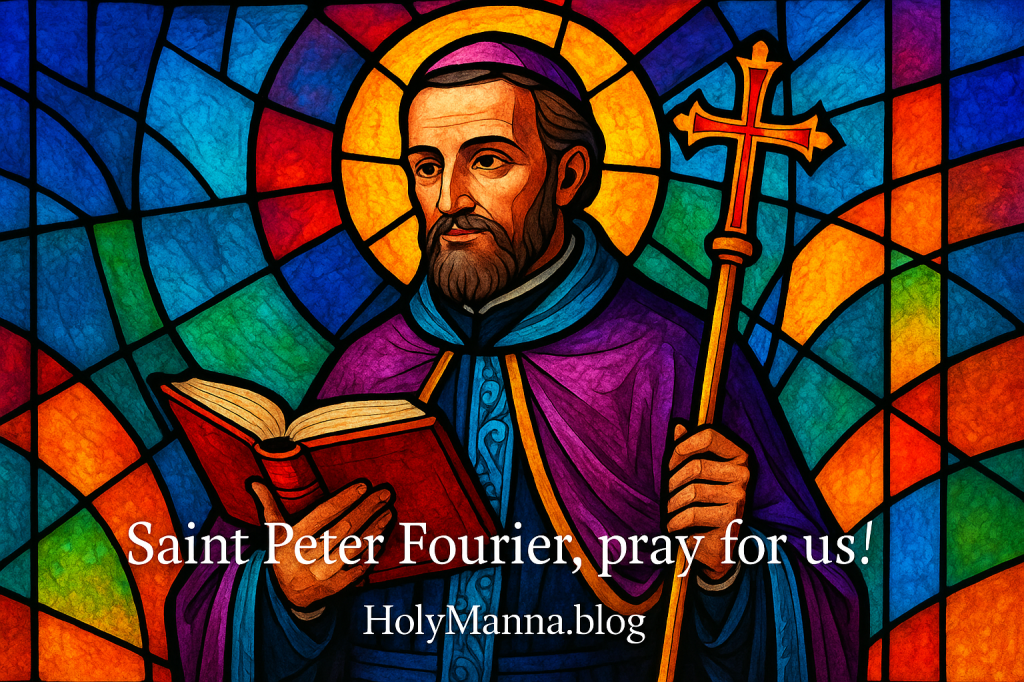
A Hidden Powerhouse of the Catholic Reformation
Saint Peter Fourier remains one of the quiet yet mighty figures of the Catholic Reformation. Born in 1565 in Lorraine during the intense religious upheaval of the era, he grew into a priest, reformer, founder, educator, and spiritual father whose life radiated humility and pastoral zeal. Known as “the Good Father of Mattaincourt,” he transformed an indifferent parish into a vibrant center of faith, founded the Congregation of Notre Dame with Blessed Alix Le Clerc for the free education of girls, and later reformed the Canons Regular of Lorraine into the Congregation of Our Savior. His spirituality was rooted in deep Marian devotion, Eucharistic reverence, and a wholehearted trust in divine Providence.
Consecrated From the Womb
Peter Fourier was born on November 30, 1565, in Mirecourt in the Duchy of Lorraine to a devout and charitable family. His parents consecrated him to God before and at his birth, hoping that their firstborn son would serve at the altar. The young Peter grew up surrounded by faith and a strong sense of duty, displaying both natural brilliance and an early sensitivity to the things of God.
At fifteen he enrolled at the Jesuit university in Pont à Mousson, where he excelled in studies and lived a life marked by piety. He later entered the Canons Regular of Saint Augustine at the Abbey of Chaumousey, professed vows in 1587, and was ordained a priest at Trier in 1589. His theological gifts were so exceptional that he reportedly mastered Summa Theologica and became widely respected by theologians and bishops. Although he was offered comfortable pastoral assignments and high ecclesial positions, he consistently refused them. He sought instead a life of humility, penance, and quiet service, choosing decayed communities and struggling orders over prestige and ease.
Saint Peter Fourier’s devotion to the Blessed Virgin Mary shaped his priesthood deeply. Long before the dogma was declared, he promoted devotion to the Immaculate Conception and sought to lead souls into the purity and trust that Mary perfectly embodies. His early years reveal a young priest already committed to hidden service, charity, and the renewal of the Church from within.
Shepherd of Souls
In 1597 Peter was assigned to Mattaincourt, a materially prosperous but spiritually impoverished village. The sacraments were neglected, holy days were profaned, and the parish lacked spiritual direction. He approached the challenge not with harsh discipline but with patient pastoral love. He visited families in their homes, gathered small groups for instruction, explained the truths of the faith with clarity and gentleness, and slowly rekindled devotion to the sacraments. His interior life mirrored what the Catechism teaches in CCC 1567, which explains that priests are to serve the People of God as living images of Christ the Good Shepherd, united with their bishop and brother priests.
Saint Peter lived in voluntary poverty, spent long hours in prayer before the tabernacle, personally cared for the sick, and gave most of his income to the poor. Among his many works he organized a community bank that provided interest free loans to those in need. This initiative anticipated Catholic social teaching on solidarity and social charity, concepts later articulated in the Catechism. He also founded sodalities for men, women, and girls to foster community, devotion, and spiritual discipline. His catechetical methods were creative and engaging, including simple dialogues on virtue and vice that children recited publicly on Sundays.
One of his most beautiful prayers before the Blessed Sacrament reveals his spirituality. He would kneel before the tabernacle and say, “You are the principal parish priest. I am only Your vicar.” His life was a testimony to this truth. He frequently reminded himself that Christ alone is Shepherd and Lord.
Saint Peter Fourier is also remembered as a pioneer in Catholic education. Working closely with Blessed Alix Le Clerc, he helped found the Congregation of Notre Dame, dedicated to providing free education for girls. The sisters even took an additional vow specifically for this mission. He introduced methods such as grouping students by level and using blackboards, not as academic innovations for their own sake, but to ensure that poor children received a dignified and Catholic formation. These efforts aligned beautifully with the teaching of CCC 2223, which emphasizes that parents are the primary educators of their children, and society must support them in forming children according to the Gospel.
Miracles also accompanied his ministry. Entire communities experienced renewal through his preaching, prayer, and example. In one remarkable case, during his missionary work in the Principality of Salm, he preached with such humble charity that the local Calvinists, whom he tenderly called his “poor strangers,” returned to the Catholic faith within six months. While these events were not spectacular in the sense of physical miracles, they revealed divine grace at work through a docile priest.
Fire in the Furnace
Saint Peter Fourier’s life was marked by suffering and opposition from the beginning of his religious vocation. After completing his studies, he returned to his abbey eager for reform and conversion. Instead, he was met with ridicule, hostility, and even an attempt to poison him. He endured this trial in silence and charity for nearly two years, growing only more steadfast in his pursuit of holiness.
Later he was entrusted with reforming the Canons Regular of Lorraine. His efforts drew resistance, suspicion, and misunderstanding, but he persevered peacefully and eventually helped establish the Congregation of Our Savior. His fidelity to the Church was tested again when political conflict erupted in Lorraine. He refused to swear an oath of loyalty to King Louis XIII, believing that the oath compromised his conscience. This refusal cost him his homeland and forced him into exile in Gray, Burgundy. Far from becoming bitter, he spent his final years serving plague victims and ministering to the poor with unwavering love.
Though he did not die a martyr, Saint Peter Fourier exemplified what the Catechism calls the “daily martyrdom” of Christian discipleship: a life of sacrificial love, courage in the face of injustice, and fidelity to Christ no matter the cost.
Heaven’s Echo
Saint Peter Fourier died in Gray on December 9, 1640. Immediately after his passing, miracles of healing and intercession were reported at his tomb just as they had been during his lifetime. The people of Gray and the faithful of Mattaincourt each desired possession of his relics, a testimony to his profound influence. Tradition recalls that when his coffin passed through Mattaincourt, the women of the parish surrounded the church and refused to allow his body to leave, a powerful expression of their love and gratitude.
His miracles contributed to his beatification by Pope Benedict XIII in 1730 and his canonization by Pope Leo XIII in 1897. For the faithful, his intercession reflects the teaching of CCC 947, which explains that the communion of saints is a living exchange of spiritual goods in the one Body of Christ. The graces received at his tomb and through his relics reveal the continuing fruitfulness of his holy life.
Today he is honored as a patron of parish priests and educators. A statue of him stands among the founders of religious orders in Saint Peter’s Basilica, silently reminding the world of the transformative power of humble holiness.
Learning from a Quiet Reformer
Saint Peter Fourier’s life offers lessons that feel surprisingly fresh in the modern world. His story encourages believers to focus less on recognition and platform and more on quiet, faithful service. He shows that true reform begins in small places: one parish, one classroom, one family, one heart. His Eucharistic humility, expressed so beautifully in the prayer “You are the principal parish priest. I am only Your vicar.”, encourages every Christian to recognize Christ as the true center of all ministry and mission. His approach to education reminds Catholics that forming young hearts and minds in the faith is both an act of justice and an act of love. His simplicity of life and dedication to the poor invite believers to examine lifestyles, budgets, and priorities with a renewed spirit of solidarity. His Marian devotion offers a path of purity and trust in a time when both are deeply needed. His courage in moments of conflict shows how to speak truth with charity, even when it brings misunderstanding or cost.
Living out these lessons can transform ordinary life. Offering time to help a struggling family with their children’s catechism, choosing a simpler lifestyle to free resources for the poor, praying the Rosary with renewed devotion, volunteering in parish ministries, visiting the elderly or sick, and approaching the Eucharist with deep reverence are all concrete ways to imitate Saint Peter Fourier today. His life is a witness that holiness often grows not in dramatic gestures but in steady, hidden fidelity to Christ.
Engage with Us!
All readers are warmly invited to share their thoughts, experiences, or devotions to Saint Peter Fourier in the comments below. His life is rich, practical, and incredibly relevant, especially for those who care about parish life, Catholic education, and compassionate service.
- Where might God be inviting you to embrace humble service rather than visible success or recognition?
- How can you support the faith formation or education of children in your parish, family, or community?
- What steps can you take to live more simply and stand closer to the poor, following Saint Peter Fourier’s example?
- How can Marian devotion, especially to the Immaculate Conception, deepen your spiritual life and renew your trust in God?
- Where in your life are you being called to respond to conflict or pressure with both courage and charity?
May Saint Peter Fourier intercede for all who seek to live with faith, humility, and compassion. May his example inspire every heart to embrace the quiet holiness of daily duty, the joy of serving the poor, and the deep peace of trusting Jesus completely. Let every action be carried out with the love and mercy that Christ has taught, so that the Church and the world may be renewed from within.
Saint Peter Fourier, pray for us!
Follow us on Instagram and Facebook for more insights and reflections on living a faith-filled life.

 Holy Manna!
Leave a comment