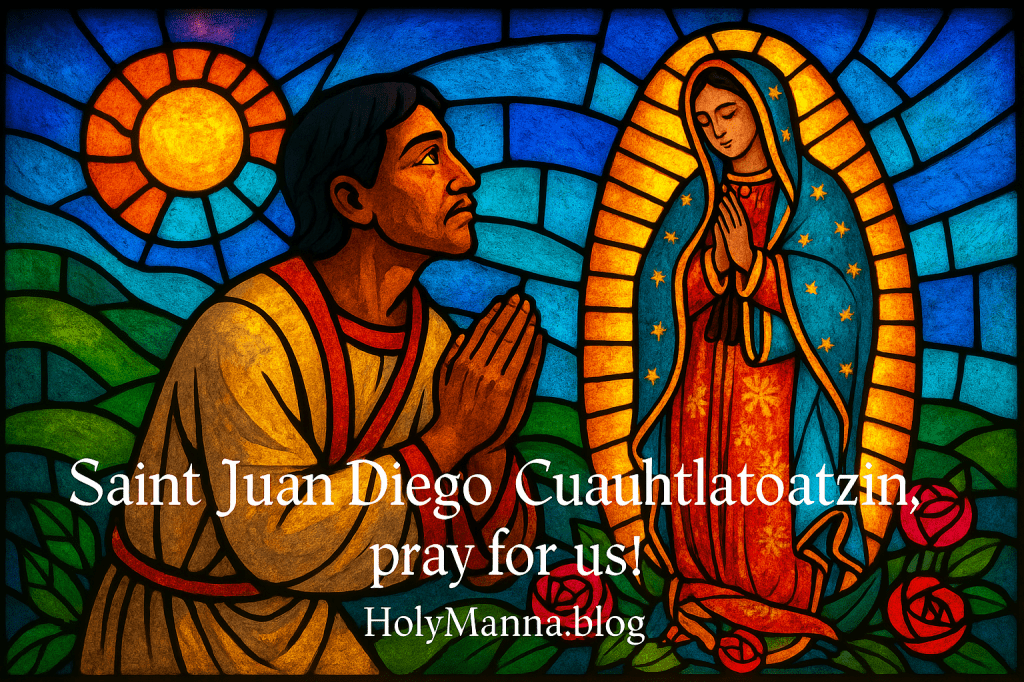
Herald of the Mother of God
Saint Juan Diego Cuauhtlatoatzin is honored as the humble indigenous man whom God chose to be the messenger of Our Lady of Guadalupe. Born around 1474 in Cuauhtitlán, near modern day Mexico City, his Nahuatl name Cuauhtlatoatzin means “the eagle who speaks.” He lived during a time of profound cultural upheaval following the fall of the Aztec Empire. His quiet obedience, deep faith, and unwavering humility helped usher in one of the most influential Marian events in history. Canonized in 2002 by Pope Saint John Paul II, he is celebrated as the first indigenous saint of the Americas and a model of authentic evangelization that respects and elevates culture from within. His feast day is celebrated on December 9.
From Cuauhtitlán to Christ
Juan Diego was born into the Chichimeca people, one of the culturally advanced groups of the Anáhuac Valley. He likely worked as a farmer, laborer, or craftsman and was known for his gentle and respectful nature. Around 1524, when the first group of Franciscan missionaries arrived in Mexico, Juan Diego and his wife, María Lucía, received baptism and became some of the earliest indigenous converts to the Catholic faith. At the time of his conversion, Juan Diego was already around fifty years old.
He and his wife grew deeply committed to their new life in Christ. Traditional accounts say they even chose to live continently as a sign of their devotion to God. After María Lucía’s death, Juan Diego embraced an even more prayerful and humble life. He would walk long distances, often miles each way, to attend Mass and receive further teaching at the Franciscan mission in Tlatelolco. This quiet devotion prepared his heart for the extraordinary mission God would soon entrust to him. He was not a priest or a scholar. He was a simple, faithful widower living on the margins of society, yet the Lord saw in him a heart ready to receive and carry a message for an entire continent.
Roses in Winter
The defining moment of Juan Diego’s life began on the morning of December 9, 1531. While walking to Mass, he passed Tepeyac Hill and was drawn by beautiful birdsong and a radiant presence. There he met a young woman clothed in garments that spoke to the hearts of both Spaniards and indigenous people. She was surrounded by light, wearing a mantle of stars, and dressed in colors rich with meaning. She revealed herself as the Mother of the true God and asked Juan Diego to go to Bishop Juan de Zumárraga to request the construction of a church on that hill. She desired that all her children might come to her and experience the love and mercy of her Son.
Juan Diego obeyed immediately, but the bishop hesitated and asked for a sign. Over the next days, Juan Diego went back and forth delivering Our Lady’s message, enduring doubts and questions from ecclesial authorities and wrestling with his own sense of unworthiness. During this time, his uncle Juan Bernardino became gravely ill, filling Juan Diego with anxiety and grief.
On December 12, while seeking a priest for his uncle, Juan Diego tried to take another route to avoid delaying his errand. Our Lady intercepted him and spoke some of the most consoling words ever given through a Marian apparition. “Am I not here, I who am your mother?” She assured him that his uncle had already been healed by her intercession and asked him to climb Tepeyac Hill to gather flowers.
Despite it being winter and the ground barren, Juan Diego found Castilian roses blooming in abundance. He gathered them carefully into his tilma and brought them to the bishop. When he opened his tilma before the bishop, the roses fell to the floor, and the miraculous image of Our Lady of Guadalupe appeared on the rough maguey fabric. That image, filled with profound symbolism, communicated the Gospel in a language the indigenous people could understand. Through Juan Diego’s humility, millions were drawn to the faith in the decades that followed.
Trials on Tepeyac
Although Juan Diego did not face violent martyrdom, his path was filled with trials. He endured the trauma of cultural devastation, the sorrow of widowhood, the poverty of his people, and the mistrust that often fell upon indigenous converts. Even during the apparitions, he faced discouragement, shame, and fear, especially when the bishop doubted his story. His anxiety over his uncle’s illness further deepened his suffering.
Yet Juan Diego responded with quiet perseverance. He returned to the bishop again and again, even when it meant humiliation. He remained faithful to Our Lady’s requests, trusting that God’s plan was unfolding through these trials. After the apparitions, he lived near the new chapel built at Tepeyac and dedicated himself to prayer, service, and caring for the sacred image. Until his death around 1548, he was known for humility, gentleness, and an unwavering love for Christ and his Mother.
The Echo of Tepeyac
The miracles associated with Juan Diego continue primarily through the miraculous tilma he presented to the bishop. Made of rough cactus fiber that should have decayed within decades, the tilma has endured for nearly five centuries without significant deterioration. The vibrant image imprinted upon it has inspired countless conversions, healings, and renewed faith across cultures and generations.
The Basilica of Our Lady of Guadalupe, built on the site of the apparitions, has become one of the most visited Catholic shrines in the world. Pilgrims travel from across the globe to venerate the image, to ask for Our Lady’s intercession, and to honor the humble saint through whom God began this great work. The Catechism of the Catholic Church teaches that the saints in heaven, united with Christ, intercede for the faithful on earth. CCC 956 explains that they “do not cease to intercede” for us before the Father. Saint Juan Diego is a powerful intercessor for the poor, for the marginalized, for indigenous peoples, and for all who seek the tender care of Our Lady.
Walking with Saint Juan Diego Today
Saint Juan Diego offers a profound witness for a world often obsessed with fame, influence, and noise. He shows that God works most powerfully through humility. His life is a reminder that every person, no matter how small or hidden, can play an essential role in salvation history.
His devotion to the Eucharist and commitment to ongoing catechesis challenge Catholics today to take seriously the call to weekly Mass, confession, and deeper formation. His tender trust in Mary models what the Catechism affirms about her special place in Christian life. CCC 971 teaches that the Church’s love for Mary is intrinsic to Christian worship, and in the Guadalupe event she reveals herself as a mother who speaks to the hearts of her children with profound tenderness.
The Guadalupe message also calls Catholics to build cultural bridges. Through Juan Diego, Mary spoke in Nahuatl and used the symbols of a people who felt conquered and forgotten. She elevated what was noble in their culture and redirected it toward Christ. The Church today can learn from this gentle inculturation, approaching evangelization with respect, compassion, and clarity.
Saint Juan Diego’s life invites every believer to trust God more deeply, to honor Mary as Mother, and to live with steady fidelity even in small, hidden moments. His example speaks especially to anyone who feels weak, unseen, or inadequate. God often chooses the smallest instruments to accomplish the greatest works of grace.
Engage with Us!
You are invited to share your thoughts and reflections in the comments below. Let this be a space to honor what God continues to do through the humble witness of Saint Juan Diego and Our Lady of Guadalupe.
- Where in your life do you feel overlooked or powerless, and how might Saint Juan Diego’s humility bring strength or clarity to that situation?
- How have you experienced Mary as a mother, especially through the message or image of Our Lady of Guadalupe?
- What is one concrete step you can take this week to imitate Juan Diego’s faithfulness, such as attending Mass, seeking confession, or serving quietly in your parish?
- How can devotion to Our Lady of Guadalupe help you love those who are marginalized or culturally different with the heart of Christ?
- In what part of your life do you most need to hear Our Lady’s consoling words: “Am I not here, I who am your mother?”
May Saint Juan Diego Cuauhtlatoatzin and Our Lady of Guadalupe help you live a life of faith, courage, and tenderness, doing everything with the love and mercy Jesus has taught us.
Saint Juan Diego Cuauhtlatoatzin, pray for us!
Follow us on Instagram and Facebook for more insights and reflections on living a faith-filled life.

 Holy Manna!
Leave a comment