Tuesday of the Second Week of Advent – Lectionary: 182
The Shepherd Who Comes Looking For You
There is a quiet ache in every heart that knows it needs to be rescued. Today’s readings speak right into that ache and reveal a God who does not stay distant, but comes close as a Shepherd-King who comforts, restores, and refuses to lose even one of His own.
In Isaiah 40:1-11, the prophet speaks to a people who have known exile, humiliation, and the heavy weight of their own sin. Into that spiritual exhaustion, God commands: “Comfort, give comfort to my people” and announces that guilt has been expiated and that the time of hard service is ending. This is not just a nice message. It is the turning point in salvation history, where God promises to come in glory, to level the valleys and mountains, and to shepherd His people with tenderness, “gathering the lambs in his arms”. The imagery is royal and gentle at the same time. The Lord is powerful enough to reshape creation and yet tender enough to carry the weakest close to His heart.
Psalm 96 invites the whole universe to respond to this coming of the Lord. The psalm calls every voice into a cosmic chorus: “Sing to the Lord a new song”, “Tell his glory among the nations”, and “declare among the nations: The Lord is king”. This is an enthronement song. It proclaims that God’s reign is not arbitrary power but justice and faithfulness. Creation itself rejoices because the true King is coming to set everything right. The sea, the plains, and the trees are pictured as celebrating because the One who made them is finally acknowledged as King.
Then The Gospel of Matthew shifts the focus from the cosmic to the deeply personal. In Matthew 18:12-14, Jesus gives the image of a shepherd who has a hundred sheep, and one goes astray. Instead of writing off the one as a loss, the shepherd leaves the ninety-nine in the hills and goes after the stray. Jesus reveals the Father’s heart with a stunning line: “It is not the will of your heavenly Father that one of these little ones be lost.” The same God who shakes the nations and governs the world with justice is the God who notices when a single heart wanders and goes searching until it is found.
Together, these readings paint one unified picture. The God of Israel, who comforted exiles and promised to come in glory, is the same God who rules the world with justice and the same God who, in Jesus, goes after the one lost soul. Advent is not just about waiting for a date on the calendar. It is about recognizing that the Shepherd-King is already on the move, already coming to comfort, to rule with justice, and to seek the lost. Are there places in life right now that feel like exile, like wandering, or like being that one lost sheep? Today’s readings whisper the same truth again and again: the Lord is coming, and He is coming for you.
First Reading – Isaiah 40:1-11
The God Who Comes to Comfort His People
The prophecy in Isaiah 40 opens what scholars call the Book of Consolation, a section addressed to the people of Israel during or shortly after the Babylonian Exile. This was one of the most painful periods in Israel’s history. The Temple had been destroyed, the people had been uprooted from their homeland, and the promises given to Abraham and David seemed shattered. Into this wounded and weary context, God speaks with unmistakable tenderness and authority. The reading announces a turning point in salvation history. The exile, understood as a consequence of sin, is coming to an end. God Himself is approaching His people, not with judgment, but with comfort, restoration, and a promise that His glory will be revealed for all to see. This passage prepares hearts for Advent by revealing a God who not only promises salvation but personally draws near to accomplish it. Every line of this reading fits perfectly with today’s theme: the Shepherd-King who comes to comfort, restore, and seek the lost.
Isaiah 40:1-11
New American Bible (Revised Edition)
Promise of Salvation
1 Comfort, give comfort to my people,
says your God.
2 Speak to the heart of Jerusalem, and proclaim to her
that her service has ended,
that her guilt is expiated,
That she has received from the hand of the Lord
double for all her sins.
3 A voice proclaims:
In the wilderness prepare the way of the Lord!
Make straight in the wasteland a highway for our God!
4 Every valley shall be lifted up,
every mountain and hill made low;
The rugged land shall be a plain,
the rough country, a broad valley.
5 Then the glory of the Lord shall be revealed,
and all flesh shall see it together;
for the mouth of the Lord has spoken.
6 A voice says, “Proclaim!”
I answer, “What shall I proclaim?”
“All flesh is grass,
and all their loyalty like the flower of the field.
7 The grass withers, the flower wilts,
when the breath of the Lord blows upon it.”
“Yes, the people is grass!
8 The grass withers, the flower wilts,
but the word of our God stands forever.”
9 Go up onto a high mountain,
Zion, herald of good news!
Cry out at the top of your voice,
Jerusalem, herald of good news!
Cry out, do not fear!
Say to the cities of Judah:
Here is your God!
10 Here comes with power
the Lord God,
who rules by his strong arm;
Here is his reward with him,
his recompense before him.
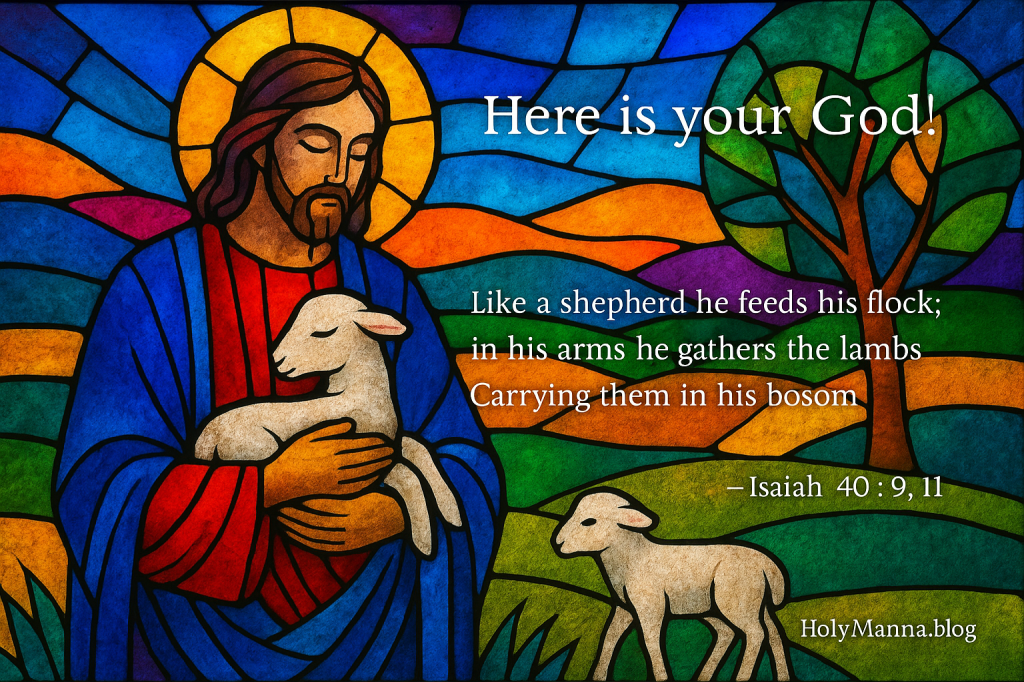
11 Like a shepherd he feeds his flock;
in his arms he gathers the lambs,
Carrying them in his bosom,
leading the ewes with care.
Detailed Exegesis
Verse 1 – “Comfort, give comfort to my people, says your God.”
God begins with a double imperative, signaling urgency and overflowing tenderness. The people are not strangers. They are “my people,” a covenant identity that remains intact despite their sin and exile. God’s comfort is not sentimental. It is restorative, signaling a divine initiative to heal what sin has broken.
Verse 2 – “Speak to the heart of Jerusalem, and proclaim to her that her service has ended, that her guilt is expiated, that she has received from the hand of the Lord double for all her sins.”
“Speak to the heart” conveys deep intimacy. God is addressing Jerusalem as a beloved. The imagery of “service” ending evokes release from servitude or bondage. The language of “guilt expiated” points to God’s mercy triumphing over judgment. The phrase “double for all her sins” means that the punishment was more than sufficient. God is declaring closure. A new chapter begins.
Verse 3 – “A voice proclaims: In the wilderness prepare the way of the Lord. Make straight in the wasteland a highway for our God.”
This verse introduces the theme of preparing the way for God’s arrival. Historically, kings would have roads built or cleared before visiting a region. Spiritually, this anticipates the ministry of John the Baptist and the call to repentance. The wilderness imagery reflects Israel’s earlier journey and symbolizes dryness, disorder, and distance from God. Into that place, God is coming.
Verse 4 – “Every valley shall be lifted up, every mountain and hill made low. The rugged land shall be a plain, the rough country, a broad valley.”
This describes a dramatic leveling of obstacles. It symbolizes the removal of everything that stands between God and His people. Pride, despair, sin, and injustice must all be flattened. The coming of the Lord brings restoration, order, and the healing of what is uneven or broken.
Verse 5 – “Then the glory of the Lord shall be revealed, and all flesh shall see it together; for the mouth of the Lord has spoken.”
God’s glory, once confined to the Temple, will now be revealed universally. This challenges Israel’s expectation that revelation belonged to them alone. God’s salvation is meant for all people. The certainty rests on God’s own authority: the Lord has spoken, and His word is unshakeable.
Verse 6 – “A voice says, Proclaim. I answer, What shall I proclaim? All flesh is grass, and all their loyalty like the flower of the field.”
Human frailty is contrasted with divine permanence. Grass and flowers fade quickly in the Middle Eastern heat. Human strength, loyalty, and effort are fragile and unreliable without God’s sustaining grace.
Verse 7 – “The grass withers, the flower wilts, when the breath of the Lord blows upon it. Yes, the people is grass.”
The breath of the Lord both gives life and takes it away. This emphasizes God’s sovereignty over creation. People are dependent and passing. This humbling truth prepares hearts for the next line.
Verse 8 – “The grass withers, the flower wilts, but the word of our God stands forever.”
Unlike human life or human promises, God’s word is eternal. This becomes a foundational theme in salvation history and is echoed throughout The New Testament. God’s promises endure, and His covenant love does not fade.
Verse 9 – “Go up onto a high mountain, Zion, herald of good news. Cry out at the top of your voice, Jerusalem, herald of good news. Cry out, do not fear. Say to the cities of Judah: Here is your God.”
Zion and Jerusalem become evangelists. The “good news” anticipates the proclamation of the Gospel. The message is not an idea, but a Person. The heart of the Gospel is the arrival of God Himself.
Verse 10 – “Here comes with power the Lord God, who rules by his strong arm. Here is his reward with him, his recompense before him.”
God is portrayed as a mighty king who comes with authority. His “strong arm” symbolizes decisive action. Yet His reward is His people. God’s justice and mercy unite here. He comes not only to rule but to restore what belongs to Him.
Verse 11 – “Like a shepherd he feeds his flock. In his arms he gathers the lambs, carrying them in his bosom, leading the ewes with care.”
The dominant image shifts from king to shepherd. This is one of the most tender portrayals of God in all of Scripture. God does not simply command. He carries. He does not simply rule. He comforts. The Shepherd loves each sheep and draws near to the weak with gentleness.
Teachings
This passage directly anticipates the revelation of Jesus Christ as the Good Shepherd. The Catechism teaches, “The Word became flesh to reconcile us with God, who loved us and sent his Son to be the expiation for our sins” (CCC 457). Isaiah’s message of guilt being expiated finds its fulfillment in Christ’s sacrifice. The Catechism also reflects Isaiah’s declaration of the permanence of God’s word: “The Old Testament is an indispensable part of Sacred Scripture. Its books are divinely inspired and retain a permanent value” (CCC 121). Just as Isaiah proclaims that God’s word stands forever, the Church confirms the enduring authority of Scripture.
Saint Gregory the Great reflects on God as Shepherd when he writes, “He who created us became Himself our guide and taught us to walk by His example”. This aligns beautifully with verse 11, where God is described as carrying His people close to His heart. Historically, this passage became a cornerstone of early Christian preaching about the coming of Christ and the call to repentance, especially during Advent. It also shaped the Church’s understanding of Christ’s kingship: one who is both mighty and meek, both judge and shepherd.
Reflection
This reading reaches deeply into the realities of everyday life. There are moments when life feels like exile, when guilt lingers, when spiritual dryness feels like a wilderness. This passage reminds every believer that God comes precisely into those places. He does not wait for perfection. He creates the path. He levels the obstacles. He carries the weak.
It helps to ask, What valleys need lifting in the heart right now? What mountains of pride or fear need to be made low? Where might God be asking for preparation so His comfort can enter more freely? Isaiah invites each person to trust that God’s word is stronger than any weakness and more enduring than any sin.
A practical step today is to take quiet time to let God’s comfort be heard. Reflect on the Shepherd who gathers the lambs, and allow the soul to rest in that image. Another step is to identify one rough or rugged place in life and consciously invite the Lord into it. Advent is the season of preparation, and Isaiah shows that preparation begins not with effort, but with receiving the comfort of the God who comes.
Responsorial Psalm – Psalm 96:1-3, 10-13
Singing With All Creation To The Shepherd King
Psalm 96 is part of a group of enthronement psalms that celebrate the Lord as King over all the earth. It likely arose in the context of liturgical worship in the Temple, where Israel publicly proclaimed God’s rule and called all nations to recognize His glory. In a world filled with rival gods and competing empires, this psalm is a bold declaration that the God of Israel alone reigns and that His kingship brings stability, justice, and joy to creation.
Today, this psalm fits perfectly with the theme of the Shepherd-King who comes to comfort and rescue His people. While Isaiah 40 announces that God is coming with power and tenderness, Psalm 96 shows how creation responds: with a new song, constant praise, and joyful expectation. The God who seeks the lost sheep in The Gospel of Matthew is the same God whose coming makes the heavens, earth, sea, plains, and forests burst into praise. The psalm invites every believer to echo that cosmic worship and to align their hearts with the joyful truth that “The Lord is king”.
Psalm 96:1-3, 10-13
New American Bible (Revised Edition)
God of the Universe
1 Sing to the Lord a new song;
sing to the Lord, all the earth.
2 Sing to the Lord, bless his name;
proclaim his salvation day after day.
3 Tell his glory among the nations;
among all peoples, his marvelous deeds.
10 declare among the nations: The Lord is king.
The world will surely stand fast, never to be shaken.
He rules the peoples with fairness.
11 Let the heavens be glad and the earth rejoice;
let the sea and what fills it resound;
12 let the plains be joyful and all that is in them.
Then let all the trees of the forest rejoice
13 before the Lord who comes,
who comes to govern the earth,
To govern the world with justice
and the peoples with faithfulness.
Detailed Exegesis
Verse 1 – “Sing to the Lord a new song; sing to the Lord, all the earth.”
The call to a “new song” points to a fresh act of God that demands a fresh response. In Advent, this resonates strongly. God is not just repeating old blessings. He is doing something new in Christ. The phrase “all the earth” expands the focus beyond Israel. God’s kingship is universal, and praise is meant to be global, not just local or private.
Verse 2 – “Sing to the Lord, bless his name; proclaim his salvation day after day.”
To “bless his name” means to honor who God is and what He has done. “Proclaim his salvation day after day” shows that worship is not limited to a single moment. It becomes a daily lifestyle. The Church takes this seriously in the liturgy, where the saving work of God in Christ is proclaimed every day in The Holy Mass. Advent invites a renewed daily awareness of God’s saving action.
Verse 3 – “Tell his glory among the nations; among all peoples, his marvelous deeds.”
This verse highlights Israel’s missionary calling. God’s people are meant to be a witness, not a closed club. The mention of “nations” and “peoples” prefigures the Church’s mission to evangelize the whole world. The Shepherd-King is not just for one group. His “marvelous deeds” are meant to be shared.
Verse 10 – “Declare among the nations: The Lord is king. The world will surely stand fast, never to be shaken. He rules the peoples with fairness.”
The core proclamation is simple and powerful: “The Lord is king.” In a world that often feels unstable, this verse reminds that stability does not come from politics, wealth, or power, but from God’s reign. “Never to be shaken” speaks to the moral and spiritual order God establishes. His rule is marked by fairness, which prepares the heart for the just and merciful kingship of Christ.
Verse 11 – “Let the heavens be glad and the earth rejoice; let the sea and what fills it resound.”
Here creation is personified, invited into joy. Heavens, earth, and sea respond to God’s kingship. This cosmic rejoicing shows that sin has affected not just human hearts, but the whole created order. When God comes, there is a healing that touches everything.
Verse 12 – “Let the plains be joyful and all that is in them. Then let all the trees of the forest rejoice.”
Even the plains and trees are pictured as rejoicing. This poetic imagery reflects a deep truth: creation was made for harmony under God’s rule. When the Shepherd-King comes, that harmony begins to be restored. This verse resonates with Romans 8, where creation is described as groaning and waiting for redemption.
Verse 13 – “Before the Lord who comes, who comes to govern the earth, to govern the world with justice and the peoples with faithfulness.”
The repetition “who comes, who comes” emphasizes movement and urgency. God is not static. He is on the way. His coming is not neutral. He comes “to govern,” which means to set things right. Justice and faithfulness describe the way He rules. This prepares the heart for Christ’s final coming in glory and His present coming in grace, especially in the sacraments.
Teachings
Psalm 96 reveals the heart of true worship. It is not just about emotions or music style. It is about recognizing God’s kingship and responding with praise, proclamation, and mission. The Catechism teaches, “The Holy Spirit, who teaches the Church and recalls to her all that Jesus said, also inspires contemporary statements of faith” (CCC 94). The “new song” of the psalm can be seen as a symbol of how the Spirit keeps renewing the Church’s praise and understanding of God’s saving work.
The psalm’s focus on all nations and all creation aligns with the Church’s teaching on the universal call to salvation. The Catechism says, “The Gospel was preached first by the Lord himself. Afterward it was proclaimed by the apostles, who handed it on” (CCC 75). This handing on of the Gospel is exactly what the psalm calls for when it says, “Tell his glory among the nations” and “declare among the nations: The Lord is king.”
Saint John Paul II often spoke about the cosmic dimension of Christ’s kingship and how creation is oriented toward Him. He explained that Christ is the center of the universe and history and that all things find their meaning in Him. This reflects the spirit of Psalm 96, where all of creation rejoices before the Lord who comes to govern with justice and faithfulness.
Liturgically, this psalm fits beautifully in Advent. The Church lives in the tension of already and not yet. Christ has already come, and yet believers still await His final coming. The repeated proclamation that “The Lord is king” reminds that even when the world feels chaotic, God’s reign is real, present, and advancing.
Reflection
This psalm invites a very concrete response. It is not just poetic language about a distant God. It is a call to let every part of life become a “new song” to the Lord. The heart, the schedule, the conversations, and even hidden sacrifices can all become a way of proclaiming His salvation “day after day.”
It helps to ask, What has God done recently that deserves a new song of gratitude? Where might there be a chance to “tell his glory” in conversations, at work, or in family life? The psalm also challenges the temptation to live as if other “kings” rule daily choices, such as fear, pleasure, comfort, or approval.
A practical step could be to consciously “declare” in prayer and even out loud at some point today: “The Lord is king.” Another step is to join creation in praise by noticing the beauty of the world, thanking God for it, and remembering that it all exists “before the Lord who comes.” In Advent, this psalm gently but firmly reminds every soul that the Shepherd-King is coming, and that the right response is joyful, bold, and missionary praise.
Holy Gospel – Matthew 18:12-14
The Shepherd Who Refuses To Give Up On The One
In The Gospel of Matthew, this short passage appears within Jesus’ teaching on life in the community of believers. The chapter focuses on humility, scandal, and care for the “little ones.” In that context, Jesus gives this simple but powerful image of a shepherd and a lost sheep. In first century Palestine, shepherding was a familiar sight. A flock of one hundred sheep represented a decent livelihood. Losing even one sheep meant real risk and real loss. Yet Jesus describes a shepherd who is willing to leave ninety-nine in the hills to go after the one that has wandered off.
Religiously, this image reveals the heart of God for sinners, the weak, and those who wander. Israel already knew God as Shepherd from passages like Psalm 23 and Ezekiel 34, where God promises to personally shepherd His people because their human leaders failed them. Jesus takes that revelation and makes it personal and concrete. The Father is not indifferent when one of His little ones strays. He is not satisfied with a ninety nine percent success rate. This fits beautifully with today’s theme from Isaiah 40 and Psalm 96: the Lord is King and Shepherd, who comes with power and tenderness, and He refuses to let even one be lost without a fight of love.
Matthew 18:12-14
New American Bible (Revised Edition)
12 What is your opinion? If a man has a hundred sheep and one of them goes astray, will he not leave the ninety-nine in the hills and go in search of the stray? 13 And if he finds it, amen, I say to you, he rejoices more over it than over the ninety-nine that did not stray. 14 In just the same way, it is not the will of your heavenly Father that one of these little ones be lost.
Detailed Exegesis
Verse 12 – “What is your opinion? If a man has a hundred sheep and one of them goes astray, will he not leave the ninety nine in the hills and go in search of the stray?”
Jesus begins with a question that draws the listener in. He uses a very ordinary situation from everyday life to reveal an extraordinary truth about God. The one sheep “goes astray,” which suggests that wandering often happens gradually. The shepherd’s response is striking. He leaves the ninety nine “in the hills” and actively goes “in search” of the stray. The initiative is entirely from the shepherd. The sheep does not find its way back. The shepherd goes out to look. Spiritually, this reveals that conversion is always first a work of grace. God moves toward the sinner long before the sinner moves toward God. This echoes Isaiah 40, where God is the one who comes, levels the path, and gathers the lambs.
Verse 13 – “And if he finds it, amen, I say to you, he rejoices more over it than over the ninety nine that did not stray.”
The condition “if he finds it” is not about doubt in God’s power but about highlighting the joy of recovery. When the shepherd finds the lost sheep, the dominant reaction is not anger, blame, or cold rebuke. It is joy. Jesus says he “rejoices more” over the one who was lost and is now found. This does not mean he loves the ninety-nine less. It highlights how precious the return of even one sinner is in the eyes of God. In The Gospel of Luke, this same idea appears in the broader context of parables of mercy. Here in The Gospel of Matthew, the focus is on the Father’s care for the “little ones” in the Church community.
Verse 14 – “In just the same way, it is not the will of your heavenly Father that one of these little ones be lost.”
Jesus moves from the parable to the direct application. “In just the same way” connects the human story to divine reality. The “heavenly Father” is the true Shepherd. His will is clear: it is not His desire that even one of these little ones be lost. The “little ones” can mean children, the humble, the weak in faith, or any vulnerable member of the community. God’s will is not vague. It is a concrete, burning desire for the salvation and protection of every soul. This verse also quietly grounds Christian efforts at evangelization, pastoral care, and fraternal correction in the Father’s heart. Everything the Church does must reflect this desire that no one be lost.
Teachings
This short Gospel reveals the core of God’s saving will. The Catechism of the Catholic Church teaches clearly that Christ died for all, not for a select few. It states: “There is not, never has been, and never will be a single human being for whom Christ did not suffer” (CCC 605). This fits directly with Jesus’ words that it is not the will of the Father that even one of the little ones be lost. Every person, no matter how far they have wandered, is someone for whom Christ shed His Blood.
The image of the shepherd and flock is a key part of how the Church understands itself. The Catechism explains: “The Church is, accordingly, a sheepfold, the sole and necessary gateway to which is Christ. It is also the flock of which God himself foretold that he would be the shepherd, and whose sheep, even though governed by human shepherds, are nevertheless continuously led and nourished by Christ himself, the Good Shepherd and Prince of Shepherds, who gave his life for his sheep” (CCC 754). This shows that the parable is not only about individual comfort. It is a blueprint for how the Church is meant to live: always seeking, always welcoming, always reflecting the Good Shepherd.
Saint Augustine loved this image of the Good Shepherd. Commenting on passages like this, he stresses that the shepherd’s joy at finding the lost sheep shows the tenderness of divine mercy. Augustine notes that God does not love the sinner because of sin, but despite it, and that He loves in order to heal. While the exact wording varies in his writings, the constant message is that God’s love goes ahead of us, finds us, and carries us back.
This Gospel also relates to the Church’s teaching on the desire of God that all be saved. The Catechism states: “God created man in his image and calls him to know him, love him, and serve him in this world, and to be happy with him forever in heaven” (CCC 1721). If this is the purpose of every human life, then the Father’s will that none be lost is simply His will that His children reach the destiny for which they were made.
Reflection
This Gospel speaks deeply to both the heart that has wandered and the heart that thinks it is safely among the ninety nine. For the one who feels far from God, this passage is pure hope. The Shepherd is not waiting with crossed arms. He is already on the move. Every stirring of conscience, every unexpected grace, every gentle nudge back toward prayer or the sacraments is a sign that the Shepherd is searching.
It helps to ask, In what areas of life does the heart feel like the stray sheep right now? Where has there been drifting, compromise, or quiet distance from God? The Gospel says very clearly that the Father does not want that distance to remain. A practical step could be to bring that specific “lost” area to prayer and, when needed, to the Sacrament of Reconciliation, where the Good Shepherd literally lifts the sheep onto His shoulders through absolution.
For those who see themselves among the ninety nine, this Gospel is also a gentle challenge. The Church is called to reflect the Shepherd’s heart. Indifference to those who have drifted away, harsh judgment of those who struggle, or a comfortable focus only on those who already belong does not match the Father’s will. Another helpful question is, Who in life right now might be that “one” the Lord is inviting a special love, prayer, or outreach toward?
Concrete steps might include praying intentionally for someone who has fallen away from the faith, reaching out with a simple message of encouragement, or being more patient and merciful with someone who is spiritually fragile. In Advent especially, this Gospel invites every believer to let the heart be shaped by the Shepherd who rejoices more over the one who comes home than over the ninety-nine who never left. The Father’s will is clear: not one of these little ones is expendable, forgotten, or written off.
Let The Shepherd-King Find You
Today’s readings fit together like a single love story from God’s heart. In Isaiah 40:1-11, the Lord speaks into the exhaustion and guilt of His people with that stunning invitation to hope: “Comfort, give comfort to my people.” He declares that the time of slavery is ending, that guilt is expiated, and that He Himself is coming as a mighty yet tender Shepherd who gathers the lambs and carries them close to His heart.
In Psalm 96, creation responds to this coming God with explosive joy. The heavens, the earth, the sea, the plains, and the trees all rejoice before the Lord who comes to rule the world with justice and faithfulness. The psalm calls every voice into the song: “Sing to the Lord a new song” and “declare among the nations: The Lord is king.” The God who comforts exiles is not weak or distant. He is the King whose reign brings stability to a shaking world and whose justice is good news, not bad news, for every heart that longs for what is true and right.
Then The Gospel of Matthew brings it all down to a deeply personal moment. Jesus reveals that the Father’s heart is like a shepherd who notices when one sheep wanders and actually goes in search of it. The conclusion is crystal clear: “It is not the will of your heavenly Father that one of these little ones be lost.” The same God who speaks comfort in Isaiah 40 and is praised as King in Psalm 96 is the God who refuses to shrug at the loss of even one soul.
Taken together, the message is simple and life changing. God comes with comfort. God comes with kingship. God comes with a searching, personal love that will not give up on anyone. Advent is not just remembering that Jesus came two thousand years ago. It is allowing that same Shepherd-King to draw close right now, in the specific valleys, wounds, sins, and confusions that weigh the heart down today.
So the real question becomes, Where is the Lord trying to comfort, reign, and rescue in life right now? Where might the heart be resisting His comfort, doubting His kingship, or hiding from His searching love? These readings invite a very concrete response. Make room for silence so that His word of comfort can actually be heard. Open the heart to His kingship by choosing His way over habits of sin. Let the Good Shepherd find the parts of life that have gone astray, especially through honest prayer and the sacraments.
The Shepherd-King is already on the move. He comes with strong arms and a gentle heart. He comes to carry, to restore, and to rejoice over every soul that lets itself be found. Let today be a day where the answer in the heart is simple and sincere: “Here is my God.”
Engage with Us!
You are invited to share your thoughts, insights, and personal reflections in the comments below. Your voice and your journey can encourage someone else who is seeking the Lord’s comfort and guidance today.
- First Reading – Isaiah 40:1-11: Where in your life is God trying to speak comfort, healing, or restoration? What obstacles need to be leveled so that His presence can reach your heart more freely?
- Responsorial Psalm – Psalm 96: What “new song” can you offer the Lord today as a response to His kingship? How can you proclaim His glory in your home, workplace, or relationships?
- Holy Gospel – Matthew 18:12-14: Where do you feel like the lost sheep in need of the Shepherd’s love? Or who in your life might be the “one” God is inviting you to pray for or reach out to with tenderness?
May these reflections inspire you to live each day with faith, courage, and a heart shaped by the love and mercy that Jesus taught. Let every choice and every act become a small echo of the Shepherd-King who comes to comfort, to save, and to lead His people home.
Sacred Heart of Jesus, we trust in You!
Immaculate Heart of Mary, pray for us!
Saint Michael the Archangel, defend us in battle!
Follow us on Instagram and Facebook for more insights and reflections on living a faith-filled life.

 Holy Manna!
Leave a comment