A Shepherd Sent to the Frontier
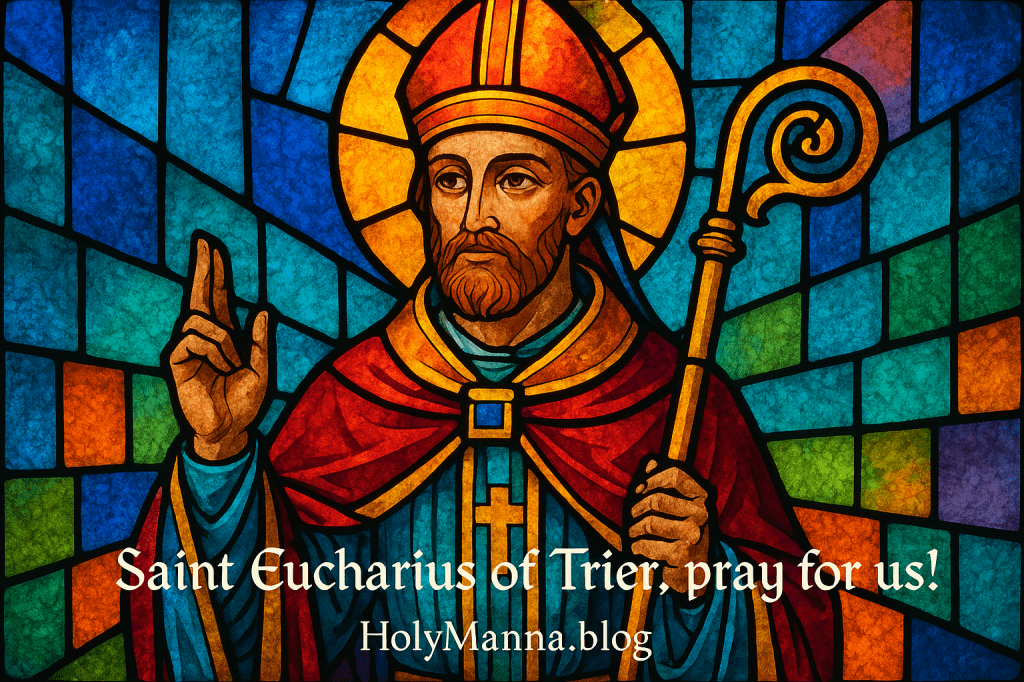
Saint Eucharius of Trier is remembered as the first bishop of Trier, one of the earliest Christian centers north of the Alps. His life sits at the powerful meeting point of the Roman Empire and the expanding mission of the early Church. He is traditionally honored as a founding figure in the Christianization of the Rhineland and a living reminder of the Church’s apostolic mission. Though some details of his story drift into legend, the heart of his legacy remains firm. His life points toward the truth found in The Catechism, which teaches that “the apostles left bishops as their successors so that the Gospel might always be preserved alive in the Church”. Saint Eucharius embodies that living continuity, serving as a concrete link between the first generations of believers and the flourishing Christian communities that would one day shape Europe.
Roots Wrapped in Mystery, Mission Rooted in Christ
Very little is historically certain about the childhood or background of Saint Eucharius. The earliest reliable records simply place him in Trier sometime after the year 250, already serving as bishop, already shepherding a growing community of believers. Later medieval traditions, especially those preserved in the monastic writings of the Gesta Treverorum, paint him as one of the seventy two disciples and even as a missionary sent personally by Saint Peter, accompanied by Valerius and Maternus. These stories are not taken as literal history today, but they reveal how deeply the faithful of Trier understood their bishop. To them, Eucharius was not just a leader but a man whose ministry reflected the apostolic heart of the Church.
What can be said with confidence is that Eucharius served in a region still largely pagan or only lightly evangelized. He became known as the founding bishop of Trier, planting a living Church in a land that had yet to hear the Gospel clearly preached. In this way he lived out the apostolic identity described in The Catechism, which teaches that the Church is apostolic because she is built on the apostles and continues their mission through bishops who teach, govern, and sanctify in Christ’s name. Saint Eucharius carried that mission into the heart of the Roman frontier, making Christ present among soldiers, merchants, and families along the Moselle River.
Signs of Life Along the Rhine
The heart of Saint Eucharius’s life is his mission. Early tradition describes him traveling across Gaul with the deacon Valerius and the subdeacon Maternus, preaching the Gospel and founding churches along the Rhine. This picture, whether fully historical or partly symbolic, fits perfectly with the Church’s understanding of the episcopacy. A bishop is not merely an administrator. A bishop is a shepherd who bears the apostolic mission, continuing the work begun by Christ and entrusted to the apostles.
One of the most famous legends associated with Eucharius centers on Maternus. According to the story, Maternus died in Alsace and was buried in a place called Elegia. Grieving and unsure, Eucharius and Valerius journeyed back to Saint Peter to seek guidance. Peter handed Eucharius his pastoral staff, and when they returned to the grave and touched Maternus with that staff, he rose after forty days in the tomb. Although this account is legendary in its details, it expresses a deeper truth: the Church’s authority and mission come from Christ, passed through the apostles, and made present through their successors.
Other traditions tell of Eucharius raising a dead person in Trier and receiving an angelic revelation concerning the time of his death and the succession of Valerius as bishop. Whether historically exact or not, these stories mirror the signs described in The Acts of the Apostles, where miracles confirm not the greatness of the preacher but the power of Christ working through His Church. Centuries later, Saint Hildegard of Bingen was so moved by Eucharius’s legacy that she composed the chant O Euchari in leta via, praising him as a joyful friend of God whose ministry bore miraculous fruit. Even long after his death, the memory of his holiness inspired music, prayer, and devotion.
The Quiet Martyrdom of Steadfast Love
There is no record of Saint Eucharius dying in violent persecution. He did not face an executioner’s sword or public torture. Instead, he appears to have died peacefully around December 8 after approximately twenty five years as bishop. Yet his life was far from easy. He shepherded a small and vulnerable Christian community in a region where pagan cults dominated daily life, imperial officials often viewed Christianity with suspicion, and early believers struggled to form stable communities.
The hardships he faced were the hardships of a frontier bishop. Travel was dangerous. Communication was slow. Evangelization required courage, tenderness, and immense patience. While he did not shed blood, he lived what the tradition sometimes calls a “white martyrdom,” the slow and steady offering of one’s life through long suffering, humble service, and daily fidelity. The Catechism teaches that the Church journeys through history with “a sanctity that is real though imperfect.” The life of Saint Eucharius shows what that sanctity looks like when it is lived through decades of quiet perseverance and unwavering devotion.
His hardships teach an essential lesson for today. Holiness does not always require dramatic sacrifice. Most often, it requires steadfast love in ordinary faithfulness: raising children, staying faithful in marriage, serving at a parish, persevering in prayer, or resisting temptation when no one else notices. Saint Eucharius models this kind of steady virtue, rooted not in emotional enthusiasm but in deep trust in Christ.
Grace That Flows
After his death, Saint Eucharius was buried in a Roman cemetery south of Trier. Soon a church and monastery rose around his tomb. This monastic community eventually became known as Saint Matthias’ Abbey after the relics of the apostle Matthias were discovered there in the twelfth century. The tombs of Saint Eucharius and his successor, Saint Valerius, remain in the abbey crypt, making it one of the oldest Christian shrines in Germany.
From early times, the faithful sought the intercession of Saint Eucharius. Stories of healings, deliverance, and spiritual protection grew around his resting place. His relics were venerated not only in Trier but as far away as Lisbon. The people of Trier honored him as a heavenly protector, especially in times of plague, reflecting the Church’s teaching in The Catechism that “the communion of saints is the Church” and that the holiness of one member benefits all.
The miracles attributed to Saint Eucharius after his death underscore a truth every Catholic needs to remember. The saints do not stop caring for the Church when they die. In Heaven they become even more alive, even more capable of interceding, even more united to Christ whose love never fails.
Walking the Apostolic Path Today
Saint Eucharius may have lived seventeen centuries ago, yet his life speaks directly into the modern world. His legacy reminds believers that the Church is not simply a structure or a set of ideas. She is built on real people who passed the faith from heart to heart, generation to generation. As The Catechism teaches, the apostles left bishops as their successors so that the Gospel would remain alive. When Catholics look at their bishop, their diocese, or their parish, they stand in continuity with saints like Eucharius.
His missionary spirit challenges every Christian to evangelize with courage and tenderness. Evangelization is not a hobby for a few, but a duty shared by all the baptized. His steady perseverance invites believers to embrace their own white martyrdom, the daily offering of life to God in small, hidden acts of love. When discouragement rises, his witness provides reassurance that holiness often grows quietly and without applause.
Finally, his continued intercession reminds the faithful that they are never alone. The saints surround the Church like a great cloud of witnesses, offering friendship, prayer, and spiritual aid. Turning to Saint Eucharius invites a deeper encounter with Christ, strengthened by the love of a shepherd who once evangelized the frontier.
Engage with Us
Readers are warmly encouraged to share thoughts, insights, or personal experiences in the comments. The story of Saint Eucharius touches themes of mission, perseverance, and apostolic faith, and every reflection can inspire someone else along their own path of holiness.
- How does the story of Saint Eucharius influence the way you see your bishop, your parish, or the wider Catholic family rooted in apostolic succession?
- Where might God be inviting you to embrace a quiet form of “white martyrdom” through patient, daily faithfulness in your own state of life?
- What is one concrete way you can live more “apostolically” this week, whether through prayer, evangelization, or support of the Church’s mission?
- How might your friendship with the saints deepen if you intentionally sought the intercession of Saint Eucharius in a specific area of your life?
May the life and intercession of Saint Eucharius of Trier inspire every reader to walk in deep faith, resilient hope, and steadfast charity, doing all things with the love and mercy taught by Jesus Christ.
Saint Eucharius of Trier, pray for us!
Follow us on Instagram and Facebook for more insights and reflections on living a faith-filled life.

 Holy Manna!
Leave a comment