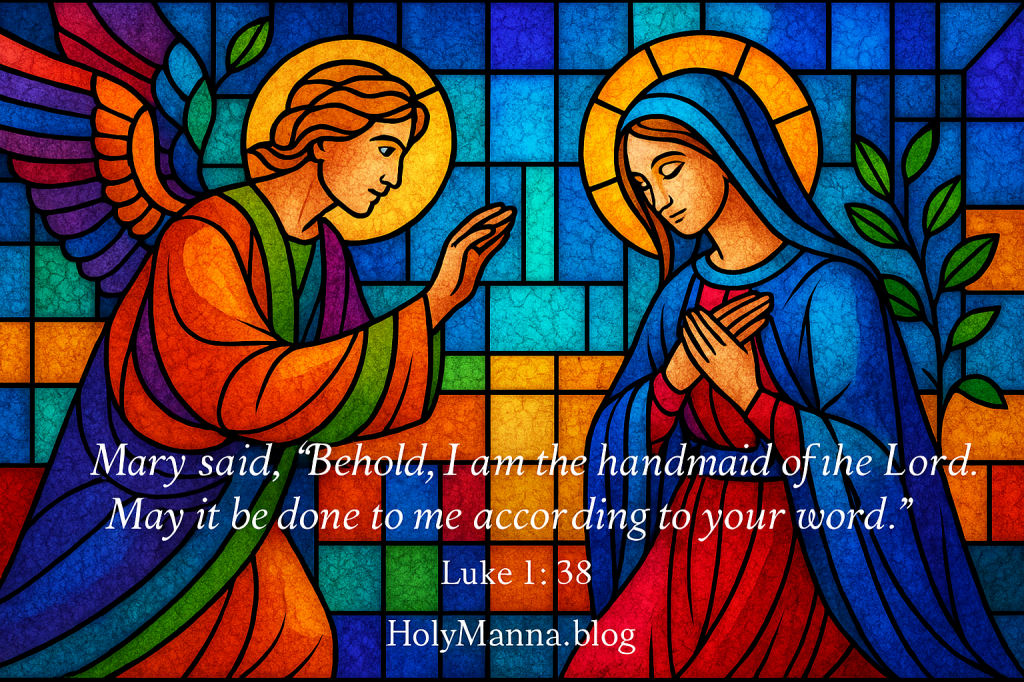
Solemnity of the Immaculate Conception of the Blessed Virgin Mary – Lectionary: 689
Crowned From the Beginning
There is something quietly breathtaking about realizing that before Adam and Eve ever reached for the forbidden fruit, God already held a plan for mercy in his heart. Today’s solemnity pulls back the veil on that hidden plan. In the middle of Advent, as hearts turn toward the coming of Christ, the Church pauses to look at how God prepared the Mother of the Savior from the very beginning, preserving her from sin so that grace could enter a shattered world through a sinless yes.
The readings for the Solemnity of the Immaculate Conception circle around a single, powerful truth: God does not improvise salvation. From the first fall in Genesis 3, through the victorious praise of Psalm 98, into the sweeping vision of Ephesians 1, and finally to the quiet home in Nazareth in Luke 1, the same message resounds. God prepared a woman, the New Eve, to stand in total enmity with the serpent so that her Son, the New Adam, could crush the power of sin.
In Genesis 3:9 15, 20, the tragic moment of the fall is not the end of the story. Right in the middle of blame, fear, and shame, God speaks a promise: “I will put enmity between you and the woman, and between your offspring and hers; they will strike at your head, while you strike at their heel.” The Church has long seen in this verse a first glimpse of Mary and Jesus, a woman and her offspring completely opposed to Satan. The Immaculate Conception flows from this enmity. For Mary to be totally on God’s side, she is preserved from sin from the first moment of her existence, as taught clearly in The Catechism (see CCC 490 493).
Psalm 98 invites all creation to burst into song because God’s victory has already been set in motion. “The Lord has made his victory known; has revealed his triumph in the sight of the nations.” This victory is not an abstract idea. It becomes concrete in a real woman, in a real womb, in real human history. The immaculate soul of Mary is one of those “marvelous deeds” that show God’s mercy and faithfulness to Israel and to the whole world.
Ephesians 1:3 6, 11 12 zooms out and shows the cosmic scale of what is happening. Before the foundation of the world, God chose his people in Christ “to be holy and without blemish before him.” What is offered to every Christian by grace and adoption shines in a unique and singular way in Mary. She is the one who is “all holy,” not by her own power, but entirely by the grace of Christ anticipated and poured into her at her conception. As The Catechism explains in CCC 491 492, this privilege is a direct fruit of the merits of Jesus, her Son.
Then the Gospel brings everything home. In Luke 1:26 38, the angel Gabriel enters the hidden life of a young virgin in Nazareth and greets her with a title rather than a name: “Hail, favored one! The Lord is with you.” This fullness of grace is not a random compliment. It is the visible manifestation of a lifelong reality that began at her conception. Because Mary is full of grace, she is free to respond fully when God asks everything of her. After hearing the astonishing promise “you will conceive in your womb and bear a son, and you shall name him Jesus”, she does not run or bargain. She listens, she asks a real question, and then she gives that answer which changed history: “Behold, I am the handmaid of the Lord. May it be done to me according to your word.”
Historically, the Church came to define this mystery formally in 1854, when Pope Pius IX, drawing from Scripture and the constant faith of the Church, proclaimed the dogma of the Immaculate Conception. Yet the belief itself is much older. It is rooted in the early Christian sense that if Christ is the New Adam, then Mary is truly the New Eve, not a neutral figure, but a woman totally aligned with God’s will and totally opposed to the serpent. The liturgy today gathers Genesis, Psalm 98, Ephesians, and Luke to show that this is not a spiritual afterthought. It is part of the original blueprint of God’s plan.
So as this solemnity is celebrated in the middle of Advent, hearts are invited to see Mary’s Immaculate Conception not as a distant theological detail but as a deeply personal gift. The same God who prepared a pure dwelling place for his Son also desires to make hearts holy and without blemish in Christ. Where does the idea that God planned mercy for you from all eternity challenge the way you see your own story today?
First Reading – Genesis 3:9 15, 20
The Fall, The First Promise, And The Hidden Preparation Of A Mother
This passage from Genesis drops everyone right into the aftermath of the first sin. The harmony of Eden has been shattered. Shame, fear, and blame have entered the human heart. Yet within this dark moment, God does something completely unexpected. Instead of wiping everything out, God steps in as a Father who questions, judges, and then promises a future victory. This scene is not only about the fall of Adam and Eve. It is also about the first whisper of the Gospel and the hidden preparation for a Woman who will one day stand in total opposition to the serpent.
In the culture of the ancient Near East, gods were often imagined as distant and unpredictable. Here, the true God walks in the garden, calls to the man, and engages personally with his creatures. The conversation reveals the depth of the wound that sin has caused. Fear replaces trust. Accusation replaces communion. Yet in pronouncing judgment on the serpent, God gives what the Church calls the protoevangelium, the first announcement of the Good News. “I will put enmity between you and the woman” points forward to a unique Woman and her offspring who will crush the serpent’s head. This is where the solemnity of the Immaculate Conception comes into focus. The New Eve, Mary, is prepared in advance so that her Son, the New Adam, can bring definitive victory over sin.
By naming the woman “Eve,” the “mother of all the living,” the text hints that even after the fall, humanity is not abandoned to despair. Life continues, and within that life, God is already at work. The Immaculate Conception is the fullest expression of this merciful plan. From the first moment of her existence, Mary is preserved from the stain of original sin so that the enmity between her and the serpent is absolute. This reading shows that the story of salvation begins not with human effort, but with divine initiative, mercy, and a promise that will echo all the way to Nazareth and beyond.
Genesis 3:9-15, 20
New American Bible (Revised Edition)
9 The Lord God then called to the man and asked him: Where are you? 10 He answered, “I heard you in the garden; but I was afraid, because I was naked, so I hid.” 11 Then God asked: Who told you that you were naked? Have you eaten from the tree of which I had forbidden you to eat? 12 The man replied, “The woman whom you put here with me—she gave me fruit from the tree, so I ate it.” 13 The Lord God then asked the woman: What is this you have done? The woman answered, “The snake tricked me, so I ate it.”
14 Then the Lord God said to the snake:
Because you have done this,
cursed are you
among all the animals, tame or wild;
On your belly you shall crawl,
and dust you shall eat
all the days of your life.
15 I will put enmity between you and the woman,
and between your offspring and hers;
They will strike at your head,
while you strike at their heel.
20 The man gave his wife the name “Eve,” because she was the mother of all the living.
Detailed Exegesis
Verse 9 – “The Lord God called to the man and said, ‘Where are you?’”
God’s first response to sin is not a thunderbolt but a question. This shows a God who seeks, who pursues, who invites the sinner to step out of hiding. The question is not about geography. It is about relationship. The man has moved away interiorly, and God gently exposes that distance. This sets the pattern for every sinner’s story. God calls, not to condemn blindly, but to bring the truth into the open.
Verse 10 – “He answered, ‘I heard you in the garden, but I was afraid because I was naked, so I hid.’”
Fear, shame, and hiding are the spiritual symptoms of sin. Before the fall, nakedness was a sign of innocence and transparency. Now it is experienced as vulnerability and danger. The man’s response reveals how sin twists the image of God in the heart. Instead of experiencing God as a loving Father, the man now experiences him as a threat. This interior distortion is part of the wound of original sin that all descendants of Adam and Eve inherit.
Verse 11 – “He asked, ‘Who told you that you were naked? Have you eaten from the tree which I commanded you not to eat?’”
God’s questioning is precise and surgical. He does not ignore the sin or gloss over it. By asking about the source of this new awareness, God leads the man to confront the act of disobedience. The reference to the command points back to the covenant relationship. Sin is not just breaking a rule. Sin is breaking trust with a personal God who gives loving commands for the good of his children.
Verse 12 – “The man replied, ‘The woman whom you put here with me, she gave me fruit from the tree, and I ate.’”
Blame enters the story. Instead of taking responsibility, the man shifts the focus to the woman and implicitly to God himself. “The woman whom you put here with me” carries a subtle accusation. This is what sin does. It fractures relationships and poisons how people see each other and even how they see God. The unity of man and woman, intended to reflect God’s love, is now wounded by suspicion and self protection.
Verse 13 – “The Lord God then asked the woman, ‘What is this you have done?’ She answered, ‘The snake tricked me, and so I ate.’”
God turns to the woman with the same honest question. The woman admits the deception but still points outward. Deception by the serpent is real, yet the choice remains hers. This shows that sin involves both external temptation and internal consent. The woman is not simply a passive victim. She is a responsible agent who has been misled. This sets the stage for the New Eve, who will also face a spiritual encounter, yet respond with total trust and obedience.
Verse 14 – “Then the Lord God said to the snake, ‘Because you have done this, cursed are you among all animals, on your belly you shall crawl and dust you shall eat all the days of your life.’”
Unlike the man and the woman, the serpent receives no questions and no chance to respond. Judgment is direct and absolute. The serpent represents Satan, the fallen angel who has chosen definitive rebellion against God. The humiliation of crawling and eating dust symbolizes total defeat and degradation. The curse signals that evil will not have the last word. God draws a line and announces that this deceiver will be opposed and ultimately crushed.
Verse 15 – “I will put enmity between you and the woman, and between your offspring and hers; they will strike at your head, while you strike at their heel.”
This verse is the heart of the passage and the reason it is proclaimed on this solemnity. The enmity described here is not a temporary tension. It is a deep, permanent opposition between the serpent and the woman, and between their respective offspring. The Church sees in this woman a prophetic foreshadowing of Mary, and in her offspring, Christ. The serpent strikes at the heel, which suggests a real but limited harm. Christ, through his cross and resurrection, strikes at the serpent’s head, a decisive and final blow. In Mary, the enmity is total, which is why the Church teaches that she is preserved from all stain of sin from the first moment of her conception.
Verse 20 – “The man gave his wife the name Eve, because she was the mother of all the living.”
After the fall and the pronouncement of judgment, life goes on. The naming of Eve is not a random detail. Names in Scripture reveal identity and mission. Calling her “mother of all the living” indicates that in spite of sin, God’s plan for life and fruitfulness continues. This title reaches its fullness in Mary, who becomes the Mother of all the living in Christ. On Calvary, when Jesus says, “Behold, your mother”, the spiritual motherhood that was hinted at in Eve finds its perfect realization in the New Eve.
Teachings: Mary, The New Eve, And The Protoevangelium
The Church reads this passage through the light of Christ and Mary. The Catechism teaches that this verse is the first announcement of the Messiah and Redeemer. CCC 410 explains that after the fall, God did not abandon humanity and that this verse contains the first promise of a Redeemer. It presents the future victory over the serpent and the restoration from the fall in a mysterious way.
In CCC 411, the Church goes further and connects this promise directly to Mary. It teaches that the Christian tradition sees this passage as announcing the New Adam and that even in this verse, Mary is foreshadowed. The text speaks of a woman who is in a state of enmity with the serpent. Since enmity with Satan cannot coexist with sin, the Church concludes that Mary, by a special grace of God, is preserved from sin entirely.
The dogma of the Immaculate Conception, defined in 1854 by Pope Pius IX, expresses this truth clearly. He taught that Mary, in the first moment of her conception, was preserved immune from all stain of original sin by a singular grace and privilege of almighty God, in view of the merits of Jesus Christ. This means that the victory promised in Genesis 3:15 is directly linked to the grace that fills Mary from the beginning.
The early Fathers of the Church saw this connection with striking clarity. Saint Irenaeus famously contrasted Eve and Mary. He wrote that “the knot of Eve’s disobedience was loosed by the obedience of Mary” and that what the virgin Eve bound by unbelief, the Virgin Mary unbound by faith. In other words, Eve’s “no” is answered and reversed by Mary’s “yes.” Where Eve listened to the serpent and doubted God, Mary listens to the angel and trusts God completely.
This reading also illuminates the teaching on original sin. CCC 404 explains that the whole human race is in Adam as one body and that his sin affects all his descendants. The broken trust, the fear, and the blame seen in this passage are not just ancient history. They are the spiritual inheritance that touches every human heart. The Immaculate Conception reveals that God can intervene in that inherited condition in a radical way. In Mary, the effects of original sin are prevented, not by her own strength, but by the foreseen merits of Christ. This shows both the seriousness of sin and the superabundance of grace.
In the context of salvation history, Genesis 3:9 15, 20 is the seed from which the rest of the Bible grows. The figure of the woman and her offspring echoes in Isaiah, in Revelation 12, and ultimately in the Gospels. The solemnity of the Immaculate Conception invites everyone to see that the preparation for Christ did not begin at Bethlehem. It began here, in the garden, with a promise spoken over a fallen world that God would one day raise up a Woman and her Son to crush evil at its root.
Reflection: Let Grace Rewrite Your Story Of Shame
This reading speaks directly into the experience of shame, fear, and hiding that so many people carry. Adam’s instinct is to hide from God, to cover himself, to shift the blame. That pattern still repeats today. When sin, failure, or weakness shows up, hearts often move into the shadows, avoid prayer, pull back from the sacraments, and even blame others or God for the mess.
Yet this passage shows a different movement from God’s side. God walks toward the sinner and asks, “Where are you?” That question is not a trap. It is an invitation to step out of hiding and into relationship. If God already had a plan of mercy at the moment of the first sin, then that same God certainly has a plan of mercy for every tangled story right now.
The promise of the woman and her offspring reminds everyone that evil does not get the last word. In Mary’s Immaculate Conception, it becomes clear that grace is stronger than sin. God can create something completely new. God does not simply repair brokenness. God can preserve, transform, and elevate. Looking at Mary, hearts see what humanity was meant to be: fully alive, fully receptive to God, completely free from the slavery of sin.
This reading also challenges the habit of blame. Adam blames Eve. Eve points to the serpent. The pattern is old and familiar. Instead of taking ownership, it is easy to point fingers: at family, at culture, at temptation, even at God. The Immaculate Conception offers a different path. Mary does not blame God for what he asks of her. Mary trusts. Mary receives. Mary responds with a clear “May it be done to me according to your word.”
Practically, this passage invites a few concrete steps. Spend time honestly answering God’s question, “Where are you?” Name the fears and the places where hiding has become a habit. Bring those areas to confession and let Christ’s victory over the serpent touch specific wounds. Ask Mary, the New Eve, to intercede for a heart that is more open, more trusting, and more docile to God’s will. When tempted to shift blame, pause and choose responsibility and humility instead.
Where are the places in life where hiding from God has become the default response rather than running toward him?
How does looking at Mary, preserved from sin yet profoundly humble, change the way sin and grace are understood in personal life?
What concrete step can be taken today to move from blame and fear into trust and obedience under the mantle of the Immaculate Virgin?
Responsorial Psalm – Psalm 98:1 4
A New Song For An Ancient Victory
Psalm 98 is a royal hymn of praise that celebrates the Lord as a victorious king whose saving power has been made visible before the nations. In ancient Israel, psalms like this would be sung in liturgical settings, possibly during processions or temple worship, to proclaim God’s faithfulness to his covenant and his public interventions in history. The language of God’s “right hand” and “holy arm” reflects the way ancient cultures spoke about the strength and honor of a king in battle. Here, however, the true warrior king is the Lord himself, and his victory is not just military. It is a saving victory that brings justice, mercy, and joy.
On the solemnity of the Immaculate Conception, this psalm takes on a special radiance. The “marvelous deeds” and “victory” of God include not only big dramatic events like the Exodus, but also the quiet, hidden marvel of a young Jewish girl conceived without sin in her mother’s womb. Mary’s Immaculate Conception is part of God’s saving plan made visible. In her, the Lord has prepared a pure dwelling place for his Son, and that work of grace is truly a “new song” in human history. While Genesis 3 shows the wound of sin, Psalm 98 shows the response: a God who does not give up, but acts in ways that make all creation want to shout for joy.
This psalm fits today’s theme by shifting the focus from the tragedy of the fall to the triumph of divine mercy. The enmity between the Woman and the serpent, promised in Genesis, becomes a cause for cosmic celebration. The Church sings Psalm 98 as a response to the first reading to say: God’s promise has not only been spoken. God’s promise has begun to be fulfilled. In Mary’s Immaculate Conception and in Christ’s coming, the victory of God is already shining for all the earth to see.
Psalm 98:1-4
New American Bible (Revised Edition)
The Coming of God
1 A psalm.
Sing a new song to the Lord,
for he has done marvelous deeds.
His right hand and holy arm
have won the victory.
2 The Lord has made his victory known;
has revealed his triumph in the sight of the nations,
3 He has remembered his mercy and faithfulness
toward the house of Israel.
All the ends of the earth have seen
the victory of our God.
4 Shout with joy to the Lord, all the earth;
break into song; sing praise.
Detailed Exegesis
Verse 1 – “Sing a new song to the Lord, for he has done wonderful deeds; his right hand and his holy arm have brought about victory.”
The call to “sing a new song” signals that God has acted in a fresh, decisive way. In the Old Testament, that phrase often appears after a major saving event, like the Exodus. A “new song” means that God’s intervention has created a new chapter in the story of his people. His “right hand” and “holy arm” are images of power and holiness. This victory is not accidental or partial. It is deliberate, holy, and complete. In the light of the Immaculate Conception, Mary herself becomes a sign of this newness. Her existence as a person preserved from sin is a “new song” of grace within fallen humanity.
Verse 2 – “The Lord has made his victory known; he has revealed his justice in the sight of the nations.”
God’s victory is not hidden in a corner. The psalm stresses that it is public and visible. “Justice” here means more than fairness. It refers to God’s faithfulness to his covenant, his determination to set things right. When God acts to save, he does not only help Israel. He reveals his character to all nations. In Jesus Christ, born of the Immaculate Virgin, this revelation reaches its fullness. Through Mary’s yes, the Lord’s saving justice is no longer only a promise to one people. It becomes flesh and walks among all.
Verse 3 – “He has remembered his mercy and faithfulness toward the house of Israel; all the ends of the earth have seen the saving power of our God.”
“Remembered” does not mean God had forgotten and then recalled. It means that God has chosen to act in line with his covenant love. “Mercy” and “faithfulness” are key biblical words that describe God’s steadfast, loyal love. The result of this faithfulness is that “all the ends of the earth” see his saving power. This is missionary language. God’s work in Israel is meant to overflow to the whole world. Mary, as Daughter of Zion and Mother of the Messiah, stands at the crossroads of this plan. Her Immaculate Conception is an act of mercy for Israel that will bless every nation through Christ.
Verse 4 – “Shout with joy to the Lord, all the earth; break into song and sing praise.”
The response to God’s saving action is not polite golf claps. It is loud, overflowing praise. The whole earth is invited to join in, not just Israel. Joy becomes the proper reaction when the truth about God’s victory sinks in. In the liturgy, this verse becomes an invitation to move from mere recitation to heartfelt worship. On this solemnity, the joy is not only for a distant spiritual reality. It is for a real woman, Mary, who shows what God’s grace can do and who leads the Church in praising the One who has done great things.
Teachings: Praise, Salvation History, And The Immaculate Virgin
Psalm 98 sits right at the intersection of praise and salvation history. The Catechism reminds the faithful that the psalms are the heart of biblical prayer. The Catechism notes that in the psalms, the Holy Spirit teaches the Church how to pray by taking up the words inspired by God himself. It explains that the psalms are both human words and God’s words, which makes them a unique school of prayer and praise.
This psalm shows that praise is not just a vague mood. Praise is a response to specific acts of God in history. God’s “marvelous deeds,” his “victory,” and his “mercy and faithfulness” are all concrete. The greatest of these deeds is the sending of his Son. However, the preparation for this sending is also part of the story. The dogma of the Immaculate Conception is rooted in this larger vision of salvation history. The Catechism explains that Mary was “enriched from the first instant of her conception with the splendor of an entirely unique holiness” and that this was “in view of the merits of her Son.” That means her existence is itself a work of Christ’s saving power, applied in advance.
The tradition has often seen Mary as the first and best singer of God’s new song. In the Gospel of Luke, Mary’s Magnificat is a kind of echo and fulfillment of psalms like this. She proclaims, “My soul proclaims the greatness of the Lord, and my spirit rejoices in God my savior.” Her praise is not abstract. It is rooted in what God has done in her and for his people. Saints and Doctors of the Church have often pointed out that in Mary, the promises made to Israel find a pure, joyful response.
The Catechism also teaches about the importance of praise in Christian prayer. It explains that praise “lauds God for his own sake and gives him glory quite beyond what he does, but simply because he is.” Psalm 98 helps the heart move from focusing only on personal needs to adoring God for who he is and for what he has done in history. When this psalm is read in the context of the Immaculate Conception, it invites the faithful to adore not only God’s power, but also his delicate, hidden craftsmanship in preparing Mary as the all holy Mother of the Redeemer.
Historically, the solemnity of the Immaculate Conception grew out of a long tradition of honoring Mary’s holiness. As the Church meditated on Scripture, especially passages like Genesis 3:15 and texts full of joy and victory like Psalm 98, the conviction deepened that God’s victory over sin began in a unique way in Mary. When the dogma was defined in the nineteenth century, it was not the invention of something new, but the clear articulation of what had been sung, prayed, and believed for centuries.
Reflection: Learning To Sing A New Song Of Trust
This psalm asks a simple but challenging question of the heart: Is life being lived like someone who believes that God has already won a real victory, or like someone who thinks everything depends on personal effort and control? The repeated calls to sing, shout, and rejoice are not just liturgical decorations. They are invitations to live out of a deep confidence in God’s faithfulness.
In daily life, it can be very easy to get stuck rehearsing the same old songs of fear, regret, or self criticism. The inner soundtrack might be full of anxiety and self doubt. Psalm 98 gently but firmly pushes back against that. If God has acted in history, if God has remembered his mercy, if God has already shown his saving power, then the soul is not meant to stay locked in those old tracks. The Immaculate Conception is a powerful reminder of this. In a world marked by sin and confusion, God quietly prepared a humble, hidden young woman to be the all holy Mother of his Son. That is not the move of a distant or indifferent God. That is the move of a God who is faithful to his promises.
Practically, this can mean choosing to bring praise into prayer even when emotions are flat. It can mean starting the day by thanking God for specific “marvelous deeds,” both in salvation history and in personal life. It can mean asking Mary to help the heart see God’s victories more clearly, just as she did. When discouragement hits, remembering that “all the ends of the earth have seen the saving power of God” can shift the focus from problems to the larger story of God’s faithfulness.
What would it look like to “sing a new song” in the middle of the routines and pressures of ordinary life today?
Where have signs of God’s mercy and faithfulness already shown up, even if they were small and quiet like the hidden beginning of Mary’s life?
How can praise become a regular part of prayer, so that the heart slowly learns to see life through the lens of God’s victory rather than through the lens of fear or defeat?
Second Reading – Ephesians 1:3 6, 11 12
Chosen Before Time: Grace, Adoption, And The Secret Of Mary’s Holiness
Ephesians is written to Christians surrounded by a pagan culture, where competing religions, philosophies, and spiritual powers shaped daily life. In that setting, this passage explodes with a breathtaking vision of God’s plan. Life is not random. History is not chaotic. Before the foundation of the world, God already desired a people who would be holy and without blemish in Christ.
This section of Ephesians 1 is like a hymn that reveals the Father’s heart. It speaks of blessing, election, adoption, grace, and glory. The language stretches beyond time and space, yet it touches very concrete realities. Through Jesus Christ, people are not only forgiven. They are made sons and daughters, destined to live “for the praise of his glory.” On this solemnity, that plan is seen shining most clearly in Mary. If all Christians are chosen in Christ to be holy, Mary is the one in whom that holiness shines perfectly from the first moment of her existence. The Immaculate Conception is not a side note. It is the most beautiful example of what this passage proclaims.
Ephesians draws the Church’s eyes back behind Genesis 3, even behind creation itself, to God’s eternal choice. The same God who promised a woman and her offspring in the garden has always known that salvation would unfold through a humble Virgin whose entire being is filled with grace. This reading anchors the feast in the eternal will of the Father, showing that Mary’s privilege is pure gift and that the same gift, in a different way, is offered to every believer in Christ.
Ephesians 1:3-6, 11-12
New American Bible (Revised Edition)
The Father’s Plan of Salvation. 3 Blessed be the God and Father of our Lord Jesus Christ, who has blessed us in Christ with every spiritual blessing in the heavens, 4 as he chose us in him, before the foundation of the world, to be holy and without blemish before him. In love 5 he destined us for adoption to himself through Jesus Christ, in accord with the favor of his will, 6 for the praise of the glory of his grace that he granted us in the beloved.
Inheritance Through the Spirit. 11 In him we were also chosen, destined in accord with the purpose of the One who accomplishes all things according to the intention of his will, 12 so that we might exist for the praise of his glory, we who first hoped in Christ.
Detailed Exegesis
Verse 3 – “Blessed be the God and Father of our Lord Jesus Christ, who has blessed us in Christ with every spiritual blessing in the heavens.”
The passage opens with praise. God the Father is blessed because he has already blessed his people in Christ. The blessings mentioned are not primarily material. They are “spiritual,” meaning they come from the Holy Spirit and have to do with the new life in Christ. “In the heavens” points to the source and quality of these blessings, not their distance. They are real and present. On this solemnity, those blessings are seen poured into Mary in a unique way. She receives “every spiritual blessing” in the most radical sense by being conceived without sin and completely open to God.
Verse 4 – “As he chose us in him, before the foundation of the world, to be holy and without blemish before him.”
Here the veil is pulled back on God’s eternal choice. Before the world existed, before sin entered the story, God already had a plan. The goal is not just survival or basic morality. The goal is holiness, being “without blemish” in God’s sight. This phrase echoes the language used for spotless sacrificial offerings in the Old Testament. In Christ, believers are meant to become living offerings pleasing to God. Mary is the most perfect realization of this. By a singular grace, she is “without blemish” from conception, entirely for God. What is given to her as a preserving grace is offered to others as a healing and transforming grace.
Verse 5 – “He destined us for adoption to himself through Jesus Christ, in accord with the favor of his will.”
God’s plan is described as “adoption.” Salvation is not only about being rescued from danger. It is about being brought into a family. Through Jesus Christ, people become sons and daughters of the Father. This adoption is not reluctant or forced. It flows from “the favor of his will,” which means his gracious good pleasure. Mary stands at the heart of this mystery. She is not adopted as a daughter in the same way that sinners are, since she is preserved from original sin. Yet she is entirely the child of the Father, filled with grace, and chosen to be the Mother of the Son. Her Immaculate Conception serves this plan of adoption for everyone else, since through her, the Redeemer enters the world.
Verse 6 – “For the praise of the glory of his grace that he granted us in the beloved.”
The purpose of this whole plan is the “praise of the glory of his grace.” Grace is not just a tool. Grace is the radiant beauty of God’s love poured into human hearts. “The beloved” refers to Jesus, the beloved Son. In him, grace is granted. Mary is “full of grace” precisely because she is uniquely united to the Beloved. Her existence points everyone back to the glory of God’s grace. The Immaculate Conception is therefore not about exalting Mary in isolation. It is about magnifying the grace of God in Christ.
Verse 11 – “In him we were also chosen, destined in accord with the purpose of the one who accomplishes all things according to the intention of his will.”
The text returns to the theme of being chosen “in him,” that is, in Christ. The language of destiny here is not fatalistic. It is hopeful. God’s purpose is loving and wise. He “accomplishes all things,” which means that even in the chaos of history, his plan is not derailed. This includes the hidden designs of the Immaculate Conception. Long before Joachim and Anne conceived Mary, God had willed that their child would be preserved from sin in view of Christ’s merits. That same providence is at work in the lives of believers, working through events, choices, and even sufferings to fulfill his intention of holiness and glory.
Verse 12 – “So that we might exist for the praise of his glory, we who first hoped in Christ.”
Here the goal is stated again, this time in personal terms. Believers are meant to “exist for the praise of his glory.” Life is not a random project. It is meant to become a hymn. “We who first hoped in Christ” likely refers to the first generation of Jewish Christians who recognized Jesus as the fulfillment of Israel’s hopes. Mary is the first and greatest of those who hoped in Christ, even before his birth. In her Immaculate Conception, hope already begins to blossom. Her whole life is praise of God’s glory, which is exactly what this verse describes as the purpose of every Christian life.
Teachings: God’s Eternal Plan, Mary’s Privilege, And The Call To Holiness
This passage from Ephesians lines up beautifully with the Church’s teaching on God’s eternal plan and Mary’s unique role within it. The Catechism teaches that God created the world to share his blessed life with creatures and that this plan of sheer goodness is called “the plan of loving kindness.” It explains that this plan is fully revealed and brought to completion in Christ.
In light of this, the Immaculate Conception is understood as part of that same plan. The Catechism states that Mary was “from the first moment of her conception, by a singular grace and privilege of almighty God and by virtue of the merits of Jesus Christ, Savior of the human race, preserved immune from all stain of original sin.” This definition echoes the language of Ephesians 1. Mary is the one who, in a unique way, has always been “holy and without blemish” in God’s sight, entirely by grace.
The Catechism continues by saying that Mary’s holiness is totally the work of God’s grace and that it is “a more sublime work of grace” because it is a preventive redemption. The grace of Christ is applied to her at the very origin of her life. This shows how deeply the Father’s plan penetrates into history. God does not merely react to sin. God anticipates and overcomes it in a way that reveals the superabundance of grace.
Saint John Paul II often linked this passage with the universal call to holiness. He insisted that every baptized person is chosen in Christ to be holy and that this is not reserved for a few. Mary is the most excellent realization of this call. The fact that she is immaculate does not distance her from sinners. It makes her the model and mother of all who are on the journey of purification and sanctification.
The tradition also sees Mary as the masterpiece of God’s predestining love. Saint Louis de Montfort spoke of God having a special plan in forming Mary, preparing her as a worthy Mother for his Son and a spiritual mother for believers. Her entire being is “for the praise of his glory,” which is exactly what Ephesians 1 says about the Church. In other words, what is said of the Church in general is embodied in Mary in a perfect and singular way.
This passage also supports the teaching on divine providence. God is described as the one who “accomplishes all things according to the intention of his will.” The Catechism teaches that this providence is mysterious but always wise and loving. The Immaculate Conception is an example of this providence acting in a way that no human could have predicted. It invites trust that the same God is at work in every baptized life, aiming at holiness and glory.
Reflection: Living As Someone Chosen And Loved From The Beginning
This reading invites a deep shift in the way a person sees life and identity. Instead of thinking of life as a random sequence of events or as something defined only by mistakes and sins, Ephesians 1 says something very different. Before the world existed, God saw each person in Christ and desired holiness, adoption, and glory. That truth is easy to affirm in theory, but much harder to let sink into the heart.
The Immaculate Conception shows what it looks like when someone’s entire existence is shaped by that eternal choice. Mary’s life is not driven by fear or self assertion. Mary moves out of a deep security in God’s love. Even in trials, she remains rooted in her identity as beloved daughter and faithful handmaid.
In daily life, it can be tempting to build identity on performance, achievements, or the opinions of others. This passage quietly but firmly challenges that. If God has blessed, chosen, and destined people in Christ, then true identity rests on grace, not on success or failure. Remembering this can change the way sin, repentance, and growth are approached. Instead of trying to earn God’s favor, the heart can respond to a favor that has already been given.
Practically, this might mean taking time in prayer to sit with these verses, slowly, and allowing them to be heard as personally addressed. It can mean asking Mary to share her sense of being totally grounded in God’s grace. It can inspire concrete choices that reflect a “chosen” identity, such as making time for the sacraments, choosing virtue over compromise, and living with a quiet confidence rather than constant anxiety.
What would change if the deepest truth about identity was not “sinner who tries hard” but “chosen son or daughter in Christ, called to be holy and without blemish”?
How does looking at Mary, immaculate from the first moment of her existence, help reveal what God desires to do, in a different way, in every baptized soul?
What specific area of life needs to be surrendered to God’s providence today, trusting that the one who “accomplishes all things” is still working for the praise of his glory in this exact situation?
Holy Gospel – Luke 1:26 38
The New Eve’s Yes And The Beginning Of The New Creation
This Gospel passage is one of the holiest moments in all of Scripture. Heaven and earth meet in a quiet house in Nazareth. A mighty archangel enters the life of a humble young woman, and with her free response, the eternal plan of God begins to unfold in history in a new and definitive way. In the culture of first century Judaism, Nazareth was an obscure town in Galilee, far from the religious center of Jerusalem. Yet God chooses this hidden place, this ordinary village, and this unknown virgin to be the stage for the Incarnation of his Son.
Luke carefully situates the scene in real history and within Israel’s story. Joseph belongs to the house of David, which means that the child to be born will be the long awaited heir to David’s throne, fulfilling promises made in 2 Samuel and echoed in the prophets. Mary is a virgin, betrothed but not yet living with Joseph, which highlights both her purity and the miraculous nature of the conception announced by Gabriel. Religiously, this moment is the turning point where the Old Covenant gives way to the New. The God who spoke through prophets now speaks through an angel to invite a young woman to become the Mother of the Messiah.
On the solemnity of the Immaculate Conception, this passage reveals why Mary’s preservation from sin matters so deeply. The New Eve stands before the messenger of God, not as a slave, but as a free daughter, full of grace. Her yes is not forced or automatic. It is a real act of faith that is made possible and radiant by the fact that her heart has never been darkened by sin. The enmity promised in Genesis 3:15 between the woman and the serpent comes into focus here. The one whom the angel greets as “favored one” is the same woman whose offspring will crush the serpent’s head.
Luke 1:26-38
New American Bible (Revised Edition)
26 In the sixth month, the angel Gabriel was sent from God to a town of Galilee called Nazareth, 27 to a virgin betrothed to a man named Joseph, of the house of David, and the virgin’s name was Mary. 28 And coming to her, he said, “Hail, favored one! The Lord is with you.” 29 But she was greatly troubled at what was said and pondered what sort of greeting this might be. 30 Then the angel said to her, “Do not be afraid, Mary, for you have found favor with God. 31 Behold, you will conceive in your womb and bear a son, and you shall name him Jesus. 32 He will be great and will be called Son of the Most High, and the Lord God will give him the throne of David his father, 33 and he will rule over the house of Jacob forever, and of his kingdom there will be no end.” 34 But Mary said to the angel, “How can this be, since I have no relations with a man?” 35 And the angel said to her in reply, “The holy Spirit will come upon you, and the power of the Most High will overshadow you. Therefore the child to be born will be called holy, the Son of God. 36 And behold, Elizabeth, your relative, has also conceived a son in her old age, and this is the sixth month for her who was called barren; 37 for nothing will be impossible for God.” 38 Mary said, “Behold, I am the handmaid of the Lord. May it be done to me according to your word.” Then the angel departed from her.
Detailed Exegesis
Verse 26 – “In the sixth month, the angel Gabriel was sent from God to a town of Galilee called Nazareth.”
“The sixth month” refers to the pregnancy of Elizabeth, tying this scene directly to the earlier announcement of John the Baptist’s conception. God’s interventions are connected and ordered. Gabriel, one of the archangels named in Scripture, is “sent from God,” which shows that this initiative starts in heaven, not on earth. Nazareth, a small town of little reputation, becomes the place where God begins the new creation. This underlines how God loves to work through what seems insignificant in the eyes of the world.
Verse 27 – “To a virgin betrothed to a man named Joseph, of the house of David, and the virgin’s name was Mary.”
The repetition of the word “virgin” highlights both Mary’s physical virginity and her spiritual consecration. In Jewish custom, betrothal was a legally binding state, more than a modern engagement, but the couple did not yet live together. Joseph’s connection to the house of David is crucial. The Messiah was expected to come from David’s line. Mary’s name is finally revealed at the end of the sentence, almost as if the narrative is gently building up to the introduction of this young woman who will carry the destiny of the world in her womb.
Verse 28 – “And coming to her, he said, ‘Hail, favored one! The Lord is with you.’”
Gabriel does not greet Mary by her name at first, but by a title. “Hail, favored one” can also be rendered as “rejoice, full of grace.” This is not just a kind phrase. It reveals Mary’s identity. She is filled with God’s grace in a unique and permanent way. “The Lord is with you” is covenant language, used of figures like Moses and Gideon when God calls them to a special mission. Here, that mission is unlike any other. The Lord is with Mary in a way that is about to become literal, as God the Son will dwell in her womb.
Verse 29 – “But she was greatly troubled at what was said and pondered what sort of greeting this might be.”
Mary’s reaction shows that holiness does not mean emotional numbness. She is “greatly troubled,” not because she doubts God, but because she humbly questions how such a greeting could apply to her. Her pondering reveals a heart that thinks deeply and prayerfully. She does not panic or run. She reflects. This interior attitude is a sign of her wisdom and purity. The immaculate heart is not naive. It is attentive and discerning.
Verse 30 – “Then the angel said to her, ‘Do not be afraid, Mary, for you have found favor with God.’”
“Do not be afraid” is one of the most repeated commands in Scripture. Here it is spoken to a young woman who is about to hear the most overwhelming call imaginable. Naming her “Mary” after calling her “favored one” ties together her personal identity and her grace filled vocation. “You have found favor with God” echoes Old Testament language used for figures like Noah and Moses, who found favor and were entrusted with crucial missions. Mary stands in that line, yet surpasses it, since her mission involves the Incarnation itself.
Verse 31 – “Behold, you will conceive in your womb and bear a son, and you shall name him Jesus.”
The angel moves from greeting to announcement. The word “Behold” signals that something astonishing is being revealed. The language mirrors the classic Old Testament pattern of annunciations, but with a decisive difference. The name “Jesus” means “God saves.” This child is not simply a prophet or leader. The name reveals his mission and identity as Savior. The conception in her womb will be miraculous, but it will also be truly human. God takes on flesh in real female biology and history.
Verse 32 – “He will be great and will be called Son of the Most High, and the Lord God will give him the throne of David his father.”
“Great” by itself would already be a powerful description, but the title “Son of the Most High” points far beyond human greatness. “Most High” is a divine title. This child shares a unique relationship with God. The mention of the throne of David connects Jesus directly to the messianic promises. He is not just spiritually great. He is the true king of Israel, the heir of God’s covenant with David.
Verse 33 – “And he will rule over the house of Jacob forever, and of his kingdom there will be no end.”
Here the eternal dimension of Christ’s kingship is made explicit. Unlike earthly kingdoms that rise and fall, his rule is forever. “House of Jacob” refers to Israel, but in the light of the New Testament, it extends to all who become children of God in Christ. The eternal kingdom described here is the same reality Jesus preaches as the Kingdom of God, which begins now and is fulfilled in heaven.
Verse 34 – “But Mary said to the angel, ‘How can this be, since I have no relations with a man?’”
Mary’s question is honest and practical. It does not come from doubt in God’s power, but from a desire to understand how this will unfold given her virginity. The wording suggests that Mary is not simply waiting to begin normal married life, but that she has some kind of intention of remaining virginal. Her question opens the door for the angel to reveal the role of the Holy Spirit. The New Eve responds not with disbelief, but with a faith that still asks for clarity.
Verse 35 – “And the angel said to her in reply, ‘The holy Spirit will come upon you, and the power of the Most High will overshadow you. Therefore the child to be born will be called holy, the Son of God.’”
This verse reveals the mystery of the Incarnation in seed form. The conception of Jesus is a direct work of the Holy Spirit. “Overshadow” echoes the cloud of God’s presence that overshadowed the tabernacle in the wilderness. The same divine presence that filled the Holy of Holies now covers Mary, making her the living ark of the covenant. Because this conception is the work of God, the child is “holy” and truly the Son of God. Mary’s womb becomes the place where heaven and earth meet.
Verse 36 – “And behold, Elizabeth, your relative, has also conceived a son in her old age, and this is the sixth month for her who was called barren.”
Gabriel offers Mary a sign rooted in her own family. Elizabeth’s miraculous pregnancy confirms that God is already doing the impossible. “Called barren” indicates how people labeled her, but God has written a different story in her body. This sign is not only proof. It is also an invitation for Mary into community. Her yes will not be lived in isolation but will be supported by the faith of others.
Verse 37 – “For nothing will be impossible for God.”
This short line is the theological core of the message. The Incarnation, Mary’s virgin motherhood, Elizabeth’s late pregnancy, and ultimately the victory over sin and death all rest on this truth. Human limitations are not barriers for God’s power and love. In the context of the Immaculate Conception, this word also echoes over Mary’s own beginning. Preserving a daughter of Adam from original sin is not impossible for the God who makes all things new.
Verse 38 – “Mary said, ‘Behold, I am the handmaid of the Lord. May it be done to me according to your word.’ Then the angel departed from her.”
This is the moment everything has been leading up to. Mary responds freely, consciously, and completely. “Behold” expresses her readiness to step into God’s plan. Calling herself the “handmaid of the Lord” is an act of humility, not self degradation. She places her whole being at God’s disposal. “May it be done to me according to your word” is the highest act of human obedience in history. At that moment, according to the faith of the Church, the Word became flesh in her womb. The angel departs because his mission is complete. Heaven has received the yes it came to seek.
Teachings: The Annunciation, The Immaculate Conception, And Mary’s Fiat
The Church sees the Annunciation as the central moment when the Incarnation begins. The Catechism teaches that when Mary answers the angel, “Behold, I am the handmaid of the Lord; let it be done to me according to your word”, her consent allows the eternal Son of God to take on human nature. In The Catechism’s language, Mary’s yes is described as a cooperation in salvation that is “through her obedience.”
Regarding the Immaculate Conception, The Catechism explains that God chose Mary “from all eternity” to be the Mother of his Son and that in order for her to give this free and total yes, she was prepared by a singular grace. It states that she was “from the first moment of her conception, by a singular grace and privilege of almighty God and by virtue of the merits of Jesus Christ, Savior of the human race, preserved immune from all stain of original sin.” This means her fiat at the Annunciation flows from a heart that has never been enslaved by sin. Her freedom is the fullest human freedom, anchored entirely in God.
The Catechism also highlights the role of the Holy Spirit in this scene. It teaches that the Holy Spirit, who overshadowed the Virgin Mary, is the one who brings about the Incarnation, making Jesus Christ the Son of God in power. The language of overshadowing connects Mary to the ark of the covenant. The Fathers of the Church loved this imagery. They saw Mary as the new ark, carrying not stone tablets, manna, and Aaron’s rod, but the living Word, the true Bread from heaven, and the eternal High Priest.
Saint Irenaeus and many other Fathers drew a powerful parallel between Eve and Mary. Irenaeus wrote that “the knot of Eve’s disobedience was loosed by the obedience of Mary” and that what the virgin Eve bound through unbelief, the Virgin Mary unbound by faith. The Annunciation is the precise moment where that untying happens. Eve listened to a fallen angel and doubted God’s goodness. Mary listens to an archangel and trusts completely. Eve’s choice ushered in death. Mary’s choice ushers in Life himself.
The Church also sees Mary as the first and most perfect disciple. The Catechism speaks of Mary’s faith as being “the purest realization of faith,” because she believes even when she cannot see how God will fulfill his word. At the Annunciation, she surrenders not only her body, but also her future, her plans, and her sense of control. This makes her the model for every Christian who is called to say yes to God’s plan, even when it feels risky or unclear.
Historically, the Annunciation has been celebrated from very early in the Church’s life, not just as a Marian feast, but as a Christological one. It is the feast of the Incarnation, where the Son of God becomes man. The solemnity of the Immaculate Conception, defined in 1854, shines a light on the hidden preparation that made this moment possible. The grace that preserved Mary from sin is the same grace that speaks through Gabriel’s greeting and that fills her heart to respond with total trust.
Reflection: Learning To Say A Real Yes In The Middle Of Real Fear
This Gospel meets the heart in a very personal way. Mary is not a distant statue. Mary is a young woman faced with a call that will change everything. She is troubled. She asks a question. She has to let go of her own plans. Yet in the middle of that, she chooses trust. Her yes is not naive. Her yes is courageous.
Everyone has their own “Nazareth moments,” times when God’s word comes through circumstances, opportunities, or interior nudges that feel overwhelming. The instinct can be to hide, to say that it is impossible, or to cling tightly to personal control. The Annunciation shows another path. It shows that God’s calls are always held inside his favor. “Do not be afraid” is not a cheap slogan. It is a word spoken by the God who already knows the whole story and will not abandon those he calls.
Mary’s Immaculate Conception might seem far from ordinary struggles, yet it actually offers deep encouragement. If God can prepare Mary so perfectly for her mission, then God can also prepare you for the mission entrusted to you. Through baptism, confession, and the Eucharist, grace is at work, slowly purifying, strengthening, and freeing your heart to respond more fully. Mary’s yes is unique, but it is also the pattern for every Christian vocation, whether in family life, priesthood, consecrated life, or the daily call to holiness in the middle of the world.
Practically, this Gospel invites a few concrete steps. Take time to sit with Mary’s words and make them a personal prayer: “Behold, I am the handmaid of the Lord. May it be done to me according to your word.” Ask Mary to share her trust and her inner freedom. When fear rises at what God might be asking, remember Gabriel’s simple statement: “Nothing will be impossible for God.” Bring that fear honestly to God instead of pretending it is not there. Let the Holy Spirit overshadow the weaknesses and uncertainties, just as he overshadowed Mary.
Where in life right now is God inviting a deeper yes, even if the details are not fully clear yet?
What fears or objections echo Mary’s question, “How can this be,” and how might God be answering them with his own quiet assurance?
How could a daily act of entrustment to Jesus through Mary help the heart move from cautious half consent into a more wholehearted fiat like hers?
Walking With The New Eve Into God’s Victory
The readings for this solemnity trace a breathtaking arc. In Genesis 3, sin enters the world, shame and blame fracture the human heart, yet God speaks a promise. A woman and her offspring will stand in permanent enmity with the serpent, and the serpent’s head will be struck. In Psalm 98, that promise turns into praise. God’s victory is not hidden. “All the ends of the earth have seen the victory of our God.” In Ephesians 1, the curtain is pulled back even further. Before the foundation of the world, God chose his people in Christ “to be holy and without blemish”, destined for adoption and made to exist for the praise of his glory. Then in Luke 1, everything converges in a small house in Nazareth, where the New Eve, full of grace, freely says, “May it be done to me according to your word.”
The Immaculate Conception sits right at the center of this story. The Woman promised in Genesis is the Virgin greeted in Luke. The victory sung in Psalm 98 begins quietly in the immaculate heart of Mary. The eternal plan of holiness described in Ephesians shines most fully in her, preserved from sin so that her yes can be completely free. God’s response to the disaster of sin is not panic or half measures. God writes a plan of mercy that reaches from eternity into a young girl’s womb, filling history with a new kind of holiness.
This solemnity is not just about admiring Mary from a distance. It is about recognizing what God desires to do in every baptized soul. The same God who prepared Mary from the first moment of her existence has also blessed you in Christ with every spiritual blessing. Through the sacraments, especially confession and the Eucharist, the Holy Spirit keeps working to make your heart more like hers, more open, more trusting, more ready to say a real yes in the concrete details of each day. Mary shows what it looks like when a human life is completely available to grace.
The call today is simple and demanding at the same time. Let God’s question from Genesis echo in your heart: “Where are you?” Let the confidence of Psalm 98 reshape how you see your story, not as a chain of failures, but as a place where God’s mercy can be made visible. Let the truth of Ephesians sink in, that you are chosen in Christ and called to be holy, not by your own strength, but by grace. Stand with Mary at Nazareth and make her words your own: “Behold, I am the handmaid of the Lord.”
Where is God inviting a deeper yes that has been postponed or held back out of fear or self reliance?
What concrete step can be taken this week to cooperate with grace, whether through confession, deeper prayer, or a simple act of obedience like Mary’s fiat?
How might asking for the intercession of the Immaculate Virgin each day help your heart grow in trust, purity, and courage, so that your life, like hers, exists more and more for the praise of God’s glory?
Engage with Us!
You are warmly invited to share reflections, insights, and personal experiences in the comments below so that others can be encouraged by the way God is moving in your life through these readings.
- First Reading – Genesis 3:9 15, 20: Where do you recognize yourself in Adam and Eve’s fear, hiding, or tendency to shift blame, and how is God gently asking “Where are you?” in your current season of life?
- Responsorial Psalm – Psalm 98:1-4: If your heart were to “sing a new song” today, what specific “marvelous deed” or hidden mercy of God would that song celebrate, and how can you choose praise even in the middle of struggle or uncertainty?
- Second Reading – Ephesians 1:3-6, 11-12: How does knowing that God chose you in Christ “before the foundation of the world” to be “holy and without blemish” change the way you see your identity, your past, and your future decisions?
- Holy Gospel – Luke 1:26-38: Where is the Lord inviting you to echo Mary’s “May it be done to me according to your word” in a concrete area of your life right now, and what fears or attachments need to be surrendered so that your yes can become more complete and more trusting?
May these questions draw your heart closer to Jesus through the Immaculate Virgin Mary, and may every choice, every sacrifice, and every ordinary moment be lived with the faith, love, and mercy that Jesus has taught, so that your whole life becomes a quiet but powerful yes to God’s saving plan.
Sacred Heart of Jesus, we trust in You!
Immaculate Heart of Mary, pray for us!
Saint Michael the Archangel, defend us in battle!
Follow us on Instagram and Facebook for more insights and reflections on living a faith-filled life.

 Holy Manna!
Leave a comment