A Heart Wide Open
Saint Maria Giuseppa Rossello is one of those saints whose life appears simple on the surface, yet it quietly reshaped the Church’s presence among the poor, the sick, and neglected children. Born Benedetta Rossello in coastal Liguria, she became a Franciscan tertiary, then the foundress and mother of the Daughters of Our Lady of Mercy, a congregation dedicated to bringing the mercy of God into concrete places of suffering and need. Her sisters served in schools, hospitals, and parishes, tending the poor, the sick, and young girls who had no one else to defend or educate them. Saint Maria Giuseppa is remembered not as a public preacher, but as a woman of quiet authority, tireless charity, and deep Eucharistic love, a living icon of the Church’s call to the works of mercy described in The Catechism as feeding, clothing, visiting, and comforting those in need (see CCC 2447). Her life teaches that holiness is not reserved for the famous or eloquent. It blossoms in hidden kitchens, crowded wards, noisy classrooms, and long days of work offered to Jesus with love.
From Benedetta to Maria Giuseppa
Benedetta Rossello was born on May 27, 1811, in Albissola Marina near Savona, in what was then the Kingdom of Sardinia. She was the fourth of several children in a poor but deeply Christian family. Her father, Bartolomeo, worked as a potter, and her mother, Maria Dedone, cared for the home. From childhood, Benedetta helped her parents with work and took care of her younger siblings. Later she spent about seven years in domestic service for a wealthy but childless couple, earning her keep through humble work while quietly nurturing a desire for religious life.
At sixteen she entered the Third Order of Saint Francis, embracing a life of prayer and mortification while still carrying out her daily responsibilities. This early Franciscan formation shaped her heart with simplicity, poverty, and devotion to Christ crucified. Her path was marked by sorrow, including the deaths of her mother, a brother, her sister Josephine, and eventually her father, leaving her as the primary support for the household. At one point she attempted to enter a religious community but was rejected because of poor health and lack of dowry. Even so, her vocation continued to grow through these hidden years of labor, grief, and responsibility.
In 1837 Bishop Agostino De Mari of Savona appealed for women willing to educate poor and abandoned girls. Benedetta and three companions offered themselves for this work, and this humble response became the beginning of a new congregation that would carry the mercy of God across continents. On October 22, 1837, she began her novitiate, received the habit, and took the name Sister Maria Giuseppa. The new institute was named the Daughters of Our Lady of Mercy, a title that would become the guiding theme of her entire mission.
Mercy in Action
From the very beginning, the Daughters of Our Lady of Mercy were called not to remain enclosed but to bring God’s mercy into the world. They educated poor girls, tended to the sick in hospitals, and served the needy in parishes and homes. Sister Maria Giuseppa served first as Mistress of Novices and treasurer, and in 1840 she was elected Superior General, a role she held for forty years. Under her leadership the congregation grew quickly. By the time of her death the sisters had nearly seventy houses throughout Italy and Latin America, including foundations in Argentina, Brazil, Chile, Uruguay, and Peru.
Many of the miracles attributed to her during life were the quiet miracles of charity that mark so many saints. Homes for orphans opened even when there was no money, the sick were comforted with gentleness, and struggling families were supported through education and spiritual care. The official documents of her beatification and canonization emphasize her heroic virtue rather than extraordinary signs, yet her holiness was unmistakable to those around her.
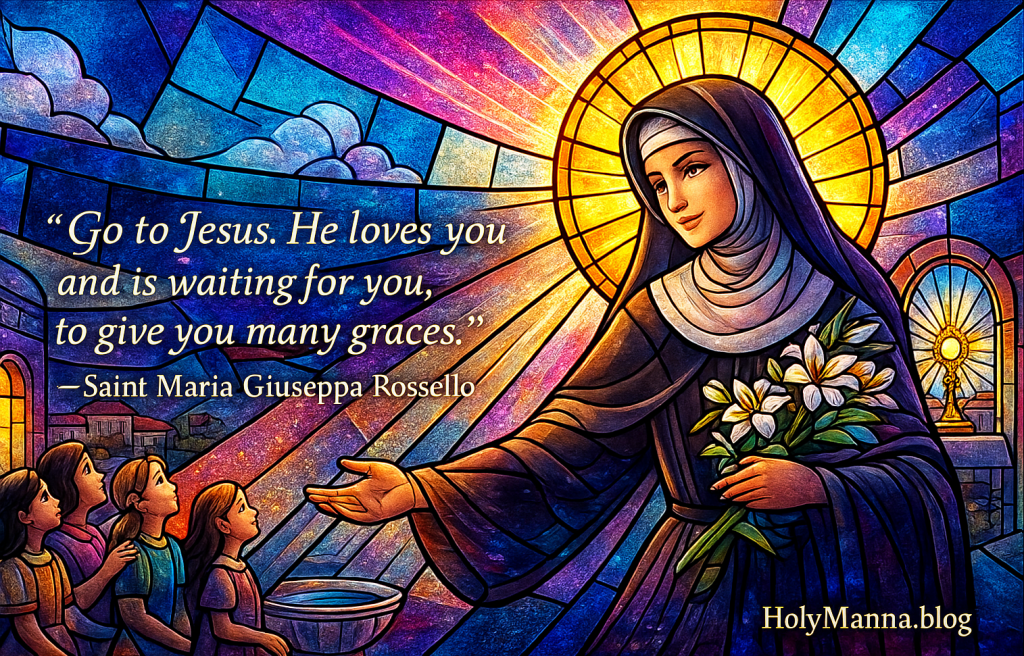
Her spirituality centered on trust in Christ and deep devotion to the Eucharist. One of her most beloved quotations expresses her Eucharistic heart: “Go to Jesus. He loves you and is waiting for you, to give you many graces. He is on the Altar, surrounded by angels adoring and praying. Let them make some room for you and join them in doing what they do.” Her entire life followed this rhythm. She knelt before Jesus in the Eucharist before going out to serve him in the poor. She asked him for strength before tending to the sick. She offered him her joys and sufferings before meeting the needs of each day. This pattern reflects the teaching of The Catechism that charity flows from the Eucharist, the “source and summit” of the Christian life (see CCC 1324).
Trials Without a Sword
Saint Maria Giuseppa was not a martyr by blood, yet her life bore the weight of quiet martyrdom. She knew the sorrow of losing close family members, the pressure of poverty, and the strain of delicate health. As Superior General she carried the emotional, spiritual, and administrative burdens of a growing congregation, responding to new missions, dealing with authorities, and guiding many sisters in their vocations. Financial uncertainties, misunderstandings, and the exhaustion of constant service marked her entire path.
Her heart suffered physically under the strain of her responsibilities, and this condition eventually led to her death. She passed from this life on December 7, 1880, at the age of sixty nine, worn out from decades of loving service. Her endurance reflects the teaching of The Catechism that Christians must be “configured to Christ” and accept trials as a means of sharing more deeply in his life (see CCC 2015). Her martyrdom was not one dramatic moment, but a lifelong offering of her will, her energy, and her heart to God and the people he placed in her care.
Mercy Beyond the Grave
After her death she was buried in the cemetery of Savona. In 1887 her body was transferred to the chapel of the motherhouse of the Daughters of Our Lady of Mercy, and later it was moved again in 1917 when the motherhouse relocated. During exhumation her body was found incorrupt, preserved from the natural decay that ordinarily occurs after death. A relic of her heart was also taken, and accounts note that it remained intact and even continued to exude blood. Many saw this as a striking sign of the charity that had filled her earthly life.
Miracles attributed to her intercession after death were carefully examined by the Church and approved for her beatification on November 6, 1938, by Pope Pius XI, and her canonization on June 12, 1949, by Pope Pius XII. Her feast day is celebrated on December 7. She is honored as the patron of the Daughters of Our Lady of Mercy and is also invoked as the patron of potters, remembering her father’s humble trade. Today her congregation continues its mission in nineteen countries across five continents, keeping alive the mercy she embodied with such faithfulness.
Learning from a Quiet Giant
Saint Maria Giuseppa Rossello offers a meaningful example for anyone who feels ordinary or unnoticed. She had no wealth, fame, or special connections. What she had was a heart that refused to close itself to the suffering of others. Her life shows that holiness often looks like loving the people who are already in front of us, accepting daily responsibilities with faith, making time for Jesus in the Eucharist, and trusting that God can work wonders through simple acts of love.
The Catechism teaches that charity is the “soul of the holiness to which all are called” (see CCC 826). Saint Maria Giuseppa lived this truth to the fullest. Her holiness was not primarily found in extraordinary visions or dramatic miracles but in doing daily tasks with extraordinary love. Her life challenges the modern obsession with recognition and visible success. Most believers live hidden lives of work, family duties, sacrifice, and quiet service, and she reminds everyone that heaven sees every hidden act of mercy. She also reminds every disciple of Christ’s words in The Gospel of Matthew 25:40, where Jesus promises that whatever is done for the least of his brothers is done for him.
A practical way to follow her example is to seek Jesus in the Eucharist before serving others, especially in moments of fatigue or discouragement. Another is to ask for the grace to notice the concrete needs of the people around us, beginning with our families, parishes, and communities. Offering daily tasks for love of Jesus, even when those tasks feel small and unnoticed, transforms them into gifts of mercy. Taking time each day to recommit to faithfulness and perseverance helps the heart to stay united to God. How might life change if every ordinary duty were offered as an act of mercy and love toward God and neighbor?
Engage with Us!
Readers are invited to share their thoughts and reflections in the comments below, especially any stories of how God’s mercy has shown up in unexpected ways.
- Where in daily life is Jesus inviting a deeper willingness to practice the works of mercy, especially toward people who are difficult to love or easy to overlook?
- How does Saint Maria Giuseppa’s hidden and persevering charity challenge the desire for recognition or visible “results” in spiritual life?
- What steps can be taken this week to root all acts of service more deeply in Eucharistic devotion, following her reminder to “go to Jesus” on the altar?
- Which particular work of mercy speaks most clearly to your heart right now, and how can you begin living it more intentionally this week?
May Saint Maria Giuseppa Rossello inspire every reader to open their heart to God and neighbor, to embrace daily responsibilities with courage, and to do everything with the love and mercy that Jesus teaches in the Gospels. May her intercession help all of us live each day as an act of Eucharistic love.
Saint Maria Giuseppa Rossello, pray for us!
Follow us on Instagram and Facebook for more insights and reflections on living a faith-filled life.

 Holy Manna!
Leave a comment