Second Sunday of Advent – Lectionary: 4
Preparing Room for the Just and Merciful King
There is a quiet ache in the human heart for a world that is truly just, peaceful, and united, yet every headline seems to shout that such a world is impossible. Advent steps right into that ache and refuses to settle for cynicism. The readings for the Second Sunday of Advent reveal a single, powerful truth: the Just and Merciful King is coming, and hearts, communities, and nations must prepare room for His reign through repentance, hope, and unity in Him.
In Isaiah 11:1-10, ancient Israel received a promise when things looked spiritually and politically dead. The royal line of David looked like a chopped down tree, just a stump. Into that hopelessness, God promised that “a shoot shall sprout from the stump of Jesse” and that this King would be filled with the Spirit of wisdom, understanding, counsel, strength, knowledge, and fear of the Lord. This was not just a political fix. It was a vision of a renewed creation where “the wolf shall be a guest of the lamb” and “the earth shall be filled with knowledge of the Lord”. This prophecy shaped Israel’s longing for a Messiah who would rule with perfect justice and bring real peace.
Psalm 72 picks up this same hope as a prayer for the king. It is not a generic blessing. It begs God to give His own justice to the king so that he can defend the poor, rescue the oppressed, and bring blessing to all the nations. The psalm looks beyond Solomon toward a greater Son of David whose reign will stretch “from sea to sea” and whose name will endure “as long as the sun”. The early Church recognized in this psalm a prophetic portrait of Jesus Christ, whose Kingdom is not limited by borders and whose heart is especially close to the poor and forgotten.
By the time of The Letter to the Romans, the early Christians were wrestling with a huge question. If Jesus is the promised King of Israel, where do the Gentiles fit in This is where Romans 15:4-9 speaks directly into the tension of divided communities. Saint Paul explains that everything written in Scripture was meant to give endurance and encouragement, so that believers might have hope. In Christ, God shows His faithfulness to the promises made to the patriarchs, while at the same time throwing open the doors of mercy to the Gentiles. The result is not two separate peoples, but one worship, “that with one accord you may with one voice glorify the God and Father of our Lord Jesus Christ”. The preparation for the King’s coming includes learning to welcome one another as Christ has welcomed each soul.
Then The Gospel of Matthew brings everything into sharp focus with the figure of John the Baptist in Matthew 3:1-12. Historically, John appears in a tense and fragile first century Judea, under Roman occupation, where many Jews longed for a political liberator. John steps into the desert, calls Israel out to the Jordan, and announces “Repent, for the kingdom of heaven is at hand”. His message is not about shallow religious appearances. He warns the Pharisees and Sadducees that having Abraham as a physical ancestor is not enough. The true preparation for the Messiah requires real conversion and “good fruit as evidence of your repentance”. The Coming One will baptize with the Holy Spirit and fire, separate wheat from chaff, and bring a final and holy clarity to every life.
Taken together, these readings show a single movement of grace. God promises a Spirit filled King who brings justice and peace. God stirs up a longing for a reign that defends the poor and heals divisions. God reveals in Christ that this Kingdom is for Jews and Gentiles together, united in worship. God then sends John the Baptist to say that the only way to receive this King is through honest repentance and a changed life. Where is the Holy Spirit inviting deeper repentance, renewed hope, and a wider welcome in the heart this Advent
First Reading – Isaiah 11:1-10
The Coming King Who Turns Stumps Into New Life
The people of Israel heard Isaiah 11:1-10 in a time of political collapse and spiritual confusion. The once glorious Davidic monarchy looked more like a chopped down tree than a living kingdom. The Assyrian threat loomed over the land, and the promise given to David in 2 Samuel 7 seemed to be hanging by a thread. Into that bleak landscape, God spoke through the prophet Isaiah and promised not just a repair of the old system, but something far deeper. From the dead looking stump of Jesse, the father of David, God promised a new shoot and a new king who would be filled with the Spirit in total fullness.
This king would not govern with spin, public image, or human favoritism. He would judge with perfect justice, especially for the poor and afflicted. Under His reign, the violence and fear that dominate the world would be transformed into a peace so complete that even wolves and lambs, lions and calves, and children and snakes would coexist without harm. This vision speaks directly into the Advent theme for today. The Just and Merciful King is coming, not to offer a spiritual escape, but to renew creation and bring a Kingdom of justice and peace that reaches into every level of life. The reading shows what kind of King is coming and what kind of world He intends to create, so that hearts can begin to desire that Kingdom and prepare for it with real repentance and renewed hope.
Isaiah 11:1-10
New American Bible (Revised Edition)
The Ideal Davidic King
1 But a shoot shall sprout from the stump of Jesse,
and from his roots a bud shall blossom.
2 The spirit of the Lord shall rest upon him:
a spirit of wisdom and of understanding,
A spirit of counsel and of strength,
a spirit of knowledge and of fear of the Lord,
3 and his delight shall be the fear of the Lord.
Not by appearance shall he judge,
nor by hearsay shall he decide,
4 But he shall judge the poor with justice,
and decide fairly for the land’s afflicted.
He shall strike the ruthless with the rod of his mouth,
and with the breath of his lips he shall slay the wicked.
5 Justice shall be the band around his waist,
and faithfulness a belt upon his hips.
6 Then the wolf shall be a guest of the lamb,
and the leopard shall lie down with the young goat;
The calf and the young lion shall browse together,
with a little child to guide them.
7 The cow and the bear shall graze,
together their young shall lie down;
the lion shall eat hay like the ox.
8 The baby shall play by the viper’s den,
and the child lay his hand on the adder’s lair.
9 They shall not harm or destroy on all my holy mountain;
for the earth shall be filled with knowledge of the Lord,
as water covers the sea.
Restoration
10 On that day,
The root of Jesse,
set up as a signal for the peoples—
Him the nations will seek out;
his dwelling shall be glorious.
Detailed Exegesis
Verse 1 – “But a shoot shall sprout from the stump of Jesse, and from his roots a bud shall blossom.”
This verse pictures the royal line of David as a stump, something cut down and seemingly finished. Yet God promises a new beginning, not from a different source, but from the same root, Jesse. The image points to the Messiah who comes from the house of David but brings a fresh and surprising work of God. For Christians, this has always been recognized as a prophecy fulfilled in Jesus Christ, whose birth in Bethlehem, the city of David, shows that God does not abandon His promises even when everything looks ruined.
Verse 2 – “The spirit of the Lord shall rest upon him: a spirit of wisdom and of understanding, A spirit of counsel and of strength, a spirit of knowledge and of fear of the Lord,”
Here the prophet describes the fullness of the Spirit resting on the Messiah. The traditional list of the seven gifts of the Holy Spirit comes from this verse, as recognized by the Church. The Messiah will not rule from human cleverness, but from divine wisdom, understanding, counsel, strength, knowledge, and fear of the Lord. This is a picture of perfect interior harmony with God. It shows that true leadership in God’s Kingdom is rooted in holiness and deep intimacy with the Lord, not in charisma or brute power.
Verse 3 – “and his delight shall be the fear of the Lord. Not by appearance shall he judge, nor by hearsay shall he decide,”
The Messiah’s joy is the fear of the Lord, which in biblical language means a deep reverence, awe, and loving obedience toward God. His judgments will not be based on outward appearances, social status, or gossip. This verse cuts straight through the superficial judgments that dominate human society. The coming King sees hearts and hidden realities. This prepares believers to understand that following Christ means allowing Him to judge thoughts, motives, and intentions, not just visible behavior.
Verse 4 – “But he shall judge the poor with justice, and decide fairly for the land’s afflicted. He shall strike the ruthless with the rod of his mouth, and with the breath of his lips he shall slay the wicked.”
The Messiah stands especially on the side of the poor and afflicted. Justice for the poor is central to His reign, not an optional extra. At the same time, He confronts and defeats the wicked, not with physical weapons, but with the power of His word. This anticipates Christ whose words bring both mercy and judgment, who comforts the humble and unsettles the hardened. The rod of His mouth and the breath of His lips suggest that truth and holiness are His weapons against evil.
Verse 5 – “Justice shall be the band around his waist, and faithfulness a belt upon his hips.”
This verse uses clothing imagery to describe the character of the Messiah. Justice and faithfulness are not occasional actions for Him, but constant garments that He never takes off. His entire being is wrapped in fidelity to God and right relationship with others. This stands in sharp contrast to leaders who use justice language while acting from selfish motives. The verse reassures believers that the coming King can be trusted completely.
Verse 6 – “Then the wolf shall be a guest of the lamb, and the leopard shall lie down with the young goat; The calf and the young lion shall browse together, with a little child to guide them.”
The prophecy now moves from the King to the transformed creation under His reign. Enemies in nature live in peace. The image of a little child leading these once dangerous animals highlights the gentleness and security of this renewed world. The Church has long seen in this a foretaste of the peace of the Kingdom of God, fulfilled in Christ and brought to fullness in the new heavens and new earth. It hints at the restoration not only of human relationships, but of all creation under Christ the King.
Verse 7 – “The cow and the bear shall graze, together their young shall lie down; the lion shall eat hay like the ox.”
Again, natural enemies are reconciled. Predators no longer kill for food. The violent order of a fallen world is replaced by a harmonious pattern in which life is not sustained by death. This imagery is symbolic, yet it signals that sin and violence are not part of God’s final plan. Under the Messiah, the damage of the fall is reversed, and peace becomes the new normal.
Verse 8 – “The baby shall play by the viper’s den, and the child lay his hand on the adder’s lair.”
This verse portrays total safety in a place that would normally mean mortal danger. Children, the most vulnerable, are now completely secure. It evokes the idea that the reign of the Messiah drives out fear at the deepest level. Spiritually, it points to the defeat of the ancient serpent, the devil, whose power is broken by Christ’s victory.
Verse 9 – “They shall not harm or destroy on all my holy mountain; for the earth shall be filled with knowledge of the Lord, as water covers the sea.”
God’s holy mountain, often associated with Zion and ultimately with the presence of God among His people, becomes a place where harm and destruction simply do not exist. The reason is not just better policies or structures. It is that the earth is filled with knowledge of the Lord, not as a small stream but like the waters that cover the sea. This knowledge is not just information about God, but intimate, lived knowledge that transforms people and societies.
Verse 10 – “On that day, The root of Jesse, set up as a signal for the peoples— Him the nations will seek out; his dwelling shall be glorious.”
The text circles back to the figure of the root of Jesse, now described as a signal or banner for the peoples. The nations will come to Him, not just Israel. His dwelling will be glorious, pointing to the universal and radiant character of His Kingdom. This verse fits perfectly with the Advent theme of Christ as King not only of Israel, but of all nations, and it prepares the ground for the Second Reading, where Saint Paul talks about Jews and Gentiles glorifying God together.
Teachings
This reading has always been central for Christian understanding of the Messiah and the gifts of the Holy Spirit. The Catechism of the Catholic Church teaches that the gifts of the Spirit are permanent dispositions that make believers docile in following divine inspirations. It states that the seven gifts are wisdom, understanding, counsel, fortitude, knowledge, piety, and fear of the Lord, reflecting the description found in Isaiah 11. One line from The Catechism explains that these gifts are given in a special way in Confirmation, “in order to spread and defend the faith”. The same Spirit that rests on the Messiah is poured out on the faithful, so that Christians can participate in His mission of justice and peace.
The peace described in this passage is not sentimental. The Catechism speaks of the peace of Christ as the work of justice and the effect of charity. It states that peace is more than the absence of war and that it “cannot be attained without safeguarding the goods of persons” and without the practice of justice and charity. This fits perfectly with verses 4 and 5, where the Messiah judges the poor with justice and wears justice and faithfulness as His constant clothing. The Kingdom that Christ inaugurates through His Incarnation, death, and Resurrection aims at the healing of all that sin has wounded, beginning in the human heart and extending outward into relationships and even creation itself.
The Fathers and Doctors of the Church have often meditated on this passage. Saint Jerome, for example, saw in the wolf dwelling with the lamb an image of former persecutors becoming gentle through conversion in Christ. Saint Augustine reflected on these images as symbolic of the unity and peace that the Church makes possible among very different peoples. For them, the prophecy of Isaiah is not about naive utopianism, but about the real power of grace to change hearts and reconcile enemies.
Historically, the Church has also read this text in the light of the universal mission of Christ. The final verse, where the nations seek the root of Jesse, aligns with the Great Commission and the missionary thrust of the Church. Christ is not an isolated tribal king. He is the Lord of all nations, and His Church is sent so that every people can come under the banner of His merciful and just reign.
Reflection
This reading offers a huge consolation and a serious challenge. It shows that God does not walk away when life feels like a chopped down stump. In family life, personal struggles, or the state of the world, situations can look hopeless and dead. Yet the Lord promises that from the stump, a shoot can still sprout. The same God who brought forth Christ from the line of Jesse continues to bring new beginnings from places that seem finished.
At the same time, this passage does not allow a comfortable or vague spirituality. The King who is coming cares deeply about justice for the poor, the afflicted, and the forgotten. Under His reign, violence and exploitation are not acceptable norms. That means that preparation for His coming during Advent is not limited to prayer and candles, as important as those are. It involves examining how the heart views the poor, how the tongue speaks about others, and how choices either participate in injustice or resist it.
The vision of wolves and lambs, lions and calves, and children safe around snakes pushes believers to examine patterns of hostility and fear in relationships. There may be people who feel like wolves in life, or situations that trigger constant defensiveness. The Messiah’s Kingdom invites movement toward reconciliation, forgiveness, and peace rooted in truth. This does not mean pretending that evil does not exist. It means letting Christ’s justice and mercy, not personal resentment, have the final word.
Practical steps might include acts of concrete mercy for the poor, such as supporting a local charity, spending time with someone lonely, or being generous with resources. It might mean resisting gossip and quick judgments, remembering that the coming King does not judge by appearances or hearsay. It could also involve asking the Holy Spirit specifically for the seven gifts named in this reading, so that daily decisions at work, in family life, and in the parish reflect the wisdom, counsel, and fear of the Lord that characterize the Messiah.
Where does life feel like a stump that needs God to bring forth a new shoot
Who are the poor and afflicted that the Lord is asking to notice and to serve in a new way this Advent
Which relationships or situations need the peace of Christ so that wolves and lambs can at least begin to move toward each other in understanding and mercy
Responsorial Psalm – Psalm 72:1-2, 7-8, 12-13, 17
Singing The Longing For A Just King Who Loves The Poor
Psalm 72 is a royal psalm traditionally linked to Solomon, but it stretches far beyond any ordinary king of Israel. In the world of ancient Israel, the king was meant to be more than a political ruler. He was supposed to be a visible sign of God’s care for the people, especially the poor and vulnerable. This psalm is both a prayer and a prophecy. It prays that God will give His own justice to the king, and at the same time it points toward a future ruler whose reign will bring blessing to all nations and last as long as the sun.
In the culture of the ancient Near East, kings were often praised for their power, wealth, and military success. Psalm 72 flips that script and measures the success of the king by his justice, his compassion, and his treatment of the poor. That is why this psalm fits so perfectly with Isaiah 11:1-10 and the Gospel for this Second Sunday of Advent. The first reading shows the Spirit filled King who judges the poor with justice and transforms creation. The psalm gives words for the heart to cry out for that kind of king. It teaches believers how to desire and welcome a Messiah whose reign brings peace, abundance, and mercy from sea to sea.
In Advent, this psalm becomes a song of hope and expectation. It prepares hearts for Christ, the Son of David, whose Kingdom is not built on worldly status but on justice, mercy, and the rescue of those who have no one else to help. This is exactly the King that John the Baptist is preparing the way for in The Gospel of Matthew, and exactly the Lord whom Romans 15 proclaims as the hope of both Jews and Gentiles.
Psalm 72:1-2, 7-8, 12-13, 17
New American Bible (Revised Edition)
A Prayer for the King
1 Of Solomon.
2 O God, give your judgment to the king;
your justice to the king’s son;
That he may govern your people with justice,
your oppressed with right judgment,
7 That abundance may flourish in his days,
great bounty, till the moon be no more.
8 May he rule from sea to sea,
from the river to the ends of the earth.
12 For he rescues the poor when they cry out,
the oppressed who have no one to help.
13 He shows pity to the needy and the poor
and saves the lives of the poor.
17 May his name be forever;
as long as the sun, may his name endure.
May the tribes of the earth give blessings with his name;
may all the nations regard him as favored.
Detailed Exegesis
Verse 1 – “O God, give your judgment to the king; your justice to the king’s son;”
This opening line sets the tone. The psalmist asks God to give His own judgment and justice to the king. The king is not the source of justice. He is supposed to receive and reflect God’s justice. The phrase “king’s son” points to the Davidic line, where each son of David is meant to rule under God’s authority. Spiritually, this prepares the way for Christ, the true Son of David, in whom the justice of God is perfectly revealed. The verse reminds believers that any human authority is healthy only when it is rooted in God’s law and truth.
Verse 2 – “That he may govern your people with justice, your oppressed with right judgment,”
Here the purpose of that divine justice becomes clear. The goal is not abstract fairness, but concrete protection of God’s people, especially those who are oppressed. The king’s legitimacy is tied to how he treats the vulnerable. In Christian reflection, this verse points straight to the heart of Christ, who consistently draws near to the poor, the sick, and the marginalized. It also echoes the Church’s insistence that a just society must prioritize the needs of the most vulnerable.
Verse 7 – “That abundance may flourish in his days, great bounty, till the moon be no more.”
This verse describes the fruit of a just reign. When the king rules according to God’s justice, abundance and peace follow. “Abundance” here is not only about material prosperity. It hints at the fullness of life that comes when relationships, structures, and hearts are aligned with God’s will. The phrase “till the moon be no more” points to a reign that lasts far beyond any normal human dynasty. Christians see in this an anticipation of the eternal Kingdom of Christ, where true flourishing is found in communion with God.
Verse 8 – “May he rule from sea to sea, from the river to the ends of the earth.”
This verse expands the vision from Israel to the entire world. The “river” likely refers to the Euphrates, the traditional northern boundary in biblical geography, but the language clearly stretches toward universal rule. The king in this psalm is not meant to be a small local ruler. His reign is meant to be worldwide. This anticipates Christ’s universal kingship, which The Catechism of the Catholic Church affirms when it speaks of Jesus as Lord of the cosmos and of history. The psalm prepares believers to understand that the Messiah’s Kingdom is meant to embrace every nation.
Verse 12 – “For he rescues the poor when they cry out, the oppressed who have no one to help.”
Here the psalm goes straight to the heart of God’s concern. The true king hears the cry of the poor and intervenes. The oppressed who have no one do not remain abandoned. This verse reveals the tenderness and urgency of divine justice. The King does not wait until the poor become influential or useful. He moves precisely because they are helpless. This verse fits deeply with Christ’s mission in The Gospel of Luke, where He proclaims good news to the poor and liberty to captives.
Verse 13 – “He shows pity to the needy and the poor and saves the lives of the poor.”
The description continues and intensifies. The king is not coldly efficient. He is moved with pity. That word echoes the Gospel descriptions of Jesus, whose heart is stirred with compassion when He sees the crowds. The king’s pity leads to action. He saves lives, not just improves circumstances. This line reminds believers that mercy is not weakness. It is the strongest and most God like response to suffering. In the Advent context, it highlights that the coming King arrives not to crush the weak, but to lift them up and guard their lives.
Verse 17 – “May his name be forever; as long as the sun, may his name endure. May the tribes of the earth give blessings with his name; may all the nations regard him as favored.”
The psalm ends by looking beyond any normal monarch. No earthly king’s name lasts “as long as the sun.” This language pushes the reader toward a messianic hope. The desire is for a king whose name is a blessing on the lips of every tribe and nation. This finds its full truth in Jesus, whose name believers call upon for salvation and whose praise is sung in every language under heaven. The verse connects tightly with Romans 15, where Saint Paul speaks about the Gentiles glorifying God and singing praises to His name. The universal praise longed for in Psalm 72 finds its fulfillment in the worldwide Church.
Teachings
Psalm 72 shines a spotlight on the kind of kingship that God approves and the kind that Christ fulfills. The Catechism of the Catholic Church teaches that Jesus is the Messiah and Lord, descended from David according to the flesh, and that His Kingdom is not of this world in the political sense, yet it is very real and demands a response. It explains that Christ exercises His kingship by drawing all people to Himself through His death and Resurrection, and that He is especially present in the least of His brothers and sisters.
The Church often returns to texts like Psalm 72 when explaining her social teaching. The preferential love for the poor is not a modern innovation. It is rooted deeply in Scripture and in the heart of the Messiah prophesied in this psalm. The Catechism states that God blesses those who come to the aid of the poor and warns that neglect of the poor is a serious offense before Him. The king described in Psalm 72 mirrors that divine concern and becomes a model for Christian leaders, families, and communities.
Saint Augustine and other Fathers of the Church read this psalm as a prophecy of Christ and His Church. Augustine saw in the worldwide reign of the king a picture of the spread of the Gospel to all nations. The abundance in his days is not just material prosperity but the overflowing of grace in the hearts of believers and in the life of the Church. For them, the rescue of the poor in this psalm is not only about physical poverty but also about the spiritual poverty that sin creates, which Christ alone can heal.
This psalm also has liturgical significance. When prayed in the Advent liturgy, it is paired intentionally with readings like Isaiah 11 to underline that the coming child of Bethlehem is the long awaited King who defends the poor, brings justice, and invites all nations into His blessing. The Church does not simply recall a distant past. She sings this psalm as a living plea for Christ to reign more fully in individual hearts, in the Church, and in the world.
Reflection
This responsorial psalm gently but firmly challenges the way power and success are viewed. In a culture that often admires influence, wealth, and visibility, Psalm 72 insists that the true measure of a king, or of any Christian life, is the way the poor and oppressed are treated. The King after God’s heart hears the cry of those who have no one to help and moves with pity to save their lives.
In daily life, this means that preparation for the Just and Merciful King cannot stay only at the level of personal feelings or private spirituality. The Advent journey includes opening eyes to the people around who are poor, lonely, burdened, or forgotten. That might be someone in the parish who stands alone after Mass, a family member who feels like a constant inconvenience, a coworker silently struggling, or the materially poor in the local community. The psalm invites a very specific imitation of the King’s heart.
Practical steps could include setting aside part of a budget during Advent for direct help to those in need, choosing to listen patiently to someone who feels unheard, or volunteering time for a work of mercy. It can also mean examining how conversations, attitudes, and votes either reflect or contradict the King who rescues the poor when they cry out. The aim is not guilt for its own sake, but a real alignment of the heart with the King who reigns from the manger and the cross.
This psalm also pushes toward deeper trust. The prayer that the King’s name endure as long as the sun is a reminder that Christ’s reign is not fragile. Even when injustice shouts loudly, the believer can cling to the promise that His Kingdom will not fail. That kind of trust can keep a heart from sliding into bitterness or despair when the world’s brokenness feels overwhelming.
Who are the “poor who have no one to help” in the world that touches daily life right now
In what concrete ways can the heart, home, and parish reflect the King who shows pity to the needy and saves the lives of the poor
How can trust in the everlasting name of Jesus reshape the way difficulties, news, and personal struggles are viewed during this Advent season
Second Reading – Romans 15:4-9
Hope, Harmony, And A Welcome Big Enough For The Whole World
The Letter to the Romans was written to a divided Church in the heart of the empire. The Christian community in Rome was made up of both Jewish and Gentile believers, and there were tensions over the Law, identity, and who really belonged to God’s people. In that setting, Romans 15:4-9 is like a bridge. Saint Paul reminds the community that everything written in the Scriptures was meant to give endurance, encouragement, and hope, and that in Christ, God has fulfilled His promises to Israel while opening wide the doors of mercy to the Gentiles.
Culturally and religiously, this is huge. For centuries, Israel had lived with the promises made to Abraham, Isaac, Jacob, and David. Many Jews saw themselves as the chosen people in a special and exclusive sense. Gentiles were often viewed as outsiders. In this passage, Paul carefully shows that Christ came as a servant to the circumcised, to confirm God’s faithfulness to the patriarchs, but also so that the Gentiles might glorify God for His mercy. The result is not two parallel groups, but one family learning to think in harmony and glorify God with one voice.
This fits beautifully into the Advent theme of welcoming the Just and Merciful King. The King prophesied in Isaiah 11 and sung about in Psalm 72 is not the tribal king of a tiny group. He is the root of Jesse set up as a signal for the peoples, the one whom the nations seek. Romans 15:4-9 shows what it looks like inside the Church when that prophecy starts to come true. The community becomes a place of endurance, encouragement, hope, mutual welcome, and unified praise. That is exactly the kind of heart John the Baptist is calling for in The Gospel of Matthew when he cries out, “Prepare the way of the Lord”.
Romans 15:4-9
New American Bible (Revised Edition)
4 For whatever was written previously was written for our instruction, that by endurance and by the encouragement of the scriptures we might have hope. 5 May the God of endurance and encouragement grant you to think in harmony with one another, in keeping with Christ Jesus, 6 that with one accord you may with one voice glorify the God and Father of our Lord Jesus Christ.
God’s Fidelity and Mercy. 7 Welcome one another, then, as Christ welcomed you, for the glory of God. 8 For I say that Christ became a minister of the circumcised to show God’s truthfulness, to confirm the promises to the patriarchs, 9 but so that the Gentiles might glorify God for his mercy. As it is written:
“Therefore, I will praise you among the Gentiles
and sing praises to your name.”
Detailed Exegesis
Verse 4 – “For whatever was written previously was written for our instruction, that by endurance and by the encouragement of the scriptures we might have hope.”
Paul begins by explaining the purpose of the Scriptures. Everything written before, especially what is now called the Old Testament, was given for instruction. Scripture is not just a collection of ancient stories. It is a living word that forms the mind and heart. Through endurance and encouragement drawn from Scripture, believers receive real hope. Advent leans heavily on this truth. The prophecies of Isaiah, the royal prayers of Psalm 72, and the stories of salvation history are meant to strengthen tired hearts and keep hope alive while waiting for the coming King.
Verse 5 – “May the God of endurance and encouragement grant you to think in harmony with one another, in keeping with Christ Jesus,”
Here Paul turns from teaching to prayer. God is called the God of endurance and encouragement, which echoes verse 4. The same God who gives strength through Scripture also shapes how believers think about each other. Paul prays that the community would think in harmony, literally to have the same mindset toward one another, according to Christ Jesus. This means that unity in the Church is not just a social project or a personality fit. It is the fruit of God’s grace and the imitation of Christ’s own way of seeing others. In a Church made of different backgrounds, that harmony is a powerful sign that the King has truly come.
Verse 6 – “that with one accord you may with one voice glorify the God and Father of our Lord Jesus Christ.”
The goal of harmony is worship. Unity is not for its own sake. It is so that believers can glorify God with one heart and one voice. This line echoes the vision in Isaiah 11 and Psalm 72, where the nations are drawn to the root of Jesse and bless the name of the King. In a divided world, a community that sings, prays, and lives in unity becomes a visible sign of the Kingdom of God.
Verse 7 – “Welcome one another, then, as Christ welcomed you, for the glory of God.”
This is one of the most concrete and challenging lines in the passage. Paul does not simply say to tolerate one another. He commands a true welcome, modeled on Christ’s own welcome. Christ did not wait for perfect behavior or cultural similarity before receiving people. He welcomed sinners, the sick, the outsider, and the broken, drawing them into repentance and communion. That same pattern becomes the standard within the Church. This welcome is not sentimental. It has a purpose. It glorifies God. When believers who would normally be divided embrace one another in Christ, God’s beauty and truth are made visible.
Verse 8 – “For I say that Christ became a minister of the circumcised to show God’s truthfulness, to confirm the promises to the patriarchs,”
Paul now clarifies how Christ fulfills God’s plan. Christ became a minister of the circumcised, that is, He came first as the Messiah of Israel, born under the Law, in the line of David. By doing so, He shows God’s truthfulness and confirms the promises made to the patriarchs. God does not cancel His covenants. He brings them to completion. This is critical. The coming of Christ is not a betrayal of Israel’s story. It is the climax of that story. The King who sprouts from the stump of Jesse is the proof that God keeps His word, even after centuries of waiting.
Verse 9 – “but so that the Gentiles might glorify God for his mercy. As it is written: ‘Therefore, I will praise you among the Gentiles and sing praises to your name.’”
The purpose does not stop with Israel. Christ’s coming also opens things up so that the Gentiles might glorify God for His mercy. Paul then quotes Scripture to show that this was always part of the plan. The nations were never an afterthought. The mercy shown to the Gentiles leads to praise. This is a key Advent theme. The King who is coming is not only the fulfillment of promises to one people. He is the hope and joy of every nation, culture, and background. In the Church, Jews and Gentiles glorify God together, forming the beginnings of that universal worship promised in the prophets.
Teachings
This passage from Romans 15 shines a light on how the Church understands Scripture, hope, and the unity of Jews and Gentiles in Christ. The Catechism of the Catholic Church teaches that God is the author of Sacred Scripture and that everything written there is for the sake of salvation. It explains that the Old and New Testaments are two parts of one unified plan, with the Old preparing for the New and the New fulfilling the Old. Paul’s words, “whatever was written previously was written for our instruction”, line up perfectly with that teaching. The Scriptures do not just belong to the past. They are meant to encourage and form believers today.
The Catechism also speaks about Christian hope as the confident expectation of divine blessing and the beatific vision of God. Hope is not a vague optimism. It is anchored in God’s faithfulness to His promises and in the Resurrection of Christ. When Paul calls God the God of endurance and encouragement and speaks about hope born from Scripture, he is describing exactly what the Church teaches. The believer keeps going, not by sheer willpower, but by clinging to a God who keeps His word.
On unity, the Church teaches that all who believe in Christ and are baptized are incorporated into His Body. There is a real, spiritual unity that needs to be lived out in visible charity. Paul’s command, “Welcome one another, then, as Christ welcomed you”, echoes this truth. Unity is both a gift and a task. The writings of saints like Saint Augustine, Saint John Chrysostom, and Saint Thomas Aquinas underline that divisions, grudges, and pride wound the Body of Christ and block the world from seeing the Gospel clearly. They insist that charity, humility, and mutual forgiveness are essential for the Church’s mission.
Historically, this section of Romans has been very important in conversations about the relationship between the Church and the Jewish people. The Church strongly affirms that God’s covenant with Israel has not been revoked and that the roots of Christian faith are deeply Jewish. At the same time, the Church proclaims that Christ is the universal Savior and that in Him, Gentiles are invited into the people of God. Romans 15:4-9 sits right in the middle of that mystery, showing that Christ’s coming is both the fulfillment of ancient promises and the opening of a new chapter of mercy for all nations.
Reflection
This reading speaks right into some of the deepest struggles of modern life. It deals with discouragement, division, and the challenge of really welcoming other people. It offers a path forward rooted in Scripture, in Christ, and in the grace of the Holy Spirit.
There are seasons when the heart feels tired or hope feels thin. Verse 4 reminds everyone that Scripture is not meant to sit on a shelf. It was written so that through endurance and the encouragement that the Scriptures give, believers might have hope. That means that spending time with the Word of God this Advent is not simply a nice idea. It is a lifeline. Regularly praying with passages like Isaiah 11, Psalm 72, and Matthew 3 can restore courage and reawaken trust when life feels heavy or confusing.
The call to think in harmony and glorify God with one voice is also incredibly practical. Families, parishes, and friend groups all deal with conflict and difference. Paul does not pretend that everyone will agree on every detail. Instead, the focus is on a shared mindset rooted in Christ. That can look like choosing to interpret another person’s actions with charity instead of suspicion, being willing to listen patiently before responding, or praying for someone who is difficult rather than gossiping about them. Harmony does not mean pretending differences do not matter. It means letting Christ’s heart be the reference point in the middle of those differences.
The command to welcome one another as Christ welcomed each person can cut deeply. Christ welcomed with truth and mercy. He did not bless sin, but He did not turn away from sinners either. In daily life, that might mean being more intentional about welcoming new people at Mass, reaching out to someone who feels like an outsider in the community, or making space in a schedule to accompany a friend who is struggling. It may also mean examining hidden prejudices, resentments, or judgments and bringing them honestly before God in confession.
This reading also pushes outward. The King who came for the circumcised and the Gentiles is still gathering people into His Church. Advent can be a time to pray for those who are far from the faith, those from other cultures or religions, and those who have been hurt by Christians. A heart that lives this passage begins to look less like a closed circle and more like an open door, patterned on Christ’s own Heart.
How can Scripture have a more central place in the daily routine so that endurance and encouragement lead to deeper hope
Where is God inviting a more Christlike welcome, especially toward people who feel different, difficult, or distant
What steps can be taken this Advent to think more in harmony with others and to glorify God with one voice, whether in family life, parish life, or friendships
Holy Gospel – Matthew 3:1-12
A Voice In The Desert Calling Hearts Back To Reality
The Gospel of Matthew places John the Baptist at center stage right before the public ministry of Jesus begins. First century Judea lived under Roman occupation, with heavy taxes, political tension, and deep spiritual longing. Many Jews hoped for a Messiah who would crush enemies and restore national glory. Into that mix, not in the Temple or the city, but out in the desert, a prophet appears dressed like Elijah, crying out for repentance and preparing hearts for a very different kind of King.
The desert in Scripture is never just a backdrop. It is the place of Israel’s testing, failure, and renewal. God formed His people in the wilderness after the Exodus. Now, centuries later, John calls Israel back to the desert to start again, not with national pride, but with honest repentance. His message, “Repent, for the kingdom of heaven is at hand”, slices through religious complacency and false security. The people flock to him, confessing sins and receiving a baptism of repentance in the Jordan, the same river that once marked their entry into the Promised Land.
Religiously, John stands as the last and greatest of the Old Testament prophets and the bridge into the New Covenant. He fulfills the prophecy from Isaiah 40, “A voice of one crying out in the desert, ‘Prepare the way of the Lord’”. He confronts religious leaders, exposes hypocrisy, and announces that someone mightier is coming who will baptize with the Holy Spirit and fire. The tone is urgent. The ax is at the root of the trees. The winnowing fan is in the Messiah’s hand.
This Gospel fits today’s theme perfectly. Isaiah 11 and Psalm 72 reveal the Just and Merciful King who defends the poor and brings peace to all nations. Romans 15 shows that this King creates a community of hope and unity for Jews and Gentiles together. The Gospel of Matthew now shows the only way to welcome such a King. There must be real repentance, real fruit, and a real turning of the heart from empty religious labels to living faith. Advent is not spiritual decoration. It is an invitation to step into the desert with John, face the truth, and let the coming King reorder everything.
Matthew 3:1-12
New American Bible (Revised Edition)
The Preaching of John the Baptist. 1 In those days John the Baptist appeared, preaching in the desert of Judea 2 [and] saying, “Repent, for the kingdom of heaven is at hand!” 3 It was of him that the prophet Isaiah had spoken when he said:
“A voice of one crying out in the desert,
‘Prepare the way of the Lord,
make straight his paths.’”
4 John wore clothing made of camel’s hair and had a leather belt around his waist. His food was locusts and wild honey. 5 At that time Jerusalem, all Judea, and the whole region around the Jordan were going out to him 6 and were being baptized by him in the Jordan River as they acknowledged their sins.
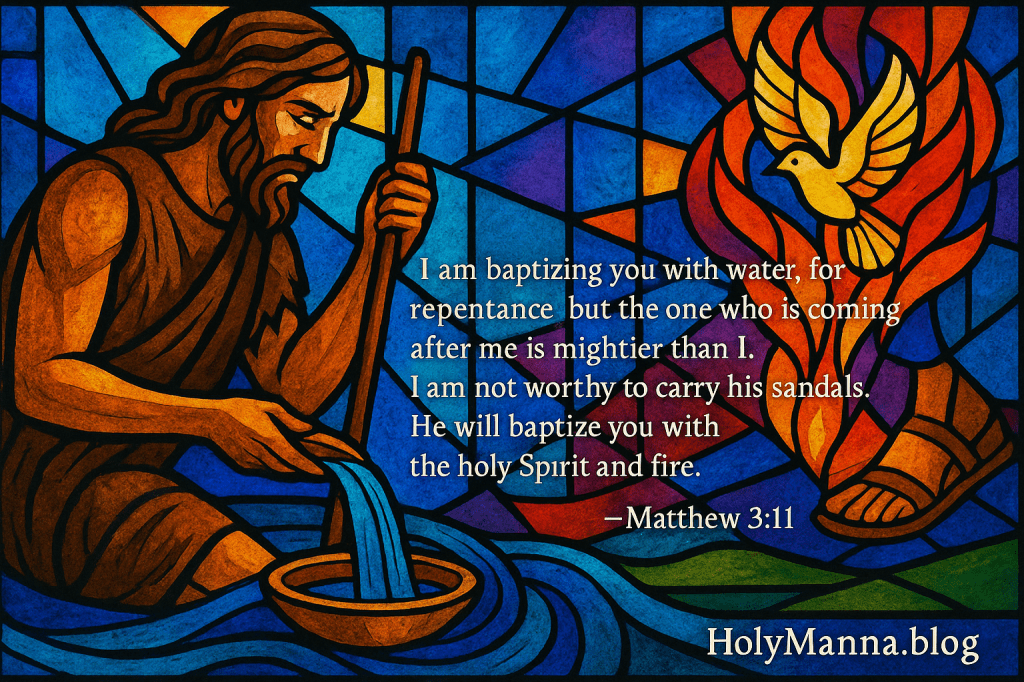
7 When he saw many of the Pharisees and Sadducees coming to his baptism, he said to them, “You brood of vipers! Who warned you to flee from the coming wrath? 8 Produce good fruit as evidence of your repentance. 9 And do not presume to say to yourselves, ‘We have Abraham as our father.’ For I tell you, God can raise up children to Abraham from these stones. 10 Even now the ax lies at the root of the trees. Therefore every tree that does not bear good fruit will be cut down and thrown into the fire. 11 I am baptizing you with water, for repentance, but the one who is coming after me is mightier than I. I am not worthy to carry his sandals. He will baptize you with the holy Spirit and fire. 12 His winnowing fan is in his hand. He will clear his threshing floor and gather his wheat into his barn, but the chaff he will burn with unquenchable fire.”
Detailed Exegesis
Verse 1 – “In those days John the Baptist appeared, preaching in the desert of Judea”
The phrase “in those days” connects John’s appearance to the larger story of Israel. John does not come out of nowhere. He arrives right on time in God’s plan. The desert of Judea recalls Israel’s history in the wilderness and signals a place of encounter and decision. John is identified as “the Baptist” because his ministry centers on a symbolic washing that prepares for something greater. The desert location shows that God is working outside the comfortable structures and invites the people to come out and meet Him in a place of simplicity and truth.
Verse 2 – “and saying, ‘Repent, for the kingdom of heaven is at hand!’”
John’s preaching can be summed up in one urgent line. Repentance is not just feeling bad. It is a change of mind and direction. The “kingdom of heaven” is God’s reign breaking in through the Messiah. To say it is “at hand” means it is drawing near in a decisive way. The two belong together. The coming of the Kingdom is good news, but it demands a response. Hearts cannot stay neutral or stuck in old patterns. In Advent, this line becomes a direct call. The King is coming. Life needs to turn toward Him now.
Verse 3 – “A voice of one crying out in the desert, ‘Prepare the way of the Lord’”
Matthew quotes Isaiah 40 to identify who John really is. John is the voice. Christ is the Lord whose way is being prepared. In the ancient world, roads were leveled and straightened for the arrival of a king. Spiritually, this means that obstacles of sin, pride, and hardness of heart must be cleared away so that Christ can enter. The desert cry reminds everyone that God often speaks most clearly when distractions are stripped back. John’s whole identity is to point away from himself and toward Jesus.
Verse 4 – “John wore clothing made of camel’s hair and had a leather belt around his waist”
This detail is not just random. It deliberately echoes the description of the prophet Elijah in Second Kings. Many Jews expected Elijah to return before the Messiah came. John’s rough clothing and simple lifestyle underline his prophetic role and complete detachment from worldly luxury. His food of locusts and wild honey points to an austere, focused life. He is not selling a brand or building a comfort zone. He is entirely consumed with preparing others for the Lord.
Verse 5 – “Jerusalem, all Judea, and the whole region around the Jordan were going out to him”
The response is huge. People leave cities and villages to go out into the wilderness. This movement shows a deep hunger and restlessness. Religious routine is not enough. They sense that God is doing something new. There is also a subtle challenge here. The center of religious life, Jerusalem, is no longer the only place of encounter. God is stirring hearts in the margins, and people are willing to step out of normal life to meet Him.
Verse 6 – “and were being baptized by him in the Jordan River as they acknowledged their sins.”
This baptism is different from the sacramental baptism instituted later by Christ, but it anticipates it. People publicly acknowledge their sins and allow themselves to be immersed in the Jordan. The Jordan carries deep symbolism. It is the river Israel crossed to enter the Promised Land. By going down into it with repentance, the people are in a sense re entering the covenant with renewed hearts. Confessing sins out loud is humbling, but it is also freeing. This verse shows that genuine preparation for the Messiah begins with honest admission of sin.
Verse 7 – “You brood of vipers! Who warned you to flee from the coming wrath?”
When John sees many Pharisees and Sadducees, he does not flatter them. He calls them a brood of vipers, suggesting poisonous cunning and spiritual danger. “Wrath” here means God’s holy opposition to sin, not a temper tantrum. John questions their motives. Are they truly coming to repent, or simply to appear religious and cover themselves from judgment without real conversion This verse exposes the danger of using religious practices as a shield instead of letting them transform the heart.
Verse 8 – “Produce good fruit as evidence of your repentance.”
John lays down a simple, hard standard. Real repentance is visible. It produces fruit. Good fruit means concrete changes in behavior, priorities, and relationships. It is not enough to feel bad or say the right words. The inner change must flow outward. This ties closely to the imagery of trees and axes that follows. In Advent, this verse invites each person to ask what actual fruit is showing up in life that proves a real turning back to God.
Verse 9 – “Do not presume to say to yourselves, ‘We have Abraham as our father.’”
John attacks false security at its root. Many relied on physical descent from Abraham as a guarantee of favor with God. John says that is not enough. God can raise up children of Abraham from stones. In other words, God is not boxed in by bloodlines or labels. What matters is living faith and obedience. For modern believers, this warns against relying on Catholic identity as a label, family background, or external involvement without personal conversion.
Verse 10 – “Even now the ax lies at the root of the trees.”
The image is intense. The ax is not far away. It is already at the root. Trees that do not bear good fruit will be cut down and thrown into the fire. This is judgment language. It reminds everyone that time is short and life is not a rehearsal. God is patient, but not indifferent. The point is not to spark panic, but to wake up hearts that drift along without urgency. Advent is a season of hope, but it is also a season of holy seriousness.
Verse 11 – “He will baptize you with the Holy Spirit and fire.”
John contrasts his own baptism with the baptism of the one to come. He baptizes with water for repentance. The Coming One, Christ, will baptize with the Holy Spirit and fire. The Holy Spirit brings new birth, power, and transformation. Fire purifies and burns away what is unworthy. This points to Pentecost and to the sacramental life of the Church, where the Holy Spirit is poured out in baptism and confirmation, and also to the ongoing purification that God works in souls. This verse holds together comfort and challenge. The coming King brings both mercy and purifying fire.
Verse 12 – “His winnowing fan is in his hand. He will clear his threshing floor.”
The final verse uses farming imagery. After harvest, grain is tossed into the air with a winnowing fan so that the wind separates wheat from chaff. Wheat is kept. Chaff is burned. John applies this to the Messiah. Christ will gather His wheat into the barn and burn the chaff with unquenchable fire. This is a sober vision of final judgment. There is a real separation based on the reality of each life. Advent looks forward to Christ’s coming at Christmas, but also to His coming in glory. This verse makes clear that His coming demands a response now.
Teachings
This Gospel passage gathers several key themes that the Church emphasizes about John the Baptist, repentance, and judgment. The Catechism of the Catholic Church teaches that John is the immediate precursor of the Lord and that he goes before Jesus “in the spirit and power of Elijah.” It explains that in John, the Holy Spirit completes the work of preparing a people ready for the Lord. One short line captures this beautifully, “John surpasses all the prophets” (CCC 523). His whole mission is to point to Christ and prepare hearts through a baptism of repentance.
On repentance, the Catechism speaks about interior conversion that reaches the heart. It teaches that true repentance is not just fear of punishment, but a turning back to God with sorrow for sin and a firm purpose of amendment. It explains that this inner conversion is expressed in visible signs, especially in the sacrament of Penance, works of charity, and changes in behavior. This matches John’s demand, “Produce good fruit as evidence of your repentance”. To claim repentance without fruit is to contradict the Gospel.
Regarding judgment, the Church is very clear that Christ is both Savior and Judge. The Catechism teaches that at the end of time, Christ will return in glory to judge the living and the dead and that each person will be judged according to their works and the state of their heart. The imagery of the ax at the root and the winnowing fan in hand fits this teaching. It reminds believers that life is moving toward a real encounter with Christ where truth will be laid bare.
The mention of baptism with the Holy Spirit and fire connects to the Church’s teaching on the sacraments. Baptism unites a person to Christ, forgives sins, and makes them a new creation. Confirmation deepens this grace and strengthens the soul with the gifts of the Holy Spirit. The fire can be understood as the purifying work of God in the soul, burning away selfishness and sin. The saints often speak about this purifying fire with love rather than fear. Saint Catherine of Siena, for example, describes God’s love as a fire that refines and transforms.
Many Fathers of the Church reflected deeply on John’s humility. When John says he is not worthy to carry the sandals of the one who is coming, he models the right posture before Christ. Saint Augustine famously said of John and Jesus, “He is the voice, but the Lord is the Word”. John is great because he refuses to make himself the center. He rejoices to decrease so that Christ may increase. That attitude is at the heart of any real Advent preparation.
Reflection
This Gospel does not let anyone stay comfortable. It lovingly but firmly asks some serious questions. Is there real repentance in the heart, or just a religious image Is there real fruit, or mostly excuses The Advent wreath, the music, and the warmth are beautiful, but John stands in the desert and reminds everyone that the coming of the King is a matter of life and death.
At the same time, there is incredible hope here. The crowds who come to John are not perfect. They are sinners who know they need mercy. They step into the Jordan, confess their sins, and begin again. The same grace is offered now through the sacrament of Reconciliation. A sincere examination of conscience, honest confession, and firm purpose of amendment are concrete ways to “prepare the way of the Lord” today. Confession is not a humiliation. It is the place where the King meets the soul in its truth and heals it.
John’s warning to the Pharisees and Sadducees also hits close to home. It is easy to rely on background, Catholic culture, or involvement in parish life and assume that everything is fine. This passage asks for more. It calls for a heart level relationship with Christ that shows up in daily choices. Good fruit can look like forgiveness offered when resentment feels justified, purity guarded in a highly impure culture, generosity when selfishness would be easier, or time given to prayer when distractions are loud.
The imagery of the ax and the winnowing fan can be frightening, but it can also be freeing. It means that evil and hypocrisy do not have the last word. Christ will sort things out with perfect justice and mercy. Living in the light of that coming judgment can actually bring peace. It helps a believer stop playing games, stop pretending, and start living with integrity before God.
Very practically, this Gospel invites concrete steps during Advent. Setting aside regular time for silent prayer, even just a few extra minutes each day, creates space to hear the Lord’s voice. Planning and making a good confession before Christmas answers John’s call directly. Asking the Holy Spirit to reveal specific areas that need change and then acting on that grace moves life from vague intentions to real conversion.
What “desert” space can be carved out in the schedule so that God’s voice can be heard more clearly this Advent
Where is there a temptation to lean on labels or background instead of true repentance and living faith
What specific fruits of repentance is the Holy Spirit inviting into daily life right now, especially in family, work, or hidden habits
Advent Hearts For A Just And Merciful King
The readings for this Second Sunday of Advent paint one united picture of the coming King and the kind of people He is forming. Isaiah 11 shows the shoot from the stump of Jesse, filled with the Spirit, who judges the poor with justice and ushers in a peace so deep that wolves and lambs share the same pasture. Psalm 72 gives words to the longing for that King, a ruler who defends the oppressed, rescues the poor when they cry out, and whose name becomes a blessing for all nations. The Letter to the Romans reveals that this hope is not reserved for one group. In Christ, God fulfills His promises to Israel and extends mercy to the Gentiles so that all can glorify Him with one voice. Finally, The Gospel of Matthew brings it to the personal level, where John the Baptist cries out in the desert, “Repent, for the kingdom of heaven is at hand”, and demands real fruits of repentance, not just religious labels or comfort.
Put together, the message is clear and incredibly relevant. The Just and Merciful King is not a fantasy or a vague spiritual idea. He is real, He has come in Jesus Christ, He will come again in glory, and His Spirit is already at work. His Kingdom is marked by justice for the poor, mercy for sinners, unity among divided peoples, and deep interior transformation. That means Advent cannot stay at the level of nostalgia or decoration. It is a season to let the Word of God shake up false security, heal cynicism, and awaken a fresh desire for holiness, justice, and peace. The King wants to reign not only in the world, but in thoughts, choices, relationships, and daily habits.
The path forward looks very concrete. It looks like allowing Scripture to encourage and form the mind so that hope does not die. It looks like welcoming others as Christ has welcomed each soul, especially those who feel different, inconvenient, or far away. It looks like noticing the poor and the forgotten and responding with mercy rather than indifference. It looks like going into the “desert” of prayer and honest self examination, letting John the Baptist’s voice echo inside: “Produce good fruit as evidence of your repentance”. It looks like trusting that in places that seem like chopped down stumps, God can still make a new shoot sprout.
Advent is a gift. It offers a chance to reset, to come back to what actually matters, and to prepare for the Just and Merciful King with a heart that is honest, humble, and ready. The world does not need more spiritual slogans. It needs men and women who allow Christ to rule in them so that His justice, mercy, and peace can reach others through their lives.
What would it look like, very practically, to welcome the King more fully into the heart, the home, and the schedule this week
Where is the Holy Spirit inviting a deeper repentance that moves beyond words into visible change and good fruit
How might God be asking for a more deliberate love for the poor, a more generous welcome of others, and a more courageous hope in His promises during this Advent season
Engage with Us!
Share your thoughts and what touched your heart most from today’s readings in the comments below. The journey through Advent deepens when believers reflect together and listen for how the Holy Spirit is speaking in real life. Use these questions to pray, journal, or start a conversation with others.
- First Reading – Isaiah 11:1-10: Where does life feel like a chopped down stump that needs God to bring forth a new shoot of hope, and how is the Lord inviting a response of trust instead of discouragement this Advent
- Responsorial Psalm – Psalm 72:1-2, 7-8, 12-13, 17: Who are the “poor who have no one to help” in the world that touches daily life right now, and what concrete step can be taken this week to reflect the King who rescues and shows pity to the needy
- Second Reading – Romans 15:4-9: How can Scripture become a more consistent source of endurance and encouragement so that hope grows stronger, and in what relationships is God asking for a deeper welcome “as Christ welcomed you”
- Holy Gospel – Matthew 3:1-12: What specific fruits of repentance is the Holy Spirit placing on the heart to pursue during this Advent season, and what might need to change in habits, attitudes, or choices so that the way of the Lord is truly prepared
May every reflection stir up a stronger desire to live a genuine life of faith, to welcome Jesus more deeply each day, and to do everything with the love and mercy that He has taught and poured out for the world.
Sacred Heart of Jesus, we trust in You!
Immaculate Heart of Mary, pray for us!
Saint Michael the Archangel, defend us in battle!
Follow us on Instagram and Facebook for more insights and reflections on living a faith-filled life.

 Holy Manna!
Leave a comment