Shepherd of Generosity
Before sleigh bells, red suits, and the global legend of Santa Claus, there lived a real fourth century bishop named Saint Nicholas of Myra. His life was marked not by folklore but by profound Christian charity, courageous defense of the faith, and miracles that revealed the loving power of God. The Church remembers him as a wonderworker whose generosity changed lives and whose faithfulness strengthened believers across centuries. He is the patron saint of children, sailors, the falsely accused, the poor, travelers, and countless others, which shows how deeply his intercession has touched the Christian world.
A Childhood Shaped By Faith And Quiet Strength
Nicholas was born in Patara in the Roman province of Lycia, in what is now southern Türkiye, to devout Christian parents who were both wealthy and deeply committed to their faith. His early home life reflected the values of prayer, reverence for God, and compassion for the poor. When Nicholas was still young, his parents died, leaving him a substantial inheritance. Instead of using this wealth for personal comfort, he understood it as a trust from God meant to bless others.
The most famous story from his early life reveals the heart of the man he would become. A once respectable father in Patara had fallen into extreme poverty and became desperate. Without dowries for his three daughters, he faced the unthinkable pressure of selling them into slavery or prostitution. Nicholas heard of this tragedy and quietly intervened. Under the cover of night, he threw a bag of gold through the family’s window. It was enough to provide a dowry for the eldest daughter. He later repeated this act twice more so that each girl could marry with dignity and security. In some retellings, the bags of gold landed in shoes or stockings drying by the fire, which inspired later Christian customs associated with Saint Nicholas.
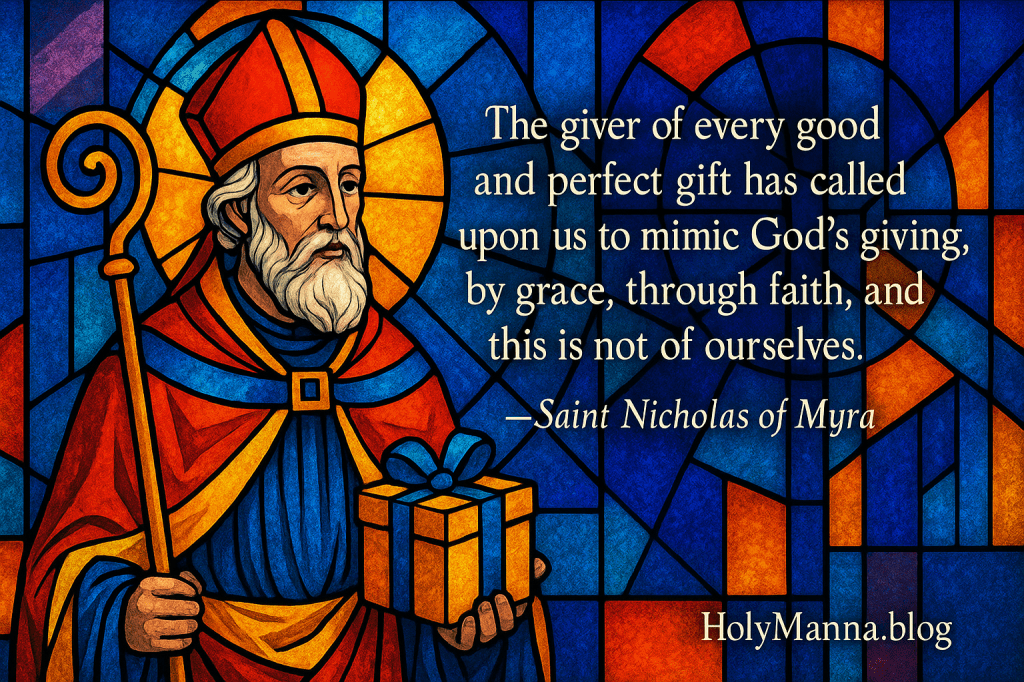
This spirit of generosity echoed through every part of Nicholas’s life. Many traditions attribute to him the beautiful words: “The giver of every good and perfect gift has called upon us to mimic God’s giving, by grace, through faith, and this is not of ourselves.” Whether or not the exact phrasing can be traced to him, it expresses the heart of his entire ministry.
Nicholas was eventually ordained a priest, and through prayerful discernment within the local Church, he was chosen as bishop of Myra. The clergy recognized in him a man of prayer, humility, and courage who could shepherd a community facing both spiritual and political turmoil.
A Bishop Who Worked Miracles And Defended The Helpless
As bishop, Nicholas became known not only for generosity but for decisive action on behalf of the suffering. One year, Myra faced a severe famine. A ship loaded with grain stopped in the harbor, but the grain was reserved for the emperor. Nicholas publicly asked the sailors to unload a portion for his starving people, promising that God would preserve their measured cargo. The sailors reluctantly obeyed, and later discovered that their load remained completely intact.
In another well known story, three innocent men were condemned to death by a corrupt official who had accepted a bribe. Nicholas rushed to the execution site, halted the executioner’s sword, and confronted the official for his injustice. He defended the innocent, exposed corruption, and secured their freedom. This act of bold pastoral courage became one of the most beloved stories in Christian art featuring Saint Nicholas.
Nicholas also became a patron for those who traveled by sea. Sailors caught in a violent storm prayed for his intercession. Tradition says Nicholas appeared to them, strengthened the ship’s rigging, and guided them safely to harbor. When the sailors later went to church to give thanks, they recognized Bishop Nicholas as the man who had helped them in the storm.
Nicholas’s life mirrors the teaching of The Catechism, which says the Church has always had a special love for the poor because Christ Himself became poor. It also teaches that the virtue of charity calls believers to love God above all things and to love their neighbor as themselves for the love of God. Nicholas demonstrated this virtue not through ideas but through action. He rescued the vulnerable, fed the hungry, defended the innocent, confronted injustice, and risked his life for the sake of the Gospel.
Endurance Under Persecution And Fidelity To Christ
Nicholas lived during the brutal Diocletian persecutions when Christians were arrested, tortured, and pressured to renounce the faith. As a well known Christian leader, Nicholas was imprisoned for his steadfast faith. Tradition holds that he endured mistreatment, yet remained unbroken in spirit until the persecutions ended and he could return to his flock.
He is also connected to the First Council of Nicaea in 325, where the Church confronted the Arian heresy and affirmed the full divinity of Jesus Christ. Some traditions say Nicholas attended the council and zealously defended the truth of Christ’s divine nature. While ancient lists do not unanimously record his presence, the tradition reflects the Church’s memory of Nicholas as a passionate defender of orthodoxy. What matters most is that the faithful remember him as a bishop who loved the truth enough to stand boldly for it.
Nicholas died peacefully on December 6, likely around the mid fourth century. Although he did not die a martyr’s death, he is honored as a confessor who suffered for the faith with courage and deep love for Christ.
A Wonderworker Even After Death
After his death, Saint Nicholas’s tomb in Myra became a major pilgrimage site. The faithful reported miracles and healings, including a mysterious liquid called the “manna of Saint Nicholas” that was said to flow from his tomb and was believed to carry healing properties.
In the eleventh century, when Myra came under political threat, sailors from Bari took most of Nicholas’s relics and brought them to Italy. There they built a basilica in his honor, and devotion to Saint Nicholas grew rapidly throughout Western Europe. Other relics were later brought to Venice and additional sites, spreading devotion even further.
Christians across centuries have testified to healings, rescues at sea, deliverance from injustice, and answers to prayer through his intercession. This reflects what The Catechism teaches about the communion of saints, reminding believers that those in heaven do not cease to intercede for the Church on earth and that their fraternal concern helps believers in their weakness.
What Saint Nicholas Teaches The Modern Christian
Saint Nicholas of Myra calls believers to a radical kind of generosity that mirrors the generosity of Jesus. It is not sentimental Christmas cheer. It is courageous charity that meets real human suffering. Nicholas reminds the Church that holiness is not about grand gestures but about hidden acts of mercy done for the love of God. He challenges Christians to give quietly, defend the vulnerable, confront injustice, and protect the dignity of every person.
His example invites believers to rediscover the heart of Christmas. It is not about commercial gifts but about recognizing Christ, the perfect gift, and imitating His sacrificial love. Saint Nicholas also encourages believers to remain steadfast in the truth, just as he defended the divinity of Christ in a time of confusion and division.
Finally, his ongoing intercession reminds Christians that the saints are not distant historical figures but living members of God’s family who help guide the faithful. Asking for his prayers can strengthen believers in generosity, courage, and purity of heart.
Engage With Us
Share your thoughts and reflections about Saint Nicholas of Myra in the comments below because his life still speaks powerfully to the Church today.
- Where is God inviting you to imitate Saint Nicholas by giving quietly and generously to someone in real need?
- How does Saint Nicholas’s courage in defending the innocent inspire you to stand up for the vulnerable in your own community?
- In what ways does his story challenge your approach to Advent and Christmas, especially regarding material gifts and spiritual priorities?
- What fears hold you back from practicing the virtue of charity as defined in The Catechism, and how might Saint Nicholas help you grow in trust?
- How can you honor Saint Nicholas’s feast day by committing to one specific act of mercy that reflects Christ’s love?
May Saint Nicholas of Myra pray for all who seek to follow Christ with generous hearts. May his example inspire every reader to live a life of faith, courage, and hidden charity, doing everything with the love and mercy that Jesus taught.
Saint Nicholas of Myra, pray for us!
Follow us on Instagram and Facebook for more insights and reflections on living a faith-filled life.

 Holy Manna!
Leave a comment