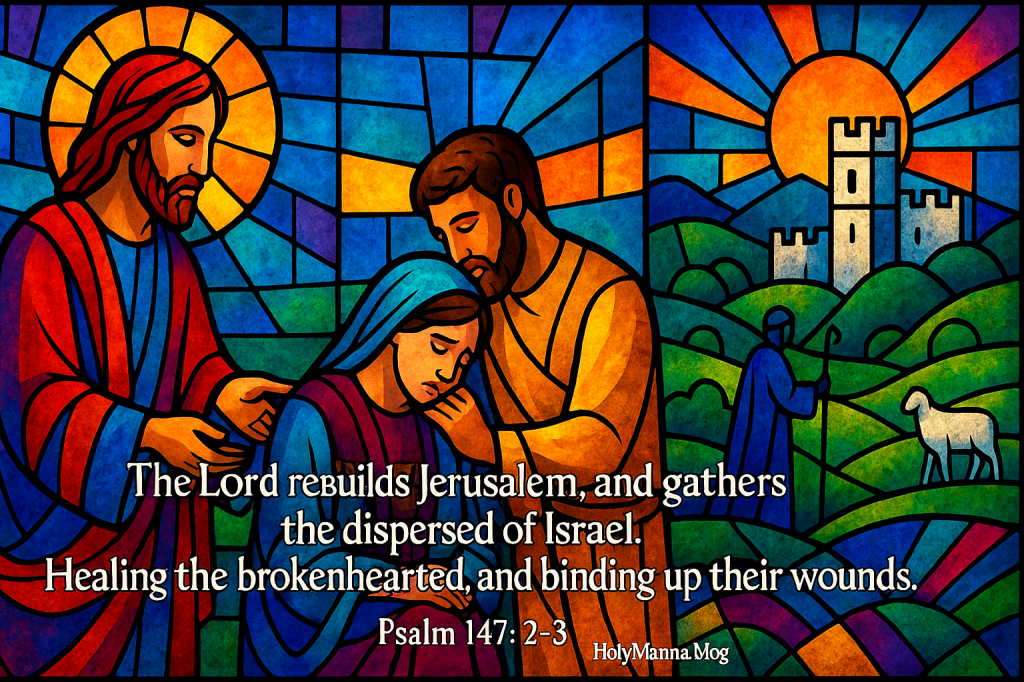
Saturday of the First Week of Advent – Lectionary: 180
When the Divine Physician Draws Near
Sometimes the soul feels like it is barely holding together, quietly hoping that God will notice the ache that no one else sees. Into that place, today’s readings speak with a gentle but forceful promise: God not only sees the wounds of his people, he draws near to heal them and then sends them out as instruments of healing for others.
In Isaiah 30, God speaks to a people who have known fear, political instability, and the consequences of their own sin. Judah had tried to rely on foreign alliances instead of trusting in the Lord. Into that messy history, God does not respond with permanent rejection, but with a promise of restoration. The prophet announces a day when God will no longer hide his face. The people will hear a clear inner guidance from the Lord: “This is the way; walk in it.” Their outward situation is transformed with abundant rain, rich harvests, and radiant light, but the deepest promise is that God will bind up their wounds and heal the bruises left by his just discipline.
Psalm 147 picks up that same melody of restoration. It likely reflects a time after the Babylonian exile, when God’s people had experienced both devastation and a surprising return. The psalm praises the Lord who “rebuilds Jerusalem” and “gathers the dispersed of Israel”, the God who “heals the brokenhearted and binds up their wounds.” The same Lord who numbers and names the stars bends low to lift up the poor and cast down the wicked. The universe sized God is also intimately concerned with the fragile heart that feels scattered, forgotten, or ashamed.
In The Gospel of Matthew, that promise takes on a human face. Jesus walks through towns and villages, teaching, proclaiming the kingdom, and “curing every disease and illness.” When he sees the crowds, he is moved with deep compassion because they are “troubled and abandoned, like sheep without a shepherd.” This is not a distant God analyzing human weakness from afar. This is the Good Shepherd and Divine Physician standing in the midst of exhausted people, ready to heal and to lead. Then something astonishing happens. He calls the Twelve, gives them authority over unclean spirits and sickness, and sends them out to proclaim: “The kingdom of heaven is at hand.” They are told to “Cure the sick, raise the dead, cleanse lepers, drive out demons. Without cost you have received; without cost you are to give.”
In Advent, the Church remembers and relives this mystery. The season is not only about waiting for a future coming, but also about recognizing how Christ already comes into the concrete wounds, confusion, and emptiness of life right now. The Catechism reminds believers that Christ is the physician of both soul and body, who came to heal the whole person, starting with sin and reaching into every form of suffering (CCC 1503). Today’s readings show that movement clearly. God rebuilds what sin and suffering have broken. God shepherds those who feel lost and abandoned. Then God sends the healed back into the world as laborers in his harvest, carrying the same mercy they have received. Where does the Lord want to meet wounds with his healing today, and where is he quietly calling someone to become a laborer in his field of broken hearts?
First Reading – Isaiah 30:19–21, 23–26
When God Steps Out of Hiding and Walks Behind You
Isaiah speaks into a moment when God’s people had tried to secure their future with human schemes instead of trusting in the Lord. In Isaiah 30, Judah is tempted to rely on political alliances, especially Egypt, to protect them from the Assyrian threat. Spiritually, it is a picture of hearts that want God’s help but still cling to their own backup plans. Into this mixture of fear, sin, and fragile hope, God promises something astonishing. He will not stay hidden. He will reveal himself as Teacher and Healer, draw near to his people, and personally guide them step by step.
This passage fits beautifully with today’s Advent theme. The Lord does not merely repair circumstances. He binds wounds, heals bruises, and changes the inner posture of the heart. The promised abundance of rain, rich harvest, and radiant light is not just about agriculture or weather. It is a sign that God is renewing his covenant love and leading his people into a future full of mercy. In the light of The Gospel of Matthew, this promise reaches its fullness in Jesus, the Good Shepherd and Divine Physician, who looks on the crowds, heals the sick, and sends out disciples to continue his mission. Isaiah 30 shows the heart of a God who moves from hiddenness to nearness, from discipline to healing, and from silence to a clear inner word: “This is the way; walk in it.”
Isaiah 30:19-21, 23-26
New American Bible (Revised Edition)
19 Yes, people of Zion, dwelling in Jerusalem,
you shall no longer weep;
He will be most gracious to you when you cry out;
as soon as he hears he will answer you.
20 The Lord will give you bread in adversity
and water in affliction.
No longer will your Teacher hide himself,
but with your own eyes you shall see your Teacher,
21 And your ears shall hear a word behind you:
“This is the way; walk in it,”
when you would turn to the right or the left.
23 He will give rain for the seed
you sow in the ground,
And the bread that the soil produces
will be rich and abundant.
On that day your cattle will graze
in broad meadows;
24 The oxen and the donkeys that till the ground
will eat silage tossed to them
with shovel and pitchfork.
25 Upon every high mountain and lofty hill
there will be streams of running water.
On the day of the great slaughter,
when the towers fall,
26 The light of the moon will be like the light of the sun,
and the light of the sun will be seven times greater,
like the light of seven days,
On the day the Lord binds up the wounds of his people
and heals the bruises left by his blows.
Detailed Exegesis
Verse 19 – “Yes, people of Zion, dwelling in Jerusalem, you shall no longer weep; He will be most gracious to you when you cry out; as soon as he hears he will answer you.”
This verse begins with a tender address to people of Zion, the covenant people who have suffered because of their own choices and because of foreign oppression. The promise that they “shall no longer weep” does not erase the fact that they have shed many tears. It reveals a turning point. God’s graciousness is stirred precisely when his people cry out. The line “as soon as he hears he will answer you” shows a God who is attentive and quick to respond with mercy. This prepares the heart to see Advent not just as a countdown to Christmas, but as a time when God leans in closely to the weak cry for help.
Verse 20 – “The Lord will give you bread in adversity and water in affliction. No longer will your Teacher hide himself, but with your own eyes you shall see your Teacher,”
Here the Lord does not promise a life without adversity or affliction. Instead, he promises “bread in adversity and water in affliction.” The presence of suffering is not denied, yet God meets it with real sustenance. The deeper gift is his self-revelation. The phrase “No longer will your Teacher hide himself” signals a shift from perceived absence to active presence. In the Old Testament, God often teaches through prophets, the Law, and events of history. Here, that teaching becomes intensely personal. “With your own eyes you shall see your Teacher” points forward to the incarnation, when the eternal Word becomes visible in Christ, and also to the inner illumination of the Holy Spirit who teaches the Church from within.
Verse 21 – “And your ears shall hear a word behind you: ‘This is the way; walk in it,’ when you would turn to the right or the left.”
This verse is incredibly intimate. The image is not of a distant voice thundering from the sky, but of a word behind you, like a teacher or shepherd walking just close enough to whisper guidance. “This is the way; walk in it” evokes the biblical theme of the “way” as the path of God’s will and covenant faithfulness. The phrase “when you would turn to the right or the left” acknowledges human tendency to drift, to get distracted, or to chase other paths. God’s answer is not to abandon the wanderer, but to provide ongoing, gentle correction. In New Testament light, this resonates with the guidance of the Holy Spirit in the Church and in the conscience of the believer, especially when close to the sacraments and the word of God.
Verse 23 – “He will give rain for the seed you sow in the ground, And the bread that the soil produces will be rich and abundant. On that day your cattle will graze in broad meadows;”
The promise now unfolds in images of agricultural abundance. Rain for the seed and rich and abundant bread represent material blessing, but they also symbolize spiritual fruitfulness. When the heart finally listens to the Teacher, even ordinary work and hidden effort can yield surprising harvests. “On that day” points to a specific moment of divine intervention, when God reverses scarcity and restores what was lost. The cattle grazing in broad meadows shows security and peace. For readers today, these images speak to a God who knows the practical needs of life and who can turn seasons of barrenness into seasons of growth.
Verse 24 – “The oxen and the donkeys that till the ground will eat silage tossed to them with shovel and pitchfork.”
Even the work animals benefit from this overflowing grace. The oxen and donkeys, which represent hard labor and daily grind, are fed not scraps but “silage tossed to them with shovel and pitchfork”, a picture of generous provision. In a spiritual sense, when God heals his people and restores right order, the blessings spill over into every corner of life, including work, routine, and the humble tasks that usually go unnoticed. The renewal is so complete that even the smallest details of existence are touched by God’s kindness.
Verse 25 – “Upon every high mountain and lofty hill there will be streams of running water. On the day of the great slaughter, when the towers fall,”
High mountains and lofty hills were often places of pagan worship and pride. The promise of “streams of running water” flowing there suggests a cleansing and transformation. Where there was idol worship and human arrogance, there will now be life giving water, a recurring symbol of grace and the Spirit in Scripture. The “day of the great slaughter, when the towers fall” points to a decisive judgment against the enemies of God and against human pride that sets itself against him. God’s healing does not ignore justice. He brings down what is opposed to his reign while opening up new springs of life for those who turn back to him.
Verse 26 – “The light of the moon will be like the light of the sun, and the light of the sun will be seven times greater, like the light of seven days, On the day the Lord binds up the wounds of his people and heals the bruises left by his blows.”
This verse reaches a kind of poetic climax. The imagery of light becoming more intense signals a new era of revelation and joy. “The light of the moon” shining like the sun and “the light of the sun” being “seven times greater” evokes completeness and superabundance, since seven is the biblical number of fullness. This overwhelming light comes “On the day the Lord binds up the wounds of his people and heals the bruises left by his blows.” God’s corrective discipline, which can feel harsh in the moment, is revealed as medicinal. The same Lord who allowed painful consequences for sin is the One who personally bandages wounds and heals bruises. This holds together divine justice and mercy in a way that points forward to the cross, where Christ bears the blows sin deserves and pours out healing light on a world in darkness.
Teachings: Discipline, Healing, and the God Who Walks With His People
This passage offers a powerful window into how the Church understands God’s work in history and in individual lives. The Lord is Teacher, Judge, and Healer all at once. His discipline is real, yet it is always ordered toward restoration, not destruction.
The Catechism speaks of Christ as the physician of soul and body. It states: “Christ’s compassion toward the sick and his many healings of every kind of infirmity are a resplendent sign that ‘God has visited his people’.” (CCC 1503). The compassion revealed in Jesus is already anticipated in Isaiah 30, where God promises to bind wounds, provide bread in adversity, and speak a guiding word. The same divine heart is at work in both Testaments.
This reading also touches the Church’s teaching on divine pedagogy, the way God educates his people over time. God does not simply deliver information. He leads through events, trials, and consolations, always with the goal of drawing hearts into deeper trust. The inner word “This is the way; walk in it” reflects the role of conscience, which The Catechism describes as a law inscribed by God in the heart that calls a person to do good and avoid evil. It teaches that conscience “enjoins him at the appropriate moment to do good and to avoid evil” and “judges particular choices, approving those that are good and denouncing those that are evil.” (CCC 1777). The quiet word behind the believer that redirects when turning left or right is closely connected to this interior voice, enlightened by grace and the teaching of the Church.
Many saints experienced God in this way, as a Teacher who sometimes seemed hidden but then drew near in moments of conversion and healing. Saint Augustine describes God as closer to him than he was to himself and realized that the Lord had been guiding him even when he had gone far astray. The logic is the same as in Isaiah 30: God permits wandering and even painful consequences, yet pursues the soul with a love that ultimately binds wounds and floods life with new light.
The image of abundant rain and overflowing fruitfulness also connects with the Church’s understanding of grace. Once the heart turns back to the Lord, grace does not merely patch over problems. It transforms, elevates, and perfects nature. Ordinary fields become places of rich harvest. Ordinary work becomes a site of blessing. Ordinary days become occasions for God’s light to shine more brightly. In that sense, this reading is a quiet Advent prophecy of the sacramental life, where Christ feeds his people in their adversity and affliction, especially through the Eucharist, and then sends them out to walk in his way.
Reflection: Hearing the Quiet Word Behind You Today
This reading speaks deeply to anyone who feels a mix of regret, confusion, and hope. It shows that God does not wait for perfect behavior before drawing near. He steps into the middle of adversity and affliction with bread, water, guidance, and healing. The key movement is not that life suddenly becomes easy, but that the Lord is no longer perceived as hidden. The Teacher steps into view and walks just behind, close enough for his voice to be heard.
In everyday life, this can look like a surprising clarity while praying with Scripture, a nudge toward confession after a long time away, a gentle conviction when about to fall into a familiar sin, or a peaceful strength to persevere in a difficult vocation. The phrase “This is the way; walk in it” might echo in the heart when choosing honesty over compromise, purity over indulgence, prayer over distraction, or mercy over resentment. The believer who listens and obeys that voice may not see immediate harvest, but over time the field of life becomes more fruitful.
This passage also invites trust when suffering feels like a blow from the Lord. The text does not pretend that God’s corrective action is painless. The language of “bruises left by his blows” acknowledges that sin has real consequences and that God’s discipline can hurt. Yet the final word is not condemnation, but healing. The One who allowed the bruise is the One who binds it up. This is fully revealed in The Gospel of Matthew, where Christ takes the blows of sin upon himself and offers his wounds as the source of the believer’s healing.
Concrete steps can grow out of this reading. A person can ask for the grace to recognize the Lord as Teacher in daily decisions and not just as a crisis fixer. Time can be set apart to sit with God’s word and actually listen for that inner whisper that points to the right path. Frequenting the sacraments, especially confession and the Eucharist, opens the soul more fully to the healing light that Isaiah describes. Acts of trust can be made in moments of confusion, choosing to believe that God is at work even when emotions do not feel it.
Where has the Lord been feeding with “bread in adversity and water in affliction,” even if that help has gone unnoticed until now?
In what choices today is there a need to pause and listen for the quiet word behind, saying, “This is the way; walk in it”?
Which wounds or bruises feel most in need of the Lord’s binding and healing during this Advent season, and what small step can be taken to bring them honestly before him?
Responsorial Psalm – Psalm 147:1–6
The God Who Names the Stars and Heals Broken Hearts
Psalm 147 likely flows out of the experience of return from exile, when Jerusalem was battered, its walls broken, and its people scattered. The psalmist looks at a city that has known devastation and sings a song of restoration. God is praised as the One who rebuilds Jerusalem, gathers the dispersed, heals the brokenhearted, and cares for the poor. In a world where power usually belongs to the strong and successful, this psalm announces a very different kind of Lord, one whose greatness is shown in tender care for the wounded and the lowly.
This fits perfectly with today’s Advent theme. In Isaiah 30, God promises to bind up the wounds of his people and to shine a new light over their darkness. In The Gospel of Matthew, Jesus looks on the crowds with compassion because they are “troubled and abandoned, like sheep without a shepherd” and then heals every disease and illness. Psalm 147 is like the Church’s musical response to these promises and their fulfillment. The same God who numbers the stars and calls them by name bends close to bind human wounds and lift up the poor. The psalm teaches that praise is not an escape from reality but a way of naming the truth of who God is in the middle of suffering and rebuilding.
Psalm 147:1-6
New American Bible (Revised Edition)
God’s Word Restores Jerusalem
1 Hallelujah!
How good to sing praise to our God;
how pleasant to give fitting praise.
2 The Lord rebuilds Jerusalem,
and gathers the dispersed of Israel,
3 Healing the brokenhearted,
and binding up their wounds.
4 He numbers the stars,
and gives to all of them their names.
5 Great is our Lord, vast in power,
with wisdom beyond measure.
6 The Lord gives aid to the poor,
but casts the wicked to the ground.
Detailed Exegesis
Verse 1 – “Hallelujah! How good to sing praise to our God; how pleasant to give fitting praise.”
The psalm opens with “Hallelujah,” literally “Praise the Lord.” The psalmist insists that it is “good” and “pleasant” to praise God, and that this praise is “fitting.” In other words, praising God is not a forced religious duty. It aligns with reality and heals the heart. When life has been shattered, praise can feel unnatural, but this verse reminds believers that God is still worthy of song. Praise helps the soul remember that God’s goodness is deeper than any present trial. It prepares the heart for the rest of the psalm, which lists concrete reasons why God deserves trust and thanksgiving.
Verse 2 – “The Lord rebuilds Jerusalem, and gathers the dispersed of Israel,”
Here the focus moves to what God actually does in history. “The Lord rebuilds Jerusalem” probably refers to the return from Babylonian exile and the physical rebuilding of the city and its walls. Yet the deeper rebuilding is spiritual and communal. God “gathers the dispersed of Israel,” bringing home those who were scattered by sin and conquest. This echoes today’s theme: God does not abandon his people in their ruin. He goes out to the scattered and brings them back into communion. In the light of Christ, this gathering points toward the Church, where God is constantly rebuilding souls and communities through grace and the sacraments.
Verse 3 – “Healing the brokenhearted, and binding up their wounds.”
This verse goes straight to the inner life. The Lord does not only fix external problems. He “heals the brokenhearted” and “binds up their wounds.” The image is that of a divine physician and gentle caregiver who leans over a wounded person and carefully bandages their injuries. This connects beautifully with Isaiah 30, where God promises to bind up the wounds of his people and heal the bruises left by his blows. It also anticipates Christ, who in The Gospel of Matthew heals every disease and illness and whose Sacred Heart burns with compassion for the lost. Spiritual and emotional wounds are not invisible to God. They are precisely where he wants to work.
Verse 4 – “He numbers the stars, and gives to all of them their names.”
Here the psalm shifts from the inner world of the broken heart to the vastness of the cosmos. God’s intimate healing is placed alongside his immense power. He not only sees the human heart, he also “numbers the stars” and “gives to all of them their names.” In ancient cultures, naming shows authority and personal knowledge. The Lord’s knowledge of each star reveals his absolute sovereignty over creation. Juxtaposed with verse 3, this means that the One who bandages human wounds is the same One who arranged the galaxies. This combination of tenderness and majesty is at the core of biblical faith.
Verse 5 – “Great is our Lord, vast in power, with wisdom beyond measure.”
This verse draws out the conclusion from the previous one. Because God numbers the stars and heals hearts, he is “great,” “vast in power,” and his “wisdom [is] beyond measure.” Human beings often feel overwhelmed by complexity, evil, or suffering, but this verse anchors hope in God’s infinite wisdom. He understands every situation more deeply than any human mind ever could. For someone who feels confused or overwhelmed, this line can be a place to rest. The Lord’s wisdom is not cold intelligence. It is the wise love of a Father who knows exactly how to rebuild a life that seems shattered.
Verse 6 – “The Lord gives aid to the poor, but casts the wicked to the ground.”
The psalm closes this section by showing how God’s greatness plays out in real moral terms. The Lord is not neutral. He “gives aid to the poor” and “casts the wicked to the ground.” The poor here are not only the materially poor, but all who know their need for God, the humble and the lowly. The wicked are those who persist in refusing God and oppressing others. God’s healing and rebuilding are not sentimental. They come with real judgment against evil and real help for those who are crushed. This fits with the whole biblical pattern where God defends the lowly and confronts pride. It also echoes Jesus’ own ministry, where he lifts up the poor and calls sinners to conversion while warning the hardened of heart.
Teachings: Praise, Providence, and the God of the Poor
Psalm 147 reveals key aspects of who God is and how the Church understands his action. The Lord is both transcendent and near. He governs the stars and enters the hidden places of the human heart. He rebuilds cities and binds private wounds.
The Catechism teaches that God is the creator and sustainer of the universe. It states: “God creates and sustains all things by his Word.” (CCC 320). This truth is reflected in the image of God numbering and naming the stars. Creation is not random or anonymous. It is personally known and held in existence by God’s wisdom.
At the same time, The Catechism emphasizes God’s particular love for the poor and suffering. It teaches: “The Church’s love for the poor is a part of her constant tradition.” (CCC 2444). This love reflects God’s own heart, who “gives aid to the poor.” The Church does not merely admire the poor from a distance. It sees in them a privileged place of encounter with Christ. The care for the poor is not an optional extra, but a serious consequence of believing in the God of Psalm 147.
The healing of the brokenhearted in this psalm also connects with the Church’s understanding of Christ’s mission. The Catechism teaches: “Moved by so much suffering Christ not only allows himself to be touched by the sick, but he makes their miseries his own.” (CCC 1505). What the psalm sings in poetic form is fulfilled in the flesh of Jesus. He makes the pain of the brokenhearted his own and heals them from the inside out.
Saint Thérèse of Lisieux spoke often of confidence in God’s merciful love. Her spirituality echoes the trust invited by this psalm. The believer is not asked to look at ruins and despair, but to look at the God who rebuilds and to entrust everything to him. For Thérèse, smallness and poverty become a path to receiving more of God’s mercy, which fits perfectly with the psalm’s insistence that God gives aid to the poor.
Historically, this psalm would have comforted a people who had lived through exile, war, and the slow work of rebuilding. Spiritually, it continues to comfort those who feel like their life is in ruins, their heart is shattered, or their hope is thin. The same Lord who rebuilt Jerusalem after exile is able to rebuild a soul after sin, trauma, or failure. That is why praise is “good” and “pleasant” and “fitting.” It proclaims that God’s mercy is stronger than the worst that sin and suffering can do.
Reflection: Letting God Rebuild and Learning to Praise Again
This psalm invites a very personal response. It does not stay at the level of poetry or theology. It asks hearts that may feel broken, scattered, or exhausted to dare to praise again and to trust again. It reminds believers that the Lord is actively rebuilding, gathering, healing, and lifting up, even when emotions say otherwise.
In daily life, this might mean choosing to praise God in prayer even when feelings are flat, simply by telling him who he is. It might mean letting God touch places of heartbreak that have been hidden or guarded for a long time, perhaps by bringing them into honest prayer or into the sacrament of reconciliation. It might mean becoming more attentive to the poor and suffering around, recognizing that God is especially close to them and often works through those small acts of mercy.
There is also an invitation here to trust God’s wisdom and power in confusing situations. The one who numbers the stars and names them knows exactly what is happening in each life. When the future feels uncertain, Psalm 147 gives words to say: God is great, God’s power is vast, and God’s wisdom is beyond measure. That is not a vague slogan. It is a concrete anchor when everything else feels unstable.
This psalm also gently pushes believers out of self focus. The Lord rebuilds and heals not only for personal comfort, but so that his people can become signs of his mercy to others. A heart that has experienced healing can become more sensitive to the wounds of others and more ready to serve. The God who gives aid to the poor calls his people to be his hands and feet.
Where are there broken places in life that need to be honestly brought to the Lord who heals the brokenhearted and binds up their wounds?
What would it look like to consciously praise God each day, even briefly, not because life feels perfect, but because God is truly worthy of fitting praise?
Who are the poor, in material or spiritual need, that God is placing nearby so that his care for the lowly can become visible through concrete acts of love?
Holy Gospel – Matthew 9:35–10:1, 5–8
From Compassionate Shepherd to Sending King
This passage from The Gospel of Matthew sits at a key turning point in Jesus’ earthly ministry. Up to this point, Jesus has been traveling throughout Galilee, personally teaching, preaching, and healing. He proclaims the kingdom, casts out demons, and restores the broken. In today’s Gospel, something new happens. The Lord looks at the immense need of the crowds and shares his own mission with the Twelve. The harvest is too great for one visible laborer. Out of compassion, the Good Shepherd raises up more shepherds.
Historically, Jesus is moving among Jewish towns and villages, addressing the lost sheep of Israel in a time of Roman occupation, heavy taxation, and deep spiritual fatigue. Many people are burdened by illness, poverty, and a religious system that often feels more like a weight than a gift. Into this world, Jesus appears as the fulfillment of the promises heard in Isaiah 30 and sung in Psalm 147. He is the visible Teacher no longer in hiding, the Divine Physician who heals the brokenhearted and binds up their wounds.
Religiously, this Gospel shows the beginning of apostolic mission. The Twelve are not just followers. They are called, given authority, and sent. Their instructions are clear. They must go first to the lost sheep of the house of Israel, proclaim that the kingdom of heaven is at hand, and perform works that make that kingdom visible. They are told to “Cure the sick, raise the dead, cleanse lepers, drive out demons. Without cost you have received; without cost you are to give.” This fits perfectly with today’s theme. God does not only heal his people. He turns the healed into healers, the comforted into comforters, and the shepherded into shepherds for others.
Matthew 9:35-10:1, 5-8
New American Bible (Revised Edition)
The Compassion of Jesus. 35 Jesus went around to all the towns and villages, teaching in their synagogues, proclaiming the gospel of the kingdom, and curing every disease and illness. 36 At the sight of the crowds, his heart was moved with pity for them because they were troubled and abandoned, like sheep without a shepherd. 37 Then he said to his disciples, “The harvest is abundant but the laborers are few; 38 so ask the master of the harvest to send out laborers for his harvest.”
The Mission of the Twelve. 10:1 Then he summoned his twelve disciples and gave them authority over unclean spirits to drive them out and to cure every disease and every illness.
The Commissioning of the Twelve. 5 Jesus sent out these twelve after instructing them thus, “Do not go into pagan territory or enter a Samaritan town. 6 Go rather to the lost sheep of the house of Israel. 7 As you go, make this proclamation: ‘The kingdom of heaven is at hand.’ 8 Cure the sick, raise the dead, cleanse lepers, drive out demons. Without cost you have received; without cost you are to give.
Detailed Exegesis
Verse 10:35 – “Jesus went around to all the towns and villages, teaching in their synagogues, proclaiming the gospel of the kingdom, and curing every disease and illness.”
This verse summarizes Jesus’ threefold ministry. He teaches in the synagogues, which means he opens the Scriptures and reveals their true meaning. He proclaims “the gospel of the kingdom,” announcing that God’s reign is breaking into history in a new and decisive way. He cures “every disease and illness,” showing that the kingdom is not a vague idea but a concrete reality that brings healing to body and soul. The phrase “all the towns and villages” emphasizes his tireless outreach. No place is too small, and no person is too insignificant. This connects directly to Isaiah 30, where God promises that the Teacher will no longer hide, and to Psalm 147, which praises God for healing the brokenhearted. In Jesus, those promises are literally walking through Galilee.
Verse 36 – “At the sight of the crowds, his heart was moved with pity for them because they were troubled and abandoned, like sheep without a shepherd.”
This is one of the most revealing verses about the heart of Jesus. He does not merely see crowds as a ministry task or a problem to manage. His heart is “moved with pity,” which in the original language points to a deep, gut level compassion. The crowds are described as “troubled and abandoned,” literally harassed and helpless, without protection or guidance. The image “like sheep without a shepherd” recalls Old Testament passages where leaders failed to care for God’s people, and God promised to shepherd them himself. Jesus here is revealed as that promised Shepherd, the one who sees and feels the pain of those who are spiritually and physically lost. This compassion is the driving force behind everything that follows.
Verse 37 – “Then he said to his disciples, ‘The harvest is abundant but the laborers are few;’”
Jesus shifts from description to interpretation. He looks at the troubled, shepherdless crowds and calls them an “abundant” harvest. This is a striking reversal. Where others might see only problems, Jesus sees a field ready for gathering. The issue is not a lack of grace or openness among the people, but a shortage of laborers. There are not enough hearts willing to step into the work of teaching, healing, and shepherding. This line reaches across centuries into every age of the Church. The Lord still looks at a wounded world and sees an abundant harvest. The question is always the same. Who will be His laborers.
Verse 38 – “so ask the master of the harvest to send out laborers for his harvest.”
Before sending, Jesus commands prayer. The disciples are told to “ask the master of the harvest” to send laborers. God is the true Lord of the mission, and the harvest is his, not theirs. This means that vocations, movements, and missionary initiatives are ultimately gifts of God, not human projects. Prayer for vocations is the first response to the sight of a wounded world. This verse also humbles any sense of self importance. Laborers are sent. They do not appoint themselves. They are part of God’s plan and must remain dependent on his will.
Verse 10:1 – “Then he summoned his twelve disciples and gave them authority over unclean spirits to drive them out and to cure every disease and every illness.”
Here the prayer and the sending meet. Jesus summons the Twelve, calling them into closer relationship and responsibility. He “gave them authority,” which is very important. The disciples do not heal or cast out demons on their own power. They share in Christ’s own authority over unclean spirits and sickness. The wording mirrors verse 35. Jesus himself had been curing “every disease and illness.” Now he enables the Twelve to participate in this same work. This passage shows the foundation of apostolic ministry and, ultimately, the sacramental life of the Church. Priests, bishops, and all who exercise pastoral care share in Christ’s authority, received from him and exercised in his name.
Verse 5 – “Jesus sent out these twelve after instructing them thus, ‘Do not go into pagan territory or enter a Samaritan town.’”
At this stage in salvation history, the mission is deliberately focused. The Twelve are told not to go into pagan or Samaritan areas yet. The reason is not lack of concern for the nations, but fidelity to God’s plan. The Father promised salvation first to Israel. Jesus honors that order. Later in The Gospel of Matthew, the Risen Lord will send the apostles to “all nations.” For now, the mission begins with the covenant people, the ones described as the lost sheep of the house of Israel. There is a divine rhythm here. God’s healing love starts in a particular place and then expands outward.
Verse 6 – “Go rather to the lost sheep of the house of Israel.”
This line makes the focus explicit. Israel is God’s flock, but many within it are “lost,” spiritually confused, misled, or hardened. The Twelve are sent precisely to those who are religiously near and yet spiritually far. This can be very relevant today, when many baptized Catholics are distant from the sacraments or unsure about the faith. The heart of Jesus aches for them just as it did for the crowds in Galilee. The mission of the Church is not only to the unreached in distant lands, but also to the lost sheep close to home.
Verse 7 – “As you go, make this proclamation: ‘The kingdom of heaven is at hand.’”
The core message is simple and explosive. The disciples are to proclaim that “The kingdom of heaven is at hand.” This means that God’s reign is near in the person of Jesus, close enough to touch, close enough to change lives. The kingdom is not primarily a place. It is God’s saving action in Christ, which demands a response of faith, repentance, and discipleship. The Twelve are not free to invent their own message. They are sent with the same proclamation that Jesus himself announced.
Verse 8 – “Cure the sick, raise the dead, cleanse lepers, drive out demons. Without cost you have received; without cost you are to give.”
The proclamation is backed up by visible signs. The disciples are commanded to “Cure the sick, raise the dead, cleanse lepers, drive out demons.” These works show that the kingdom is not talk. It is power. Leprosy, death, sickness, and demonic oppression represent the various ways sin and evil disfigure human life. Jesus sends his disciples right into those places of darkness with his authority and mercy. The final line, “Without cost you have received; without cost you are to give,” is crucial. Everything they have is gift. Therefore, their ministry must be marked by generosity, humility, and freedom from greed or self promotion. Grace is never a commodity. It is a gift that must remain gift.
Teachings: The Kingdom, the Apostolic Mission, and the Compassion of Christ
This Gospel passage reveals the heart of Christ’s mission and the Church’s identity. The Lord sees wounded humanity, is moved with compassion, proclaims the kingdom, heals, and then shares this mission with the Twelve.
The Catechism teaches about the kingdom of heaven in powerful words. It states: “The Kingdom of heaven was inaugurated on earth by Christ. ‘This kingdom shone out before men in the word, in the works, and in the presence of Christ.’ The Church is the seed and beginning of this kingdom. Its keys are entrusted to Peter.” (CCC 567). In today’s Gospel, the kingdom shines out through Christ’s teaching, healing, and compassionate gaze, and it begins to take visible form in the group of the Twelve.
On the mission of the apostles, The Catechism says: “As the Father has sent him, so he sends his apostles, filled with the Holy Spirit. Their mission is to proclaim, in the name of Christ, to all peoples and to all generations, the Good News of the salvation which Christ offers to all men.” (CCC 858). What is seen in seed form in Matthew 9–10 will blossom at Pentecost. The apostles are not freelancers. They are sent in continuity with Christ’s own mission and share in his authority and Spirit.
Regarding Christ’s compassion and healings, The Catechism teaches: “Moved by so much suffering Christ not only allows himself to be touched by the sick, but he makes their miseries his own: ‘He took our infirmities and bore our diseases.’” (CCC 1505). The compassion described in verse 36 is not a passing feeling. It leads all the way to the cross, where Jesus literally carries human misery in his own body.
The sharing of Christ’s healing power with the apostles is also addressed. The Catechism says: “The Lord Jesus has united the Church to himself in a special way through the sacraments. By the working of the Holy Spirit, the sacraments make present the grace that Christ won for us and give us a share in his life.” (CCC 1084). The authority to “Cure the sick, raise the dead, cleanse lepers, drive out demons” finds a lasting echo in the sacramental and pastoral ministry of the Church. Through confession, anointing of the sick, the Eucharist, and all the sacraments, Christ continues to heal and free.
The line “Without cost you have received; without cost you are to give” reflects the Church’s teaching on gratuity in ministry and charity. The Catechism says: “It is by what they have done for the poor that Jesus Christ will recognize his chosen ones. When ‘the poor have the good news preached to them,’ it is the sign of Christ’s presence.” (CCC 2443). True apostolic service is always marked by generosity toward the poor, not only materially but spiritually as well. The absence of calculation and the presence of sincere love show that the kingdom is really near.
Saint John Paul II often emphasized that every Christian, not just clergy and religious, is called to be a laborer in the Lord’s harvest. The lay faithful are called to bring the Gospel into workplaces, families, culture, and public life. This flows directly from today’s Gospel, where Jesus looks at the abundant harvest and calls for more laborers. The mission is universal. Everyone who has freely received must freely give.
Reflection: Living as Healed Sheep and Willing Laborers
This Gospel is both consoling and challenging. It consoles by showing the heart of Jesus toward the crowds. He sees the confusion, exhaustion, and spiritual hunger of people and responds with deep compassion. He sees the same things today in parishes, cities, universities, workplaces, and homes. No troubled heart is invisible to him. No abandoned soul is outside his gaze.
At the same time, the passage challenges every disciple. Jesus does not say only that the harvest is abundant. He says that the laborers are few and commands prayer for more laborers. Then he immediately calls and sends the Twelve. That pattern continues across centuries. God stirs prayer for vocations, and then he calls ordinary people to step forward.
In daily life, this can mean several concrete things. Someone can begin by asking the Lord, with sincerity, to send laborers into his harvest, especially priests, religious, and holy families. It can also mean asking in prayer how the Lord wants to use that person’s own life as part of the answer to that prayer. Maybe it is through more intentional involvement in parish life, more courage in speaking about faith with friends, or more generosity with time and resources toward those who are spiritually or materially poor.
The command, “Without cost you have received; without cost you are to give,” invites a deep check of the heart. The Christian has received forgiveness, teaching, sacraments, community, and countless hidden graces without payment. The Lord invites each person to mirror that same gratuity in how they serve, forgive, and share the Gospel. That might look like quietly helping a struggling friend, serving behind the scenes in parish ministries, being patient with difficult family members, or offering a clear but loving witness to Christ when it is risky.
There is also a personal encouragement here for anyone who feels like one of those “troubled and abandoned” sheep. Jesus does not wait for people to get everything together before having compassion. His heart moves toward the messy, the confused, and the wounded. The first step might simply be to bring that sense of being lost into honest prayer and to ask Jesus to shepherd that situation.
Where does life feel like that crowd, troubled and abandoned, in need of the gaze of the Good Shepherd who is moved with pity at what he sees.
How might the Lord be quietly calling today to move from being only a comforted sheep to becoming a willing laborer in his harvest.
What are some concrete ways to live out “Without cost you have received; without cost you are to give” in relationships, work, parish life, and care for the poor during this Advent season.
From Wounded Hearts to Willing Harvesters
Today’s readings trace a beautiful arc, like a single story told in three movements. In Isaiah 30, God promises to step out of hiding and draw near to a wounded people. He gives bread in adversity and water in affliction, and he speaks that quiet guiding word: “This is the way; walk in it.” In Psalm 147, the Church responds in praise to the Lord who “rebuilds Jerusalem”, “heals the brokenhearted”, and “binds up their wounds”, the same God who numbers and names the stars while stooping down to lift up the poor. Then in The Gospel of Matthew, all of this mercy takes on a human face in Jesus, whose heart is moved with pity for the crowds who are “like sheep without a shepherd” and who sends the Twelve to “Cure the sick, raise the dead, cleanse lepers, drive out demons. Without cost you have received; without cost you are to give.”
Taken together, the readings reveal a God who never stays distant from pain, confusion, or sin. The Lord disciplines, but only so that he can bind up wounds and flood life with new light. He rebuilds what has been torn down, gathers what has been scattered, and heals what seems beyond repair. Then he does something even more astonishing. He entrusts this healing mission to human hearts. Those who have been fed with bread in adversity are called to become bread for others. Those who have been shepherded as lost sheep are called to become laborers in the harvest.
Advent is the perfect time to lean into this movement. It is a season for letting the Teacher be seen again, for listening to the quiet word behind the heart, for allowing Christ to touch old bruises with new grace. It is also a season for asking honestly how the Lord wants to use each life in his field of broken hearts. The world is full of crowds that feel troubled and abandoned, sometimes under the same roof, sometimes sitting in the same pew. The harvest is still abundant. The Master of the harvest is still sending.
A simple but powerful call to action can grow from this. Time can be made for real prayer with these readings, asking the Lord to show where his healing is needed most and where he is inviting a more generous response. Space can be opened for the sacraments, especially confession and the Eucharist, where Christ’s healing and strengthening love is poured out. Intentional choices can be made to notice and serve the poor, the lonely, and the spiritually drifting nearby. The Lord does not ask for perfection in a day. He asks for a willing heart that lets itself be healed and then steps out when he says, “This is the way; walk in it.”
Where is the Lord gently pointing and saying, “This is the way,” inviting a concrete step of trust, repentance, or generosity today.
How might the healing and mercy received from God become a real gift for someone else in this Advent season, especially someone who feels like a sheep without a shepherd.
Engage with Us!
Share your thoughts and reflections in the comments below so that others can be encouraged by how God is working in your life through today’s readings. Use these questions to pray, journal, or start a deeper conversation with family, friends, or your parish community.
- First Reading – Isaiah 30:19–21, 23–26:
Where has the Lord been quietly giving “bread in adversity and water in affliction” in life, even if that help has not always been noticed or acknowledged?
In what concrete situation right now is there a need to slow down and listen for that inner voice of the Teacher saying, “This is the way; walk in it”? - Responsorial Psalm – Psalm 147:1–6:
What parts of life feel most “brokenhearted” or scattered and need to be brought honestly before the Lord who heals and rebuilds?
How could daily praise, even just a short moment of thanking God, begin to reshape the way struggles, worries, and fears are carried? - Holy Gospel – Matthew 9:35–10:1, 5–8:
Where does life most resemble the crowds that are “troubled and abandoned, like sheep without a shepherd,” and how is Jesus looking with compassion into that very place today?
What might it look like in real, practical terms to live out “Without cost you have received; without cost you are to give” with family, friends, coworkers, and the poor during this Advent season?
May these questions lead to deeper trust, bolder love, and a more generous response to God’s call. Let every thought, word, and action be shaped by the faith, love, and mercy that Jesus has taught, so that each day becomes a small but real step toward the kingdom of heaven at hand.
Sacred Heart of Jesus, we trust in You!
Immaculate Heart of Mary, pray for us!
Saint Michael the Archangel, defend us in battle!
Follow us on Instagram and Facebook for more insights and reflections on living a faith-filled life.

 Holy Manna!
Leave a comment