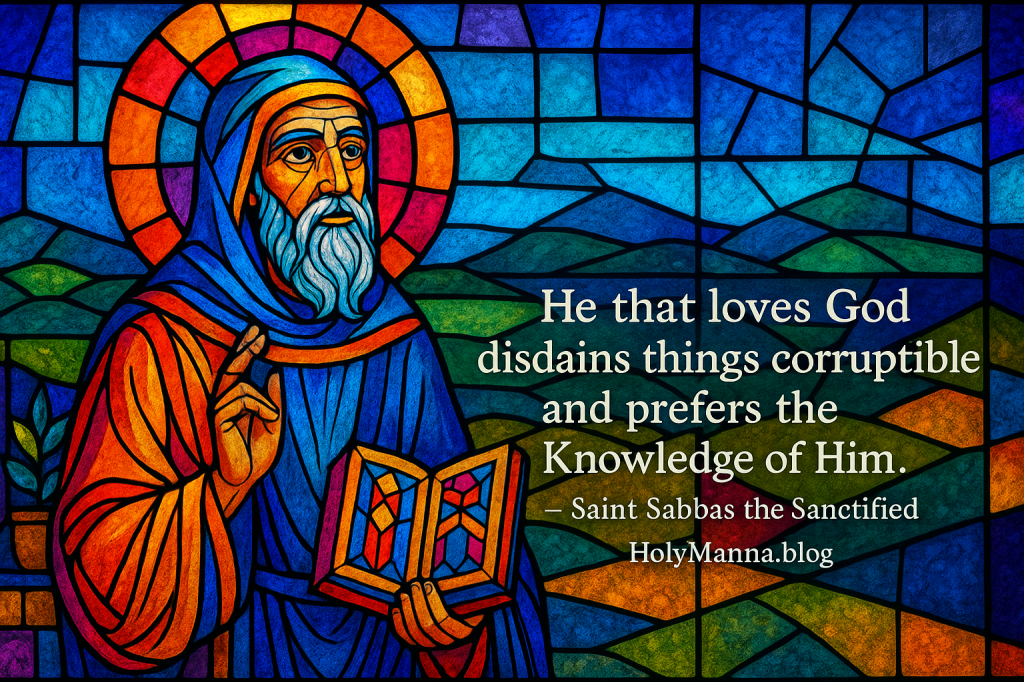
A Desert Father for a Restless Age
Saint Sabbas the Sanctified, also called Sabas, stands as one of the great patriarchs of Palestinian monasticism. Born in Cappadocia in 439 and dying near Jerusalem in 532, he spent more than seventy years in radical consecration to Christ. He is best known for founding the Great Lavra of Mar Saba in the Judean desert, one of the oldest continually inhabited monasteries in the world, and for shaping the Jerusalem Typikon, a monastic rule of liturgical prayer that would influence the Byzantine Rite and Eastern Catholic spirituality for generations.
Sabbas is remembered not only as a solitary mystic but as a leader, organizer, and defender of the orthodox Christian faith during turbulent theological controversies. His life holds profound insight for anyone seeking peace in a noisy world and holiness in daily life.
From Family Turmoil to Desert Freedom
Saint Sabbas was born in Mutalaska near Caesarea in Cappadocia to Christian parents, John, a military officer, and Sophia. Because of his father’s military service, Sabbas passed through the care of relatives who fought over his inheritance, leading to an unstable and painful childhood. Rather than clinging to wealth or security, the young boy sought God. Around the age of eight he entered a Basilian monastery near his home and quickly became known for obedience, love of Scripture, and a mature spiritual seriousness unusual for a child.
An early story preserved by tradition describes him picking up an apple in a garden and then putting it down, saying of the forbidden fruit: “Beautiful in sight and good for food, but this killed us.” That moment captures the purity of his heart and his lifelong refusal to embrace anything that would pull him away from God. His relatives later attempted to draw him back into the world and press him toward marriage, but tradition preserves his firm reply: “Having once enlisted in the service of God the King of all, I cannot cancel this service.”
As he grew older, Sabbas journeyed to Jerusalem. He was drawn both by devotion to the holy places and by the fame of the desert fathers whose holiness filled the region. Under the guidance of great saints such as Euthymius the Great and Theoktistos, Sabbas spent years in humility and obedience before receiving permission to pursue a more solitary life. He eventually became known for three great contributions to the Church: a life of profound contemplative prayer, the founding and shaping of monastic communities that became models for centuries, and steadfast defense of true Christology at a time of deep doctrinal division.
A Builder of Monasteries and a Beacon of Holiness
After years of hidden formation, Sabbas received permission to live in a cave in the Judean desert. He devoted his days to manual labor and his nights to psalmody and contemplation. His holiness attracted disciples who desired the same depth of communion with God. Around 483, the Great Lavra of Mar Saba developed around his cave, offering a rhythm of solitude, manual work, silence, and communal worship that would shape Eastern monastic life for centuries.
This lavra became a place where younger monks lived communally while elder monks lived as semi-hermits nearby, coming together for liturgical celebrations. Sabbas also helped give structure to the Church’s prayer by influencing the development of the Jerusalem Typikon, the monastic rule of liturgy and prayer that shaped Byzantine worship.
The Catechism of the Catholic Church teaches that religious life belongs to the very holiness of the Church, stating in CCC 914: “The state of life which is constituted by the profession of the evangelical counsels belongs undeniably to her life and holiness.” Saint Sabbas embodies this teaching with striking clarity.
Many miracles were attributed to him during his lifetime. His biographer, Cyril of Scythopolis, recounts that Sabbas discovered a life-giving spring in the desert after noticing a wild animal pawing at the ground, providing vital water to the monks. Other accounts describe miraculous rain during droughts, healings of the sick, and liberation of the afflicted through his intercessory prayer. One famous story tells of a lion that attempted to claim Sabbas’s cave. The saint calmly finished his psalmody and addressed the beast, saying: “The cave is spacious enough to provide plentiful lodging for both of us, for we both have the one Creator.” The lion withdrew, humbled by the holiness of the man before him.
Sabbas was not only a contemplative but also a courageous defender of the faith. He opposed the Monophysite heresy, upheld the teaching of the Council of Chalcedon, and even traveled to Constantinople in old age to plead for orthodoxy and for the protection of the monasteries. Tradition also preserves another brief spiritual maxim attributed to him: “He that loves God disdains things corruptible and prefers the Knowledge of Him.”
A Martyrdom of Austerity and Fidelity to Truth
Although he did not die by violence, Saint Sabbas lived a lifelong white martyrdom, offering his entire existence to God through extreme asceticism, obedience, and humility. His hardships began in childhood and continued in monastic life. Some monks resisted his authority because he was not yet a priest, which led to moments of internal conflict within his communities. Sabbas responded with charity, prayer, and forgiveness, even helping those who had opposed him.
His public defense of the faith also demanded great sacrifice. He traveled long distances, endured political pressures, and represented the monks of Palestine in their commitment to uphold the true doctrine of Christ’s two natures, fully God and fully man. After a long life poured out for Christ, Sabbas died peacefully in his lavra on December 5, 532, at about ninety-three years of age. His death crowned a life marked by quiet, steady martyrdom of daily self-denial and unwavering fidelity.
A Legacy of Holiness and Miracles After Death
After his death, devotion to Saint Sabbas flourished. His lavra, Mar Saba, continued as a center of monastic life and theology and later became home to major spiritual figures such as Saint John of Damascus. Over time, Sabbas’s relics were taken to Italy and venerated in Venice. In 1965, in an act of charity and unity, Pope Saint Paul VI returned the saint’s relics to Mar Saba, where they are honored today.
The monastery still stands dramatically in the desert cliffs of the Kidron Valley and remains one of the oldest inhabited monasteries in the world. Pilgrims continue to visit, seeking the intercession of the saint for deeper prayer, spiritual clarity, and strength in the face of trials. The Catechism beautifully explains the communion of saints in CCC 947: “Since all the faithful form one body, the good of each is communicated to the others.” Through this spiritual bond, the holy life of Saint Sabbas continues to bless the Church in every age.
Silence, Courage, and Simplicity
Saint Sabbas might seem distant from modern life, but his witness speaks clearly to the anxious and noisy world of today. His fidelity to the evangelical counsels reminds us that every Christian is called to practice poverty of spirit, purity of heart, and obedience to God’s will. His dedication to contemplative prayer echoes the words of CCC 2724, which describes contemplation as “a gaze of faith fixed on Jesus, an attentiveness to the Word of God, a silent love.” This is exactly the life Sabbas lived in the desert.
His courage in defending orthodox teaching reminds us that truth matters, especially when it concerns the identity of Jesus Christ. His daily examination of conscience and unwavering commitment to simplicity challenge us to choose holiness over comfort. Even small moments of silence, fidelity to daily prayer, and honest self-reflection bring us closer to the God whom Sabbas sought with his whole heart.
Engage with Us!
Your thoughts matter, and your reflections enrich our community. Share below what stirred your heart as you learned about Saint Sabbas and how his witness challenges or inspires you today.
- Where might God be inviting you to embrace a little more silence or simplicity in your daily life?
- How do you respond when faced with conflict regarding your faith, and what would it look like to imitate Saint Sabbas’s patience and courage?
- What practical steps can help strengthen your daily prayer life or examination of conscience this week?
- Is there any “forbidden fruit” in your life that looks attractive but leads you away from God, and what would it mean to set it aside like Saint Sabbas did?
- How might you support or learn from those living a monastic or consecrated vocation today?
May Saint Sabbas intercede for all who seek deeper prayer, stronger faith, and a heart anchored in Christ. May we continue to live with courage, humility, and the love and mercy that Jesus calls each of us to embody every day.
Saint Sabbas the Sanctified, pray for us!
Follow us on Instagram and Facebook for more insights and reflections on living a faith-filled life.

 Holy Manna!
Leave a comment