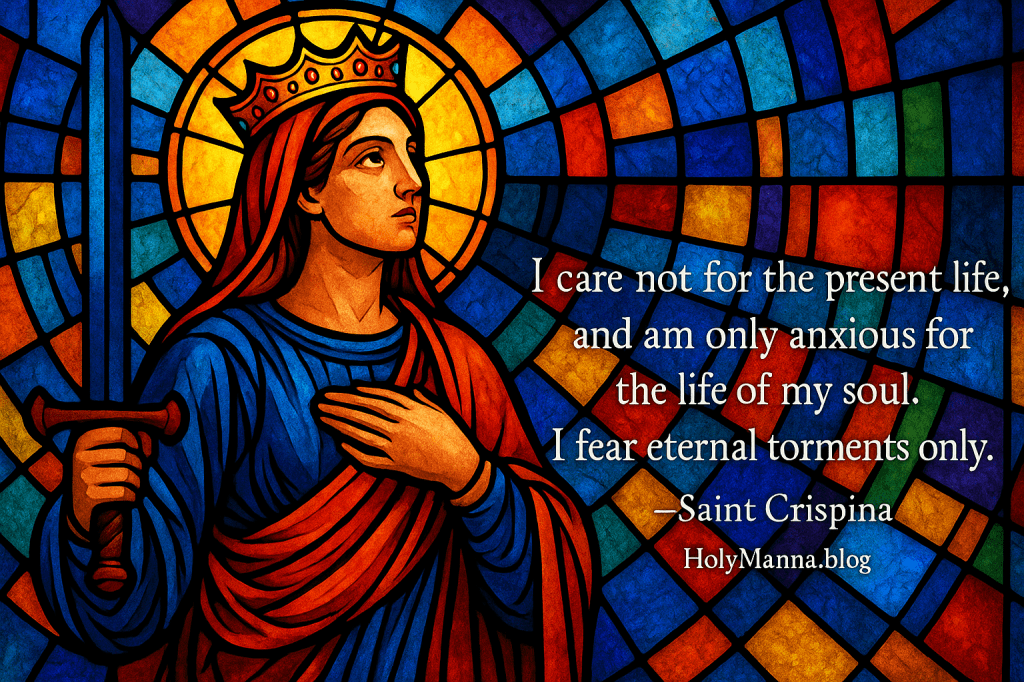
Crowned with Courage
Saint Crispina stands as one of the Church’s most inspiring early martyrs. A wealthy Roman noblewoman, a devoted wife, and a mother of several children in North Africa, she embraced radical fidelity to Christ at a time when doing so meant risking everything. She was executed by beheading on December 5, 304, during the fierce persecution of Emperor Diocletian. Her unwavering courage became so celebrated that Saint Augustine preached about her repeatedly, placing her in the same company as beloved virgin martyrs like Saint Agnes and Saint Thecla. Augustine admired how she rejected the comforts of wealth and privilege rather than betray her Lord.
The Catechism of the Catholic Church teaches that “martyrdom is the supreme witness given to the truth of the faith” (CCC 2473). Saint Crispina embodied this definition perfectly. Her life shows that holiness is not limited to desert hermits or cloistered nuns, but is just as possible for parents, professionals, and people entrusted with worldly responsibilities. What set her apart was an unshakable conviction that Christ is worth more than comfort, status, or even life itself.
Born to Comfort, Called to the Cross
Crispina was born in the third century in Thagara, a town in the Roman province of Numidia, located in what is today Algeria. She belonged to a wealthy Roman family and enjoyed all the status and comfort that came with it. She was married and the mother of several children, fulfilling the respected role of a noble matron.
At some point, Crispina’s faith in Christ became the defining force of her life. By the time persecution spread across North Africa, she was already deeply rooted in the teachings of the Gospel. Her trial records preserve her calm declaration before the Roman authorities: “I observe the commands of my Lord Jesus Christ.” Her reputation for holiness became so widespread that decades later Saint Augustine could reference her example as if every Christian in North Africa already knew her story.
Crispina is remembered not for theological writings or founding monasteries but for transforming the ordinary vocation of wife and mother into a path of extraordinary holiness. She lived her family life with integrity, generosity, and quiet devotion until the moment came when fidelity to Jesus demanded a public stand.
A Faith That Would Not Bend
The most detailed accounts of Crispina’s life come from her trial. During the Diocletianic persecution, the Roman Empire required all citizens to offer sacrifice to the pagan gods as a sign of loyalty. Refusing to do so was seen as treason.
Crispina was arrested and brought before the proconsul Anulinus at Theveste. There she faced intense pressure to renounce Christ. Threats meant nothing to her. Promises of safety meant nothing to her. She calmly replied that she would worship only the one true God, the Creator of heaven and earth. Another line recorded from her interrogation captures her spiritual clarity with striking beauty: “I care not for the present life, and am only anxious for the life of my soul. I fear eternal torments only.”
While there are no detailed accounts of miracles she performed during her earthly life, the courage she displayed is itself a kind of miracle. Her refusal to bow before the idols of her age showed a supernatural strength rooted in deep prayer and unwavering trust in Christ. Her example offers a powerful reminder that the grace of God equips ordinary believers to make extraordinary sacrifices.
Stripped of Glory, Filled with Grace
When threats failed to change Crispina’s mind, the authorities resorted to humiliation. Anulinus ordered her hair to be publicly shaved, hoping to break her spirit by robbing her of the dignity associated with her noble status. The tears and pleas of her children also could not persuade her to compromise her faith. Her heart remained fixed on eternity and entirely entrusted to Jesus.
Finally, when her fidelity proved unshakable, Anulinus pronounced the sentence. Crispina responded with serene gratitude, saying at the moment of her condemnation: “I return thanks to Jesus Christ, and I bless the Lord who has vouchsafed thus to deliver me from the hands of men.” She made the sign of the cross, extended her neck, and willingly accepted death by the sword.
Her martyrdom reflects exactly what the Catechism means when it teaches that in martyrdom the Christian is united to Christ who died and rose, enduring death “through an act of fortitude” (CCC 2473). Crispina did not chase death. She clung to the Lord with a love stronger than fear.
A Tomb That Became a Lighthouse
After her death, devotion to Crispina spread rapidly throughout North Africa. By around the year 400, a large pilgrimage complex had been built over her tomb near Theveste. Archaeological studies describe a church on a high podium with an atrium and, beneath it, a smaller chapel dedicated specifically to Saint Crispina. Pilgrims visited this site to honor her memory, seek her intercession, and draw strength from her witness.
Saint Augustine spoke often of Crispina in his sermons, praising her courage and urging his listeners to follow her example of unwavering faith. Although the records do not describe specific healings or miraculous events at her shrine, the enduring veneration surrounding her relics speaks to the spiritual power of her sacrifice. Her memory strengthened countless believers who also faced pressure to compromise their faith.
When Love Costs Everything
Saint Crispina challenges every Christian to ask what fidelity to Jesus actually looks like in daily life. Her story is uncomfortable in the best way because it forces believers to confront their own attachments. She had wealth, status, and a beloved family. Yet her love for Christ outweighed them all. Her words, “I care not for the present life”, call modern Christians to reexamine their priorities and to ask whether they are more attached to comfort than to Christ.
The Catechism teaches that through baptism believers are “freed from sin and reborn as sons of God” and that this new identity shapes every part of life. It is not meant to stay theoretical. It demands concrete choices. Most people will never face a martyr’s sword, but everyone faces “little martyrdoms” that require courage. Telling the truth when it costs something, practicing chastity when temptation is real, refusing to participate in workplace corruption, defending the dignity of the vulnerable, or publicly saying yes to the teachings of the Church may all feel like small sacrifices, yet they train the soul in fortitude.
Saint Crispina reminds us that holiness is possible in every state of life. Her example invites each reader to examine the places where fear, compromise, or desire for approval might be weakening faith. Her witness encourages believers to choose Christ with renewed boldness and to trust that His grace will supply every strength needed.
Engage with Us!
Readers are invited to share their reflections and thoughts in the comments below.
- Where in your life do you feel pressure to compromise your convictions, and how does Saint Crispina’s courage help you confront that challenge?
- How does her statement about caring only for the life of the soul inspire you to reexamine your priorities and daily habits?
- Which “little martyrdoms” might God be calling you to accept today so that your witness to Jesus becomes more authentic and wholehearted?
- How can the sacraments, Scripture, and prayer strengthen you to live with the same fidelity that defined Saint Crispina’s life?
- If someone close to you questioned your choices of faith, how would you lovingly explain why Jesus must come first in everything?
May Saint Crispina help every heart choose eternal life over temporary comfort, embrace courageous faith, and live with the love and mercy that Jesus taught.
Saint Crispina, pray for us!
Follow us on Instagram and Facebook for more insights and reflections on living a faith-filled life.

 Holy Manna!
Leave a comment