Friday of the First Week of Advent – Lectionary: 179
Learning To See Again
Sometimes the spiritual life feels like walking through a dimly lit room. The promises of God are known in theory, but the heart struggles to see how they could actually break into real life. The readings for this Friday of the First Week of Advent speak directly into that experience, revealing a God who not only brings light into darkness, but teaches His people how to see again.
In Isaiah 29:17-24, God speaks to a wounded and spiritually dull Israel, a people surrounded by political pressure and interior confusion. Assyria threatens from outside, while inside the nation many hearts have grown blind to God’s ways. Into that gloom the Lord promises a future reversal: “the deaf shall hear the words of a scroll” and “out of gloom and darkness, the eyes of the blind shall see”. The prophet is not only talking about physical healing, but about spiritual clarity, renewed joy for the lowly, and the collapse of unjust power. This is classic Advent territory: a people in darkness, and a God who promises a decisive intervention in history and in the human heart.
Psalm 27 gives voice to the soul that chooses to live inside that promise. Surrounded by fear and uncertainty, the psalmist can still proclaim: “The Lord is my light and my salvation; whom should I fear?” and “I believe I shall see the Lord’s goodness in the land of the living”. This is not naive optimism. It is battle tested trust. The psalm forms hearts that are willing to wait without giving in to despair. The repeated call, “Wait for the Lord, take courage; be stouthearted, wait for the Lord!”, shapes the inner posture that Advent demands.
Then in The Gospel of Matthew, specifically Matthew 9:27-31, the promise and the prayer converge in the person of Jesus. Two blind men cry out with a loaded title: “Son of David, have pity on us!” They recognize in Jesus the long awaited Messiah promised to David’s line. When He asks, “Do you believe that I can do this?”, their response, “Yes, Lord”, is not just a statement about eyesight but a confession of faith in His identity and power. Their physical healing becomes a visible sign of the deeper spiritual healing that faith in Christ brings. Sight is restored according to faith, just as Isaiah foretold and the psalmist trusted.
Together, these readings trace a single arc: God promises to transform blindness into sight, teaches the heart to trust that promise through waiting, and finally fulfills it concretely in Jesus Christ. Advent invites every disciple into that same movement. Where has the heart grown dim or discouraged, and where is the Lord quietly asking, “Do you believe that I can do this?”
First Reading – Isaiah 29:17-24
When God Turns Darkness Into Sight And Shame Into Joy
Isaiah speaks these words to a people under pressure from foreign powers and from their own spiritual drift. Judah sits in the shadow of Assyria, and many in Jerusalem rely more on political maneuvering than on trust in the Lord. Religious practices continue on the surface, yet hearts are often distant. Into this mixture of fear, complacency, and spiritual blindness, God speaks a stunning promise through Isaiah 29:17-24.
This passage belongs to a section of Isaiah that confronts false security and announces that God Himself will act to purify, judge, and restore His people. The images of Lebanon becoming an orchard and the deaf and blind being healed are not just poetic decorations. They describe a radical reversal, both in creation and in the hearts of God’s people. Those who once lived in gloom will see. Those who were poor, overlooked, and crushed will rejoice in the Holy One of Israel. The unjust and arrogant will lose their grip.
For Advent, this reading reveals the heart of what God desires to do in every generation. The Lord promises not only to fix external circumstances, but to give new vision, new understanding, and new joy. The whole passage fits today’s theme of moving from blindness to sight through trusting faith. It prepares the heart to recognize in Jesus the fulfillment of this prophecy, especially as the day’s Gospel shows Him literally opening the eyes of the blind.
Isaiah 29:17-24
New American Bible (Revised Edition)
Redemption
17 Surely, in a very little while,
Lebanon shall be changed into an orchard,
and the orchard be considered a forest!
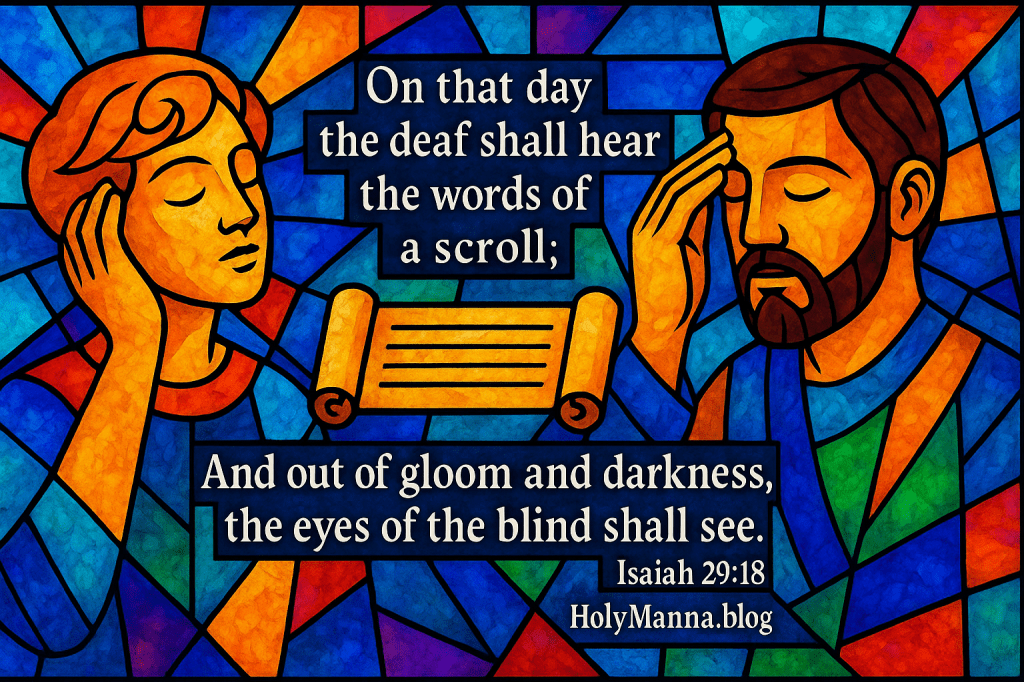
18 On that day the deaf shall hear
the words of a scroll;
And out of gloom and darkness,
the eyes of the blind shall see.
19 The lowly shall again find joy in the Lord,
the poorest rejoice in the Holy One of Israel.
20 For the tyrant shall be no more,
the scoffer shall cease to be;
All who are ready for evil shall be cut off,
21 those who condemn with a mere word,
Who ensnare the defender at the gate,
and leave the just with an empty claim.
22 Therefore thus says the Lord,
the God of the house of Jacob,
who redeemed Abraham:
No longer shall Jacob be ashamed,
no longer shall his face grow pale.
23 For when his children see
the work of my hands in his midst,
They shall sanctify my name;
they shall sanctify the Holy One of Jacob,
be in awe of the God of Israel.
24 Those who err in spirit shall acquire understanding,
those who find fault shall receive instruction.
Detailed Exegesis
Verse 17 – “Surely, in a very little while, Lebanon shall be changed into an orchard, and the orchard be considered a forest!”
Lebanon was famous for its mighty cedar forests, symbols of strength, grandeur, and often human pride. Here, Lebanon is pictured becoming an orchard, a place of fruitfulness and cultivation, and the orchard in turn is considered a forest. God uses agricultural imagery to describe a surprising transformation. What seems wild and remote becomes ordered and fruitful. What already appears fruitful becomes even more abundant. In Advent terms, God is showing that He can take what looks barren or misdirected in a life and turn it into something unexpectedly fruitful for His Kingdom.
Verse 18 – “On that day the deaf shall hear the words of a scroll; And out of gloom and darkness, the eyes of the blind shall see.”
This verse moves from nature to the human person. The deaf hear the words of a scroll, pointing to the restoration of the ability to receive God’s revelation. The blind emerge from gloom and darkness, able to see. There is certainly a hint of physical healing, but the deeper sense is spiritual. Hearts previously closed to God’s word become open. Minds that once stumbled in confusion begin to see truth. Advent looks toward this “day” when the Messiah will heal both body and soul. The Church reads this alongside the Gospel where Jesus literally gives sight to the blind, revealing Him as the one who fulfills Isaiah’s prophecy.
Verse 19 – “The lowly shall again find joy in the Lord, the poorest rejoice in the Holy One of Israel.”
Joy returns to those who had every earthly reason to despair. The lowly and the poor represent those who know their need and have no illusions of self sufficiency. Scripture consistently reveals that God has a special love for the poor and humble. Their joy is not in changed circumstances alone, but in the Lord Himself, the Holy One of Israel. This prepares the way for the Beatitudes in The Gospel of Matthew, where the poor in spirit and those who mourn are called blessed. Here, the promise is that God will personally be the joy of the poor, not just their helper from a distance.
Verse 20 – “For the tyrant shall be no more, the scoffer shall cease to be; All who are ready for evil shall be cut off,”
God’s restoration is not sentimental. It involves judgment against real evil. Tyrants, mockers, and those eager to commit injustice do not get the last word. Their power is temporary. The Lord promises that all who are ready for evil, those who lean into wickedness, will be cut off. This shows that God’s mercy and God’s justice are not opposed. If the lowly are to rejoice in the Lord, then the structures and agents of oppression must be confronted and removed. Advent hope is therefore not mere comfort. It includes a longing for God’s justice to purify the world and the heart.
Verse 21 – “those who condemn with a mere word, Who ensnare the defender at the gate, and leave the just with an empty claim.”
This verse specifies the kind of injustice that God will judge. Those who condemn with a mere word misuse speech to destroy reputations and lives. Those who ensnare the defender at the gate corrupt the very place where justice should be upheld, since the city gate was the traditional location of legal proceedings. Leaving the just with an empty claim means that those who should be vindicated instead walk away with nothing. God is deeply concerned with legal and social systems that crush the innocent and reward the manipulative. He promises that such injustice will not stand forever.
Verse 22 – “Therefore thus says the Lord, the God of the house of Jacob, who redeemed Abraham: No longer shall Jacob be ashamed, no longer shall his face grow pale.”
The Lord now speaks as the God of the covenant, the one who redeemed Abraham. This evokes the whole story of God’s faithfulness to His people from the very beginning. Shame and fear have marked Jacob, another name for Israel, because of sin, exile, and humiliation. God promises that this shame will end. Faces that once grew pale from fear and disgrace will regain color and dignity. The reference to Abraham reminds the listener that God’s promise is not new, yet it is always fresh. Advent invites a return to that covenant faithfulness and a rejection of shame rooted in sin and doubt.
Verse 23 – “For when his children see the work of my hands in his midst, They shall sanctify my name; they shall sanctify the Holy One of Jacob, be in awe of the God of Israel.”
The transformation God works produces worship. When the children of Jacob see the work of God’s hands in their midst, they respond by sanctifying His name. This means they recognize, honor, and publicly treat God as holy. Awe returns, not a terrified fear, but a reverent amazement at the God who saves. True liturgy flows from this sight of God’s saving action. In Advent, the Church looks at the “work of His hands” in the Incarnation and responds in the same way. The proper response to God’s mercy and justice is adoration.
Verse 24 – “Those who err in spirit shall acquire understanding, those who find fault shall receive instruction.”
The final verse emphasizes inner transformation. Those who err in spirit, whose inner attitudes have been distorted or confused, will gain understanding. Those who habitually find fault will receive instruction. God’s grace does not only comfort victims or remove external oppressors. It also corrects those who have been part of the problem. Cynical spirits, harsh critics, and those who constantly look for flaws are invited into a new way of thinking and seeing. Advent is a privileged time for this kind of inner conversion, where the Lord gently but firmly heals spiritual blindness and teaches the heart to see like Him.
Teachings: How The Church Reads Isaiah’s Promise Of Sight And Joy
The Church reads passages like Isaiah 29:17-24 as part of the great tapestry of salvation history. The Catechism teaches that the prophetic books announce both judgment and hope, preparing for Christ. CCC 712 explains about the prophetic expectation of the Messiah that “the features of the Messiah are revealed above all in the ‘Servant songs.’ These songs proclaim the meaning of Jesus’ Passion and show how he will pour out the Holy Spirit to give life to the many.” Isaiah’s promises of healing and restored understanding point forward to the Messianic age when the Spirit will renew hearts.
This reading also shows how God loves the poor and lowly. CCC 544 states that “The kingdom belongs to the poor and lowly, which means those who have accepted it with humble hearts. Jesus is sent to ‘bring good news to the poor.’” Isaiah’s words about the lowly finding joy in the Lord and the poorest rejoicing in the Holy One of Israel anticipate this teaching. God delights to raise up those who are small in the world’s eyes.
The transformation from blindness to sight is intimately connected with Christ’s miracles. CCC 548 teaches that “The signs worked by Jesus attest that the Father has sent him. They invite belief in him. To those who turn to him in faith, he grants what they ask.” The healing of the blind in the Gospel is not an isolated wonder. It is a direct fulfillment of promises like Isaiah 29:18 and an invitation to deeper faith.
Regarding spiritual blindness, the Catechism also recalls the danger of refusing God’s light. CCC 588 explains that “Jesus scandalized the Pharisees by eating with tax collectors and sinners as familiarly as with themselves… Jesus is not scandalized by them because he is concerned with their conversion.” Some religious leaders remained blind by choice, clinging to self righteousness, while those who knew their need welcomed healing. This dynamic echoes Isaiah’s warning to those who condemn with a mere word and trap the just.
The saints frequently speak about the need for purified vision. Saint Augustine famously prayed for the healing of his own inner sight, writing about God: “You were within me, but I was outside, and there I searched for you.” His journey from error to understanding mirrors the promise that “those who err in spirit shall acquire understanding.”
Saint John Paul II also highlighted the importance of allowing God to reshape perception. Speaking about faith, he said that “Faith, in fact, is a decision involving one’s whole existence.” This connects directly with Isaiah’s vision of a people who not only receive physical sight, but see God’s work and respond by sanctifying His name. Faith is not a vague feeling. It is a total reorientation of how reality is viewed.
Reflection: Letting God Heal Spiritual Blindness Today
This reading reaches into very concrete areas of daily life. It speaks to anyone who feels stuck in cycles of shame, fear, cynicism, or injustice. The promise that Lebanon will become an orchard can easily look far away, yet God is fully capable of transforming areas that seem wild, wasted, or unfruitful into places of real spiritual fruitfulness. Gloom and darkness describe not only external situations, but inner discouragement, anxiety, and confusion. The Lord wants to bring light and clarity there.
A key invitation in this passage is to stand with the lowly and the poor. Joy in the Lord often becomes clearest among those who know they depend on Him. That can mean choosing humility instead of defensiveness, gratitude instead of entitlement, and generosity instead of fear based hoarding. It can also mean examining how speech and influence are used. Condemning with a mere word can happen in digital spaces, in families, or in parishes. God takes seriously the way reputations are treated and how justice is handled.
Practically, this reading encourages honest examination before God. Time in prayer with Isaiah 29:17-24 can open up the question of where spiritual blindness has been tolerated. The heart can ask for the grace that the deaf in the prophecy receive, the grace to truly hear the word of God again. One concrete step could be to pray slowly with this passage, asking the Holy Spirit to highlight a single verse to carry through the day. Another step could be an examination of conscience focused on speech and attitudes toward the poor, especially before going to Confession.
Where has life begun to feel like Lebanon, impressive yet fruitless, instead of a humble orchard bearing good fruit for God’s Kingdom?
In what areas has gloom and spiritual fatigue made it hard to believe that the eyes of the blind can still see?
Are there patterns of speech, online or in person, that resemble those who condemn with a mere word, and how might the Lord be asking for change there?
How might the Holy Spirit be inviting a move from fault finding toward receiving instruction and deeper understanding in the Church’s teaching and in personal prayer?
As this First Reading sinks in, the heart is gently led to the same place as the two blind men in The Gospel of Matthew: standing before the Lord with a humble cry for mercy and a real willingness to let Him restore sight.
Responsorial Psalm – Psalm 27:1, 4, 13-14
Learning To Wait In The Dark With Confidence In The Light
Psalm 27 comes from the heart of someone who knows what it feels like to be surrounded by trouble and yet refuses to let fear have the final word. In ancient Israel, enemies, war, and uncertainty were part of daily life, and the temptation to panic or to trust in human strength rather than in God was very real. This psalm responds to that pressure with a bold confession of confidence in the Lord.
In the context of today’s readings, Psalm 27 becomes the bridge between the promise of God in Isaiah 29 and its concrete fulfillment in The Gospel of Matthew. Isaiah promises that the blind will see and the lowly will rejoice. The Gospel shows Jesus healing the blind according to their faith. The psalm reveals what the heart looks like in the middle of the journey, before everything is fully clear. It teaches the attitude of someone who waits for the Lord to act, convinced that God is light in the middle of the darkness, not just at the end of it. This is exactly the posture Advent invites, a confident, courageous waiting that expects to see the goodness of God break into real life.
Psalm 27:1, 4, 13-14
New American Bible (Revised Edition)
Trust in God
1 Of David.
The Lord is my light and my salvation;
whom should I fear?
The Lord is my life’s refuge;
of whom should I be afraid?
4 One thing I ask of the Lord;
this I seek:
To dwell in the Lord’s house
all the days of my life,
To gaze on the Lord’s beauty,
to visit his temple.
13 I believe I shall see the Lord’s goodness
in the land of the living.
14 Wait for the Lord, take courage;
be stouthearted, wait for the Lord!
Detailed Exegesis
Verse 1 – “The Lord is my light and my salvation; whom should I fear? The Lord is my life’s refuge; of whom should I be afraid?”
The psalm opens with a clear and personal confession. God is described as light, salvation, and refuge. Light means guidance, clarity, and the ability to see truth in the middle of confusion. Salvation means rescue from danger and sin. Refuge means a safe place when everything else feels shaky. Notice how fear is directly challenged. The question, “whom should I fear?”, is not bravado. It is logic rooted in faith. If the Lord really is all of this, then no enemy, no circumstance, and no spiritual darkness can ultimately dominate. In the context of today’s theme, this line shows that spiritual sight begins with knowing who God is. If God is light, then darkness is never absolute.
Verse 4 – “One thing I ask of the Lord; this I seek: To dwell in the Lord’s house all the days of my life, To gaze on the Lord’s beauty, to visit his temple.”
The psalmist reveals the deepest desire of the heart. Out of all the possible requests, one rises to the top. The goal is not just safety or comfort but dwelling in the Lord’s house, living in His presence, and gazing on His beauty. This is the language of relationship, not mere religion. To gaze on the Lord’s beauty means to contemplate God Himself, not just His gifts. In Advent, the Church prepares to gaze on the humility and beauty of God made flesh in Christ. Spiritual sight is not only about understanding doctrine. It is about learning to see God as beautiful, desirable, and worth seeking above everything else.
Verse 13 – “I believe I shall see the Lord’s goodness in the land of the living.”
This line is a powerful statement of hope. The land of the living refers to this life, not only heaven. The psalmist does not expect God’s goodness only after death. There is confidence that the Lord will show His goodness here and now, even in a broken world. This fits perfectly with Isaiah’s promise that the lowly will find joy in the Lord and with the Gospel scene where the blind men see again. Faith does not deny suffering, but it refuses to accept that suffering is the final reality. The believer holds on to the conviction that God’s goodness will become visible in concrete ways.
Verse 14 – “Wait for the Lord, take courage; be stouthearted, wait for the Lord!”
The psalm closes with a repeated call to wait. Waiting in Scripture is not passive laziness. It is active trust, steady perseverance, and obedience in the meantime. The heart is told to take courage and be stouthearted, which means to resist discouragement and spiritual collapse. Advent is a season of waiting for the Lord in exactly this way. It is not a sentimental countdown, but a training in steady trust, especially when God feels hidden. This verse gives language to those seasons when God’s timing seems slow and when the temptation is strong to give up or to grasp for control. The answer of the psalm is clear: keep waiting on Him.
Teachings: Trust, Desire For God, And The Courage To Wait
The Church has always seen in Psalm 27 a model of confident trust in God. The Catechism teaches that the desire for God is written into the human heart. CCC 27 states that “The desire for God is written in the human heart, because man is created by God and for God.” The psalmist’s longing to dwell in the Lord’s house and gaze on His beauty echoes this truth. The deepest desire of the human person is to live in communion with God, even when that desire gets buried under distractions or fears.
The psalm’s insistence on God as light connects closely with Christ’s own revelation. In The Gospel of John, Jesus says, “I am the light of the world.” The light that the psalmist trusts is fully revealed in Jesus. In today’s Gospel from The Gospel of Matthew, the blind men who cry out to Jesus embody this trust. They believe that in Him they will see the goodness of the Lord in the land of the living.
Regarding fear and trust, The Catechism highlights that faith is a response to God that involves trusting Him completely. CCC 150 explains that “Faith is first of all a personal adherence of man to God.” This personal adherence is exactly what appears when the psalmist says, “The Lord is my light and my salvation.” Faith is not just agreeing with ideas about God. It is entrusting one’s entire life to Him.
The theme of waiting for the Lord appears often in the spiritual tradition. Saint Augustine once reflected that time of waiting purifies desire. He taught that God stretches the heart through delay so that it can receive more. In that light, the command, “Wait for the Lord, take courage; be stouthearted”, is not a cruel reminder of delay, but a loving invitation into deeper capacity for God. The waiting of Advent is meant to shape hearts that can truly welcome Christ when He comes.
Saint John Paul II, speaking about hope, said that “It is Jesus that you seek when you dream of happiness.” This resonates strongly with the psalmist’s focus on one thing alone, dwelling with the Lord. Human hearts chase many things, yet underneath it all there is a longing for the face of God, the beauty of the Lord, and the safety of His house.
Reflection: Learning To Live With A Psalm 27 Heart
This psalm has very practical implications for daily life, especially in seasons of uncertainty and spiritual dryness. Many believers know what it feels like to be surrounded by worries, anxieties, or situations that seem out of control. Fear easily becomes the driving force behind decisions. The opening line of Psalm 27 gently but firmly redirects the heart. If the Lord is truly light, salvation, and refuge, then fear does not have to be the main story. Choosing to repeat this verse in prayer, especially in moments of anxiety, can slowly reshape how situations are seen.
The desire expressed in verse 4 also invites a real examination of priorities. The psalmist has “one thing” they ask of the Lord. Modern life often encourages divided hearts, pulled in many directions. This verse pushes back and raises a question. What is the one thing that is really being sought beneath all the activity and striving? Allowing this question to sit in prayer can be uncomfortable, but it can also be incredibly freeing. It may lead to concrete decisions about how time is spent, how Sunday worship is prioritized, and how often space is made for silence before God.
The line about seeing the Lord’s goodness in the land of the living challenges the temptation toward cynicism. It can be easy to believe in God’s goodness in theory, but quietly expect disappointment in practice. This verse offers a different posture. It encourages the heart to look actively for signs of God’s goodness in the present moment, in small mercies, in answered prayers, and even in hidden graces that only become clear later. One simple step could be to end each day by naming at least one way the Lord’s goodness was visible, no matter how small.
Finally, the call to wait for the Lord speaks to impatience in prayer and in life. Waiting does not mean doing nothing. It means refusing to abandon trust when God’s timeline does not match personal expectations. It means staying close to the sacraments, to Scripture, and to daily faithfulness even when emotions feel flat. It might involve continuing to pray for a loved one’s conversion, healing in a marriage, freedom from a particular sin, or clarity in vocation, without giving in to despair.
Where is fear currently louder than the truth that the Lord is light and salvation, and what would it look like to bring that fear honestly into prayer with this psalm?
What practical choices could help the heart seek “one thing” more clearly, especially when it comes to dwelling in the Lord’s presence through Mass and personal prayer?
How might a daily habit of noticing and naming the Lord’s goodness change the way difficult circumstances are carried?
In which area of life is the Lord inviting a deeper, more courageous waiting, and what step of trust can be taken today in response to that invitation?
Prayed with sincerity, Psalm 27 forms hearts that can stand in the dark with confidence, eyes fixed on the God who promises that His goodness will indeed be seen in the land of the living.
Holy Gospel – Matthew 9:27-31
When Faith Opens What Blind Eyes Cannot See
This scene from The Gospel of Matthew comes in a stretch of powerful miracles where Jesus reveals both His compassion and His authority. By this point in the Gospel, He has already healed the sick, calmed storms, cast out demons, and raised the dead. The word about Him is spreading, and people are starting to whisper messianic titles. When two blind men cry out “Son of David”, they are not just asking for help from a healer. They are publicly confessing Jesus as the promised Messiah from the royal line of David, the one foretold by the prophets like Isaiah who said that in the Messianic age the blind would see.
In first century Judaism, blindness was often associated with shame, poverty, and a sense of spiritual distance. Many would have assumed that such men were under some kind of curse or at least trapped in hopeless marginalization. Yet these blind men do something deeply right. They follow Jesus, they cry out to Him with a Messianic title, and they confidently ask for mercy. When Jesus questions them about their faith, He is drawing out their trust, not fishing for compliments.
Within today’s theme of moving from blindness to sight, this Gospel is the concrete fulfillment of what Isaiah 29 promised and what Psalm 27 longed for. The blind literally receive sight, but the deeper miracle is that their faith recognizes Jesus for who He truly is. Advent invites every disciple into the same posture: crying out to the Son of David, professing real faith in His power, and letting Him open eyes that have grown dim.
Matthew 9:27-31
New American Bible (Revised Edition)
27 And as Jesus passed on from there, two blind men followed [him], crying out, “Son of David have pity on us!” 28 When he entered the house, the blind men approached him and Jesus said to them, “Do you believe that I can do this?” “Yes, Lord,” they said to him. 29 Then he touched their eyes and said, “Let it be done for you according to your faith.” 30 And their eyes were opened. Jesus warned them sternly, “See that no one knows about this.” 31 But they went out and spread word of him through all that land.
Detailed Exegesis
Verse 27 – “And as Jesus passed on from there, two blind men followed him, crying out, ‘Son of David, have pity on us!’”
The action begins with Jesus on the move, and two blind men somehow keep following Him despite their disability. That already says something about their determination. They address Him as “Son of David”, which is a loaded title. In the Jewish mind, this name pointed directly to the promised Messiah, the king who would restore Israel. They are not simply looking for a miracle worker. They are professing a belief that Jesus is the long awaited heir to David’s throne. Their cry, “have pity on us”, is a classic prayer of the poor and afflicted in Scripture. It is humble, direct, and full of trust. Their physical blindness contrasts with their spiritual clarity. They see Jesus more clearly than many who have perfect eyesight.
Verse 28 – “When he entered the house, the blind men approached him and Jesus said to them, ‘Do you believe that I can do this?’ ‘Yes, Lord,’ they said to him.”
Jesus allows them to follow Him into the house, a more intimate space. There, He turns the encounter into a personal, faith filled dialogue. His question, “Do you believe that I can do this?”, goes straight to the heart. He is not unsure of His own power. He wants their cooperation in faith. Their response, “Yes, Lord”, is short but incredibly rich. They affirm that they believe He can heal them, and they call Him Lord, a title that hints at divine authority. In the context of Advent, this moment highlights that God often asks for a response of trust before revealing His power, not because He needs permission, but because He desires a free and loving faith from His people.
Verse 29 – “Then he touched their eyes and said, ‘Let it be done for you according to your faith.’”
The physical gesture of touching their eyes shows Jesus’ tenderness and closeness. He is not distant or clinical. He engages personally with their brokenness. His words, “Let it be done for you according to your faith”, reveal a key principle in the spiritual life. The measure of what they receive is mysteriously linked to the measure of their faith. This does not mean that every unhealed suffering is due to a lack of faith, but it does show that faith is the door through which God’s power often enters. Jesus is honoring the trust they have already shown. He is also teaching the Church that faith is not an optional add on, but central to receiving His saving work.
Verse 30 – “And their eyes were opened. Jesus warned them sternly, ‘See that no one knows about this.’”
The miracle happens with beautiful simplicity. “Their eyes were opened” fulfills Isaiah’s prophecy that “out of gloom and darkness, the eyes of the blind shall see” from Isaiah 29. The physical change points to a greater spiritual reality. Vision is restored, both literally and symbolically. Then Jesus does something that can feel surprising. He warns them sternly not to broadcast the miracle. This so called “Messianic secret” appears several times in the Gospels. Jesus is not trying to hide the truth forever, but He is managing how and when His identity becomes publicly apparent. He avoids a shallow, crowd driven messianism that would reduce Him to a political or wonder working figure rather than the suffering and saving Son of God.
Verse 31 – “But they went out and spread word of him through all that land.”
Despite His warning, the healed men cannot keep the news to themselves. Their disobedience is not ideal, but it does underline how powerful their experience is. Once touched and healed by Christ, they feel compelled to share what happened. Their enthusiasm also anticipates the missionary impulse of the Church after the Resurrection, when those who have encountered the Risen Lord go out to the ends of the earth. In the context of Advent, this verse points forward to the call to bear witness. Those who have had their eyes opened to Christ are not meant to stay silent, even as they continue to grow in obedience and humility.
Teachings: Faith, Miracles, And Recognizing The Son Of David
This Gospel passage sits at the intersection of several important teachings in The Catechism of the Catholic Church. First, the title “Son of David” is directly addressed. CCC 439 explains that “Many Jews and even certain Gentiles who shared their hope recognized in Jesus the fundamental attributes of the messianic ‘Son of David,’ promised by God to Israel.” When the blind men use this title, they are lining up with the deepest hopes of Israel and acknowledging Jesus as the one who fulfills them.
The role of miracles in the life of Jesus is also clarified by the Church. CCC 548 teaches that “The signs worked by Jesus attest that the Father has sent him. They invite belief in him. To those who turn to him in faith, he grants what they ask. So miracles strengthen faith in the One who does his Father’s works.” The healing of the blind men is not just an act of compassion, although it is deeply compassionate. It is a sign that reveals Jesus as the one sent by the Father and invites a deeper faith in Him.
This passage also highlights the nature of faith filled prayer. CCC 2616 says that “Jesus hears the prayer of faith, expressed in words, but above all in the heart. Such faith is a gift of God and his personal response to the prayer of faith is a sign of the coming of the Kingdom.” The blind men’s cry for mercy and their answer, “Yes, Lord”, embody this kind of prayer. Their faith filled request becomes the setting for a sign of the Kingdom that is already breaking in through Jesus.
The saints echo these themes. Saint Augustine commented frequently on spiritual blindness and light. Reflecting on Christ, he wrote that “You were more inward to me than my innermost and higher than my highest.” The problem is not that Christ is distant, but that hearts are often blind. The blind men in Matthew 9 show what it looks like when that inner blindness begins to fall away through trust in Jesus.
Saint Thomas Aquinas, speaking about faith, taught that “To believe is an act of the intellect assenting to the divine truth by command of the will moved by God through grace.” In this Gospel, both intellect and will are at work. The blind men recognize something true about Jesus and freely choose to entrust themselves to Him. Their faith does not come from themselves alone. It is stirred by grace and then confirmed by the miracle.
Reflection: Walking Behind Jesus Until Sight Is Restored
This Gospel has a very real word for daily life, especially for anyone who feels spiritually stuck, confused, or in the dark. The two blind men model several concrete attitudes that can be imitated. They persevere in following Jesus even when they cannot see. They cry out with a clear, humble prayer. They are not afraid to address Him as “Son of David” and “Lord”, which means they are not shy about acknowledging His authority in their lives. When Jesus questions them, they do not hedge or give half hearted responses. They say “Yes, Lord” with simple conviction.
In practical terms, this can translate into staying close to Jesus in the sacraments and Scripture even when emotions are flat or circumstances feel heavy. It might mean continuing to bring a particular wound, sin, or fear to Him in prayer, not with vague formulas but with real honesty and trust. The line “Let it be done for you according to your faith” can become a repeated prayer, not in a superstitious way, but as a reminder that trust matters deeply to the Lord.
This passage also invites a check on how Jesus is named and approached. The title “Son of David” and the word “Lord” suggest surrender, not negotiation. That can be uncomfortable in a culture that often treats faith as a side hobby or a spiritual accessory. Yet the deepest healing happens when Jesus is allowed to be who He really is: King, Messiah, Savior, and Lord.
There is also a missionary edge to this story. The healed men spread word of Jesus throughout the land, even after being told to keep quiet. While their disobedience should not be casually excused, their instinct to share is worth noticing. When Christ has truly touched someone, silence becomes hard. In a world that often lives in spiritual darkness, quietly but clearly witnessing to what Jesus has done is part of the call. That might look like sharing a testimony with a friend, praying openly with someone who is suffering, or simply speaking about Jesus with normal, unembarrassed reverence in everyday conversations.
Where are there areas of spiritual or emotional blindness right now, and what would it look like to bring those honestly to Jesus with the same cry, “Son of David, have pity on us”?
Is there any part of life where there is hesitation to say a full and honest “Yes, Lord” when Jesus asks, “Do you believe that I can do this?”
How might the words “Let it be done for you according to your faith” shape the way prayer, decisions, and struggles are approached this week?
Who might need to hear about the ways Jesus has already brought light and healing, and what simple step can be taken to “spread word of him” in a humble and loving way?
Prayed and lived with sincerity, this Gospel draws every heart into the same journey as the two blind men: following Jesus in the dark, confessing Him as Son of David and Lord, and allowing Him to open eyes to see His goodness more clearly than ever before.
Letting Christ Open Your Eyes This Advent
Advent in these readings looks a lot like a slow sunrise. Isaiah 29 promises that “out of gloom and darkness, the eyes of the blind shall see” and that the lowly and the poor will finally rejoice in the Holy One of Israel. Psalm 27 teaches the heart to live as if that promise is already on the way, proclaiming with confidence, “The Lord is my light and my salvation; whom should I fear?” and choosing to “wait for the Lord, take courage; be stouthearted” even when nothing seems to change overnight. Then The Gospel of Matthew shows the promise fulfilled in the flesh, as Jesus, the Son of David, touches the eyes of two blind men and says, “Let it be done for you according to your faith”, and suddenly they see.
Together, these passages sketch a path for every disciple in Advent. God speaks a real promise of transformation, not just for the world in general, but for specific areas of blindness, fear, and discouragement. The psalm shapes the interior response, forming hearts that choose trust and steady waiting instead of panic or despair. The Gospel reveals that the promise is not an abstract idea. It has a name, a voice, and a human face in Jesus Christ, who still asks, “Do you believe that I can do this?” and still opens eyes that turn to Him in faith.
This day’s readings invite a very concrete response. It is not enough to admire Isaiah’s poetry, nod along to the psalm, and be moved by the miracle story. The Lord is gently asking for the same attitudes that marked the blind men. Courage to follow Him even in the dark. Humility to cry out, “have pity on us” from a place of real need. Honesty to say “Yes, Lord” when He questions the depth of faith. Openness to let Him rewrite the story in areas that have long felt stuck.
A simple Advent challenge flows from all of this. Each day, a believer can bring one concrete area of “gloom and darkness” into prayer in front of the Lord. That might be a relationship, a hidden sin, a fear about the future, or a place of old shame. In that place, the heart can repeat the words of Psalm 27 as a deliberate act of trust and echo the blind men’s cry from The Gospel of Matthew. Over time, this kind of honest, persevering prayer makes room for God to work in ways that might not have seemed possible.
Where is the Lord asking for a bolder trust in His promise to turn darkness into light and blindness into sight?
What would it look like, very practically, to “wait for the Lord” this week with courage, rather than giving in to fear or control?
In what concrete area is Jesus quietly asking, “Do you believe that I can do this,” and how might the heart respond with a sincere, “Yes, Lord”?
Advent is not just a countdown to a holy day on the calendar. It is a season where Christ draws close as light for every hidden corner of the soul. These readings encourage every believer to step toward Him with the honesty of the blind men, the confidence of the psalmist, and the hope of Isaiah, trusting that the same Jesus who opened their eyes is ready to open eyes and hearts again today.
Engage with Us!
Feel free to share your thoughts, prayers, and experiences in the comments below, so that others can be encouraged by how God is working in your life through these readings.
- In the First Reading from Isaiah 29:17-24, where do you most relate to the image of moving from gloom and darkness into sight, and how is the Lord inviting you to trust Him to transform a specific area of your life that feels barren or confusing right now?
- In Psalm 27, what does it mean in a concrete way for you to say, “The Lord is my light and my salvation; whom should I fear?”, and how can you practice “waiting for the Lord” with courage in the middle of your current struggles or uncertainties?
- In The Gospel of Matthew, Matthew 9:27-31, where do you feel called to echo the blind men’s response, “Yes, Lord”, and what step of faith is Jesus asking you to take so that He can open your eyes more fully to His presence and His will?
As these questions are prayed with and lived out, may every choice, word, and action be shaped by a deeper faith in God, a stronger hope in His promises, and a growing desire to do everything with the love and mercy that Jesus taught and perfectly lived.
Sacred Heart of Jesus, we trust in You!
Immaculate Heart of Mary, pray for us!
Saint Michael the Archangel, defend us in battle!
Follow us on Instagram and Facebook for more insights and reflections on living a faith-filled life.

 Holy Manna!
Leave a comment