A Golden Voice for Christ in an Age of Confusion
Saint John of Damascus, also called Saint John Damascene, stands at the crossroads of the ancient Church and the Middle Ages. He is often called the last of the Greek Fathers and was later declared a Doctor of the Church, especially honored as the Doctor of the Assumption for his powerful preaching about Our Lady being taken body and soul into heaven. He lived in a world torn by the first great battle over sacred images during the iconoclastic crisis, and in that storm he became the Church’s clearest and strongest voice defending the proper veneration of icons and holy images. His theological masterpiece, The Fount of Knowledge, which includes An Exact Exposition of the Orthodox Faith, helped organize and transmit the teaching of the Fathers in a clear, systematic way that shaped both East and West. John was also a monk, a priest, and a hymn writer whose Easter and festal canons are still sung in the Christian East. He shows what it looks like when solid doctrine, deep prayer, and beauty in worship come together in one life.
From Royal Court to Desert Cave
John was born around 675 in Damascus, in what was then the Umayyad Caliphate, to a prominent Christian family. His father, Sarjun or Sergius, served as a high-ranking financial official under the Muslim caliphs, and his grandfather had previously served the Byzantine Empire before the Arab conquest. Wanting his son to receive a strong education, his father ransomed a brilliant monk named Cosmas, who had been captured by Saracen raiders, and entrusted John’s education to him. Under Cosmas, John received a remarkable formation in Scripture, philosophy, theology, and the sciences.
After his father’s death, John followed in his footsteps and became a top civil official at the Damascus court. He lived with influence, wealth, and comfort, yet remained a devout Christian. Over time grace stirred his heart, and he realized he desired a life entirely given to Christ. He renounced his position, distributed much of his wealth, and entered the monastery of Mar Saba near Jerusalem. There he embraced the life of a monk and was later ordained a priest, serving as a preacher attached to the Holy Sepulcher.
John is most known for gathering the wisdom of the Fathers in The Fount of Knowledge, for offering some of the earliest and most beautiful reflections on the Dormition and Assumption of Our Lady, and for rising as the main defender of sacred images during the iconoclastic struggle.
A Life of Teaching, Beauty, and a Miraculous Hand
John’s writings were deeply pastoral. He wanted ordinary Christians to understand that creation itself is a kind of icon pointing toward God, and that because the Word became flesh, matter can now reveal divine realities. One of his most famous sayings expresses this beautifully: “I do not worship matter; I worship the Creator of matter who became matter for my sake.” He also understood that icons were not mere artwork but doorways into the mysteries of Christ. Another well-known line attributed to him explains this powerfully: “If a pagan asks you to show him your faith, take him into church and place him before the icons.”
During the iconoclastic controversies, Emperor Leo III sought to eliminate the use of holy images in Christian worship. John countered with powerful writings defending the Incarnation and the proper veneration of icons. This angered the emperor, who could not punish him directly since John lived under Muslim rule. Tradition holds that Leo falsely accused John of treason by forging a letter against him. The caliph believed the accusation and ordered John’s right hand to be cut off. According to the long-held account, John took his severed hand and knelt before an icon of the Mother of God, begging her for healing so he could continue defending the truth. After falling asleep in prayer, he dreamed of the Theotokos assuring him of her intercession. When he awoke, his hand had miraculously been restored, leaving only a faint red line. In thanksgiving, John commissioned a silver hand and attached it to the icon, which became known as the icon of the Mother of God “Of the Three Hands,” or Tricherousa.
This miracle was more than a personal consolation. It confirmed the very truth John defended, that God uses matter, grace, and real human history to reveal Himself.
Hardships and a Quiet Martyrdom of Obedience
John’s sufferings did not end after the restoration of his hand. He chose not to return to political life but embraced the hidden and humbling discipline of monastic obedience at Mar Saba. His spiritual father tested him severely, including an instance when John was ordered to sell simple baskets at an absurdly high price in the market of Damascus. The former court official stood all day under ridicule until someone who recognized him bought the baskets out of gratitude. John accepted every humiliation silently, allowing grace to purify his pride.
Although he did not die as a martyr shedding blood, his life is often described as a form of white martyrdom. He gave up social status, wealth, comfort, and even his reputation to follow Christ more closely. He died peacefully around 749 after a long life devoted to prayer, teaching, and service. His sacrifice of worldly honor and his unwavering fidelity stand as a powerful witness to authentic holiness.
Wonderworking Icons and a Legacy that Still Heals
After his death, John’s writings profoundly influenced the Second Council of Nicaea in 787, the council that defended the veneration of holy images and condemned iconoclasm. The Catechism of the Catholic Church summarizes this tradition by teaching that the seventh ecumenical council justified the veneration of icons of Christ, the Mother of God, the angels, and the saints, grounding this practice in the truth of the Incarnation (CCC 2131). The Catechism further says that “the honor rendered to an image passes to its prototype” and that sacred images lead believers to Christ rather than distract them from Him (CCC 2132).
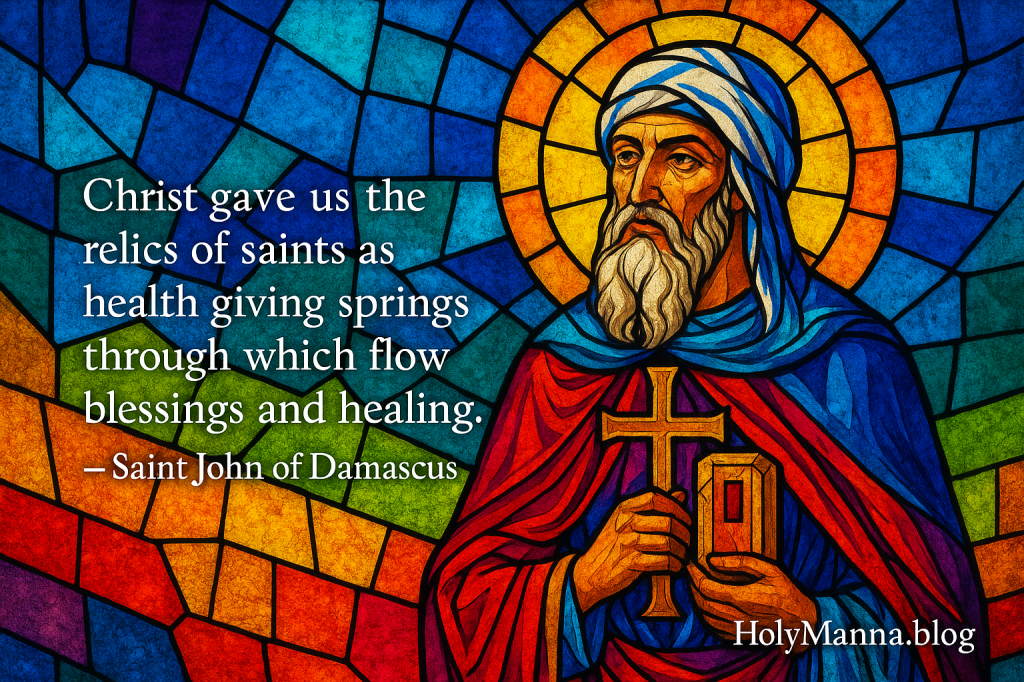
The wonderworking icon of the Mother of God “Of the Three Hands” became a beloved source of miracles for centuries, especially at Mar Saba and later in the Christian East. Healings, protections, and unexpected graces were often attributed to the intercession of Our Lady through this image. John himself once wrote that “Christ gave us the relics of saints as health giving springs through which flow blessings and healing.” His deep understanding of the communion of saints fits perfectly with the Catechism’s teaching that the saints in heaven intercede for the faithful on earth, strengthening them with their prayers and love (CCC 946 to 947 and CCC 956).
John’s legacy continues in every Catholic home that lifts its eyes to a crucifix, every parish that honors Our Lady, and every believer who understands that sacred images draw the heart toward Christ.
Learning to See with the Eyes of the Heart
Saint John of Damascus offers modern Christians profound lessons about the mystery of the Incarnation, the goodness of creation, and the power of beauty in worship. His teaching reminds believers that the material world is not an obstacle to God but a pathway toward Him, especially when elevated by grace. The Catechism teaches that sacred images lead believers toward God incarnate and not away from Him (CCC 2132), and John’s theology embodies exactly this truth.
His courage shows the importance of defending truths of the faith with clarity and charity. His humility reveals the hidden strength found in obedience and quiet sacrifice. His devotion to the Mother of God and his trust in her intercession encourage all Christians to approach her with confidence. Practically, his life invites believers to pray intentionally before sacred images, to purify what enters the imagination, to ask the saints for help regularly, and to entrust all wounds to Jesus and Mary, trusting that God can restore what is broken just as He restored John’s hand.
Engage with Us
Share your thoughts and reflections in the comments below.
- How does Saint John of Damascus deepen your understanding of sacred images and their purpose in prayer?
- Where have you experienced moments of quiet sacrifice or humility that you can unite to Christ?
- What steps can you take to make your home a place of prayer, perhaps with a crucifix, Marian image, or favorite saint to guide your heart?
- How does the miracle of John’s restored hand inspire you to trust Jesus and Mary with your own wounds?
- In what ways is God calling you to reflect His mercy to others, becoming an icon of His love in daily life?
May Saint John of Damascus inspire you to love the truth boldly, to seek holiness humbly, and to do everything with the love and mercy that Jesus taught us.
Saint John of Damascus, pray for us!
Follow us on Instagram and Facebook for more insights and reflections on living a faith-filled life.

 Holy Manna!
Leave a comment