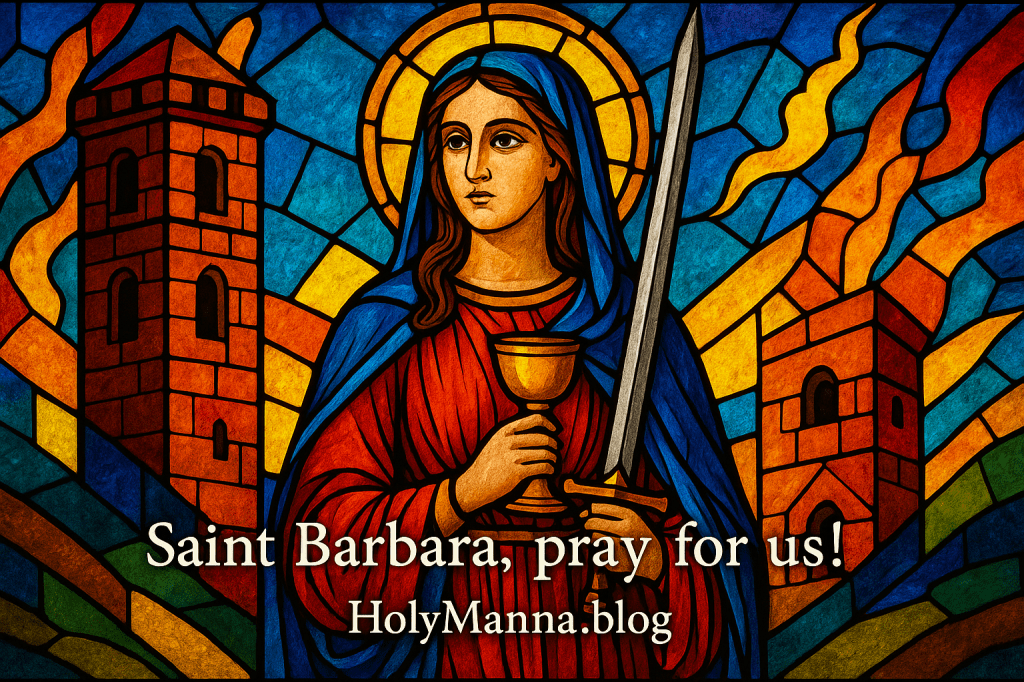
Hidden in a Tower, Found by Christ
Saint Barbara stands as one of the most beloved virgin martyrs of early Christian tradition. Though much of her life comes to us through legend rather than early documented history, the Church has cherished her story for centuries because it conveys powerful truths about courage, purity, fidelity, and God’s protection in the midst of violence and danger. She is honored both in the East and the West, recognized as one of the Fourteen Holy Helpers, and invoked especially by those who face sudden peril in their daily work, including artillerymen, miners, engineers, firefighters, and anyone exposed to accidents or explosive force.
According to ancient accounts, Barbara was born to a wealthy pagan named Dioscorus, likely in Heliopolis of Phoenicia or in Nicomedia of Asia Minor. Her father was fiercely possessive and sought to protect her from the outside world. Out of obsessive fear, he locked her in a tower and strictly controlled her interactions. Yet from that tower she gazed upon the beauty of the natural world and began to sense that the Creator of the stars, the wind, and the seasons could not possibly be the idols her father worshipped. Over time she encountered the Christian faith, embraced it, and consecrated her virginity to Christ, refusing the suitors Dioscorus brought before her.
Tradition recalls that when her father ordered a private bathhouse to be built for her with two windows, Barbara asked the builders to add a third window as a sign of the Holy Trinity. This small architectural detail revealed the deeper transformation of her soul. When Dioscorus learned that she had become Christian and that she publicly professed her faith, his love turned to fury, and he denounced her to the Roman authorities. Her arrest marked the beginning of the passion that would seal her witness to the Lord.
A Life Marked by Light and Protection
The accounts of Saint Barbara’s trial and suffering portray a woman whose faith remained unwavering even as the world attempted to crush her. She was brought before the prefect and ordered to renounce Christ, yet she refused with steadfast courage. The tortures that followed were brutal. She was beaten, torn by iron hooks, and humiliated, yet she continued to profess Christ.
According to the tradition, God answered her fidelity with signs of tender protection. While she lay in prison after her first beating, her wounds were healed overnight, and her cell filled with radiant light. The next day the guards were astonished to find her completely restored. Later, when her executioners attempted to burn her with torches, the flames died out before reaching her. These miracles echoed the truth taught in The Catechism that martyrdom is the supreme witness to the faith, a profound participation in the death and resurrection of the Lord (cf. Catechism of the Catholic Church, 2473). Barbara’s miracles during life, though wrapped in legend, point to the deeper reality that God strengthens and sustains those who trust Him completely.
Barbara’s story also reflects the universal human experience of conscience under pressure. A young woman expected to conform to her culture’s religious practices instead allows the truth to reshape her deepest identity. Her virginity is not a rejection of love but a radical openness to the love of God. Her refusal to compromise, even for the sake of family approval, reveals a heart anchored entirely in the eternal.
Torture, Lightning, and the Crown of Glory
As the tortures continued, Barbara remained resolute. Tradition says she was dragged naked through the streets to shame her, yet God protected her modesty by covering her with a miraculous garment. She endured repeated beatings and burnings, but none of these trials weakened her spirit. Eventually, the governor condemned her to death by beheading. In one of the most sobering details of her story, her own father Dioscorus carried out the execution. Moments after he struck off her head, a bolt of lightning fell from the sky, killing him instantly.
This dramatic ending reflects a common theme in hagiography. Those who persecute the servants of Christ can destroy the body but never the soul. Barbara’s martyrdom fulfilled the Lord’s words: “Do not be afraid of those who kill the body but cannot kill the soul” (The Gospel of Matthew 10:28). Her death was not a defeat but a victory, a moment in which she entered the glory that Christ promises to all who follow Him faithfully. A Christian named Valentinus is said to have buried her body, and God granted many favors to those who prayed at her tomb.
After the Thunder, a Living Intercession
Over the centuries, Saint Barbara’s intercession became widely revered. Her feast day on December 4 is celebrated in the Roman Catholic Church, the Eastern Orthodox Churches, and several Protestant communities that maintain devotion to ancient saints. Because lightning killed her persecutor, believers began invoking her protection against storms, lightning, fire, and sudden death. As gunpowder and artillery spread across Europe, soldiers entrusted themselves to her care. Images of Saint Barbara were placed in powder magazines, and even the term “powder magazine” in some languages came to be associated with her name.
Miners, tunnel workers, and geologists also adopted her as their patron because of the constant risk of sudden collapse or explosion. In many countries, especially in Germany and Central Europe, her feast became intertwined with local customs. One of the most beloved traditions is the cutting of “Barbara branches” from cherry or fruit trees on December 4 and placing them in water indoors so they bloom at Christmas. The blooming branches symbolize hope arising from cold and barren seasons, a reminder that God gives new life even after hardship.
Throughout the Middle Ages, various churches claimed to possess relics of Saint Barbara, and faithful pilgrims sought her intercession for healing and protection. Many reported miracles after praying at her shrines. Even in more recent times, she has appeared in the writings of saints. Saint Faustina Kowalska wrote that Saint Barbara appeared to her holding a sword and asked that Holy Communions be offered for their country. Her presence in the lives of the faithful continues to reflect what The Catechism teaches. The saints intercede for the Church and encourage the faithful on their earthly pilgrimage (cf. Catechism of the Catholic Church, 956).
The Church acknowledges that the historical details of Saint Barbara’s life cannot be confirmed with certainty, which is why she was removed from the universal liturgical calendar in 1969. Yet she remains in the Roman Martyrology, and her devotion endures because her story conveys timeless truths of courage, purity, and unwavering faith. Authentic popular devotions, as The Catechism explains, can deepen love for God when ordered properly toward the mystery of Christ (cf. Catechism of the Catholic Church, 1674 to 1676). Saint Barbara’s veneration has done exactly that for countless generations.
Living Saint Barbara’s Courage Today
The life of Saint Barbara, even in its legendary form, reveals a soul who trusted God more than safety, comfort, or the approval of those closest to her. Her tower becomes a symbol for every Christian who feels trapped by fear, pressure, or uncertainty. The three windows she added represent the light of the Father, the Son, and the Holy Spirit breaking through the walls that surround the human heart.
Her example challenges believers who face spiritual storms or pressure to soften their witness to Christ. Many experience tension within their families, workplaces, or friendships because of their fidelity to Catholic teaching. Saint Barbara shows that love for Christ sometimes brings conflict, but the grace of God strengthens hearts to remain gentle, truthful, and courageous.
The symbols associated with Barbara invite reflection. The tower recalls both confinement and God’s protection. The chalice points to the Eucharist, where believers draw strength from Christ’s sacrifice. The sword symbolizes both the Word of God and the willingness to endure suffering for Christ. Each of these images offers a practical way to deepen one’s spiritual life: through regular participation in the sacraments, daily prayer, Scripture reading, acts of courage in small moments, and trust in God’s providence.
Anyone who works in dangerous environments can entrust those risks to Saint Barbara’s intercession, asking not only for physical protection but for the grace to live each day in a state of readiness for eternity. Believers who face inner battles, moral challenges, or difficult relationships can look to her as a companion who understands the cost of discipleship and the peace that comes from belonging entirely to Christ.
Engage with Us!
Readers are invited to share their thoughts and experiences in the comments below, especially if they or someone they love faces real danger in daily life or has had to choose faith over approval.
- Where do you feel most walled in right now, and how might the light of the Holy Trinity shine into that place the way it did through Saint Barbara’s three windows?
- Have you ever felt pressured to hide or soften your Catholic faith, and how does Saint Barbara’s courage help you respond with charity and conviction?
- If you face physical danger in your work or home life, how can you invite Christ more intentionally into that risk and offer it for your own holiness and for others?
- What steps can you take this week to prepare your soul with the peace and readiness that the saints lived, such as confession, Mass, or reconciling with someone?
- How might you encourage someone in your life who is enduring criticism or pressure because of their fidelity to Catholic teaching?
May Saint Barbara, virgin and martyr, intercede for all who read this reflection. May her courage strengthen your heart, may her purity inspire your choices, and may her witness draw you deeper into the love and mercy of Jesus Christ. Let everything you do be rooted in faith and carried out with the love that Christ Himself taught.
Saint Barbara, pray for us!
Follow us on Instagram and Facebook for more insights and reflections on living a faith-filled life.

 Holy Manna!
Leave a comment