Thursday of the First Week of Advent – Lectionary: 178
Built On The Rock In A World Of Sand
There are days when the soul feels the quiet question rising: What is this life actually standing on right now? Today’s readings come together like a gentle but honest spiritual inspection, inviting hearts to look at their foundations and to decide again where to place their trust.
In Isaiah 26:1-6, Judah sings a victory song about a city that is not strong because of its walls, armies, or politics, but because “the Lord is an eternal Rock” (Israel 26:4). This passage probably arose in a time of political upheaval, when kingdoms rose and fell and proud cities that looked invincible were suddenly leveled. Into that instability, God promises a different kind of security. He brings down the lofty human projects that rely on power and pride, and he raises up the lowly, lifting the feet of the poor and the needy over the ruins of earthly arrogance. The prophet points to a people who are not merely religious in appearance, but who “keep faith” and find true peace by trusting God with firm purpose.
Psalm 118 picks up that same melody of trust and makes it personal. It is a liturgical hymn of thanksgiving, likely sung in processions going up to the Temple, as the people approached the holy place. The psalmist proclaims that it is “better to take refuge in the Lord than to put one’s trust in princes” (Psalm 118:9). Human leaders, systems, and strategies cannot carry the weight of ultimate hope. Only God can. The “gates of righteousness” and “the Lord’s own gate” point ahead to Christ himself, the one who brings salvation and opens the way into true worship. The cry “Blessed is he who comes in the name of the Lord” (Psalm 118:26) will echo again on Palm Sunday, and the leafy branches in the procession quietly foreshadow the way Jesus will be welcomed into Jerusalem as King.
Then the Gospel from The Gospel of Matthew 7:21, 24-27 brings this theme home with very concrete clarity. At the end of the Sermon on the Mount, Jesus draws a sharp line between those who say “Lord, Lord” and those who actually do the will of the Father. It is not enough to sound pious or to have spiritual language. Real discipleship means building life on obedience to his words. So he offers the image that every child can picture and every adult can feel: a house on rock versus a house on sand. “Everyone who listens to these words of mine and acts on them will be like a wise man who built his house on rock” (Matthew 7:24). Storms are not a possibility; they are a guarantee. The difference is not whether the rain falls, but whether the foundation holds.
Taken together, these readings form one united call: trust in the Lord as the only solid foundation, and let that trust become concrete, obedient action. The Advent season is all about that shift from vague spiritual feelings to real, embodied faith. It is about moving from relying on princes, careers, status, and self, to resting on the Eternal Rock who comes to save. Where is the real foundation of the heart resting today? What would it look like to let Jesus’ words shape choices, habits, and priorities in a way that could actually withstand the storms?
As hearts walk through this Advent day, the readings invite a simple but radical move: stop leaning on what cannot hold, and start building everything on the One who can.
First Reading – Isaiah 26:1-6
Trusting The Eternal Rock In A Shaking World
Isaiah speaks into a time when kingdoms rose and fell, when the people of Judah knew the fear of invasion, exile, and political insecurity. In that fragile context, God gives them a song to sing. It is not a song that glorifies human strength, military strategy, or royal alliances, but a song that celebrates a “strong city” whose true walls are God’s own saving power. This passage forms part of what many scholars call the “Isaiah Apocalypse,” where God reveals a future in which he judges the proud nations, vindicates his people, and establishes lasting peace. The imagery of a city, gates, and walls would resonate deeply in the ancient world, where a city’s strength meant survival, identity, and hope.
Here, though, the prophet flips the script. Security does not come from height and pride but from humility and faithfulness. God invites a “righteous nation” that “keeps faith” to enter his city. The real strength of the people is not their defenses but their relationship with the Lord. This fits perfectly with today’s Advent theme of building life on the only solid foundation. Isaiah points ahead to the Gospel image of houses built on rock instead of sand. The “eternal Rock” in Isaiah 26 prepares hearts to recognize that the only unshakable foundation is God himself, fully revealed in Jesus Christ. As this reading is heard, the call is clear: place trust not in lofty earthly projects, but in the Lord who humbles the proud and raises up the poor.
Isaiah 26:1-6
New American Bible (Revised Edition)
Judah’s Praise and Prayer for Deliverance. 1 On that day this song shall be sung in the land of Judah:
“A strong city have we;
he sets up victory as our walls and ramparts.
2 Open up the gates
that a righteous nation may enter,
one that keeps faith.
3 With firm purpose you maintain peace;
in peace, because of our trust in you.”
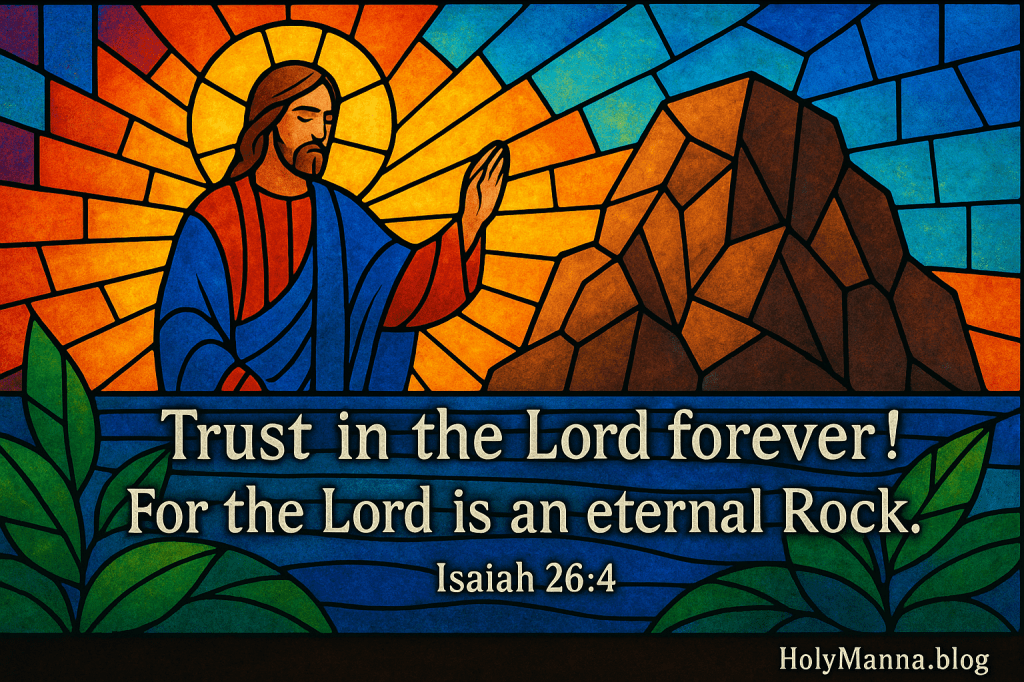
4 Trust in the Lord forever!
For the Lord is an eternal Rock.
5 He humbles those who dwell on high,
the lofty city he brings down,
Brings it down to the ground,
levels it to the dust.
6 The feet of the needy trample on it—
the feet of the poor.
Detailed Exegesis
Verse 1 – “A strong city have we; he sets up victory as our walls and ramparts.”
Isaiah begins with a victory song that looks beyond human power. The “strong city” is not strong because of stone walls, but because God himself is the protector. “Victory” as walls and ramparts shows that God’s saving action surrounds his people. This anticipates the New Testament understanding of the Church as the new people of God, guarded not by earthly fortifications but by grace and truth. The focus is on what God has done, not what the people have built. The verse gently challenges worldly ideas of security that rely on money, status, or influence, and it reminds believers that their true safety is God’s saving love.
Verse 2 – “Open up the gates that a righteous nation may enter, one that keeps faith.”
The gates of the city are opened, but not to just anyone. This is not a careless inclusivity. The ones who enter are those who “keep faith,” which in biblical language means steadfast trust and covenant loyalty. God is not only building a safe place; he is forming a faithful people. This connects to Psalm 118, where the psalmist speaks of the “gates of righteousness” and the righteous who enter through them. The emphasis here is that belonging to God’s city involves more than identity on paper. It is about real fidelity to the covenant, lived out in trust and obedience.
Verse 3 – “With firm purpose you maintain peace; in peace, because of our trust in you.”
Here the prophet reveals the inner life of the people God protects. They do not experience peace because circumstances are always calm. They experience peace because their minds and hearts are firmly fixed on God. The phrase “firm purpose” points to a steady, focused soul, not tossed around by the storms of life. God “maintains” peace, which means he continually upholds and sustains it. The root of this peace is trust. This anticipates the teaching of The Gospel of Matthew 7, where the wise builder stands firm because he acts on the Lord’s words. Interior stability flows from a decision to lean on God rather than on self.
Verse 4 – “Trust in the Lord forever! For the Lord is an eternal Rock.”
This verse is the heart of the passage. The prophet issues a direct command: trust in the Lord, not occasionally, not only when things are falling apart, but “forever.” The image of God as “Rock” appears throughout Scripture, especially in the Psalms, where God is called “my rock and my fortress”. Here Isaiah adds the word “eternal.” Human supports are temporary. God alone is forever. This verse speaks strongly into Advent, when the Church looks both back to Christ’s first coming and forward to his return in glory. The “eternal Rock” does not shift with cultural moods or political trends. He is the same in every age, utterly worthy of trust.
Verse 5 – “He humbles those who dwell on high, the lofty city he brings down, brings it down to the ground, levels it to the dust.”
Isaiah now contrasts God’s city with the proud city of man. Those who “dwell on high” represent the arrogant powers that exalt themselves against God. God’s judgment is described as a leveling. The proud city that seemed untouchable is brought down to dust. This echoes the Tower of Babel, where human pride tried to reach the heavens, and God scattered the builders. It also anticipates Mary’s Magnificat in The Gospel of Luke, where she praises God who “has put down the mighty from their thrones and exalted those of low degree”. The verse is a sober reminder that pride always collapses in the end.
Verse 6 – “The feet of the needy trample on it, the feet of the poor.”
The image is striking. The very ones who were ignored or oppressed by the proud city now walk over its ruins. The “needy” and “poor” here are not only economically poor but also those who are humble, dependent on God, and often overlooked by the powerful. God’s justice reverses the world’s patterns. Those who seemed weak stand firm, and those who seemed strong fall. This anticipates the Beatitudes in The Gospel of Matthew 5, where Jesus calls the poor in spirit blessed and promises them the kingdom of heaven. The verse invites readers to stand with the poor, both materially and spiritually, and to let God transform weakness into a path of victory.
Teachings: Faith, Humility, And The True Foundation
This reading from Isaiah 26:1-6 resonates deeply with the Church’s teaching on faith, trust, and humility. The Catechism describes faith as a total response to God: “Faith is a personal act, the free response of the human person to the initiative of God who reveals himself” (CCC 166). The “righteous nation” that “keeps faith” is precisely this kind of people, those who respond freely and faithfully to God’s self revelation.
The Catechism also insists that faith is not a vague feeling but a firm trust in God’s truth: “Believing in God cannot be separated from believing in the One he sent, his ‘beloved Son’ in whom the Father is ‘well pleased’; God tells us to listen to him. The Lord himself said to his disciples: ‘Believe in God, believe also in me’” (CCC 151). When Isaiah calls the people to trust in the Lord as an “eternal Rock,” he prepares hearts for the fullness of this call in Christ. The foundation is not an abstract idea, but a Person.
Isaiah’s contrast between the strong city of God and the lofty city of human pride ties into the Catechism’s teaching on humility. The Church teaches: “Humility is the foundation of prayer. Only when we humbly acknowledge that ‘we do not know how to pray as we ought’ are we ready to receive freely the gift of prayer” (CCC 2559). The proud city symbolizes self reliance and self exaltation. The poor and needy who trample over its ruins symbolize those who recognize their dependence on God and are therefore open to his grace.
Saint Augustine often reflected on the two cities described in his work The City of God: one built on the love of self even to the contempt of God, and the other built on the love of God even to the contempt of self. He writes: “Accordingly, two cities have been formed by two loves: the earthly by the love of self, even to the contempt of God; the heavenly by the love of God, even to the contempt of self”. Isaiah’s “strong city” is a glimpse of that heavenly city, where God’s love and justice form the walls.
Finally, the image of God as Rock connects to Jesus’ own words in The Gospel of Matthew 7:24-27, where he declares that those who hear his words and act on them are like a wise man building on rock. The Catechism explains that Christian morality is built on this listening and acting: “By his Revelation, ‘the invisible God, from the fullness of his love, addresses men as his friends, and moves among them, in order to invite and receive them into his own company’” (CCC 142). Once God has revealed himself as the eternal Rock, the only sane response is to entrust everything to him.
Reflection: Where Is The Heart Actually Leaning?
Isaiah’s song of the strong city raises some honest, uncomfortable questions for anyone trying to follow Christ in the middle of a turbulent world. It can be easy to say that the Lord is trusted, but day to day, the heart might be leaning pretty heavily on other foundations. Careers, savings, reputation, relationships, health, or political outcomes can quietly become the real “walls and ramparts” that are counted on for security.
Advent is a perfect time to let this reading do some interior demolition and rebuilding. Instead of assuming everything is fine, the soul can ask: What does the heart actually rely on when anxiety hits? When plans fall apart, is there a collapse inside, or is there a deeper peace rooted in God’s promises? If the “lofty city” of personal plans or pride came crashing down, would the faith still stand?
A practical way to live this reading is to start bringing specific areas of life under the shelter of the “eternal Rock.” That can look like daily surrender in prayer, where concrete fears and desires are named before God and placed intentionally in his hands. It can look like choosing obedience to God’s commands even when it costs socially or professionally, trusting that his way is safer than any compromise. It can look like solidarity with the poor and needy, not only through charity, but also through recognizing that every disciple is spiritually poor and in need of grace.
Another helpful step is to pay attention to the inner dialogue. When something goes wrong, what is the first instinctive thought? Is it “This is hopeless”, or is it closer to “Lord, you are still my Rock”? Shifting that reflex takes time, but Isaiah’s promise is encouraging: God himself “maintains” peace in hearts that trust him with firm purpose.
As this reading lingers in the mind today, the invitation is simple, but deep. Let the Lord be more than a spiritual idea. Let him be the actual Rock under every decision, every hope, every fear. Where is he asking for a deeper act of trust right now? What would it look like, in very real and practical choices, to walk today as part of that “righteous nation” that keeps faith and finds peace in him?
Responsorial Psalm – Psalm 118:1, 8-9, 19-21, 25-27
Singing Our Way Into The Gate Of Trust
Psalm 118 is part of the Hallel psalms, traditionally sung by Israel during major feasts such as Passover. It would have been on the lips of pilgrims going up to Jerusalem, processing toward the Temple, and giving thanks for God’s saving work in their history. This psalm carries the voice of someone who has experienced distress, cried out to the Lord, and then tasted real deliverance. That is why it can say with such conviction that the Lord is good and that his mercy endures forever. In the liturgy, this psalm becomes a shared memory. God has saved his people before, and he will save them again.
Today, the Church puts this psalm alongside Isaiah 26 and The Gospel of Matthew 7:21, 24-27 to deepen the theme of true security in God alone. The psalmist declares that it is better to take refuge in the Lord than to trust in mortals or princes. The imagery of “gates of righteousness” and “the Lord’s own gate” connects beautifully with Isaiah’s “strong city” and its opened gates for the righteous nation that keeps faith. The line “Blessed is he who comes in the name of the Lord” will later be shouted at Jesus as he enters Jerusalem, and it is repeated at every Mass before the consecration. This psalm helps hearts move from abstract ideas about trust to a concrete attitude of praise and dependence on God as Savior and light. It keeps the Church honest about where real refuge is found.
Psalm 118:1, 8-9, 19-21, 25-27
New American Bible (Revised Edition)
Hymn of Thanksgiving
1 Give thanks to the Lord, for he is good,
his mercy endures forever.
8 Better to take refuge in the Lord
than to put one’s trust in mortals.
9 Better to take refuge in the Lord
than to put one’s trust in princes.
19 Open the gates of righteousness;
I will enter and thank the Lord.
20 This is the Lord’s own gate,
through it the righteous enter.
21 I thank you for you answered me;
you have been my savior.
25 Lord, grant salvation!
Lord, grant good fortune!
26 Blessed is he
who comes in the name of the Lord.
We bless you from the house of the Lord.
27 The Lord is God and has enlightened us.
Join in procession with leafy branches
up to the horns of the altar.
Detailed Exegesis
Verse 1 – “Give thanks to the Lord, for he is good, his mercy endures forever.”
The psalm opens with a call to thanksgiving that the Church repeats often. Gratitude here is not based on passing feelings, but on the unchanging character of God. He is good, and his mercy endures forever. The word often translated as “mercy” refers to God’s covenant love, his faithful kindness that does not give up on his people. This line anchors everything that follows. Before speaking of enemies, struggles, or needs, the psalmist proclaims who God is. It sets the tone for Advent as well. Before looking at storms or instability, the heart is invited to stand under the truth that God’s goodness and mercy are not temporary moods but permanent realities.
Verse 8 – “Better to take refuge in the Lord than to put one’s trust in mortals.”
This verse draws a sharp comparison. People are good, relationships matter, and community is necessary, but no human being can carry the weight of ultimate trust. Refuge suggests a place to run when danger hits. The psalmist insists that God, not other people, must be that final shelter. This does not mean isolation or suspicion of others. It means that the core security of the heart cannot rest on fragile human support. This ties directly into the theme of building on rock instead of sand. Mortals, even well-intentioned ones, are sand. The Lord alone is Rock.
Verse 9 – “Better to take refuge in the Lord than to put one’s trust in princes.”
Here the focus tightens from people in general to “princes,” the political and social leaders of the day. Ancient Israel often struggled with the temptation to seek protection through alliances with powerful nations instead of trusting God. This verse calls out that temptation. Modern hearts might not speak of “princes,” but the same pattern shows up in the tendency to place absolute hope in governments, parties, economic systems, or influential figures. The psalm refuses that illusion. True safety and lasting hope come only from God, not from any earthly power structure.
Verse 19 – “Open the gates of righteousness; I will enter and thank the Lord.”
The image shifts to city gates, likely those of Jerusalem and the Temple. The “gates of righteousness” represent the entrance into the place of God’s presence and worship. The speaker expresses a strong personal desire to enter and give thanks. This is not just about being rescued; it is about being drawn into right relationship with God. The gate imagery echoes Isaiah 26, where the gates of the strong city are opened for the righteous nation that keeps faith. It suggests that true security is connected to worship and holiness, not just external safety.
Verse 20 – “This is the Lord’s own gate, through it the righteous enter.”
This verse makes things even more explicit. The gate belongs to the Lord. Entry is not on human terms. The righteous, those who live in right relationship with God, are the ones who pass through. In a Christian reading, this verse points to Christ, who says in The Gospel of John 10:9: “I am the gate. Whoever enters through me will be saved.” The psalm prepares the way for that revelation by teaching that approach to God is not a self-directed journey. It is a gift, a path opened and guarded by the Lord himself.
Verse 21 – “I thank you for you answered me; you have been my savior.”
Now the psalmist speaks from lived experience. This is not theoretical trust. God has answered. God has saved. The memory of that salvation fuels present gratitude. The title “savior” belongs above all to Jesus, whose very name means “God saves.” In light of the whole Bible, this verse becomes the voice of every believer who has cried out in distress and seen God’s faithful hand. It shows that trust in God is not blind or baseless. It rests on what he has already done.
Verse 25 – “Lord, grant salvation! Lord, grant good fortune!”
This is a prayer from the heart of a worshiping community. It combines spiritual and temporal petitions. “Grant salvation” asks for deliverance from sin, danger, or enemies. “Grant good fortune” asks for blessing in the concrete details of life. There is no sharp divide here between the spiritual and material. Everything is brought before God. The cry is simple but profound: everything needed, from forgiveness to daily bread, comes from the Lord.
Verse 26 – “Blessed is he who comes in the name of the Lord. We bless you from the house of the Lord.”
This verse has an especially powerful place in Christian memory. It is shouted by the crowds as Jesus enters Jerusalem, and the Church sings it at every Mass before the Eucharistic Prayer. The one who comes in the name of the Lord is first the king or high priest entering the Temple, but in its fullness, it is Christ. The “house of the Lord” blesses him, which shows a mutual exchange of blessing between God’s presence and the one sent in his name. This line draws Advent attention straight to the coming of Jesus as the true King and Savior.
Verse 27 – “The Lord is God and has enlightened us. Join in procession with leafy branches up to the horns of the altar.”
The psalm closes this section with liturgical joy. God is recognized as Lord, and he has “enlightened” his people. That light is both guidance and revelation. The procession with leafy branches up to the altar evokes a festival scene in the Temple, filled with worship and thanksgiving. For Christians, this imagery naturally looks to Palm Sunday and to every Mass, where the faithful come up to the altar, not with animal sacrifices, but to receive the Lamb of God. The God who enlightens is the same God who gives his people the light of Christ.
Teachings: Refuge, Worship, And The Coming King
Psalm 118 speaks strongly to the Church’s understanding of trust, worship, and Christ as the one who comes in the name of the Lord. The Catechism describes trust in God as a core expression of faith. It teaches: “To believe in God alone” already implies a refusal to treat any creature as an absolute source of hope. The verses that say it is better to take refuge in the Lord than to trust in mortals or princes echo this deeply Catholic conviction that only God deserves unconditional trust.
The Catechism also emphasizes that worship is the proper response to God’s saving action. It teaches: “Adoration is the first act of the virtue of religion. To adore God is to acknowledge him as God, as the Creator and Savior, the Lord and Master of everything that exists, as infinite and merciful Love” (CCC 2096). When the psalmist speaks of entering the gates of righteousness to thank the Lord, this is exactly what is happening. The heart acknowledges God as Savior and responds in adoration and thanksgiving.
The line “Blessed is he who comes in the name of the Lord” is taken up directly in the Holy Mass, right before the consecration, in the Sanctus. The Catechism explains: “In the Sanctus, the Church unites herself with the heavenly powers to sing: ‘Holy, Holy, Holy is the Lord God of hosts’; she also repeats the acclamation of the crowds who greeted Jesus in Jerusalem: ‘Blessed is he who comes in the name of the Lord’” (CCC 1352). This shows that Psalm 118 is not just an ancient song. It is a living part of the Church’s worship, shaping how believers welcome Christ in the Eucharist and anticipate his final coming in glory.
The mention that “the Lord is God and has enlightened us” also connects to the Church’s teaching on Christ as the light of the world. Saint John writes in The Gospel of John 1:9: “The true light, which enlightens everyone, was coming into the world”. The psalm anticipates this revelation by proclaiming that God enlightens his people and invites them into joyful procession toward the altar. Saint Augustine often reflected on how God’s light exposes false securities and leads the heart into true refuge. He famously prayed in his Confessions: “You have made us for yourself, O Lord, and our heart is restless until it rests in you”. That rest is the very refuge Psalm 118 urges believers to seek.
Reflection: Where Do You Run When Life Shakes?
This psalm gently but firmly asks every disciple to check where the heart instinctively runs when life becomes hard. It is easy to say in calm moments that trust is in the Lord, but the real test comes under pressure. When anxiety spikes, when finances get tight, when relationships strain, or when the news cycle feels overwhelming, it is worth asking: What is the first place the mind and heart run to? Is it to human solutions alone, or is it to the Lord as refuge?
One practical way to live this psalm is to turn its lines into real prayer during the day. When worry surfaces, the soul can quietly repeat: “Give thanks to the Lord, for he is good, his mercy endures forever”. When disappointment with people sets in, no matter how justified it feels, the heart can answer with: “Better to take refuge in the Lord than to put one’s trust in mortals”. When confusion about the future creeps in, the mind can lean on: “The Lord is God and has enlightened us”. These are not magic words, but they are truth, and repeating them trains the heart to anchor itself in God.
Another concrete step is to approach the liturgy more consciously in light of this psalm. At Mass, when the words “Blessed is he who comes in the name of the Lord” are sung, the heart can intentionally welcome Jesus as King, not just in a vague spiritual way, but as the actual Lord of personal decisions, fears, and plans. This transforms the liturgy from a routine into a real procession of the soul up to the altar, leafy branches or not.
It can also help to name specific “princes” in life that have been carrying too much of the weight of hope. That might be a job, a political leader, a social circle, or even an image of self sufficiency. Laying those down before God in prayer and consciously choosing to place deeper trust in him is a strong way to respond to this psalm.
As this day unfolds, Psalm 118 invites a few simple, honest questions. Where is refuge really being taken right now? If one human support collapsed, would the heart be able to say, “You have been my savior”? How can thanksgiving become a more regular part of daily prayer, not only when things go well, but especially when things feel uncertain? Allowing these questions to sink in can gently move the soul from fragile trust in mortals and princes into the steady, unshakable refuge of the Lord.
Holy Gospel – Matthew 7:21, 24-27
When Saying “Lord, Lord” Is Not Enough
These verses come at the very end of the Sermon on the Mount in The Gospel of Matthew, which runs from chapters 5 through 7. Jesus has just laid out the heart of life in the Kingdom of Heaven: the Beatitudes, deeper interpretations of the Law, teachings about prayer, fasting, mercy, purity, and trust in the Father. He is speaking primarily to his disciples, but in the hearing of the crowds, spelling out what it really means to belong to him. This is not a casual talk. It is the blueprint for a life that actually reflects the Father’s will.
In this Gospel, Jesus closes his sermon with a sobering warning and a vivid image. First, he says that not everyone who calls him “Lord, Lord” will enter the Kingdom, but only those who do the will of his Father. Then he tells the parable of the wise and foolish builders, one who builds on rock and one who builds on sand. The cultural setting makes this hit even harder. In the climate of the Holy Land, sudden storms and flash floods can sweep away houses that looked fine in good weather but had a weak foundation. Everyone listening would have understood the danger.
This Gospel fits perfectly into today’s theme of trust and foundation. Isaiah 26 calls the Lord an “eternal Rock,” and Psalm 118 insists that it is better to take refuge in the Lord than to trust in mortals or princes. Jesus now makes that Rock image concrete. Building on the Rock means not just hearing his words, but acting on them. Advent is a season of expectation, but also of decision. This passage presses a gentle but real question into every heart: is faith just on the lips, or is it poured into choices, habits, and daily obedience that can actually survive the storm?
Matthew 7:21, 24-27
New American Bible (Revised Edition)
The True Disciple. 21 “Not everyone who says to me, ‘Lord, Lord,’ will enter the kingdom of heaven, but only the one who does the will of my Father in heaven.
The Two Foundations. 24 “Everyone who listens to these words of mine and acts on them will be like a wise man who built his house on rock. 25 The rain fell, the floods came, and the winds blew and buffeted the house. But it did not collapse; it had been set solidly on rock. 26 And everyone who listens to these words of mine but does not act on them will be like a fool who built his house on sand. 27 The rain fell, the floods came, and the winds blew and buffeted the house. And it collapsed and was completely ruined.”
Detailed Exegesis
Verse 21 – “Not everyone who says to me, ‘Lord, Lord,’ will enter the kingdom of heaven, but only the one who does the will of my Father in heaven.”
Jesus begins with a warning that cuts through superficial religion. The repetition “Lord, Lord” suggests urgency and emotion, maybe even enthusiasm. But he makes it clear that verbal confession alone does not guarantee entry into the Kingdom. The decisive factor is doing the Father’s will. This does not mean that human effort earns salvation, but it does mean that authentic faith always shows itself in obedience. In the biblical mindset, to know the Lord is to walk in his ways. The line exposes the danger of having a Christian identity in name, tone, or culture without a corresponding life of discipleship.
Verse 24 – “Everyone who listens to these words of mine and acts on them will be like a wise man who built his house on rock.”
Jesus now turns to a parable. The key phrase is “listens to these words of mine and acts on them.” The house represents a person’s whole life: beliefs, relationships, choices, and destiny. The builder is called “wise,” which in Scripture means more than intelligent. Wisdom is skill in living according to God’s design. The rock echoes the Old Testament image of God as Rock and connects with Isaiah 26:4, which proclaims that the Lord is an eternal Rock. By placing himself at the center and saying “these words of mine,” Jesus implicitly identifies his teaching with the very will of God. To build on rock is to treat his words as the non negotiable reference point for life.
Verse 25 – “The rain fell, the floods came, and the winds blew and buffeted the house. But it did not collapse; it had been set solidly on rock.”
The storm represents trials, suffering, temptations, and ultimately the final judgment. Jesus does not say “if” the rain falls but simply describes it as a fact. Storms will come. The wise builder’s house is not spared from the storm, but it survives. The stability does not come from the house’s appearance or size, but from the hidden foundation. Spiritually, this means that when life gets hard, the disciple whose life is grounded in real obedience to Christ’s teaching will remain standing. He or she may feel the pressure, but will not collapse, because the root is in the eternal Rock.
Verse 26 – “And everyone who listens to these words of mine but does not act on them will be like a fool who built his house on sand.”
Now Jesus turns to the contrast. The foolish builder also “listens” to his words. This is not someone who has never heard the Gospel. This is someone who has sat under Jesus’ teaching, maybe for years, but has not allowed it to shape concrete decisions. The foundation is sand, which might feel solid in good weather but gives way under pressure. In biblical language, “fool” does not mean unintelligent, but morally and spiritually blind, someone who lives as if God’s wisdom does not matter. This is a warning for every baptized person who can quote Scripture or speak religious language while ignoring God’s commands in daily life.
Verse 27 – “The rain fell, the floods came, and the winds blew and buffeted the house. And it collapsed and was completely ruined.”
The same storm hits both houses. Outwardly, they might have looked similar, but the outcome is dramatically different. The phrase “completely ruined” shows that the collapse is total. Spiritually, this points to the tragedy of a life that seemed stable in worldly terms but has no lasting substance before God. It can also describe how sin and disobedience can cause interior collapse even in this life. Jesus is not trying to scare his listeners just for effect. He is offering a merciful warning: now is the time to check the foundation and rebuild if necessary.
Teachings: Obedience Of Faith And The Rock Of Christ
This Gospel sits at the heart of the Church’s understanding of what real faith looks like. The Catechism speaks of the “obedience of faith” and teaches: “By faith, man completely submits his intellect and his will to God. With his whole being man gives his assent to God the revealer” (CCC 143). This is exactly what Jesus is asking for when he says that only the one who does the will of the Father will enter the Kingdom. Saying “Lord, Lord” without this surrender is incomplete.
The Catechism also describes the Sermon on the Mount as the central summary of Christian moral teaching. It says: “The Sermon on the Mount is the principal expression of the New Law. It is found in the Gospel according to Matthew in the Lord’s Sermon on the Mount” (CCC 1966, summarized). When Jesus talks about “these words of mine” in this passage, he is referring to the entire sermon that has just been proclaimed. Building on rock means embracing that New Law of love, purity, mercy, and trust, not as an optional ideal but as the actual pattern for life.
Another important line from The Catechism explains that Jesus’ parables call for a decision. It teaches: “Through his parables he invites people to the feast of the kingdom, but he also asks for a radical choice: to gain the kingdom, one must give everything” (CCC 546). The parable of the two foundations is one of those invitations. It is not just a comforting story. It is a call to a radical choice about what the life of a disciple will rest on.
Saint Augustine often reflected on the danger of simply hearing the word without doing it. He preached: “What is the use of having a house, if it is built on sand? Let us build on rock, let us do what we hear”. For Augustine, hearing Christ’s words without acting on them is like storing beautiful building materials in a warehouse and never actually constructing anything. The value of the material shows itself in the finished house.
Saint John Chrysostom, commenting on this passage, pointed out that Jesus is not looking for spectacular displays of spirituality but for everyday obedience. He explained that the wise builder is not the one who has the most impressive religious experiences, but the one whose life agrees with Christ’s words. This fits the Church’s teaching that holiness is for everyone, in every state of life, not just for a few. The Catechism says: “All Christians in any state or walk of life are called to the fullness of Christian life and to the perfection of charity” (CCC 2013). To build on rock is simply to take that call seriously and to let it reach into the smallest corners of daily living.
Finally, this passage reminds believers that grace makes obedience possible. The Catechism teaches: “The Holy Spirit is the master of the interior life. By giving birth to the ‘inner man,’ justification entails the sanctification of his whole being” (CCC 1995, summarized). No one builds on rock by sheer willpower. The Spirit takes the word of Christ and writes it on the heart, giving strength to live it out. The wise builder is really a graced builder, cooperating with what God is already doing inside.
Reflection: What Is Your Life Actually Built On?
This Gospel invites a pretty honest self check. It is one thing to admire Jesus’ teaching, and it is another thing to reorder real life around it. It might be helpful to sit with this passage and ask: Where are the “Lord, Lord” moments in life that have not yet turned into action? Are there areas where Jesus’ words are respected, but not obeyed?
Sometimes the foundation is revealed most clearly when storms hit. When a crisis comes, it gets very obvious what the heart has really been leaning on. If peace vanishes completely when money, approval, or control are threatened, that can be a sign that the house has been resting too heavily on sand. That is not a cause for despair, but an invitation to rebuild.
A practical way to respond to this reading is to choose one specific teaching of Jesus from the Sermon on the Mount and intentionally act on it this week. Maybe that means forgiving someone who has hurt you, letting go of a grudge, or praying for an enemy. Maybe it means cutting out a hidden sin that has been quietly undermining the interior structure. Maybe it means concretely trusting God with finances or future plans instead of trying to manage everything alone. Whatever it is, acting on Jesus’ words, even in a small way, is a real step onto the Rock.
Another helpful practice is a short daily examen at night. Taking a few minutes to look back over the day and ask: Where were his words heard but ignored? Where were his words heard and actually lived? Over time, this kind of reflection trains the heart to recognize both sand and rock and to choose differently.
It might also be worth asking the Lord directly in prayer: Lord, show the parts of my life that are still built on sand. Give the grace to rebuild on you, even if it feels costly or scary. He is not a harsh inspector looking for reasons to condemn. He is the master builder who wants the house of your life to stand forever.
As Advent continues, this Gospel offers a simple but powerful challenge. Let faith be more than a label or a feeling. Let it become a foundation. Let Jesus’ words sink deep enough to shape real decisions. If a serious storm hit tomorrow, would the life of faith stand firm, or would it crack? What is one concrete change that could be made today that would move your house from sand to rock? Bringing those questions to prayer, and then to action, is exactly the kind of Advent preparation that opens the heart for the One who comes in the name of the Lord.
Standing Firm With Hearts Set On The Rock
Today’s readings weave together a single, steady invitation. Isaiah sings of a strong city whose walls are not built by human hands but by the saving power of God. The psalmist echoes that strength with the reminder that it is better to take refuge in the Lord than to trust in mortals or princes. Jesus then takes all of this and places it in front of the listener with undeniable clarity. Hearing the word is not enough. Faith becomes real when it shapes choices, habits, priorities, and the inner architecture of life. Only the one who acts on the words of Christ builds on rock.
Across all three readings, the message is unmistakable. Real peace comes from trusting God. Real safety comes from rooting life in him. Real discipleship comes from obedience that flows from love. Storms are certain, but collapse is not. The house built on the eternal Rock stands because it draws its strength from the One who never shifts.
As this day moves forward, there is an invitation to let these readings press into the heart with honesty and hope. Where is trust actually placed? Which parts of life still sit on shaky ground? What practical step can be taken to anchor things more firmly in Christ? Advent is the perfect season to rebuild, to return, and to let God shore up what has been neglected.
The Lord is not asking for perfection by tomorrow. He is asking for trust, humility, and a willingness to act on his words. He is asking for foundations, not façades. If the heart feels unsteady, that is exactly where he wants to meet his people. If life feels stormy, that is the moment to cling tightly to the Rock who never moves.
Today is a gift. It is a chance to choose again where to stand. May every decision, every prayer, and every act of faith become another stone in a life securely anchored in the God who saves.
Engage with Us!
You are invited to share your reflections, graces, and even your struggles with today’s readings in the comments below so that everyone can grow together as one family in Christ.
- First Reading – Isaiah 26:1-6: Which “city” feels more familiar in your life right now, the lofty city of self reliance or the strong city built on God’s saving power? Where is the Lord inviting you to shift your trust so that you can truly say “Trust in the Lord forever, for the Lord is an eternal Rock”?
- Responsorial Psalm – Psalm 118:1, 8-9, 19-21, 25-27: When anxiety or stress hits, where do you instinctively seek refuge first, in people, plans, or in the Lord? How can you practice turning more quickly to God in prayer so that the words “It is better to take refuge in the Lord than to put one’s trust in princes” become a lived reality and not just a beautiful line?
- Holy Gospel – Matthew 7:21, 24-27: What is one concrete area of your life where you might be saying “Lord, Lord” with your lips but not yet acting on his words? What specific step can you take this week to move from hearing to doing so that your “house” stands firmly on the Rock when the rain falls and the winds blow?
May these questions help you listen more deeply to the voice of God, respond with courage, and build every part of life on Christ the Rock. Go forward with confidence, striving to live a life of faith in every moment, and do everything with the love and mercy that Jesus has taught and poured out for the world.
Sacred Heart of Jesus, we trust in You!
Immaculate Heart of Mary, pray for us!
Saint Michael the Archangel, defend us in battle!
Follow us on Instagram and Facebook for more insights and reflections on living a faith-filled life.

 Holy Manna!
Leave a comment