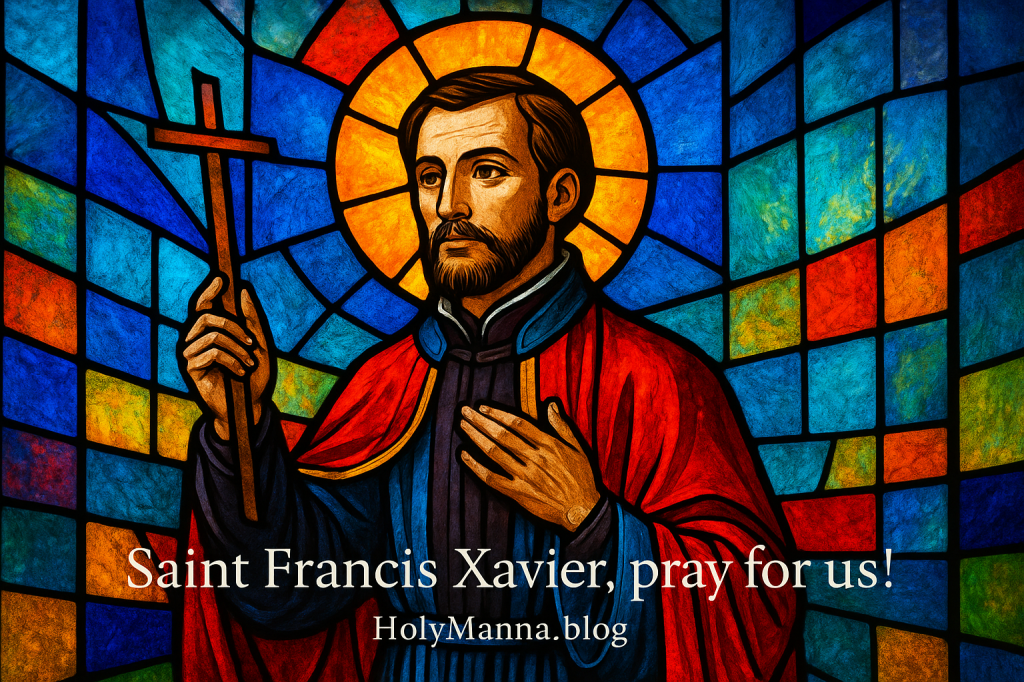
Set Hearts on Fire
Saint Francis Xavier stands as one of the greatest missionaries in the history of the Church, a man whose burning zeal carried the Gospel to lands that had scarcely heard the name of Jesus Christ. Known as the Apostle of the Indies and the Apostle of Japan, he became a foundational figure in the expansion of Christianity across Asia. His life fulfilled what the Catechism teaches about the Church’s very identity, reminding the faithful that the Church is missionary by her nature (CCC 849). Through tireless travel, countless baptisms, and unbreakable courage, he helped shape the Christian landscape of India, Japan, and the Malay world, and he died longing to proclaim Christ in China.
From Castle to Classroom
Francis Xavier was born on April 7, 1506, at the Castle of Xavier in the Kingdom of Navarre. His family belonged to Basque nobility, and his childhood was formed by both privilege and political turmoil as Navarre was absorbed into Spain. These challenges shaped his early ambitions and fostered a drive for accomplishment that marked his youth. At nineteen, he traveled to Paris to study at the University of Paris, where he excelled academically and athletically and quickly gained a reputation as a man destined for success. Yet God was preparing to turn those ambitions upside down.
In Paris he shared a room with Pierre Favre and an older student whose relentless charity would eventually change his life: Ignatius of Loyola. At first Francis resisted Ignatius’ spiritual conversations. He was brilliant, confident, and focused on worldly achievement. Ignatius patiently repeated Christ’s words from The Gospel of Matthew: “What will it profit a man if he gains the whole world and forfeits his soul?” (Mt 16:26). Those words slowly broke through Francis’ pride. In 1534 he joined Ignatius and several companions at Montmartre, professing vows of poverty and chastity and offering themselves to the Pope for mission. He was ordained a priest in 1537 and soon discovered that God had prepared him for a life far more adventurous and demanding than anything he had imagined.
On Fire at the World’s Edge
Francis embarked on his first mission on April 7, 1541, sailing from Lisbon to Goa and arriving after more than a year at sea. His initial work was not glamorous. He labored to reform and re-evangelize Portuguese settlers who had grown spiritually careless. He preached constantly, visited the sick and imprisoned, taught catechism to children, and embraced the poor and abandoned. From there he traveled south to the Parava coast, where he catechized entire villages, taught prayers and the Creed, and baptized thousands. His willingness to adapt himself to local culture reflected the missionary spirit emphasized in the Catechism, which calls the Church to respect cultures while bringing them to the fullness of truth (CCC 854).
His missionary path soon led him across the Malay Archipelago. In Malacca he met a Japanese man named Anjirō who inspired him to bring the Gospel to Japan. In 1549 he became the first major Christian missionary to enter Japanese territory. Realizing the sophistication of Japanese society, he adjusted his approach by dressing more formally and conversing with local leaders to earn their respect. He admired the Japanese deeply for their discipline and dignity, and he worked tirelessly to lay a foundation for a Church that would endure persecution in centuries to come.
Many miracles accompanied his ministry. In the village of Kombuthurai, tradition tells of a woman who had suffered in labor for three days and was near death. After Francis baptized her and her family, she safely delivered her child, leading many in the community to embrace the faith. In the same region, a boy named Matthew reportedly drowned in a well and was brought lifeless to the church. Through the fervent prayer of Francis, the child revived. Stories of healings, protection from storms, and deliverance from evil followed him wherever he went, echoing the scriptural pattern of miracles confirming the proclamation of the Gospel (cf. CCC 547 to 550).
His letters reveal the burning zeal that drove him. In one well known passage he lamented the spiritual hunger of the people he encountered, writing, “Many, many people hereabouts are not becoming Christians for one reason only: there is nobody to make them Christians.” In another he urged students not to settle for comfort or prestige, pleading, “Tell the students to give up their small ambitions and come eastward to preach the gospel of Christ.” These words still echo across centuries as a challenge to lukewarm hearts.
Exhausted for Christ
The missionary life of Saint Francis Xavier was marked by constant hardship. Travel across the ocean meant months in cramped and disease ridden ships. He endured hunger, heat, and sickness, as well as misunderstanding and hostility from those threatened by his work. He often lacked food and lived with almost no rest, pouring himself into ministry even when his body could barely keep up. His hut was burned on more than one occasion, and he faced both spiritual and physical dangers throughout his travels.
By 1552 he felt called to bring the Gospel to China, believing that evangelizing such an influential civilization would have lasting impact on all of Asia. He traveled toward Canton but was blocked by political restrictions. Eventually he reached the island of Shangchuan off the Chinese coast. There, weakened and without adequate medical care, he grew gravely ill. Surrounded by only a few companions, he died on December 3, 1552, at the age of forty six. Though he did not die by martyrdom, his passing was the natural conclusion of a life wholly spent for Christ.
A Body That Would Not Rot
After his death, God continued to affirm the sanctity of Francis Xavier through extraordinary signs. When his body was exhumed several months after being buried with lime, which normally accelerates decay, it was found incorrupt and free of odor. His body remained intact through multiple exhumations as it was transferred from Shangchuan to Malacca and eventually to Goa. Many witnesses reported a sweet fragrance emanating from his remains. His body now rests in a silver casket at the Basilica of Bom Jesus in Goa, a site that has drawn countless pilgrims for centuries.
Exhibitions of his relics have taken place periodically and have inspired conversions and renewed missionary zeal among the faithful. His right arm, which baptized so many, has also journeyed on pilgrimage in modern times and continues to be a powerful reminder of the missionary mandate given by Christ. In 1622 he was canonized alongside Ignatius of Loyola, Philip Neri, Teresa of Ávila, and Isidore the Farmer. In 1927 he was named co patron of all foreign missions, paired beautifully with Saint Thérèse of Lisieux, who offered her hidden sacrifices for missionaries around the world.
Living Missionary Zeal Today
The story of Saint Francis Xavier challenges followers of Christ to consider the size of their ambitions and the focus of their hearts. He began as a young man consumed with worldly goals, but he allowed Christ’s demanding love to reshape everything. His life asks each person to wrestle with the question from The Gospel of Matthew: “What will it profit a man if he gains the whole world and forfeits his soul?” He discovered that true greatness is found not in achievement or comfort but in giving oneself entirely to God’s mission.
This missionary fire can be lived out in any state of life. Union with Christ through prayer, the sacraments, and deeper study of the faith gives strength for witness. Charity toward the forgotten, courage in sharing the faith, and a willingness to embrace discomfort out of love for souls all reflect the spirit of Francis Xavier. The Catechism reminds believers that every Christian is called to holiness and to evangelization, even if they never travel far from home (CCC 863 to 864). The real mission field begins in the family, the parish, the workplace, and the circles where God has placed each person.
Saint Francis Xavier’s life is a vivid reminder that the Gospel is not a private treasure but a fire meant to be carried into the world, even when it costs something. The courage to speak, to love, and to pray with boldness is the missionary spirit the world still desperately needs.
Engage With Us!
Share your thoughts and reflections in the comments below, because honest engagement helps everyone grow in faith and missionary courage.
- Where in your daily life do you sense people who, as Saint Francis Xavier said, “are not becoming Christians for one reason only, that nobody is making them Christians”?
- Which ambitions in your life may be too small for the greatness God desires for you, and how could you surrender them to His will?
- How can you live the missionary spirit of Saint Francis Xavier within your ordinary responsibilities at home, at work, or in your parish?
- What step toward missionary courage could you take this week, such as inviting someone to Mass or sharing your testimony with someone who is searching?
- How does the example of Saint Francis Xavier challenge your understanding of sacrifice and faithfulness in the Christian life?
May the fire of Saint Francis Xavier inspire every heart to live with courage, to love boldly, and to give everything with the love and mercy that Jesus taught.
Saint Francis Xavier, pray for us!
Follow us on Instagram and Facebook for more insights and reflections on living a faith-filled life.

 Holy Manna!
Leave a comment