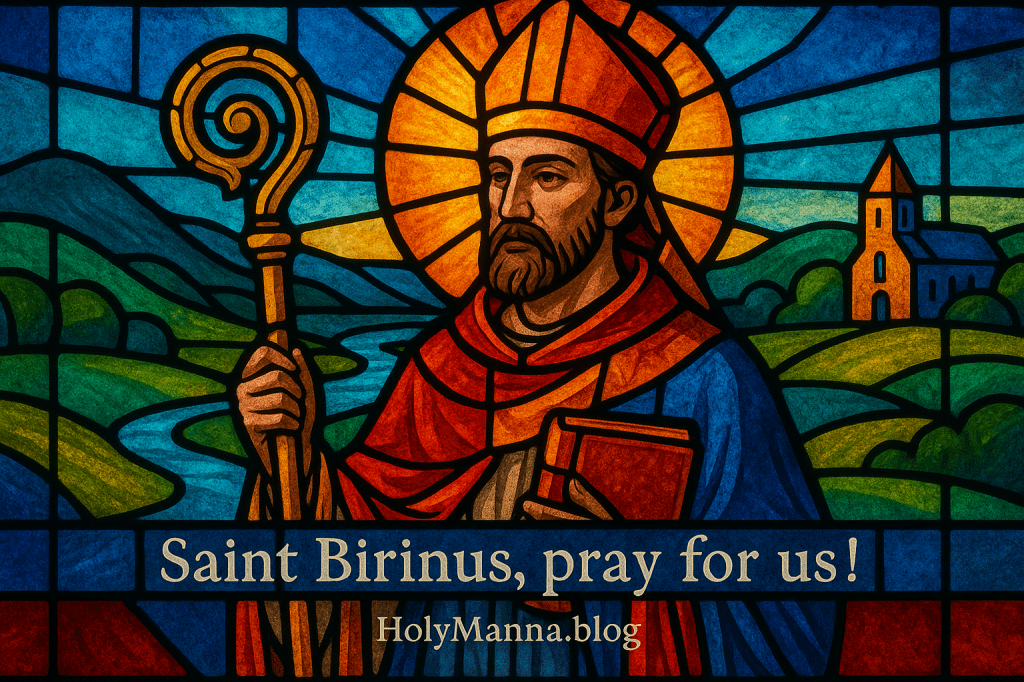
A Missionary Bishop
Saint Birinus is remembered as the Apostle to the West Saxons, the first bishop of Dorchester on Thames, and one of the quiet giants of early English Christianity. Sent by Pope Honorius I to a still largely pagan Britain around the year 634, Birinus planted the Church in the kingdom of Wessex and transformed a people steeped in ancient customs into followers of Jesus Christ. He preached the Gospel to King Cynegils of Wessex, baptized him in the presence of King Oswald of Northumbria, and established his episcopal see at Dorchester. Through patient preaching, countless baptisms, and the founding of churches across Wessex, he helped anchor the Christian faith in southern England.
His life beautifully illustrates the teaching of the Catechism of the Catholic Church, which affirms in CCC 849 that “the Church, in obedience to the command of her founder… strives to preach the Gospel to all men.” Saint Birinus’ whole mission flowed from this call.
From Rome to the Edge of the World
The early years of Saint Birinus are hidden in the quiet humility that would mark his entire life. Traditional accounts suggest he was likely of Frankish origin and formed within Roman ecclesial circles. Some traditions speak of him as a Roman priest, others as a bishop from the region of Genoa. What is historically certain is that Birinus approached Pope Honorius I with a burning desire to preach the Gospel in Britain, especially in regions untouched by Christian teaching.
The pope approved his zeal and had him consecrated a bishop. Birinus promised that he would carry the Gospel message into the most inland and unreached corners of the English lands. Arriving in southern England around 634, he discovered that Wessex was still pagan. Instead of turning back or seeking a more comfortable assignment, he chose to stay. This decision would define the rest of his life.
Saint Birinus became known above all as a missionary bishop whose obedience to the pope, devotion to the sacraments, and courage among pagan peoples converted not just individuals but an entire kingdom.
Baptizing Kings and Building Churches
Birinus’ missionary work quickly bore astonishing fruit. During the reign of King Cynegils, he preached the Gospel, instructed the king as a catechumen, and prepared him for baptism. The ceremony was made even more powerful by the presence of King Oswald of Northumbria, who acted as Cynegils’ sponsor. After the baptism, Cynegils granted Birinus land at Dorchester on Thames, where the saint established his episcopal see.
The bishop traveled constantly throughout the region, preaching, catechizing, and baptizing. He became associated with the founding and dedication of early churches in Dorchester, Reading, Checkendon, Ipsden, and many more sites, transforming the landscape of Wessex into a network of communities centered on the Eucharist and the teaching of Christ. He later baptized Cynegils’ son Cwichelm and grandson Cuthred and served as godfather to the latter.
Medieval traditions also recall miraculous elements in Birinus’ life. One account speaks of him miraculously crossing the sea to recover a corporal entrusted to him by Pope Honorius, highlighting his deep devotion to the Blessed Sacrament. Whether literal or symbolic, the tradition reflects how believers associated Birinus with Eucharistic faith and missionary courage.
The Catechism teaches in CCC 850 that the Church is missionary by her very nature, since she continues the mission of the Son and the Holy Spirit. Birinus lived this teaching not with grand gestures, but through years of steady, faithful labor in a difficult mission field.
Trials and Pagan Resistance
Although Saint Birinus was not a martyr in the sense of dying for the faith, he is honored as a confessor, one who suffered and labored heroically for Christ. His hardships were real and constant. He left the stability of Christian Europe and entered a land shaped by pagan beliefs, tribal warfare, and deep cultural suspicion. He faced language barriers, harsh travel conditions, and the unpredictable reactions of kings and chieftains.
His mission demanded a daily dying to comfort, fear, and discouragement. He chose to remain in Wessex precisely because it had never been evangelized. He embraced the slow, patient work of catechesis, the long journeys between scattered settlements, and the spiritual battles that come with preaching the Gospel where it has never taken root.
The Catechism reminds believers that the Church shares in Christ’s own sufferings as she carries out His mission. Birinus embodied this truth, pouring out his life in a steady, quiet martyrdom of love. He died around 649 or 650 in Dorchester, having given everything to the people God entrusted to him.
Shrines, Relics, and the Miracles After His Death
After his death, Saint Birinus was buried in the church he built at Dorchester. His holiness was quickly recognized. Within a few decades, his relics were translated to Winchester, which by then had become a major Christian center in Wessex. Later translations occurred as well, including one associated with a vision granted to Saint Aethelwold in the tenth century.
Medieval writers testify to many miracles associated with his relics. One notable tradition from Dorchester Abbey recounts how, when monks in the thirteenth century believed they had rediscovered his tomb, miracles followed, including the healing of a mute child who suddenly began speaking in both English and French.
Churches dedicated to Saint Birinus continue to stand across England, particularly in Berkshire and around Dorchester. His feast is celebrated on December 3 in the Roman Catholic Church. These shrines and stories reflect a simple truth: God delights in confirming the holiness of those who spent their lives serving Him with humility and fidelity.
Living Saint Birinus’ Mission Today
Saint Birinus speaks powerfully into a world that often feels cold to faith. His life reminds believers that evangelization is not an optional activity for a select few. It is the natural expression of a heart transformed by Christ. The Catechism teaches that the Church has “the obligation and also the sacred right to evangelize,” which means every baptized person shares in the mission to bring Christ to others.
Birinus shows that evangelization requires both courage and patience. He never watered down the Gospel to make it culturally convenient, yet he offered instruction, hospitality, and pastoral care to those who were struggling to embrace the faith fully. His willingness to remain in difficult places invites readers to ask where God may be calling them to plant deeper roots, even when the environment feels spiritually barren.
The promise of Jesus in The Gospel of Matthew, “I am with you always, to the close of the age”, sustained Birinus through every hardship. That same promise strengthens believers today. His example encourages a renewed fidelity to the sacraments, a deeper love for the Eucharist, and a willingness to share the Gospel in ordinary conversations, family settings, workplaces, and digital spaces.
Engage With Us!
Please share your thoughts and reflections in the comments below. Let this be a space where the faith is strengthened and where the example of Saint Birinus inspires all who read.
- Where is the “Wessex” in your own life right now, the place or community that feels far from the Gospel, and how might God be inviting you to stay present there with love rather than escape to something easier?
- How does the missionary call taught in the Catechism challenge your understanding of what it means to live as an ordinary Catholic today?
- What simple and concrete action could you take this week to imitate Saint Birinus, whether through a conversation, a quiet act of charity, or an invitation to prayer or Mass?
- Do the miracles associated with Saint Birinus’ relics help you grow in awareness of God’s presence in your own life, and how might that awareness deepen your trust in His providence?
- If Jesus spoke directly to you as He did to every missionary saint, what might He be inviting you to do so that your life reflects His love more clearly to others?
May Saint Birinus, Apostle of Wessex, pray that every heart is renewed with missionary zeal, strengthened by the Eucharist, and filled with the courage to share Christ with a world longing for His light. May all things be done with the love and mercy Jesus taught, so that His presence shines through every thought, word, and action.
Saint Birinus, pray for us!
Follow us on Instagram and Facebook for more insights and reflections on living a faith-filled life.

 Holy Manna!
Leave a comment