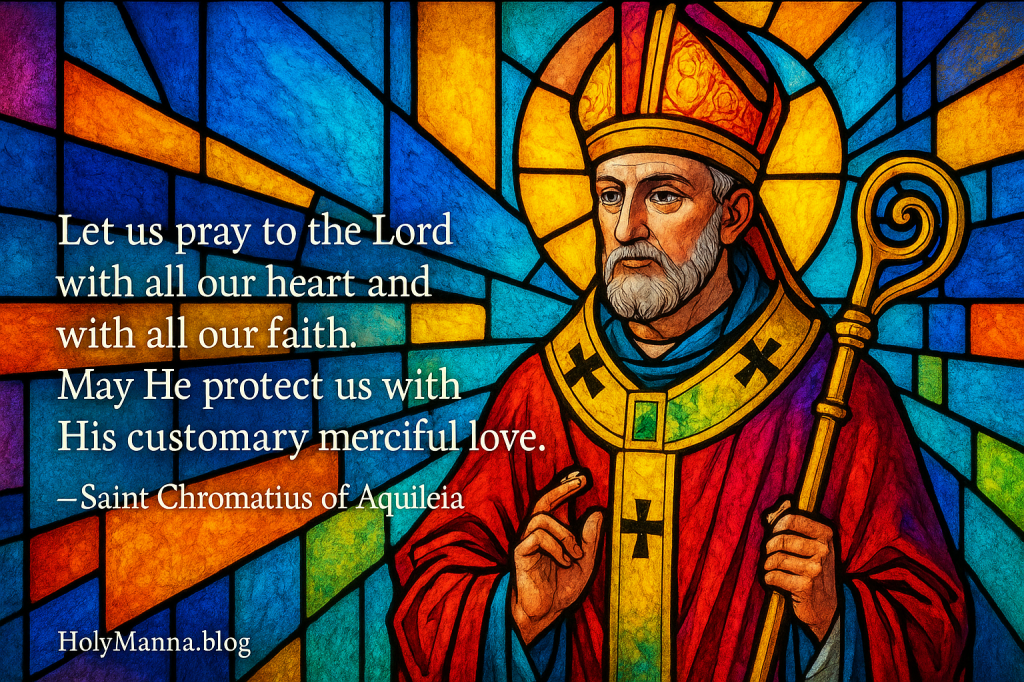
A Hidden Giant at the Edge of the Empire
Saint Chromatius of Aquileia stands as one of the quiet giants of the early Church. He never led armies or wrote monumental treatises like some of his contemporaries, but his faith, wisdom, and pastoral courage helped hold the Church together during a time of intense doctrinal conflict and political instability. Born in the 4th century in northern Italy, he became bishop of Aquileia, a major crossroads of the Roman Empire, and guided his people with clarity and charity. He is remembered as a spiritual father to other great saints, a defender of the Nicene faith, and a gifted preacher who nourished the Church with rich biblical teaching. Saint Jerome once referred to him as “the holiest and most learned of bishops.”
Roots of Faith
Saint Chromatius was born around the year 345 in Aquileia. His father died during his infancy, so he was raised by his widowed mother and a large household that was deeply Christian. Saint Jerome compared Chromatius’ mother to the prophetess Anna in The Gospel of Luke, his sisters to the wise virgins of Matthew 25, and Chromatius and his brother Eusebius to the young Samuel listening to the voice of the Lord. This description offers a moving glimpse into a home deeply grounded in prayer, Scripture, and Christian virtue. Chromatius did not have a dramatic conversion but rather grew steadily in holiness through a family immersed in the life of faith.
He eventually became a deacon and then a priest in Aquileia. In 381, he served as a theological expert at the Synod of Aquileia, which condemned Arianism and reaffirmed the full divinity of Christ. His reputation for holiness and wisdom led to his election as bishop around 387 or 388. His diocese covered an enormous region stretching across parts of modern Italy, Switzerland, Austria, Slovenia, and Hungary. Chromatius is best known for defending the true faith against heresy, strengthening and guiding other great theologians, and preaching extensively on Scripture, especially The Gospel of Matthew.
A Bishop Who Built With the Word
Aquileia was one of the most important cities of its time, a bustling center of trade and culture. This made Chromatius’ task both promising and challenging. He ministered in an environment marked by intellectual movements, pagan remnants, and ongoing threats from invading tribes. Yet he approached his mission with steadiness and deep trust in Christ.
One of his greatest contributions was his defense of the Nicene faith. Arianism had caused enormous confusion by denying the full divinity of Jesus Christ. Chromatius taught clearly that Jesus is true God and true man, perfectly in line with the Church’s teaching later expressed in CCC 464 to 469. He strengthened his flock through pastoral guidance rooted in Scripture and Tradition.
Another hallmark of his ministry was his collaboration with other great saints. Chromatius encouraged Saint Jerome, Saint Ambrose, and Rufinus of Aquileia in their theological and literary work. He suggested biblical commentaries, supported the translation of important texts such as Eusebius’ Ecclesiastical History, and tried to foster peace when Jerome and Rufinus clashed over theological controversies. He worked tirelessly to keep unity without sacrificing truth.
His preaching left a lasting mark on the Church. More than forty homilies and over sixty commentaries on The Gospel of Matthew survive. In one reflection on the Beatitudes, he wrote: “Our Lord, our savior, establishes extremely solid steps of precious stones, by which saintly souls and faithful can climb, can rise to this supreme good, which is the kingdom of heaven.” He also reflected beautifully on Christ’s words about being the “salt of the earth,” saying: “The Lord called his disciples the salt of the earth because they seasoned with heavenly wisdom the hearts of men, rendered insipid by the devil.” Chromatius’ teaching was direct, scripturally grounded, and deeply pastoral, always aimed at helping believers grow closer to Christ.
Graces of a Faithful Life
There are no dramatic miracle stories associated with Chromatius during his lifetime. Instead, the Church remembers the quieter graces that marked his ministry. One such grace was his ability to guide and encourage other saints, often strengthening their work for the good of the entire Church. His attempts to mediate peace between Jerome and Rufinus were themselves acts of charity and courage, especially during a time when theological debates could quickly become divisive.
Another quiet miracle is the preservation of his writings. For centuries many of his sermons were scattered, lost, or misattributed to other Church Fathers. Only in more recent times were scholars able to identify a consistent collection of his authentic works. These rediscovered texts have allowed the Church to hear once again the voice of this gentle and brilliant bishop.
Storms, Exile, and a Shepherd Who Endured
Although not a martyr, Chromatius lived through real trials. Aquileia was repeatedly threatened by Gothic and Hunnic invasions. These upheavals devastated the region and endangered the lives, memories, and manuscripts of the Church. Tradition holds that Chromatius spent his last days in exile at Grado, dying around 406 or 407 as the empire continued to unravel.
He also endured the sorrow of watching his friend Saint John Chrysostom unjustly exiled. Chrysostom wrote only three letters to Western bishops asking for help, and one of them went to Chromatius. Though Chromatius appealed to Emperor Honorius on Chrysostom’s behalf, the plea was ignored. Despite the pain of this failure, Chromatius remained faithful and steadfast. His preaching often compared the Church to a ship tossed in stormy seas but safely guided by Christ. In one homily he urged believers with the words: “Let us pray to the Lord with all our heart and with all our faith. May he protect us with his customary merciful love.”
This trust in the Lord echoes the hope described in CCC 1817 to 1821, which teaches that Christian hope does not deny suffering but confidently expects the fulfillment of God’s promises.
A Lasting Voice in the Church
After his death, Chromatius continued to speak through the preservation and rediscovery of his writings. His relics are venerated in Aquileia, where a bust containing them remains a reminder of this early shepherd who loved Scripture and protected the faith. His feast on December 2 is celebrated both in the Catholic and Eastern Orthodox Churches, showing how widely he is honored.
The greatest miracle after his death is the ongoing impact of his biblical preaching and theological insight. His writings encourage believers to love the Trinity, honor the Blessed Virgin Mary, trust the Church even in turbulent times, and rely on God’s mercy with unfailing hope. He is a quiet but powerful witness to what CCC 828 teaches about the saints as “the outstanding fruit of the Holy Spirit.”
Walking With Chromatius Today
Saint Chromatius might not have the dramatic stories of miracle workers or martyrs, but he is a deeply relatable model for the ordinary Christian who is trying to remain faithful in a confusing and unstable world. His life encourages readers to root themselves in Scripture, just as he rooted his ministry in The Gospel of Matthew. His fidelity to the Church, even in moments of conflict or uncertainty, shows what it means to trust that the Holy Spirit guides Christ’s Body in every age, as taught in CCC 797 to 801 and CCC 869.
He also teaches the value of spiritual friendship. His encouragement of Jerome, Ambrose, Rufinus, and Chrysostom reminds believers that God often works through the relationships He places in their lives. Holy friendships help people grow in virtue, clarity, and courage.
Finally, Chromatius invites Christians to practice hope. In times of anxiety or cultural turmoil, his counsel to pray with all the heart and trust in Christ’s merciful love offers a timeless remedy.
Engage with Us!
Saint Chromatius lived through storms, conflict, and uncertainty, yet he remained rooted in Scripture and anchored in trust. His life invites every reader to do the same. Please share your thoughts and reflections in the comments below.
- How does Saint Chromatius’ steady fidelity challenge you to respond differently when you see confusion or conflict in the Church or the world?
- What step can you take this week to immerse yourself more deeply in Scripture, especially in The Gospel of Matthew or the Beatitudes?
- Where might God be calling you to encourage someone else’s faith the way Chromatius encouraged Jerome, Ambrose, and Rufinus?
- How does Chromatius’ image of the Church as a ship in rough seas help you trust more deeply in Christ’s protection?
May Saint Chromatius of Aquileia intercede for all who seek to live with courage, clarity, and charity. May everyone grow in faith, walk in hope, and act with the love and mercy that Jesus taught in the Gospel.
Saint Chromatius of Aquileia, pray for us!
Follow us on Instagram and Facebook for more insights and reflections on living a faith-filled life.

 Holy Manna!
Leave a comment