A Saint Forged in Fire
Saint Eligius of Noyon, also known as Saint Eloy, is one of the most compelling examples of holiness lived in the world of work. He was a master goldsmith, a trusted adviser to Merovingian kings, a founder of monasteries, and eventually a missionary bishop who dedicated his life to evangelization, charity, and reform. The Church venerates him as the patron saint of goldsmiths, blacksmiths, farriers, metalworkers, coin collectors, and even those who care for horses because his work, miracles, and craftsmanship became channels of God’s grace. Saint Eligius embodies what the Catechism of the Catholic Church teaches in CCC 2427, reminding us that human work honors the Creator’s gifts and can be united to the saving work of Christ. His life shows how professional skill, influence, and wealth can become instruments of divine love when offered fully to God.
From Village Forge to Royal Court
Saint Eligius was born around 588 in Chaptelat near Limoges, France, into a Gallo Roman family known for its integrity and devotion to God. His parents, Eucherius and Terrigia, recognized early that their son possessed remarkable technical abilities and an unusually steady character. They placed him as an apprentice under Abbo, a master goldsmith and the local mint official, where Eligius excelled quickly through diligence, craftsmanship, and honesty.
His skill eventually brought him to the royal court, where he entered the service of the treasurer Bobo under King Clotaire II. When commissioned to craft a golden throne, Eligius astonished the king by producing two thrones from the amount of gold intended for one. His complete honesty in a position where corruption was common won him immediate trust. He became a close counselor first to Clotaire II and then to King Dagobert I. Even as wealth and influence surrounded him, Eligius embraced an increasingly penitential life, wearing fine court garments externally while practicing asceticism secretly. He memorized passages of Sacred Scripture for meditation and cultivated deep interior conversion, allowing the Holy Spirit to shape him into a saint long before he wore a bishop’s mitre.
Gold, Mercy, and Mission
As a royal adviser, Eligius used his influence not for luxury but for mercy. He directed significant resources for the ransom of captives from many nations and diligently cared for the poor. He sent servants to remove the bodies of executed criminals so they could receive Christian burial, restoring dignity to those whom society despised. His life reflects the spirit of CCC 2443–2444, which teaches that the Church’s love for the poor is part of her constant tradition and a sign of God’s presence.
Eligius also poured his resources into building up the visible Church. He founded the monastery of Solignac near Limoges, a convent of several hundred consecrated women in Paris, and was involved in the construction or restoration of churches dedicated to saints such as Saint Paul, Saint Martial, Saint Martin of Tours, and Saint Denis. His goldsmithing glorified God by adorning altars and relics with a beauty intended to lift the faithful toward heaven.
After King Dagobert’s death, Eligius was ordained a priest and soon selected as bishop of Noyon Tournai. Many in the region were still pagans, and he spent the rest of his life preaching along the North Sea coast, evangelizing Flemings, Frisians, and other tribes. One of his surviving teachings warns Christians to abandon superstition and trust in Christ alone, summarized in the line attributed to him: “He is a good Christian who puts faith in no charms or diabolical inventions, but places all his hope in Christ alone.”
Saint Eligius’ life was marked by miracles, including healings, prophecies, and acts of divine insight. A famous tradition describes how, when confronted with a horse that could not be shod, he fearlessly removed the horse’s leg, affixed the shoe with precision, and then miraculously reattached the leg. Whether understood as literal or symbolic, the story highlights his extraordinary faith, calmness, and trust in God and is one of the reasons he is honored as patron of those who work with horses. Every aspect of his life radiated a confidence that God works through human labor to bless the world.
Trials in Silk and Hairshirt
Although Saint Eligius did not suffer physical martyrdom, his life was filled with the trials of spiritual martyrdom. Living in a royal court surrounded by wealth, political ambition, and temptation, he embraced voluntary penance, wore a hairshirt under elegant court attire, and gradually gave away his possessions to the poor. His life reflects the teachings of CCC 2110–2117, which condemn superstition and call the faithful to trust in God’s providence alone.
As a missionary bishop, he frequently preached against pagan practices in regions hostile to change. Some leaders threatened his life, and stones were sometimes raised against him, but he remained steadfast in prayer and continued preaching with courage. He felt deeply responsible for the salvation of souls and never softened the truth out of fear of criticism or danger. His preaching, baptisms, reforms, and constant pastoral care demonstrated the heart of a shepherd willing to suffer for his flock.
A Bishop Who Keeps Working
Saint Eligius died on December 1, 660, in Noyon after an illness and was buried there. His close friend Saint Audoin, who wrote his biography, recorded many miracles following his death. These miracles strengthened devotion to him and confirmed his holiness in the eyes of the early Church. Traditions speak of visions, healings, and divine interventions attributed to his intercession.
Throughout France and Flanders, his relics became important centers of pilgrimage. They were solemnly transferred multiple times and honored in cities such as Tournai, Ghent, Bruges, and Antwerp. Many craftsmen, metalworkers, and those who worked with horses began invoking his protection, experiencing powerful intercession and practical help. His veneration reflects what the Catechism teaches in CCC 957: that the communion of saints strengthens the entire Church in the Spirit and unites heaven and earth in fraternal charity.
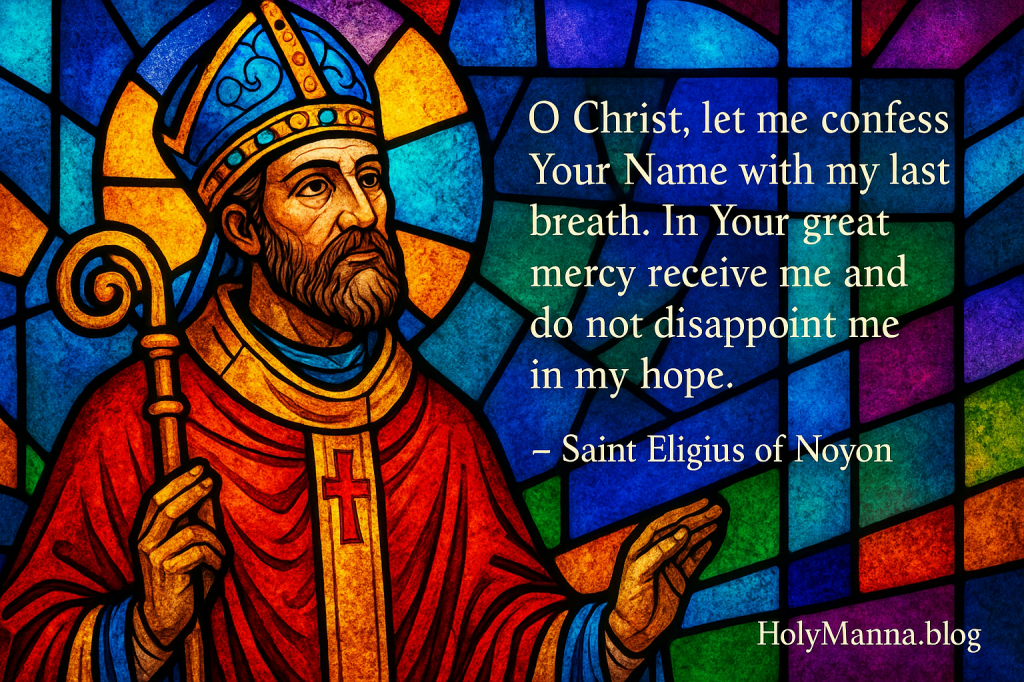
A prayer attributed to Saint Eligius beautifully expresses his humility and faith: “O Christ, let me confess Your Name with my last breath. In Your great mercy receive me and do not disappoint me in my hope.” This simple yet profound prayer captures a soul entirely surrendered to the mercy of Jesus.
Living Like Saint Eligius Today
Saint Eligius offers a powerful reminder that holiness is not limited to monasteries or hermitages. It can be forged on the workbench, in the office, in the financial world, in leadership, and in any place where integrity is tested. He shows that wealth, influence, and skill become holy when they are used for the good of others. His life directly reflects the teachings of CCC 2427, demonstrating that human work becomes redemptive when united to the Cross and offered with love.
His strong warnings against charms, magic, and superstition remain especially relevant in a culture that often blends spirituality with occult practices. He calls every Christian to reject false comforts and trust fully in Jesus Christ. His dedication to craftsmanship reminds believers that excellence, honesty, and beauty in work can glorify God just as much as preaching or missionary travel. His devotion after death reminds us that the saints remain close to us, helping us live lives worthy of the Gospel.
Engage with Us!
Share your thoughts and reflections in the comments below. Saint Eligius invites us to look at our careers, talents, and resources with new eyes, seeing them as opportunities to love God and neighbor.
- How does Saint Eligius challenge modern ideas about success, wealth, and professional achievement?
- Where is God calling for more integrity, honesty, or virtue in daily work?
- Are there places where subtle superstitions or “little charms” have replaced simple trust in Christ?
- How can you use your skills, time, or resources this week to help someone in need, following Saint Eligius’ example of mercy?
- What role do the saints, especially Saint Eligius, play in strengthening your faith and trust in God’s providence?
May Saint Eligius of Noyon inspire you to see your work as a path to holiness, to use every gift with generosity, and to live a life filled with the love and mercy that Jesus teaches.
Saint Eligius of Noyon, pray for us!
Follow us on Instagram and Facebook for more insights and reflections on living a faith-filled life.

 Holy Manna!
Leave a comment