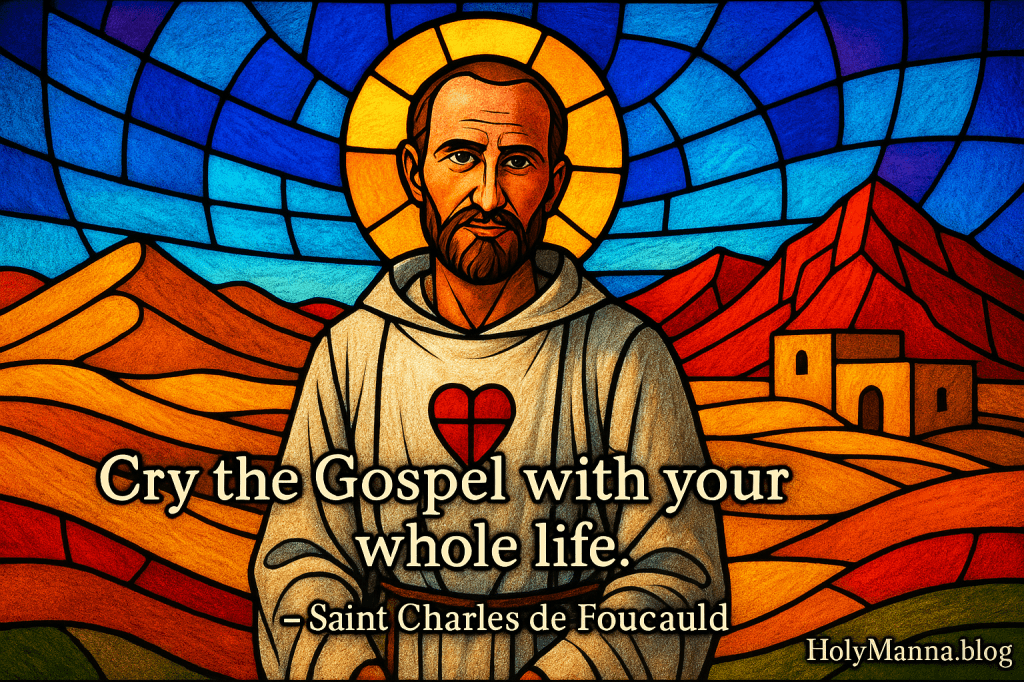
Hidden Fire in the Desert
Saint Charles de Foucauld lived a life that looked quiet on the outside but burned with deep love for God on the inside. Born into wealth and privilege, he wandered through skepticism, military adventure, and restless pleasure before encountering Christ in a way that changed him forever. He eventually became a poor hermit priest in the Sahara, living among the Tuareg people and allowing his entire existence to become a living Gospel. His spirituality later inspired religious communities and lay fraternities across the world, all seeking to imitate the humility and hidden holiness of Nazareth. Charles reminds the Church that authentic discipleship is often found not in noise or recognition, but in simple, faithful love for Jesus.
From Champagne and Comfort to Confession and Grace
Charles Eugène de Foucauld was born on September 15, 1858, in Strasbourg, France. Coming from an old and noble family, he lived a privileged childhood until tragedy struck when both of his parents died, leaving him and his sister to be raised by their grandfather. As a teenager he abandoned his Catholic faith entirely, later admitting that by age fifteen or sixteen he no longer believed in God. He attended the prestigious Saint Cyr military academy, but he developed a reputation for indulgence and irresponsibility. His worldly lifestyle eventually led to his suspension from the army.
Restless and aimless, Charles turned to exploration. Between 1883 and 1884 he undertook a daring journey through Morocco in disguise, producing a groundbreaking geographical report that earned him significant acclaim. Yet despite his outward success, he felt an inner emptiness. During his time in North Africa, he watched Muslim communities pray with deep reverence, and their devotion stirred something within him. He later described his own simple prayer during this time: “My God, if you exist, let me know you.”
Everything changed in 1886 when he returned to Paris and sought spiritual guidance from Abbé Henri Huvelin. Huvelin instructed him to make his confession, and in that moment Charles encountered the presence of God so powerfully that he later said: “As soon as I came to believe that there was a God, I understood that I could not do otherwise than to live for him alone.” His conversion reflects what the Catechism of the Catholic Church teaches about faith as a total submission of intellect and will to God (cf. Catechism of the Catholic Church, 142–143).
Seeking the most radical form of discipleship, Charles became a Trappist monk in 1890. After several years he discerned that God was calling him to even greater poverty and hiddenness. He lived as a humble servant near the Poor Clares in Nazareth, spending long hours in adoration before the Blessed Sacrament. In 1901 he was ordained a priest and took the name Brother Charles of Jesus, committing his entire life to imitation of Christ’s hidden years in Nazareth.
Crying the Gospel in the Sahara
After ordination, Charles returned to North Africa and settled among the poorest and most isolated people in the Sahara. He first established a small hermitage in Béni Abbès, a place dedicated to Eucharistic adoration and hospitality. Later he moved deeper into the desert to Tamanrasset, living among the Tuareg tribe and immersing himself in their language and culture. Although he did not preach through sermons, he preached through presence, charity, and daily adoration of Christ in the Eucharist.
One of his well-known spiritual insights captures the essence of his mission: “Cry the Gospel with your whole life.” His writing also reflects profound reverence for the dignity of every person, shown in his words: “Always see Jesus in every person and treat each one with great humility, respect, and selfless generosity.” These statements echo the teaching of the Catechism that every person is made in the image of God and worthy of love and dignity (cf. Catechism of the Catholic Church, 1700–1703, 1931).
No extraordinary public miracles are attributed to Charles during his lifetime. His “miracles” were the hidden ones: conversions of heart, healing of divisions, friendships formed across religious boundaries, and the quiet but powerful transformation of his own soul. His life demonstrates the truth of the Catechism’s teaching that holiness is most often born in ordinary acts of charity, humility, and fidelity (cf. Catechism of the Catholic Church, 2044, 2472).
A Seed Buried in the Sand
Life in the Sahara tested Charles’s physical and spiritual endurance. He lived in severe poverty, with minimal food, harsh heat, and constant vulnerability to sickness and tribal conflict. Yet he embraced this hardship as a way to imitate Christ’s humility and hiddenness, reflecting what the Catechism teaches about Christ’s self-emptying love (cf. Catechism of the Catholic Church, 520, 561).
Charles lived as a Christian in primarily Muslim regions during times of great tension. While France and local tribes clashed politically and militarily, Charles chose to be a bridge rather than a weapon, offering hospitality and respectful friendship to all. The Catechism teaches that Christians must show respect and charity toward Muslims who, like us, profess belief in the one merciful Creator (cf. Catechism of the Catholic Church, 841). Charles embodied this teaching by his daily life.
On December 1, 1916, armed raiders attempting to seize him as a hostage surrounded his hermitage. Amid the chaos, a young guard accidentally fired his weapon, killing Charles instantly. His death looked like a failure in worldly terms. He had no followers, no established community, and no visible success. Yet his sacrifice mirrors the teaching of John 12, where Jesus explains that “unless a grain of wheat falls into the earth and dies, it remains just a grain; but if it dies, it bears much fruit.” Charles’s silent martyrdom became a seed that would eventually grow into a great spiritual family.
The Hidden Saint Revealed
After his death, Charles’s writings began to circulate widely, and his life inspired the Little Sisters of Jesus, the Little Brothers of Jesus, and numerous lay communities dedicated to living the spirituality of Nazareth. His cause for canonization opened in 1927.
For his beatification in 2005, the Church approved a miracle involving the healing of Giovanna Citeri Pulici, an Italian woman suffering from bone cancer. Her complete recovery, after prayers offered specifically through Charles’s intercession, was medically inexplicable.
The miracle that led to his canonization occurred in 2016 when a young carpenter named Charle fell from more than fifteen meters while restoring a chapel roof. He was impaled by a wooden armrest in a way that should have caused fatal damage to his internal organs. Despite the severity of the accident, he suffered no permanent injuries and recovered fully within weeks. The community had just completed a novena to Charles de Foucauld, and many immediately prayed for his intercession. Medical and theological commissions unanimously judged the healing to be miraculous.
Because of these miracles and his heroic virtue, Saint Charles de Foucauld was canonized on May 15, 2022.
Abandonment, Hidden Holiness, and Universal Brotherhood
Saint Charles de Foucauld speaks powerfully to anyone who has ever felt restless, empty, or searching for purpose. His life reminds believers that God can reach a person anywhere, even in the middle of confusion or indulgence, and draw that person into an entirely new life. His most famous prayer captures the heart of his spirituality: “Father, I abandon myself into your hands; do with me what you will.” This prayer echoes Christ’s own words in Luke 22 and Luke 23: “Not my will but yours be done” and “Father, into your hands I commend my spirit.” The Catechism teaches that this kind of childlike trust lies at the center of Christian prayer (cf. Catechism of the Catholic Church, 2610, 2730–2731).
Charles’s devotion to the hidden life of Jesus in Nazareth challenges today’s world, which often expects recognition and immediate results. He shows that quiet fidelity, Eucharistic love, and humble service can transform hearts and communities from within. As the Catechism teaches, holiness is not reserved for the few but is a universal call for every baptized person (cf. Catechism of the Catholic Church, 2013–2014).
Readers can imitate Saint Charles by carving out time for Eucharistic adoration or quiet prayer, offering the ordinary tasks of daily life to God, choosing charity when it is difficult, and treating every person with the dignity due to a child of God. His spirituality invites everyone into a deeper trust in God’s will and a more generous love toward others.
Engage with Us!
Share your thoughts and reflections in the comments. Saint Charles de Foucauld reminds the Church that holiness often grows in hidden places, and his life invites every believer to trust more deeply in God’s love and providence.
- Where do you recognize yourself in Saint Charles’s story, whether in his restlessness, his conversion, or his desire for a more faithful and hidden life?
- How does his Prayer of Abandonment challenge you to trust God more in your own difficulties or uncertainties?
- What would it look like for you to “cry the Gospel with your whole life” during this upcoming week?
- In what ways can you intentionally see Jesus in every person you encounter today?
- Is there an area of your life that feels like a desert, and how might God be using it to draw you closer to his heart?
May the example and intercession of Saint Charles de Foucauld strengthen your faith, deepen your trust in God’s love, and inspire you to live every moment with the mercy and compassion of Jesus Christ.
Saint Charles de Foucauld, pray for us!
Follow us on Instagram and Facebook for more insights and reflections on living a faith-filled life.

 Holy Manna!
Leave a comment