Monday of the First Week of Advent – Lectionary: 175
Waiting For a Holy Place and a Healed Heart
Sometimes the deepest longing in the soul is not just to fix a problem, but to finally belong somewhere holy, safe, and whole. That longing sits right at the center of today’s readings for Monday of the First Week of Advent.
In Isaiah 4:2-6, God speaks to a wounded, chastened Jerusalem that has gone through judgment and purification. The prophet announces that “on that day, the branch of the Lord will be beauty and glory”, and that those who survive will be called holy. This is not just cosmetic cleanup. It is a total renewal of a people and a city so that God can dwell among them. The images of a cloud by day and fire by night echo the Exodus, when God’s presence visibly guided and protected Israel. Here, that ancient story is renewed as a promise. God will once again be a shelter, a shade, and a refuge for those who let Him purify their lives.
Psalm 122 takes that same Jerusalem and shows it through the eyes of joyful pilgrims. They are thrilled just to stand within her gates and say, “Let us go to the house of the Lord”. This is the city where God’s presence dwells, where the tribes go up to give thanks, and where the thrones of justice stand. The psalm is not only about geography. It is about a people whose hearts are set on God’s dwelling and who pray for peace and goodness for the place where He is honored.
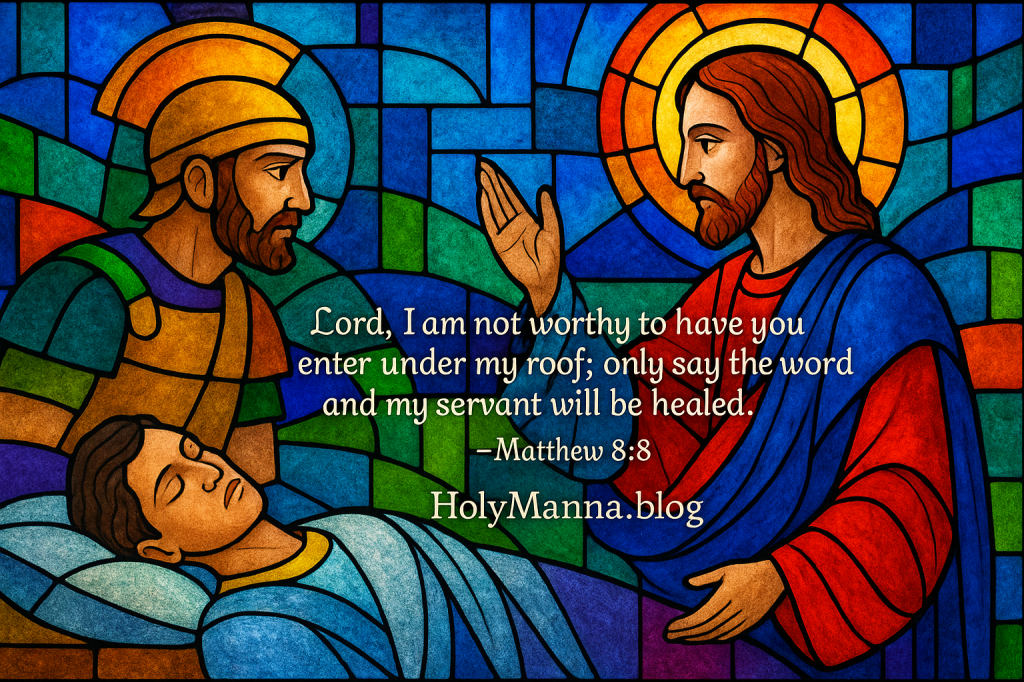
Then The Gospel of Matthew (Matthew 8:5-11) shifts the focus from the holy city to a surprising holy heart. A Roman centurion, an outsider from a occupying power, approaches Jesus with a plea for his suffering servant. Instead of demanding a sign or insisting on his status, he offers one of the most humble and powerful declarations in all of Scripture: “Lord, I am not worthy to have you enter under my roof; only say the word and my servant will be healed.” Jesus is amazed and says that such faith has not been found even in Israel. Then He reveals that many will come from east and west to recline with Abraham, Isaac, and Jacob at the banquet in the kingdom of heaven. The true Jerusalem, the true holy city, will be filled with those who trust His word with this same humble confidence.
Taken together, these readings paint a unified Advent picture. God is preparing a purified people and a holy dwelling. The psalm gives the sound of hearts already rejoicing to enter that place. The Gospel reveals the kind of faith that opens the door. The central theme could be summarized this way. God promises a renewed dwelling and a holy people, and the way in is a humble, trusting faith that lets Him purify, heal, and shelter the heart. Are you willing to let the Lord both cleanse your life and amaze you with what His word can do when you simply trust Him?
First Reading – Isaiah 4:2-6
A Purified People Under the Shelter of God’s Glory
Isaiah speaks into a moment when Jerusalem has been shaken by judgment and humbled by its own infidelity. The people have experienced the consequences of sin, both spiritually and politically, and their confidence in themselves has been exposed as fragile. Into that wounded reality, God does not simply promise a return to business as usual. God promises a purified people, a renewed city, and His own presence as a visible protection.
In Isaiah 4:2-6, the prophet looks ahead to a day when the Lord Himself will renew Zion from within. The proud will be humbled, the unfaithful will be sifted out, and those who remain will be called holy. The language of the “branch of the Lord” echoes the hope for a future messianic king from the line of David, while the “cloud by day and fire by night” recalls God’s presence with Israel in the Exodus. For a people who know what it feels like to be exposed and vulnerable, these verses promise that God will not simply clean up their failures. God will dwell in their midst, cover them, shelter them, and make them beautiful again in holiness.
This ties directly into today’s Advent theme. God is preparing a holy dwelling and a holy people. Isaiah shows that this holiness is not a human self-improvement project. It is the result of God’s own purifying action and protective presence. That same promise is fulfilled in Jesus, who later praises the centurion’s humble faith and reveals that many will come from every direction to share the banquet of the kingdom. The path into that holy dwelling begins with allowing God to cleanse the heart and trusting His word more than personal strength or status.
Isaiah 4:2-6
New American Bible (Revised Edition)
Jerusalem Purified
2 On that day,
The branch of the Lord will be beauty and glory,
and the fruit of the land will be honor and splendor
for the survivors of Israel.
3 Everyone who remains in Zion,
everyone left in Jerusalem
Will be called holy:
everyone inscribed for life in Jerusalem.
4 When the Lord washes away
the filth of the daughters of Zion,
And purges Jerusalem’s blood from her midst
with a blast of judgment, a searing blast,
5 Then will the Lord create,
over the whole site of Mount Zion
and over her place of assembly,
A smoking cloud by day
and a light of flaming fire by night.
6 For over all, his glory will be shelter and protection:
shade from the parching heat of day,
refuge and cover from storm and rain.
Detailed Exegesis
Verse 2 – “On that day, The branch of the Lord will be beauty and glory, and the fruit of the land will be honor and splendor for the survivors of Israel.”
This verse points to a future moment of restoration after judgment. The phrase “on that day” in Isaiah often signals a decisive intervention of God in history. The “branch of the Lord” has been traditionally understood in the Church as a messianic image pointing toward Christ, the shoot that springs from the stump of Jesse. Instead of human pride or political power being the glory of Israel, God’s own Messiah will be beauty and glory for the people. The “fruit of the land” becoming honor and splendor for the survivors shows that even the ordinary realities of life will be transformed when God restores His people. What remains after purification is not ruin, but a renewed, humble remnant whose beauty comes from God.
Verse 3 – “Everyone who remains in Zion, everyone left in Jerusalem Will be called holy: everyone inscribed for life in Jerusalem.”
Here the focus shifts to the remnant. Not everyone will remain. Those left in Zion are not simply survivors in a natural sense. They are those who have passed through judgment and purification and have allowed God to claim them fully. To be “called holy” in biblical language means to be set apart for God, belonging to Him in a special way. The phrase “inscribed for life” suggests a heavenly register. Their names are written down by God. This anticipates the New Testament image of the “book of life.” Holiness is not an optional add-on for the extra religious. It is the mark of those who belong to God and are destined to dwell with Him.
Verse 4 – “When the Lord washes away the filth of the daughters of Zion, And purges Jerusalem’s blood from her midst with a blast of judgment, a searing blast,”
The language here becomes intense. The “filth of the daughters of Zion” and the “blood” in the city point to serious moral corruption and violence. God does not ignore this. God acts to wash and purge His people. The imagery of washing suggests cleansing from impurity, while the “blast of judgment” and “searing blast” suggest a kind of purifying fire. The Church often uses this kind of imagery for purification from sin, both in this life and, ultimately, in the cleansing associated with final judgment and purgation. God’s judgment is not aimed at destroying the people, but at burning away what is unworthy so that the people can be truly His.
Verse 5 – “Then will the Lord create, over the whole site of Mount Zion and over her place of assembly, A smoking cloud by day and a light of flaming fire by night.”
Once purification has taken place, God renews His presence in a striking way. The “smoking cloud by day” and “light of flaming fire by night” clearly recall the pillar of cloud and fire that led Israel out of Egypt and through the wilderness. This is covenant language. God does not leave the purified remnant alone. God covers and guides them. The mention of “the whole site of Mount Zion” and “her place of assembly” shows that this presence is not limited to one tiny spot. It extends over the worshiping community as a whole. The city becomes a kind of living sanctuary, overshadowed by the presence of the Lord.
Verse 6 – “For over all, his glory will be shelter and protection: shade from the parching heat of day, refuge and cover from storm and rain.”
The final verse drives home the pastoral heart of God. The “glory” of the Lord is not just a dazzling display. It functions as shelter and protection. The images of shade from heat and refuge from storm are deeply human. They speak to exhaustion, vulnerability, and fear. God’s presence becomes a covering, a safe place where His people can rest. This fulfillment is ultimately seen in Christ, who promises to be with His Church always and who sends the Holy Spirit to dwell within believers. This verse anticipates the Church as the place where God’s glory protects and shelters those who have allowed Him to cleanse their hearts.
Teachings: Purified For God’s Dwelling
This passage reflects a pattern at the heart of the Catholic understanding of salvation. God prepares a people, purifies them, and then dwells among them. The purification of Zion in Isaiah 4 foreshadows the way God purifies each soul and the whole Church. The Catechism of the Catholic Church teaches that the Church is at once holy and always in need of purification, and that every member is called to continual conversion and renewal in the Spirit. This reflects exactly what is happening in this reading. God does not abandon His people when they are stained by sin. God calls them through judgment into a deeper holiness so that His glory can dwell among them.
The imagery of washing and purging points forward to the sacraments, especially Baptism and Reconciliation. Baptism is described in the Catechism of the Catholic Church as a washing that cleanses from all sin and makes the believer a new creature in Christ, adopted as a child of God and a member of the Church. The sacrament of Reconciliation continues this cleansing work, restoring the baptized person when serious sin has damaged communion with God and the Church. The washing away of filth and the purging of blood in Isaiah anticipates this sacramental reality, where grace does not just cover sin but truly heals and restores.
The image of the cloud and fire connects to God’s guiding presence and points ultimately to the Holy Spirit. In the Old Testament, the glory cloud filled the tabernacle and later the Temple. In the New Covenant, the Holy Spirit fills the Church and the hearts of believers. The Catechism of the Catholic Church explains that the Holy Spirit is the soul of the Church, building, animating, and sanctifying the Body of Christ. This is the deeper meaning behind the promise that God’s glory will be shelter and protection. The Church is not merely a human institution. It is the place where God’s presence dwells and protects His people on their pilgrimage toward the heavenly Jerusalem.
Finally, the idea of names “inscribed for life” in Jerusalem hints at the eternal dimension of salvation. The Book of Revelation will later speak of the “book of life” and the heavenly Jerusalem coming down out of heaven from God. The purified Zion of Isaiah 4 is a prophetic glimpse of that final reality where those who have allowed God to cleanse and transform them will live forever in His presence.
Reflection: Let God Cleanse And Cover Your Life
This reading pushes right into the heart of Advent. Advent is not just about preparing for a sentimental celebration or a beautiful liturgy. It is about letting God purify the heart so that His glory can truly dwell there. The image of the “filth” being washed away and the “blood” being purged may feel uncomfortable, but it names the reality of sin, selfishness, and hidden wounds that cling to every human life. God loves too much to leave any of that untouched.
There is an invitation here to step honestly into God’s light. That can look very concrete. It can mean going back to Confession after a long time away. It can mean bringing hidden struggles out of the dark and into spiritual direction or trusted accountability. It can mean allowing the Lord to challenge patterns of resentment, impurity, or pride that have become normal. The promise is that on the other side of this purification stands shelter, not shame. The goal is not to leave anyone exposed, but to cover every part of life with the protective glory of God.
The mention of shade from heat and refuge from storms speaks directly to modern anxieties. Life can feel like relentless pressure by day and sudden storms by night. When hearts are purified and surrendered, the presence of God becomes a place of interior rest even when circumstances do not change. Holiness is not a stiff, grim perfection. It is a life that has been opened to God’s presence in such a way that He can truly guard, guide, and console.
Where is the Lord inviting a deeper purification in your life right now?
What “heat” or “storms” are you trying to endure alone, instead of letting God’s glory be your shelter and protection?
Are you willing to trust that any painful purification God allows is ordered toward a deeper peace and a more real experience of His presence?
Responsorial Psalm – Psalm 122
Rejoicing On the Road to the House of the Lord
Psalm 122 is a “song of ascents,” one of the pilgrim hymns sung as Israelites went up to Jerusalem for the great feasts. In the time of King David and after, Jerusalem was not just a capital city. It was the place of the Temple, the visible sign of God’s dwelling with His people. Walking up to Jerusalem meant drawing near to the presence of the Lord, joining the tribes in worship, and stepping into the heart of the covenant story.
Religiously, this psalm captures the joy, reverence, and unity of God’s people as they gather in the holy city. Culturally, it reflects the deep bond between God’s people and the city where His name is honored and His justice is exercised. Historically, these pilgrim songs formed the soundtrack of Israel’s worship life, especially during major feasts like Passover, when the people remembered God’s saving power.
In today’s Advent context, Psalm 122 fits perfectly with the theme of a purified people and a holy dwelling. Isaiah 4 promises that God will cleanse Zion and cover it with His glory. The psalm lets a reader hear the joyful footsteps and prayers of those who actually enter that city. The Gospel in Matthew 8:5-11 then widens the promise, showing that many from east and west will recline at the heavenly banquet. The earthly Jerusalem points forward to the heavenly Jerusalem, the eternal “house of the Lord.” This psalm becomes a prayer that the heart might long for that house, seek its peace, and live as a pilgrim whose true destination is God’s presence.
Psalm 122
New American Bible (Revised Edition)
A Pilgrim’s Prayer for Jerusalem
1 A song of ascents. Of David.
I rejoiced when they said to me,
“Let us go to the house of the Lord.”
2 And now our feet are standing
within your gates, Jerusalem.
3 Jerusalem, built as a city,
walled round about.
4 There the tribes go up,
the tribes of the Lord,
As it was decreed for Israel,
to give thanks to the name of the Lord.
5 There are the thrones of justice,
the thrones of the house of David.
6 For the peace of Jerusalem pray:
“May those who love you prosper!
7 May peace be within your ramparts,
prosperity within your towers.”
8 For the sake of my brothers and friends I say,
“Peace be with you.”
9 For the sake of the house of the Lord, our God,
I pray for your good.
Detailed Exegesis
Verse 1 – “I rejoiced when they said to me, ‘Let us go to the house of the Lord.’”
This opening line shows spontaneous joy at the invitation to worship. The “house of the Lord” refers to the Temple, the center of sacrifice, prayer, and God’s dwelling. The psalmist does not treat worship as a chore or a cold obligation. It is a cause for real rejoicing. For a Christian, this anticipates the joy of going to Mass, where Christ is truly present in the Eucharist. The response of the heart reveals spiritual health. A soul that rejoices to enter God’s house is already moving in step with His grace.
Verse 2 – “And now our feet are standing within your gates, Jerusalem.”
The pilgrim has arrived. After the journey, there is a sense of amazement just to be within the city gates. The mention of “feet” standing in Jerusalem underlines that worship is not only about ideas. It is physical, embodied, and communal. The people of God come with real bodies, real fatigue, and real hope to a real place. For believers now, there is a parallel experience each time a church is entered. Stepping over the threshold into a sacred space is a small echo of this moment of arrival in Jerusalem and points toward the final arrival in the heavenly city.
Verse 3 – “Jerusalem, built as a city, walled round about.”
Here the psalmist admires the structure and unity of Jerusalem. The city is well built and well defended. Spiritually, this speaks to order, stability, and protection. Jerusalem is not chaotic or fragile. It is a carefully constructed dwelling place for God’s presence and God’s people. In Catholic understanding, this image connects to the Church as the new Jerusalem, structured and ordered with bishops, priests, deacons, sacraments, doctrine, and discipline, not as a burden, but as a protective wall around the faith and unity of the people.
Verse 4 – “There the tribes go up, the tribes of the Lord, as it was decreed for Israel, to give thanks to the name of the Lord.”
All the tribes go up together. Worship is not a private spiritual adventure. It is a covenant community responding to God’s command. The purpose is clear. The people go up to give thanks to the name of the Lord. Gratitude is at the center of true worship. In the New Covenant, the word “Eucharist” literally means thanksgiving. The gathering of the tribes anticipates the gathering of all nations in the Church, united in giving thanks to the Father through the Son in the Holy Spirit.
Verse 5 – “There are the thrones of justice, the thrones of the house of David.”
Jerusalem is not only a worship center. It is also the seat of governance and justice. The “thrones of the house of David” show that kingship, law, and worship are meant to be united under God’s rule. True justice flows from right worship. For Catholics, this points toward Christ, the Son of David, whose throne is the Cross and whose kingdom is exercised through mercy and truth. The Church is called to reflect that justice in her life and in the way believers act in the world.
Verse 6 – “For the peace of Jerusalem pray: ‘May those who love you prosper!’”
The psalm shifts from admiration to intercession. Love for Jerusalem expresses love for the place where God’s presence dwells. Praying for its peace and prosperity is not about worldly luxury. It is about the flourishing of God’s people and the unhindered freedom to worship. For Christians, this naturally extends to prayer for the Church and for the cities, parishes, and families where the faith is lived.
Verse 7 – “May peace be within your ramparts, prosperity within your towers.”
The prayer becomes more specific. The psalmist asks that peace and well-being penetrate the defenses and structures of the city. It is a picture of deep, interior security, not just temporary calm. Spiritually, this points to the need for peace not only around a person, but within a person. Christ, the Prince of Peace, desires to bring that kind of interior serenity to the mind, heart, and community that belong to Him.
Verse 8 – “For the sake of my brothers and friends I say, ‘Peace be with you.’”
The motivation for this prayer is love. The psalmist prays for peace in Jerusalem because it affects brothers, friends, and community. Peace in God’s house blesses everyone. This anticipates Christ’s resurrection greeting, “Peace be with you.” The believer who prays for the peace of the Church and the world is moved by charity, not just by personal comfort.
Verse 9 – “For the sake of the house of the Lord, our God, I pray for your good.”
The deepest reason for seeking the good of Jerusalem is the presence of the house of the Lord. Concern for the city flows from concern for God’s honor. In Catholic life, this can be seen in care for the Church, reverence for the liturgy, and a desire to see the faith flourish in every place. The psalm ends with prayer, not with nostalgia. The vision of Jerusalem becomes a mission: to seek, pray, and work for the good of the place where God dwells.
Teachings: The Church As Pilgrim People And Holy City
Psalm 122 gives a beautiful window into how the Church understands herself as both a pilgrim people and a holy city. The journey up to Jerusalem prefigures the journey of the Church through history toward the heavenly Jerusalem. The Catechism of the Catholic Church explains that the Church on earth is already the beginning of the kingdom. It teaches that the Church is at the same time hierarchical and mystical, visible and spiritual, both human and divine in origin, and that she is “on earth the seed and the beginning of that kingdom.” When believers pray with Psalm 122, they are not just thinking about an ancient city. They are entering into the mystery of the Church as God’s dwelling among humanity.
The psalm’s focus on peace and unity connects with the Church’s teaching on communion. The Catechism of the Catholic Church emphasizes that the unity of the People of God is a gift from the Trinity. Division, rivalry, and hatred wound that unity. Praying for the peace of Jerusalem becomes, in Christian terms, a prayer for unity and reconciliation within the Church and the wider world. Saint Augustine, reflecting on the restless human heart, famously said, “You have made us for yourself, O Lord, and our heart is restless until it rests in you.” That rest is precisely the peace the psalm longs for, a peace that is found most deeply in God’s dwelling.
The connection between worship and justice in verse 5 points toward Catholic social teaching. True justice flows from right worship. When God is honored, human dignity is protected and the vulnerable are defended. The thrones of the house of David foreshadow the kingship of Christ. In the New Covenant, His rule shapes not only personal morality but also concern for the poor, the oppressed, and the common good.
Historically, Jerusalem’s Temple was destroyed, rebuilt, and finally replaced by the reality it foreshadowed. Christ identified His own Body as the true Temple. The Church, as His Body, carries that presence into the world. The heavenly Jerusalem depicted in Revelation shows the final fulfillment of all that Psalm 122 anticipated. There, God dwells with His people and wipes away every tear. Praying this psalm in Advent keeps the heart awake to that final destiny.
Reflection: Learning To Long For God’s House Again
This psalm is a gentle but strong invitation to examine what the heart truly loves and where it longs to be. The joy of the psalmist at the thought of going to the house of the Lord challenges the casual or lukewarm attitude that can easily creep into spiritual life. If Sunday Mass feels like a burden, if time in prayer feels like an afterthought, Psalm 122 becomes a mirror that reveals a deeper hunger that might be buried under distraction or fatigue.
There is also a very concrete call to pray for the peace of the Church and the places where the faith is lived. That can mean praying for the local parish, the bishop, the Pope, and the wider Catholic community. It can mean offering sacrifices for unity in divided families, for reconciliation in broken relationships, and for stability in societies marked by violence and confusion. The desire for the “peace of Jerusalem” becomes a desire for Christ to rule more fully in every heart and every community.
On a personal level, the image of standing within the gates of Jerusalem can be applied to moments of grace. Each time someone goes to Confession, receives Communion, or kneels in silent prayer before the tabernacle, there is a real entrance into the “house of the Lord.” Over time, these encounters shape a pilgrim heart that is not content with comfort alone, but longs for God’s presence and God’s justice.
Does the idea of going to the house of the Lord stir real joy in your heart, or has worship become routine and dry?
How can you begin to pray more intentionally for the peace and unity of the Church and of your own family or community?
What practical step can you take this week to live more consciously as a pilgrim whose true destination is the heavenly Jerusalem where God dwells forever?
Holy Gospel – Matthew 8:5-11
Humble Faith That Opens the Gates of the Kingdom
The Gospel of Matthew presents this scene in Matthew 8:5-11 right after Jesus has begun His public ministry and worked powerful signs, especially in Galilee. Capernaum was a bustling town on the Sea of Galilee, a kind of ministry “base” for Jesus. Into that Jewish setting walks a Roman centurion, a military officer of the occupying power. Culturally, this man would have been seen as powerful, wealthy, and very much an outsider to the covenant people of Israel. Yet in this encounter, the centurion does not act like a conqueror. He approaches Jesus as a beggar in need and as a believer who understands authority.
Religiously, this moment is stunning. A pagan officer shows a depth of faith and humility that surpasses what Jesus has seen among His own people. The centurion recognizes that Jesus does not just work miracles. He has real authority, the kind that needs only a word to change reality. That faith moves Jesus to praise him publicly and to reveal a mystery at the heart of salvation history. Many will come from east and west and recline at the banquet in the kingdom of heaven with Abraham, Isaac, and Jacob. The promises made to Israel will overflow to the nations through faith in Christ.
In the light of today’s theme, this Gospel shows what it looks like to enter the purified dwelling that Isaiah 4 and Psalm 122 anticipate. The centurion does not claim worthiness. He confesses unworthiness and throws himself on the mercy and power of Jesus. His heart becomes like a living Jerusalem, open to the presence of the Lord. The same humble, trusting faith that he shows is what allows people from every background to become part of God’s holy people and to share in the joy of the kingdom.
Matthew 8:5-11
New American Bible (Revised Edition)
5 When he entered Capernaum, a centurion approached him and appealed to him, 6 saying, “Lord, my servant is lying at home paralyzed, suffering dreadfully.” 7 He said to him, “I will come and cure him.” 8 The centurion said in reply, “Lord, I am not worthy to have you enter under my roof; only say the word and my servant will be healed. 9 For I too am a person subject to authority, with soldiers subject to me. And I say to one, ‘Go,’ and he goes; and to another, ‘Come here,’ and he comes; and to my slave, ‘Do this,’ and he does it.” 10 When Jesus heard this, he was amazed and said to those following him, “Amen, I say to you, in no one in Israel have I found such faith. 11 I say to you, many will come from the east and the west, and will recline with Abraham, Isaac, and Jacob at the banquet in the kingdom of heaven,
Detailed Exegesis
Verse 5 – “When he entered Capernaum, a centurion approached him and appealed to him,”
Jesus enters Capernaum, and immediately a centurion approaches and pleads. The centurion is a man of status and command, yet the Gospel highlights his act of approaching and appealing, not commanding. This tells a lot about his heart. He recognizes Jesus as someone greater, someone to whom even a powerful Roman must come in need. Theologically, this shows the beginning of conversion. It starts when a person stops pretending to be self sufficient and turns toward Christ with honest petitions.
Verse 6 – “saying, ‘Lord, my servant is lying at home paralyzed, suffering dreadfully.’”
The centurion calls Jesus “Lord,” not as a casual title but with real reverence. His request is not for himself, but for his servant who is paralyzed and in terrible suffering. This reveals the compassion and humility of the centurion. He uses his access to Christ on behalf of someone weaker. It is an image of intercessory prayer. In Catholic tradition, praying for others, especially the suffering and vulnerable, is a powerful act of charity. The centurion’s love for his servant mirrors the way believers are called to bring the needs of others before the Lord.
Verse 7 – “He said to him, ‘I will come and cure him.’”
Jesus responds immediately and generously. There is no hesitation or condition. He offers to come personally to the centurion’s home. This shows the tenderness of the Heart of Christ. He is ready to cross boundaries of culture, religion, and social class to bring healing. It also hints at the Incarnation itself. God does not stay distant. God comes into human homes, human situations, and human suffering.
Verse 8 – “The centurion said in reply, ‘Lord, I am not worthy to have you enter under my roof; only say the word and my servant will be healed.’”
This line has become part of the Latin Rite of the Mass, just before Holy Communion. The centurion recognizes both his unworthiness and Christ’s power. He does not deny that Jesus could come. He simply confesses that he does not deserve such a visit. At the same time, he expresses absolute confidence that a mere word from Jesus is enough to heal. This is the heart of living faith. It is humble about self and bold about Christ. The Church places these words on the lips of the faithful because every time someone approaches the Eucharist, there is a similar mystery. No one is worthy by personal merit, yet Christ chooses to come under the “roof” of the soul.
Verse 9 – “‘For I too am a person subject to authority, with soldiers subject to me. And I say to one, ‘Go,’ and he goes; and to another, ‘Come here,’ and he comes; and to my slave, ‘Do this,’ and he does it.’”
The centurion explains his reasoning using his own experience of military authority. He knows how command works. When a superior speaks, things happen. He applies this to Jesus in a far deeper way. If human words can move soldiers and servants, how much more can the word of the Son of God command illness, nature, and even demons. This is a profound act of faith in the divinity and authority of Christ, even though the centurion might not fully understand all the theology behind it. His example shows that genuine faith uses ordinary life experience to grasp the power of God’s word.
Verse 10 – “When Jesus heard this, he was amazed and said to those following him, ‘Amen, I say to you, in no one in Israel have I found such faith.’”
Jesus is “amazed,” which is a strong expression in the Gospel. The Lord, who knows hearts, delights in the centurion’s faith and uses the moment to teach the crowd. This is not meant to humiliate Israel. It is a wake up call. The one who should have been far from God turns out to be closer than many who have grown up with the promises. Faith is not automatic, even for those raised in religious settings. It is a personal response of trust and humility. Jesus’ praise shows how much He values this kind of faith.
Verse 11 – “‘I say to you, many will come from the east and the west, and will recline with Abraham, Isaac, and Jacob at the banquet in the kingdom of heaven,’”
Here Jesus opens the lens wide. The faith of this one Gentile becomes a sign of what is to come. People from all directions, beyond the borders of Israel, will be gathered into the kingdom. The image of “reclining” with Abraham, Isaac, and Jacob at a banquet evokes a joyful, intimate, eternal communion. This is the heavenly Jerusalem that Isaiah 4 and Psalm 122 anticipate in a hidden way. Jesus reveals that the way into that banquet is not bloodline or cultural background, but living faith like the centurion’s.
Teachings: The Power Of The Word And The Humility Of Faith
This Gospel passage is rich in Catholic teaching about faith, the authority of Christ, the universality of salvation, and the mystery of the Eucharist. The Catechism of the Catholic Church directly quotes the centurion’s words in its teaching on the Mass. Speaking about the preparation to receive Holy Communion, it says, “Lord, I am not worthy to have you come under my roof” as the prayer that expresses both humility and confidence in Christ’s healing power. The Church preserves this line in the liturgy because it perfectly sums up the attitude every believer should have before the Real Presence.
The centurion’s understanding of authority also highlights the divine authority of Jesus. Christ’s word is not like human advice. It is effective. When He speaks, reality obeys. This connects with the Church’s faith in the sacraments. When Christ, acting through the priest, says, “This is my body”, something truly happens. The bread becomes His Body. When Christ says in Confession, “I absolve you from your sins”, sin is truly forgiven. The same Lord who healed the centurion’s servant by a word continues to act in His Church through His word and His sacraments.
The universality of salvation shines in Jesus’ promise that many will come from east and west to the banquet. The Church teaches that God wills all people to be saved and to come to the knowledge of the truth. The faith of the centurion foreshadows the inclusion of the Gentiles in the People of God. The new Jerusalem is not made up of one ethnic group only. It is a family drawn from every nation, united in the one faith and one Lord.
This passage also speaks strongly about intercessory prayer and charity. The centurion uses his concern and his influence for his servant’s sake. He models the Christian vocation to bring the needs of others to Christ. The Catechism of the Catholic Church teaches that intercession is a prayer of petition that leads to praying as Christ prays, who “intercedes for us with the Father.” The believer shares in that priestly heart of Jesus by praying for the sick, the suffering, and those who are far from God.
Finally, there is an important warning wrapped in Jesus’ praise of the centurion. Having religious background or external status does not guarantee living faith. The people who should have recognized Christ most easily often struggle to believe, while an outsider humbles himself and trusts completely. This is a call for constant conversion, not presumption.
Reflection: Letting Christ’s Word Enter Under The Roof Of The Heart
This Gospel has a way of cutting through excuses and touching very real places in the heart. The centurion is busy, important, and culturally distant from Jesus, yet he chooses to come close and to ask with courage. There are many pressures, distractions, and reasons that could be used to justify a distant relationship with God. The centurion quietly exposes those excuses. He shows that the real issue is not time or background, but willingness to humble the heart and trust the Lord’s word.
There is also a powerful invitation to bring others to Jesus in prayer. The centurion is deeply concerned for his servant’s suffering. Many people today have family members, friends, or coworkers who are spiritually or physically paralyzed in some way. This passage encourages a believer not to give in to helplessness or cynicism, but to “approach and appeal” to Christ on their behalf, day after day, with persevering trust.
His words before Jesus are especially important in a culture that often swings between pride and self-hatred. He does not say that he is worthless. He says that he is not worthy to receive such a gift, yet he completely believes that Jesus can and will act. That balance of humility and confidence is exactly what healthy spiritual life looks like. Receiving Communion with these words on the lips is not just a ritual. It is a chance to renew that attitude every time the Lord comes under the “roof” of the soul.
This Gospel also asks for a check of the heart toward those who seem like outsiders. Jesus praises a Roman soldier, a symbol of oppression, because of his faith. That challenges any tendency to write off entire groups of people as unreachable or unworthy. Christ is ready to welcome anyone who turns to Him with sincere faith, even if their past or their background looks complicated from the outside.
Where is the Lord inviting a deeper humility that honestly says, “I am not worthy,” while still trusting Him to act with power in your life?
Who in your life is spiritually or physically “paralyzed” right now, and how can you bring that person before Jesus daily with the same persistent love as the centurion?
Do you truly believe that Christ’s word spoken in the sacraments has real authority to heal, forgive, and transform, or have you started to treat those words as empty religious language?
Letting The Lord Prepare Your Heart As His Home
Today’s readings sketch one unified picture of what God desires to do in every soul. In Isaiah 4:2-6, the Lord promises to cleanse Jerusalem, to wash away filth and blood, and then to stretch His glory over His people as shelter, shade, and refuge. In Psalm 122, that same holy city becomes the joy of the pilgrim, who rejoices to go to the house of the Lord and prays fervently for its peace. In Matthew 8:5-11, the Roman centurion shows what it looks like when a human heart actually becomes that purified dwelling. He knows he is not worthy, yet he trusts so deeply in the word of Jesus that the Lord Himself is amazed.
Together, these passages reveal a beautiful Advent pattern. God purifies, God gathers, and God dwells. God purifies His people so that His presence can rest on them without obstruction. God gathers them like pilgrims into His house, uniting them in worship and peace. God dwells among them with real protection and blessing. The centurion shows the key that unlocks all of this. Humble, confident faith opens the door. It does not deny sin or weakness. It brings them honestly before Jesus and trusts that one word from Him has more power than any wound, any history, or any spiritual paralysis.
This is not just a distant ideal. It is meant to become very concrete. The glory that sheltered Zion now comes in the sacraments. The house of the Lord is not only an ancient Temple. It is every tabernacle, every church, and ultimately every soul that lets Christ enter. The banquet with Abraham, Isaac, and Jacob is already anticipated every time the Eucharist is received with the centurion’s words on the lips and in the heart. Advent is the perfect time to let the Lord go deeper, to welcome His purifying work, and to rediscover the joy of going to His house with renewed love.
The invitation now is simple and strong. Let the Lord cleanse whatever needs cleansing. Let the heart become more like that pilgrim walking toward Jerusalem and less like a tourist drifting through holy things. Speak to Jesus with the same honesty and trust as the centurion. Admit unworthiness without despair, and believe that His word over your life is stronger than your own weakness.
Where is the Lord asking you to let Him wash, heal, or reorder something in your life so that His glory can be more at home in you?
How can you approach the house of the Lord this week, especially in the Eucharist, with the same joy as the pilgrim in Psalm 122?
What would it look like, very practically, to place one specific person or situation before Jesus each day with the faith of the centurion and simply ask Him to “say the word”?
Engage with Us!
Share your thoughts and prayers in the comments below, and let these readings shape a real conversation with God and with one another.
- From Isaiah 4:2-6, where do you sense the Lord inviting you to let Him “wash away” and “purge” what does not belong in your life so that His glory can be your shelter and protection?
- Praying with Psalm 122, what would it take for you to honestly say, “I rejoiced when they said to me, ‘Let us go to the house of the Lord.’” and really mean it in your current season of life?
- In Matthew 8:5-11, how is the Holy Spirit nudging you to make the centurion’s words, “Lord, I am not worthy to have you enter under my roof; only say the word and my servant will be healed,” more than just a line at Mass and instead a daily attitude of the heart?
May these questions help you grow deeper in faith, hope, and love, and may every choice today be done with the faith, mercy, and self giving love that Jesus has taught and entrusted to His Church.
Sacred Heart of Jesus, we trust in You!
Immaculate Heart of Mary, pray for us!
Saint Michael the Archangel, defend us in battle!
Follow us on Instagram and Facebook for more insights and reflections on living a faith-filled life.

 Holy Manna!
Leave a comment