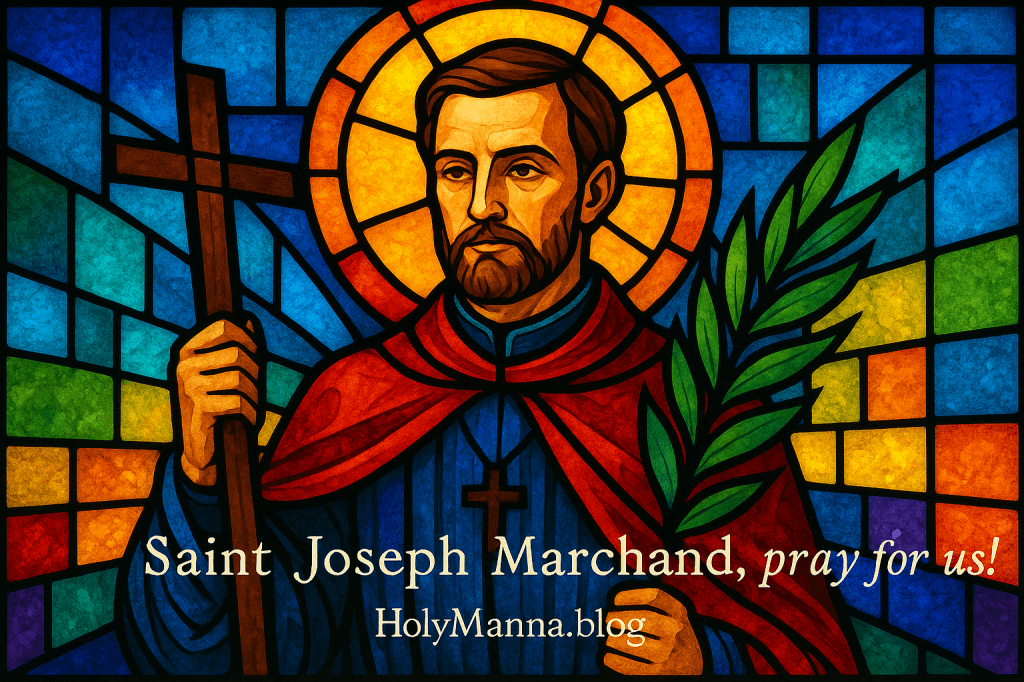
A Hidden Missionary Giant of Vietnam
Saint Joseph Marchand is remembered as one of the great missionary martyrs of Vietnam, a man whose life was shaped by quiet fidelity, sacrificial love, and steadfast courage. He served as a priest of the Paris Foreign Missions Society and spent his short life bringing the Gospel to Vietnamese communities during a time of intense persecution. Though he left behind no famous writings and no recorded personal maxims, his entire life embodies the definition found in The Catechism: “Martyrdom is the supreme witness given to the truth of the faith” (CCC 2473). His ministry and his death stand as a powerful reminder that authentic discipleship often flourishes in hidden places.
From Rural Passavant to the Ends of the Earth
Joseph Marchand was born on August 17, 1803, in Passavant, a small rural village in eastern France. His parents were poor peasants, and Joseph grew up learning the virtues of hard work, simplicity, and perseverance. His path to the priesthood was not sparked by a dramatic conversion moment but by the steady growth of a heart responsive to God’s call. He entered the ecclesiastical school at Orsans in 1821 and later continued his priestly studies at the major seminary in Besançon, where his instructors recognized his deep piety and intelligence.
Ordained in 1829, he soon applied to the Paris Foreign Missions Society, drawn by a desire to share the Gospel in lands where the Church was young and often persecuted. Although he was later offered a position back in France as the head of the Foreign Mission Seminary, a prestigious and safer role, he declined the offer. His heart belonged to the missions, and he chose to return to the Vietnamese people whom he had come to love. His conversion was not a single moment but an ongoing, faithful “yes” expressed through obedience and sacrifice. He remains known for his humility, missionary zeal, and unwavering commitment to Christ.
Shepherd in a Time of Storm
Father Marchand arrived in Cochinchina (southern Vietnam) around 1830. He adopted a Vietnamese name, learned the language, and immersed himself in the lives of the faithful. His mission territory grew to include approximately twenty five communities and thousands of Catholics scattered across regions around Saigon and even stretching toward Phnom Penh. He cared for seminarians, catechized families, administered the sacraments, and nurtured vocations, all during a period when imperial persecution loomed constantly.
No spectacular miracle stories from his lifetime have been recorded in detail. Yet the quiet miracles of endurance, conversion, and faithfulness among the Vietnamese Catholics he served testify to the grace active in his ministry. His perseverance under pressure, his refusal to seek earthly security, and his generous pastoral love are themselves signs of God at work. As The Catechism teaches, the Church is called “to be the universal sacrament of salvation” (CCC 849), and Father Marchand embraced that mission with remarkable dedication.
Standing Firm under the Dragon Throne
Father Marchand lived and served under Emperor Minh Mang, a ruler who viewed Christianity as a destabilizing force that threatened traditional Confucian culture. Severe edicts outlawed Christian practice, and many priests and laypeople were arrested, tortured, or executed.
In 1833 a wave of intensified persecution spread throughout the region, forcing Father Marchand into hiding. During the same period, the Lê Văn Khôi revolt took place in Saigon. Some historical sources state that Father Marchand was drawn into the conflict, while others describe him as a prisoner of the rebels who was later blamed by imperial forces. Regardless of the political complexities, once the emperor regained control, Father Marchand was arrested and accused of treason.
He was interrogated, tortured, and repeatedly urged to renounce his faith by trampling upon a cross. His refusal to profane the symbol of Christ’s sacrifice cost him dearly. Sentenced to the gruesome “punishment of the hundred wounds,” he endured brutal torture before being killed near Huê on November 30, 1835, at only thirty two years old. His body was cut apart and thrown into the sea to prevent the faithful from venerating his remains. His death stands as a stark testament to the cost of discipleship and the victory of love over violence.
A Seed of Faith in Vietnam and Beyond
Because his body was destroyed, few relics of Saint Joseph Marchand remain. Yet the witness of his life could not be erased. His birthplace in Passavant became a memorial site, with artwork depicting the stages of his life and martyrdom. More importantly, devotion to him grew in Vietnam, where Catholics recognized him as one of the many foreign missionaries who gave their blood so that the faith could take deep root in their land.
Over time, the Church formally studied his life and the miracles attributed to his intercession. He was beatified in 1900 and canonized on June 19, 1988, by Pope Saint John Paul II, together with 116 other Vietnamese Martyrs. His feast day is celebrated on November 30, as well as during the collective memorial of the Vietnamese Martyrs on November 24.
The greatest miracle flowing from his intercession is the endurance and flourishing of the Catholic faith in Vietnam. Despite centuries of persecution, the Church there remains vibrant, courageous, and missionary, nourished by the blood of witnesses like Saint Joseph Marchand.
Learning to Love Christ in Hostile Times
The life of Saint Joseph Marchand challenges every Catholic to embrace the Gospel with courage and humility. He shows that God rarely calls people to greatness through fame or recognition. Instead, holiness is often found in the quiet and hidden sacrifices of daily life. He had the opportunity to choose safety and honor, yet he chose to remain with the people who needed him, trusting that God would use his small offerings in ways he could not foresee.
His story invites us to reflect on the way comfort shapes our decisions. He rejected security out of love for Christ, while many today struggle even to speak openly about their faith. His witness reminds us that the Church grows not through cultural approval but through fidelity, especially in times of pressure. His death also helps us understand suffering in a more Christ centered way. As Jesus teaches in The Gospel of Matthew 16:25, “Whoever loses his life for my sake will find it.” Saint Joseph Marchand’s sacrifice echoes this truth with purity and power.
His life encourages every believer to take concrete steps to live their faith boldly. That might mean inviting a friend back to Mass, defending Church teaching with charity, frequenting the sacraments, or courageously choosing virtue when the world offers compromise. His courage shines as a light for anyone seeking holiness in a culture that often opposes the Gospel.
Engage with Us!
Saint Joseph Marchand’s example is meant to stir hearts and inspire deeper faith. Share your thoughts and reflections in the comments. Let this be a place where honest conversation and spiritual growth can thrive.
- Where do you feel the most pressure to hide or soften your Catholic faith in order to fit in with those around you?
- What comfort or routine might God be inviting you to release so that you can serve Him more generously?
- How does hearing about Saint Joseph Marchand’s martyrdom shape your understanding of your own trials and hardships?
- What is one practical way you can be more intentionally missionary in your daily life?
- How does the witness of the martyrs deepen your appreciation for the sacraments and the freedom to practice your faith?
May Saint Joseph Marchand intercede for each of us, that we may live our faith with courage, perseverance, and love, doing everything with the mercy and compassion that Jesus taught us.
Saint Joseph Marchand, pray for us!
Follow us on Instagram and Facebook for more insights and reflections on living a faith-filled life.

 Holy Manna!
Leave a comment