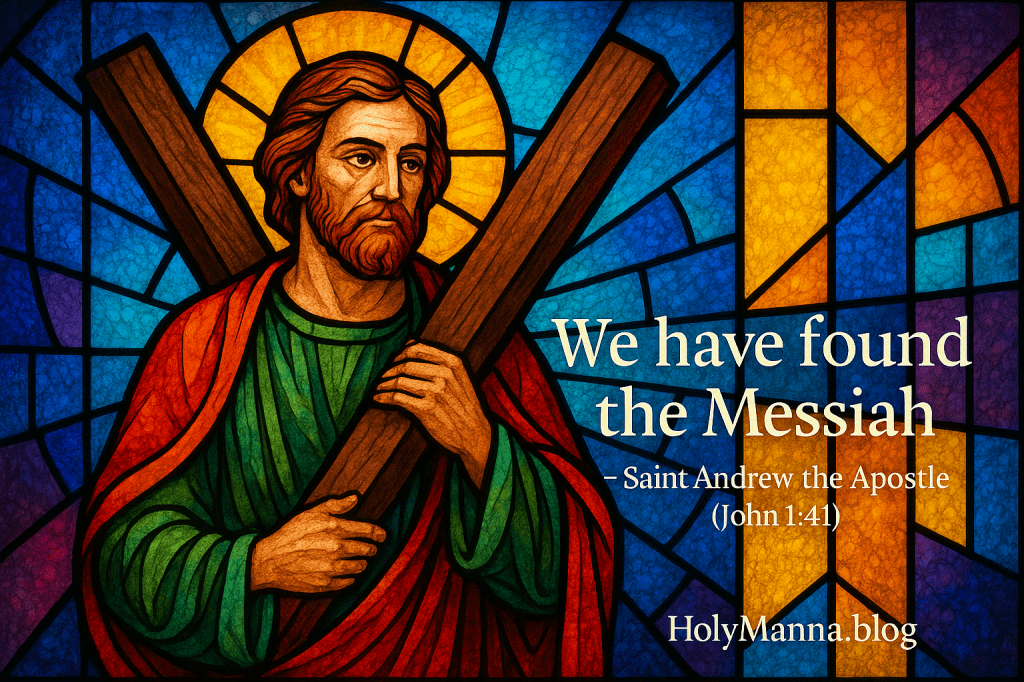
Fisher of Men and Friend of the Cross
Saint Andrew the Apostle stands at the very beginning of the Gospel story. He is remembered as the “first-called” disciple who hears about Jesus before almost anyone else and immediately brings others to Him. The Church remembers Andrew as an apostle, evangelizer, and martyr, and as a visible reminder that the whole Church is built on the foundation of the apostles. The Catechism teaches that the Church “was and remains built on the foundation of the Apostles” and that their mission continues in their successors until the end of time (CCC 857, 860, 869). Andrew is especially loved as the quiet apostle who constantly points away from himself and toward Christ. He introduces his own brother Peter to Jesus, brings the boy with the loaves and fishes to the Lord, and helps the Greeks who want to see Jesus find their way to Him. Because of this, he is a powerful patron for anyone who wants to learn how to evangelize in a humble and relational way. His feast day is November 30, and he is venerated across the Christian world as patron of places such as Scotland, Greece, Russia, Romania, and Ukraine, as well as of fishermen and seafarers.
From Galilean Nets to the Lamb of God
Andrew was born in Bethsaida in Galilee, along the Sea of Galilee, into a Jewish family that made its living from fishing. Scripture tells us that he was the brother of Simon Peter and both were sons of Jonah. Galilee in his time was a crossroads of cultures, and even his name “Andrew,” which is Greek and means “manly” or “brave,” hints at a family familiar with both Jewish and Greek influences. Andrew grew up working the nets with Peter, likely dealing with long nights, unpredictable catches, and the labor of hauling boats and gear every day. This simple hard-working background matters, because when Christ called Andrew, He did not call a scholar or statesman but a fisherman who understood perseverance and community.
Before following Jesus, Andrew was a disciple of John the Baptist. The Gospel of John tells us that Andrew was standing with John when John pointed to Jesus and proclaimed Him the Lamb of God. Andrew followed, spent time with Jesus, and hurried to his brother with the joyful confession: “We have found the Messiah” (Jn 1:41). From that moment forward, Andrew’s life was forever changed. The Gospel of Matthew tells us that Jesus saw Andrew and Simon Peter casting a net into the sea and called them with the words: “Follow me, and I will make you fishers of men” (Mt 4:19). Andrew obeyed immediately. He is most known for being the first-called, the one who brought others to Christ, and the apostle who quietly served in the background of major Gospel moments, content to let Jesus and others take the forefront.
Bringing Others to Jesus
As an apostle, Andrew walked with Jesus throughout His public ministry. He listened to the teachings, witnessed healings, and saw the Lord cast out demons. Like the other apostles, he was sent to preach and heal in the Lord’s name. Andrew appears in several powerful Gospel scenes that reveal his heart. When a large crowd followed Jesus and there seemed to be almost no food, Andrew noticed a small opportunity and brought it forward, saying: “There is a boy here who has five barley loaves and two fish” (Jn 6:9). It was not much, yet Andrew offered even the little he could find. Jesus took that small gift and multiplied it into abundance.
In another moment, when Greeks approached Philip saying they wanted to see Jesus, Philip turned to Andrew, and together they guided them to the Lord (Jn 12:20–22). Andrew’s missionary spirit shines here. He is always ready to help someone find a path to Christ. After Pentecost, Christian tradition holds that Andrew traveled widely to preach the Gospel, journeying through regions such as Scythia, Thrace, and Achaea. Many early sources describe him as the “Apostle to the Greeks.” Tradition attributes numerous miracles to Andrew during his missionary work, especially in Patras in Achaea, where he is said to have healed the sick, cast out demons, and converted many through his preaching. These works were not signs of personal glory but reminders that the risen Christ continued His mission through His apostles. The Catechism reminds us that the apostles were chosen witnesses of Christ’s Resurrection and remain the foundation stones of the Church (CCC 860, 869).
Cross Shaped Love
Following Christ brought Andrew into conflict with those who resisted the Gospel. As the faith spread across the pagan world, opposition rose from political leaders, idol worshippers, and those who felt threatened by Christian teaching. Tradition holds that Andrew eventually arrived in the city of Patras in Achaea, where his preaching converted many, including influential citizens. This angered the local Roman proconsul, who condemned him to death for refusing to renounce Christ or participate in pagan sacrifices.
Ancient tradition tells us that Andrew was sentenced to crucifixion, but he requested not to die on a cross exactly like that of Christ. Instead, he was bound to a cross shaped like the letter X, which became known as Saint Andrew’s Cross or the saltire. Some accounts say he hung upon the cross for two days, continuing to preach and encourage the faithful until he surrendered his spirit. Regardless of the precise details, the Church has always remembered that Andrew embraced martyrdom with courage and love, offering his final witness to Christ through his suffering. His life and death became a model of cruciform discipleship for every generation.
An Apostle Across Continents
After Andrew’s martyrdom, Christians honored his body in Patras. In the fourth century, Emperor Constantius II ordered that Andrew’s relics be transferred to Constantinople, where they were enshrined with great reverence in the Church of the Holy Apostles. During the medieval period, many of these relics were brought to Amalfi in Italy, where they remain today in the Cathedral of Saint Andrew. Other churches across Europe, including those in Scotland, Greece, and other countries under his patronage, venerate smaller relics of the apostle.
For centuries, the faithful have reported miracles through Andrew’s intercession. These include healings, protection at sea, and assistance in times of personal trial. A well-known tradition associated with his relics in Amalfi is the “Manna of Saint Andrew,” a dew or oil-like substance that appears on his tomb and has been linked by the faithful to miracles and healings. While the Church has not issued doctrinal judgment on this phenomenon, it has allowed the longstanding pious devotion connected to it. Pilgrimages to Patras, Amalfi, and other sites dedicated to Saint Andrew continue to draw believers seeking the apostle’s intercession and closeness to Christ. The Catechism teaches that the communion of saints is real and that the Church on earth shares spiritual goods with the saints in heaven (CCC 949). Andrew’s ongoing presence through devotion and miracles is a reminder of that truth.
Following the First Called
Saint Andrew may not take center stage in the Gospels as often as Peter or John, but his quiet faithfulness is a powerful example. He shows how discipleship unfolds in simple steps that point others to Jesus. Andrew is the one who shares the joyful news “We have found the Messiah” with his brother. He is the one who notices the boy with the small lunch and brings him to the Lord. He is the one who helps outsiders, like the Greeks seeking Christ, find their way to Him. His life demonstrates that evangelization often happens through simple invitations, small moments of courage, and personal relationships.
The Catechism teaches that the Church “keeps and hands on the teaching” of the apostles and remains guided by them through their successors, the bishops (CCC 857–860). This means that every Catholic today is called to live with an apostolic mindset. Andrew encourages modern believers to pay attention to the people around them, to offer even their smallest gifts to God, and to stay faithful during trials. His X-shaped cross is a symbol of a life stretched outward in love. It invites every follower of Jesus to let their faith touch their families, friendships, workplaces, and communities. Andrew’s life reminds Christians that holiness is often lived quietly, steadily, and with deep trust in Jesus.
Engage with Us!
Take a moment to sit with the witness of Saint Andrew and let his example encourage, challenge, and inspire your own walk with Christ. Share your thoughts and reflections in the comments below so that others can grow from your insights as well.
- Where in your daily life do you feel called to bring others to Jesus in the same simple and relational way that Saint Andrew did?
- Who is someone in your life right now who might be waiting for a personal invitation to grow closer to Christ?
- What small gifts, limited resources, or moments of your day can you offer to Jesus and trust Him to multiply for the good of others?
- How does the image of Saint Andrew’s X shaped cross help you understand the crosses you carry and the way God may want to use them?
- In what practical way can you live a more apostolic faith this week by sharing the Gospel through kindness, courage, and intentional conversations?
May the example of Saint Andrew the Apostle strengthen every heart to follow Christ with courage, to love the Church built on the foundation of the apostles, and to do all things with the love and mercy that Jesus has taught.
Saint Andrew the Apostle, pray for us!
Follow us on Instagram and Facebook for more insights and reflections on living a faith-filled life.

 Holy Manna!
Leave a comment