First Sunday of Advent – Lectionary: 1
Waking Up While The World Sleeps
There is a quiet ache in every human heart for a world that finally makes sense, where justice is real, peace is lasting, and love is more than a slogan. Advent steps right into that ache and says: “The night is advanced, the day is at hand.” It is not just a cozy season of candles and wreaths. It is a wake up call from God.
The readings for the First Sunday of Advent line up like three clear bells ringing the same message. In Isaiah 2:1-5, the prophet looks ahead to a time when the Lord’s mountain stands above every other power and all nations stream toward it. People beg to be taught by God so that they can walk in His ways. Weapons are turned into farming tools and war training is replaced by a new kind of training in peace. The vision ends with an invitation that still hits the soul hard today: “House of Jacob, come, let us walk in the light of the Lord!” This is Israel’s hope, born in a world of invasion, fear, and fragile kingdoms. It is also the Church’s hope in a restless and anxious age.
Psalm 122 takes that hope and puts it into the mouth of a pilgrim who finally stands inside Jerusalem. Ancient Israel knew the joy of going up to the holy city for the great feasts, of walking as a family toward the house of the Lord. The psalm carries that same thrill: “I rejoiced when they said to me, ‘Let us go to the house of the Lord.’” This is not just geography. Jerusalem means the place of God’s presence and the place of His justice. In a culture where kings were often corrupt and courts were uneven, the promise of true thrones of justice in the house of David was a radical hope. The Church now reads this psalm as a song of the Christian heart moving toward the heavenly Jerusalem, longing for real peace and stability in the middle of chaos.
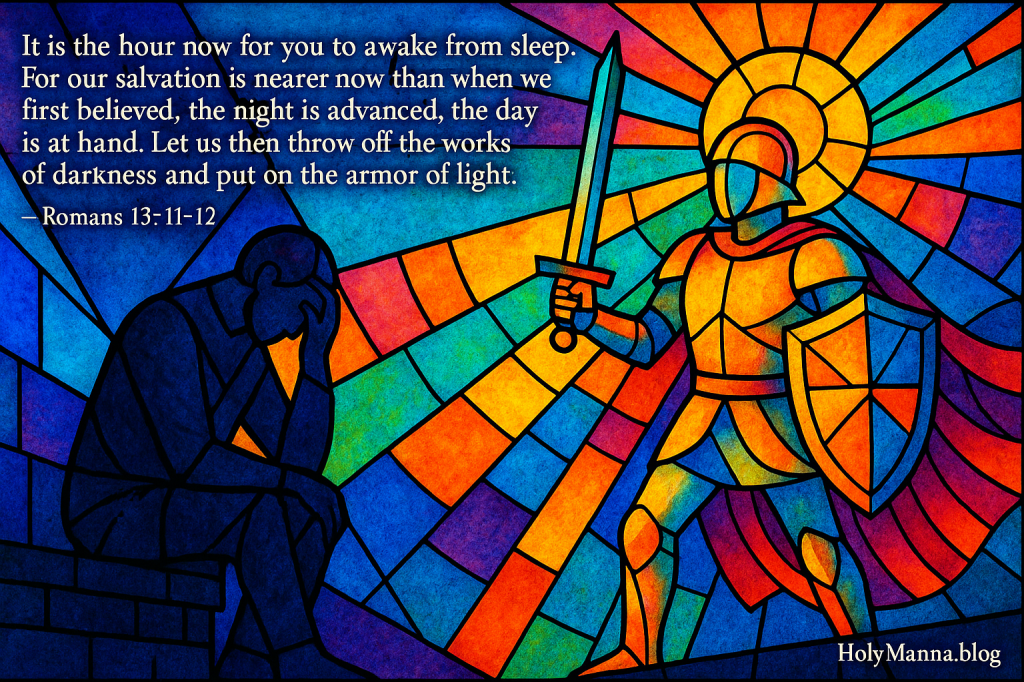
Into that longing, Romans 13:11-14 speaks with urgency. The Christians in Rome lived in a city full of pagan worship, sexual chaos, entertainment, and constant distraction. Saint Paul tells them the truth they are tempted to ignore: “It is the hour now for you to awake from sleep.” Spiritual drowsiness is more dangerous than political persecution. The apostle calls them to throw off the works of darkness and to “put on the armor of light”, to “put on the Lord Jesus Christ”. The Catechism of the Catholic Church teaches that Advent is a time when the Church makes present the ancient expectation of the Messiah and renews the desire for Christ’s second coming. Advent is not passive waiting. It is active preparation, a change of lifestyle, a new way of walking in the light.
Then The Gospel of Matthew 24:37-44 gives the sharp edge to that call. Jesus reminds His disciples of the days of Noah. People were eating, drinking, marrying, and just living life as usual until the flood came. Ordinary life is not the problem. The problem is living ordinary life without God, spiritually asleep to the reality that the Lord is coming. Jesus gives the clear command: “Therefore, stay awake!” and “You also must be prepared, for at an hour you do not expect, the Son of Man will come.” In a world that loves constant stimulation but often hates real reflection, these words cut through the noise. Advent begins here, with a serious question to the heart: Is life being lived awake in the light of Christ, or drifting along as if there will always be more time?
The central theme that ties all of today’s readings together is this call to Advent wakefulness. God is not only promising a future kingdom of peace. He is inviting every believer right now to step out of spiritual sleep, to walk in the light, to live as a citizen of the coming Kingdom today, and to be ready to meet the Lord whenever He comes.
First Reading: Isaiah 2:1-5
Walking Out Of The Dark And Up The Mountain Of God
Isaiah speaks to Judah and Jerusalem during a time of political anxiety, moral compromise, and looming invasion. The kingdom of Judah sits between aggressive empires, and many people are tempted to rely on alliances, idols, and human strategies instead of trusting the Lord. Into that setting, God gives Isaiah a stunning vision of the future. Instead of collapse and ruin as the final word, God reveals a day when His presence on Zion will draw all nations, establish true justice, and bring real peace.
This prophecy is not just a pretty image. It is a promise that God Himself will be the one to fix what human politics, treaties, and wars cannot heal. The mountain of the Lord becomes the place where people come to be taught, corrected, and transformed. Weapons of war become tools for cultivating life. The reading ends with a direct call: “House of Jacob, come, let us walk in the light of the Lord!” That call fits perfectly with the Advent theme of waking up. The Lord is showing the final destination, His holy mountain and His Kingdom of peace, and inviting every believer to start walking toward it right now, leaving the darkness of sin behind.
Isaiah 2:1-5
New American Bible (Revised Edition)
1 This is what Isaiah, son of Amoz, saw concerning Judah and Jerusalem.
Zion, the Royal City of God
2 In days to come,
The mountain of the Lord’s house
shall be established as the highest mountain
and raised above the hills.
All nations shall stream toward it.
3 Many peoples shall come and say:
“Come, let us go up to the Lord’s mountain,
to the house of the God of Jacob,
That he may instruct us in his ways,
and we may walk in his paths.”
For from Zion shall go forth instruction,
and the word of the Lord from Jerusalem.
4 He shall judge between the nations,
and set terms for many peoples.
They shall beat their swords into plowshares
and their spears into pruning hooks;
One nation shall not raise the sword against another,
nor shall they train for war again.
5 House of Jacob, come,
let us walk in the light of the Lord!
Detailed Exegesis
Verse 1: “This is what Isaiah, son of Amoz, saw concerning Judah and Jerusalem.”
This first verse sets the scene. Isaiah is not giving a personal opinion or a political analysis. He is describing what he “saw,” which is prophetic vision revealed by God. The focus on “Judah and Jerusalem” shows that God begins His plan of salvation with a particular people and a particular place. From there, this plan will expand outward to all nations. The Church sees in this a pattern for salvation history. God chooses Israel first, then fulfills His promises in Christ and extends them through the Church to the ends of the earth. The vision invites trust in God’s revealed plan rather than in human guesswork.
Verse 2: “In days to come, the mountain of the Lord’s house shall be established as the highest mountain and raised above the hills. All nations shall stream toward it.”
The phrase “in days to come” points to the future, to the messianic age and ultimately to the fullness of the Kingdom of God. The “mountain of the Lord’s house” refers to Mount Zion, the site of the Temple in Jerusalem. Calling it the “highest mountain” does not just mean topography. It means that God’s presence and worship are above every other power, ideology, and culture. When Isaiah says “all nations shall stream toward it”, he reverses the natural image. Rivers do not flow uphill, yet here the nations flow toward God’s mountain. Grace pulls hearts upward, even against the natural current of sin and division. This points to the universal mission of salvation, fulfilled in Christ, where every nation is invited into the New Covenant.
Verse 3: “Many peoples shall come and say: ‘Come, let us go up to the Lord’s mountain, to the house of the God of Jacob, that he may instruct us in his ways, and we may walk in his paths.’ For from Zion shall go forth instruction, and the word of the Lord from Jerusalem.”
Here the nations are not dragged to God. They invite one another. They say “Come, let us go up”, which shows a free and joyful response to God’s call. The goal is not just pilgrimage tourism. It is a desire for teaching and conversion: “that he may instruct us in his ways, and we may walk in his paths.” The focus is on learning and then living God’s will. The phrase “from Zion shall go forth instruction, and the word of the Lord from Jerusalem” points ahead to the preaching of the Gospel from Jerusalem after the Resurrection and Pentecost. The Church Fathers often saw this as a foreshadowing of the Church’s mission to teach all nations. The reading highlights that true peace and unity only come when people surrender to the Lord’s word and walk in His ways.
Verse 4: “He shall judge between the nations, and set terms for many peoples. They shall beat their swords into plowshares and their spears into pruning hooks. One nation shall not raise the sword against another, nor shall they train for war again.”
Here God is shown as the true Judge of the world. “He shall judge between the nations” means He will be the one who decides and settles disputes, who brings real justice, not just a balance of power. When God judges rightly and people accept His judgment, the fruit is peace. The famous line “They shall beat their swords into plowshares and their spears into pruning hooks” shows a total change of purpose. Tools of death become tools of life. Energy once spent on killing and defending is now used to cultivate and nourish. The line “nor shall they train for war again” shows that peace is not just a pause between conflicts. It is a new way of being. This verse points to the ultimate peace of the Kingdom of God, while also challenging today’s world to let Christ’s justice reshape politics, economics, and personal relationships.
Verse 5: “House of Jacob, come, let us walk in the light of the Lord!”
After the grand vision of the future, Isaiah turns directly to his listeners. The call is urgent and practical. “House of Jacob, come” is an invitation to respond now, not later. The command “let us walk in the light of the Lord” ties everything together. God has shown what His Kingdom looks like. Now His people are called to live as if that Kingdom is already real, by walking in His light. Walking in the light means living in truth, rejecting idols, embracing God’s law, and allowing His presence to shape every decision. In the context of Advent, this verse sounds like a spiritual alarm clock. The Lord is saying that it is time to get up, leave the darkness, and start walking up the mountain toward Him.
Teachings: Zion, The Church, And The Coming Kingdom
The Church reads this passage as both promise and mission. Zion, the mountain of the Lord, points forward to Christ and His Church. The Catechism of the Catholic Church explains that the Church is both the seed and beginning of the Kingdom of God on earth. It teaches that “To carry out the will of the Father, Christ inaugurated the Kingdom of heaven on earth” and that this Kingdom “shines out before men in the word, in the works, and in the presence of Christ” (cf. CCC 541). When people come to the Church to be taught, to receive the sacraments, and to be reformed in their lives, Isaiah’s vision begins to unfold.
Advent deepens this understanding. The Catechism says that the liturgy of Advent makes present the expectation of Israel and renews in the hearts of believers the desire for Christ’s second coming. It states that the Church “celebrates the ancient expectation of the Messiah” and at the same time “renews her ardent desire for his second coming” (cf. CCC 524). Isaiah 2 shows the end point of that desire: the nations gathered, peace established, and God’s instruction going forth from His house.
The saints also echo this longing for the peace of God’s Kingdom. Saint Augustine loved to speak of the “City of God” and the “city of man.” According to him, those who love God to the point of despising self form the City of God, while those who love self to the point of despising God form the earthly city. In his reflection, the world’s wars, rivalries, and injustices come from disordered love. True peace begins when the soul is rightly ordered under God. Isaiah’s prophecy fits this view. Only when God judges and teaches, and only when people submit to His ways, do swords become plowshares and war training stops.
There is also a Eucharistic dimension. The pilgrim joy of Psalm 122 and the vision of Zion in Isaiah 2 find a real foretaste in the Mass. The Catechism teaches that in the Eucharist the Church already “receives the pledge of her inheritance” and “the life of the eternal Kingdom” (cf. CCC 1402 1405). When believers go up to the house of the Lord for Mass, they are already living the movement Isaiah describes. They go to be taught by Christ, to be fed by Him, and then to go back into the world as witnesses of His peace.
Reflection: Walking In The Light During Advent
This reading presses a simple but piercing question into the heart: Which direction is the soul walking right now? Isaiah shows all the nations streaming uphill toward God. Advent asks if daily choices are flowing in that same direction, or drifting the other way.
Modern life trains people to trust in human strategies, political power, economic comfort, and personal control. Judah in Isaiah’s time faced the same temptation. Instead of trusting God, many relied on foreign alliances and idols. The Lord responds by lifting the eyes higher. He shows a mountain that will not fall, a city that will not crumble, and a peace that is not based on fragile deals. The invitation to “walk in the light of the Lord” is a real call to examine what the heart leans on for security.
Practically, this reading can shape Advent in several concrete ways. First, it invites a serious look at prayer. Is there daily time when the soul “goes up” to the Lord to be instructed in His ways, especially through Scripture and silence before Him? Second, it challenges attitudes about conflict. Where are there “swords” in life: harsh words, resentments, passive aggression, grudges, or the desire to win every argument? Advent is a powerful time to let the Holy Spirit begin turning those weapons into “plowshares” that cultivate peace: honest conversations, forgiveness, patient listening, and acts of mercy.
It also raises the question of whose teaching is really shaping the mind. Is the heart being formed more by news feeds, social media, and cultural trends, or by the word of the Lord going forth from His Church? Isaiah’s vision urges believers to let God set the terms, not the surrounding culture. That can mean choosing to read Scripture each day, revisiting the teachings of the Catechism, going to Confession, and taking the Sunday Eucharist more seriously as the center of the week.
Finally, this reading encourages hope. The world often looks more like a battlefield than a peaceful mountain. Yet God has already shown the ending. There will be a day when Christ judges the nations with perfect justice and establishes unshakeable peace. Advent faith means living now as citizens of that future Kingdom, even when the present feels dark. The question becomes very personal: What is one “work of darkness” that needs to be surrendered this Advent, and what is one concrete step that can help “walk in the light of the Lord” today?
Responsorial Psalm: Psalm 122
Longing For The City Where God Dwells
Psalm 122 is one of the “songs of ascents,” prayed by pilgrims walking up to Jerusalem for the great feasts. In the ancient world, Jerusalem was not just a capital city. It was the spiritual heart of Israel, the place of the Temple, the Ark, sacrifice, and blessing. Going up to Jerusalem meant drawing close to the visible sign of God’s dwelling among His people. For a faithful Israelite, this journey was filled with joy, reverence, and hope.
In this psalm, the pilgrim has finally arrived. The long walk is over and the gates of Jerusalem are under his feet. He rejoices in the unity of the tribes of the Lord, the thrones of justice, and the call to pray for the peace of the holy city. This longing for Jerusalem points beyond the earthly city. For Christians, it becomes an image of the Church and the heavenly Jerusalem, where God will wipe away every tear and establish perfect peace.
Within the Advent theme of wakefulness, this psalm stirs up holy desire. It shows a heart that is fully awake to the privilege of entering the house of the Lord. While the world is often spiritually drowsy, this pilgrim is thrilled to stand where God is worshiped and where His justice reigns. The Church prays this psalm to awaken a similar joy in going to Mass, in belonging to the Church, and in journeying toward the Kingdom that Isaiah and the other readings describe.
Psalm 122
New American Bible (Revised Edition)
A Pilgrim’s Prayer for Jerusalem
1 A song of ascents. Of David.
I rejoiced when they said to me,
“Let us go to the house of the Lord.”
2 And now our feet are standing
within your gates, Jerusalem.
3 Jerusalem, built as a city,
walled round about.
4 There the tribes go up,
the tribes of the Lord,
As it was decreed for Israel,
to give thanks to the name of the Lord.
5 There are the thrones of justice,
the thrones of the house of David.
6 For the peace of Jerusalem pray:
“May those who love you prosper!
7 May peace be within your ramparts,
prosperity within your towers.”
8 For the sake of my brothers and friends I say,
“Peace be with you.”
9 For the sake of the house of the Lord, our God,
I pray for your good.
Detailed Exegesis
Verse 1: “I rejoiced when they said to me, ‘Let us go to the house of the Lord.’”
The psalm opens with deep gladness. The invitation to go to the house of the Lord is not a burden. It is a cause for joy. In a world that often treats worship as optional or inconvenient, this verse reveals the heart of someone who understands that the greatest privilege in life is access to God’s presence. Spiritually, it challenges any coldness or routine approach to Mass. The Christian is invited to rediscover that going to church is not just an obligation. It is a joyful response to God who calls His people into communion.
Verse 2: “And now our feet are standing within your gates, Jerusalem.”
The journey is complete. The pilgrim has arrived. Jerusalem is no longer an idea or a far-off hope. It is concrete reality. The phrase “our feet are standing” carries a sense of relief, stability, and fulfillment. For Israel, this meant physical arrival in the city of God. For the Church, it also symbolizes the grace of already belonging to the people of God and already having a place within the spiritual Jerusalem. In Advent, this verse echoes the tension between already and not yet. In Christ, believers have already entered God’s household, yet still await the full vision of the heavenly city.
Verse 3: “Jerusalem, built as a city, walled round about.”
Here Jerusalem is praised for its unity and security. The walls represent protection, order, and a defined identity. This is more than architecture. It reflects a people gathered and held together by God’s covenant. The Church reads this as an image of herself as a spiritual city, structured and protected by God. The unity of the city points to the unity of the Church’s faith, worship, and charity. The Advent call to wakefulness includes being alert to divisions, gossip, and factions that threaten this unity and praying for the Church to stand firm as a strong, well built city.
Verse 4: “There the tribes go up, the tribes of the Lord, as it was decreed for Israel, to give thanks to the name of the Lord.”
The psalmist sees all the tribes of Israel converging on Jerusalem. This is a powerful image of unity in worship. Twelve different tribes, with different histories and territories, gather in one place to give thanks. They go up because God has decreed it. Obedience to God’s command leads to communion with Him and with one another. Gratitude is at the center. They ascend to “give thanks to the name of the Lord.” Advent invites the same attitude. The people of God gather in parishes from many backgrounds to give thanks in the Eucharist, which literally means thanksgiving. This verse also hints at the future, when people from every nation will come together in Christ.
Verse 5: “There are the thrones of justice, the thrones of the house of David.”
Jerusalem is not only a religious center. It is also the political and judicial heart of the kingdom. The “thrones of justice” are where decisions are made, disputes are judged, and laws are applied. By mentioning the house of David, the psalm recalls God’s promise that David’s line would endure. This points to the Messiah, the true Son of David, who will reign in perfect justice. For Christians, this verse turns the eyes toward Christ the King, whose judgment is fair, merciful, and final. During Advent, the Church remembers that He will come again to judge the living and the dead. The psalm’s focus on thrones of justice reminds the soul that every choice in life moves either toward or away from that final judgment.
Verse 6: “For the peace of Jerusalem pray: ‘May those who love you prosper!’”
Now the psalmist calls the people to intercession. Peace is not assumed. It is asked for in prayer. The word “peace” here is rooted in the biblical idea of shalom, which means wholeness, right relationship, and well-being, not just the absence of war. Praying for the peace of Jerusalem means asking God to keep His people in unity, fidelity, and blessing. Those who love the holy city are blessed in that peace. For the Church, this becomes a call to pray for the peace and unity of the Church, especially when scandals, divisions, or external hostility threaten her. A heart that is awake in Advent will not just complain about the state of the Church. It will earnestly pray for her peace.
Verse 7: “May peace be within your ramparts, prosperity within your towers.”
This line continues the prayer. The psalmist prays for peace and prosperity to fill the city’s defenses and towers. The desire is that every part of Jerusalem would be secure and fruitful. Spiritually, this can be read as a prayer for the peace of the entire Church, from the highest leadership to the simplest parish. It also reaches into the life of every believer, since the human heart is a kind of interior city where God desires to reign. The prayer can be applied personally as a desire for inner peace and spiritual prosperity, rooted in God’s presence rather than in wealth or comfort.
Verse 8: “For the sake of my brothers and friends I say, ‘Peace be with you.’”
The focus shifts outward. The psalmist does not seek peace only for himself. He desires peace for “brothers and friends.” Peace in Jerusalem is a blessing for everyone who belongs there. There is a strong sense of fraternal charity. The wish “Peace be with you” anticipates the greeting used by Christ after the Resurrection and in the liturgy. It is not just a polite phrase. It is a real blessing spoken over others. Advent wakefulness includes caring about the spiritual and emotional state of others and sincerely desiring that the peace of Christ rest on them.
Verse 9: “For the sake of the house of the Lord, our God, I pray for your good.”
The psalm ends with a pure motive. The reason for praying for Jerusalem’s good is “for the sake of the house of the Lord.” The city matters because it houses the presence of God. In Christian reading, the Church matters above all because it is the dwelling place of God’s Spirit. Praying for the good of the Church, the parish, or the family is ultimately rooted in love for God Himself and for His dwelling among His people. This final verse sums up the attitude Advent calls forth. A heart truly awake in faith will pray for the good of the Church, the good of the community, and the good of the world, because God’s name is honored when His people flourish in holiness.
Teachings: The Church, The Liturgy, And The Heavenly Jerusalem
This psalm has always been cherished as more than a travel song for ancient pilgrims. In Christian tradition, Jerusalem becomes a rich symbol of the Church and the heavenly city that awaits the faithful. The Catechism of the Catholic Church speaks of the Church as a “holy city” and connects her to the “Jerusalem above.” It teaches that the Church is “the place where humanity must rediscover its unity and salvation” and that she is “like a stranger in a foreign land” on pilgrimage toward the heavenly Jerusalem (cf. The Catechism of the Catholic Church 845). This mirrors the pilgrim spirit of Psalm 122, where the tribes go up together for worship and justice.
The Catechism also explains that in the liturgy believers already participate in the worship of heaven. It states that “in the earthly liturgy we share in a foretaste of that heavenly liturgy” (cf. The Catechism of the Catholic Church 1090). When the Church prays Psalm 122 before or during the Eucharist, the words “Let us go to the house of the Lord” are fulfilled in a new and deeper way. The Mass is not only a community gathering. It is the entrance into the house of God, where Christ Himself is present and where heaven and earth meet.
The early saints saw the same mystery. Saint Augustine often spoke of the Church as the City of God, journeying amid the struggles of history toward the heavenly peace God has promised. He viewed the earthly city as marked by love of self and the heavenly city as marked by love of God. Psalm 122 fits this vision. It describes a people whose deepest joy is to go to God’s house, to stand in His city, and to pray for her peace. The saints teach that this is not just poetic language. It is the real identity of every baptized person, who belongs to the household of God and walks with the people of God toward the eternal Jerusalem.
The call to pray for the peace of Jerusalem also has an enduring connection to the Church’s prayer for peace in the world. The Church prays at every Mass for peace in families, parishes, nations, and among all peoples. This flows from Christ, who is called “our peace” in Ephesians 2:14. The psalm’s prayer “May those who love you prosper” becomes, in the New Covenant, a prayer that all who love Christ and His Church may be strengthened and protected, even amid persecution and trial. Advent, with its focus on the coming of the Prince of Peace, gives special weight to this psalm and its plea for peace.
Reflection: Loving The House Of The Lord Today
Psalm 122 gently but firmly examines the heart. It asks whether the house of the Lord is truly loved or merely tolerated. The psalmist rejoices at the invitation to go to God’s house. Many people today feel bored or indifferent about Sunday Mass. This psalm invites a deeper honesty. Does the heart light up at the thought of entering the church, receiving the sacraments, and standing in the presence of Christ, or has worship become just one more thing on the calendar?
Advent is a perfect time to let the Holy Spirit renew love for the Church and for the liturgy. A practical step might be to arrive a little earlier before Mass, to sit quietly, to meditate on the tabernacle, and to make an intentional act of thanksgiving. Another step could be to consciously pray Psalm 122 before entering the church, asking God to restore the same joy expressed in the words “I rejoiced when they said to me, ‘Let us go to the house of the Lord.’”
The call to pray for the peace of Jerusalem challenges modern habits as well. It is easy to criticize the Church, complain about leaders, or focus on scandals and divisions. The psalm suggests a different approach. Before speaking critically about the Church or the parish, has the heart sincerely prayed, “For the peace of Jerusalem pray: ‘May those who love you prosper’”? Advent wakefulness means caring enough to intercede, not just to comment. That can mean regularly including the parish priest, parishioners, and the wider Church in daily prayer.
This psalm also touches relationships. The line “For the sake of my brothers and friends I say, ‘Peace be with you’” can be applied in families, friendships, and workplaces. Is there someone who needs to hear a sincere word of peace, a real apology, or an offer of reconciliation? Advent is an ideal time to take a first step, to send a message, to have a conversation, or to lay down a long held grudge.
Finally, Psalm 122 reminds every believer that life is a pilgrimage. This world is not the final home. The Christian is on the way to the heavenly Jerusalem. That reality can change how daily struggles are carried. When work feels heavy, when family life is messy, when the world seems unstable, can the heart remember, “And now our feet are standing within your gates, Jerusalem,” because in Christ there is already a place prepared in the Father’s house? Holding that truth close can bring steady hope as Advent unfolds and the Church walks together toward the coming King.
Second Reading: Romans 13:11-14
Time To Wake Up And Get Dressed For The Day
The Letter to the Romans is written to Christians living at the heart of the Roman Empire, surrounded by pagan worship, moral confusion, and constant distraction. They have heard the Gospel and begun a new life in Christ, but Saint Paul knows how easy it is to drift into spiritual laziness. In this passage, he sounds an alarm. He reminds them that history is moving, Christ is coming, and the way they live right now truly matters.
Paul uses strong images that fit perfectly with the Advent theme. He speaks about waking up from sleep, noticing that the night is almost over, and recognizing that the day is near. He calls believers to throw off the works of darkness and to put on the armor of light. Finally, he gives one of the most powerful lines in the New Testament about Christian identity: “put on the Lord Jesus Christ”. This reading fits the First Sunday of Advent because it cuts through excuses and delays. The message is simple and urgent. The time for half hearted faith is over. The time to live fully awake in Christ has come.
Romans 13:11-14
New American Bible (Revised Edition)
11 And do this because you know the time; it is the hour now for you to awake from sleep. For our salvation is nearer now than when we first believed; 12 the night is advanced, the day is at hand. Let us then throw off the works of darkness [and] put on the armor of light; 13 let us conduct ourselves properly as in the day, not in orgies and drunkenness, not in promiscuity and licentiousness, not in rivalry and jealousy. 14 But put on the Lord Jesus Christ, and make no provision for the desires of the flesh.
Detailed Exegesis
Verse 11: “And do this because you know the time; it is the hour now for you to awake from sleep. For our salvation is nearer now than when we first believed.”
Paul begins with time. He reminds the Christians that they already “know the time.” This does not mean knowing a date on a calendar. It means understanding where they stand in God’s plan of salvation. With the coming, death, and Resurrection of Christ, the decisive moment in history has already begun. The phrase “it is the hour now for you to awake from sleep” shows that spiritual drowsiness is no longer acceptable. Sleep here means living on autopilot, stuck in sin, habit, or indifference. Paul adds “For our salvation is nearer now than when we first believed”. He is not denying that they are already saved by grace. He is pointing to the full, final salvation that will be revealed when Christ returns. Every day brings that moment closer. This is exactly the mindset Advent wants to restore. The season is not just about looking back at Bethlehem. It is about realizing how close eternity really is and letting that reality wake the soul up.
Verse 12: “The night is advanced, the day is at hand. Let us then throw off the works of darkness [and] put on the armor of light.”
Here Paul shifts to the language of night and day. “The night is advanced” means that the old age of sin and ignorance is running out of time. “The day is at hand” points to the dawn of Christ’s Kingdom and His return in glory. Paul does not want believers to live like people who think it is still midnight. He calls them to act like it is almost sunrise. That means making a choice. “Let us then throw off the works of darkness” is a very concrete command. Sin is described like clothing that has to be stripped off and left behind. Then he says to “put on the armor of light”. Light here is not just softness or comfort. It is armor. Living in the truth, staying in grace, and practicing virtue is a kind of spiritual protection in a dark world. Advent wakefulness, in this sense, is not sentimental. It is battle ready holiness.
Verse 13: “Let us conduct ourselves properly as in the day, not in orgies and drunkenness, not in promiscuity and licentiousness, not in rivalry and jealousy.”
Paul now gets very specific. To live “as in the day” means to act like everything is visible, nothing is hidden, and God’s light is shining on every action. In that light, certain behaviors simply do not belong. He names “orgies and drunkenness”, which refer to wild parties, excess, and the loss of self control. He adds “promiscuity and licentiousness”, which include sexual sin, impurity, and any way of treating the body or others as objects. Finally, he mentions “rivalry and jealousy”, which show how darkness can also live in the heart through comparison, competition, and hidden resentment. This verse hits especially hard in a culture that normalizes and celebrates exactly these things. Paul is reminding Christians that they belong to the day. Their lifestyle should look different. Advent is a prime time to examine honestly where any of these patterns might be present and to bring them to Confession.
Verse 14: “But put on the Lord Jesus Christ, and make no provision for the desires of the flesh.”
This final verse gives the heart of the passage. The Christian life is not only about saying no to sin. It is about saying yes to a person. “Put on the Lord Jesus Christ” is powerful language. Clothing shapes how someone appears and often how someone behaves. To put on Christ means to allow His life, His virtues, and His Spirit to cover and permeate everything. It means thinking with His mind, loving with His heart, and acting with His obedience. The second part, “and make no provision for the desires of the flesh”, warns against leaving little escape routes for sin. To “make provision” is to plan ahead, to keep options open, to provide fuel for temptation. Paul is urging believers to cut off the small compromises that feed the old self. In Advent terms, this is a call to concrete conversion. It is not enough to feel vaguely sorry. It is time to remove the hidden supports of sin and choose practical steps that make room for Christ.
Teachings: The Urgency Of Conversion And The New Life In Christ
The Church has always read this passage as a clear call to ongoing conversion. The Catechism of the Catholic Church teaches that conversion is a lifelong task. It explains that interior repentance is a radical reorientation of the whole life toward God, a turning away from sin and a turning toward God with all the heart. The language of throwing off works of darkness and putting on the armor of light fits exactly with this teaching. Conversion is not a one time emotional moment. It is a daily decision to move from darkness into light.
The Catechism also speaks about the moral life as a response to grace. It teaches that Christians are called to live as children of the light and to be renewed in their minds. It describes the new life in Christ as participation in the very life of the Holy Trinity. When Paul commands believers to “put on the Lord Jesus Christ”, he is not asking for a shallow imitation. He is inviting them to live out the mystery of their baptism, where they were clothed with Christ and became part of His Body.
The language about the “flesh” can be misunderstood. Paul does not mean that the human body is evil. The Church is very clear that the body is created good and is destined for resurrection. In this context, “flesh” refers to human nature wounded by sin, turned in on itself, and inclined to selfish desires. The call to “make no provision for the desires of the flesh” is a call to refuse whatever feeds selfishness, impurity, and rebellion against God. It is the flip side of living in the Spirit.
Many saints have echoed this sense of urgency. Saint Augustine famously lived a life of restlessness and sin before his conversion. When he finally surrendered to God, he wrote in Confessions: “You have made us for yourself, O Lord, and our heart is restless until it rests in you.” This restlessness is what Paul is addressing. Sleep, in Romans 13, is not peaceful rest in God. It is restless drift away from Him. The saint’s experience shows that waking up and putting on Christ leads to the true rest every heart craves.
The Church also connects this passage to the expectation of Christ’s return. The Creed professes that Christ will come again in glory to judge the living and the dead. The Catechism explains that since the Ascension, this coming could occur at any moment, even though the exact time is unknown. That is why the Church rejects both idle speculation about dates and lazy indifference. Paul’s words “our salvation is nearer now than when we first believed” echo this teaching. Salvation history is moving forward. Advent is the liturgical season that keeps this reality in front of the eyes of believers and calls them to live ready.
Reflection: Living Like It Is Almost Dawn
This reading presses a real question into daily life. If the night is advanced and the day is at hand, is life being lived like someone who knows dawn is coming or like someone pretending it is still night? It is very easy to slip into spiritual sleep. The routines of work, social media, entertainment, and constant noise can dull the sense of God’s presence and the seriousness of sin.
One practical way to respond is to ask the Holy Spirit for light on the “works of darkness” that need to be thrown off. Is there a pattern of drinking, partying, or entertainment that crosses into sin or leads toward it? Is there any area of sexual sin, either in actions, relationships, or what is watched or consumed online, that needs to be faced and confessed? Is there rivalry or jealousy toward someone in family, work, or parish life that poisons the heart? Paul names these things not to crush people, but to help them see clearly what does not belong in the light.
Another concrete step is to look at how provision is being made for the desires of the flesh. What are the little choices that make it easier to fall into the same sins? That might be certain apps, accounts followed, private habits, or friendships that pull the soul away from God. Advent can be a season of real decisions. That might mean deleting something, changing a routine, setting a filter, seeking accountability, or reaching out for help. Making no provision for the flesh is not about fear. It is about taking holiness seriously.
On the positive side, to “put on the armor of light” and “put on the Lord Jesus Christ” invites some creative commitments. What small daily practice could help wrap the mind and heart in Christ each morning? That could be a short morning offering, a decade of the Rosary, reading the Gospel of the day, or a brief examination of conscience at night. The point is to live like someone who knows that Christ is near, not far.
Finally, this passage encourages hope. The fact that “our salvation is nearer now than when we first believed” means that God is not distant and that every step of conversion is worth it. The day really is at hand. Advent is the time to wake up, get dressed in the armor of light, and walk forward with confidence. A good question to carry is this: If Christ came visibly tomorrow, what is one change that would be wished had already been made today, and what would it look like to start that change right now?
Holy Gospel: Matthew 24:37-44
Staying Awake When Everyone Else Is Asleep
The Gospel of Matthew in this chapter records Jesus speaking about His coming and the end of the age. He is sitting on the Mount of Olives, facing Jerusalem, answering the disciples’ questions about the destruction of the Temple and His return. The disciples want signs and timelines. Jesus gives something much more personal and demanding. He calls them to constant vigilance, not obsessive prediction. The focus is not on guessing dates, but on living every day ready to meet Him.
In this passage, Jesus uses the days of Noah as a warning. People were living normal lives, doing normal things, but they were spiritually blind. They ignored God’s call to repentance until it was too late. Jesus then gives sharp images. Two people side by side. One taken, one left. A thief coming at night when the master of the house is relaxed and off guard. The message fits perfectly with the theme of Advent: wakefulness, readiness, and a life that reflects true faith, not just routine religion.
Advent is the Church’s way of standing with the disciples on that hillside, listening again to the Lord say “Therefore, stay awake!” and “You also must be prepared.” This Gospel reminds every believer that Christ’s coming is not just an old story from Bethlehem or a vague future idea. It is a real event that could break into any ordinary day. The right response is not fear, but a serious and hopeful readiness that shapes how life is lived right now.
Matthew 24:37-44
New American Bible (Revised Edition)
37 For as it was in the days of Noah, so it will be at the coming of the Son of Man. 38 In [those] days before the flood, they were eating and drinking, marrying and giving in marriage, up to the day that Noah entered the ark. 39 They did not know until the flood came and carried them all away. So will it be [also] at the coming of the Son of Man. 40 Two men will be out in the field; one will be taken, and one will be left. 41 Two women will be grinding at the mill; one will be taken, and one will be left. 42 Therefore, stay awake! For you do not know on which day your Lord will come. 43 Be sure of this: if the master of the house had known the hour of night when the thief was coming, he would have stayed awake and not let his house be broken into. 44 So too, you also must be prepared, for at an hour you do not expect, the Son of Man will come.
Detailed Exegesis
Verse 37: “For as it was in the days of Noah, so it will be at the coming of the Son of Man.”
Jesus begins with a comparison. He points to the days of Noah, a time when human wickedness had grown and people ignored God’s warnings through Noah. The phrase “so it will be at the coming of the Son of Man” connects that ancient story to the final judgment. The “Son of Man” is Jesus’ favorite title for Himself, rooted in Daniel 7, where a mysterious figure receives everlasting dominion from God. Here, Jesus is claiming that His coming will be the decisive moment of judgment and salvation, just as the flood was in Noah’s time. The focus is on the attitude of people before that moment. They were not ready.
Verse 38: “In those days before the flood, they were eating and drinking, marrying and giving in marriage, up to the day that Noah entered the ark.”
Jesus underlines how normal life looked before the flood. There is nothing wrong in itself with eating, drinking, marrying, or giving in marriage. These are ordinary human activities. The problem was that people were completely absorbed in these things without reference to God. They had no sense of urgency, no openness to conversion, no listening to Noah’s preaching. Life had turned inward on itself. This is a mirror for modern life. Many people live busy, full, “normal” lives with no serious attention to God, eternity, or judgment. Jesus is warning that this kind of practical atheism is dangerous, even if it looks socially acceptable.
Verse 39: “They did not know until the flood came and carried them all away. So will it be also at the coming of the Son of Man.”
This verse is sobering. The people “did not know” until it was too late. It is not that they had zero information. Noah had been building an ark and preaching righteousness. They chose not to know. Their ignorance was rooted in indifference. Then the flood came and “carried them all away”. Jesus says this is how it will be when He returns. The point is not to terrify believers, but to snap hearts out of spiritual sleep. The Lord is making it clear that ignoring God’s call will not stop the day of judgment from arriving. Advent wakefulness means choosing to know, to listen, and to respond now.
Verse 40: “Two men will be out in the field; one will be taken, and one will be left.”
Now Jesus moves from the flood story to an image of ordinary work. Two men are doing the same job, side by side, in the field. Outwardly, their lives look identical. Inwardly, something is different. One is taken, one is left. The Gospel does not spell out all the details of what “taken” and “left” mean here. The key point is that the final separation is not based on social status, job, or external appearance. It is based on the hidden state of the heart and the person’s relationship with God. This is a strong reminder that every workplace, every field, every office, every job site is a place where someone can live in friendship with Christ or live as if He does not exist.
Verse 41: “Two women will be grinding at the mill; one will be taken, and one will be left.”
Jesus repeats the same pattern with two women performing ordinary labor. Grinding at the mill was a daily task. Again, the outward picture is the same. What distinguishes the women is not the task but the heart. One is ready, one is not. The Lord is teaching that the moment of His coming will reveal what is already true in the soul. This is not about guessing who will make it. It is about realizing that every hidden choice, every pattern of faith or unfaith, is shaping who a person is in relation to God.
Verse 42: “Therefore, stay awake! For you do not know on which day your Lord will come.”
Here Jesus gives the direct command. “Therefore, stay awake!” In biblical language, staying awake means remaining spiritually alert, attentive to God, rooted in prayer, and living in a state of grace. It does not mean living in constant anxiety. It means not drifting into sin, apathy, or forgetfulness of God. Jesus adds “For you do not know on which day your Lord will come.” The uncertainty of the timing is not an accident. It is part of God’s plan. If the exact day and hour were known, people would be tempted to delay conversion. The unknown day keeps the heart humble and continually turned toward God.
Verse 43: “Be sure of this: if the master of the house had known the hour of night when the thief was coming, he would have stayed awake and not let his house be broken into.”
Jesus uses a simple, relatable image. A homeowner would never relax if he knew a thief was coming at a certain hour. He would stay awake and guard the house. The thief in this image is not Christ Himself, but the suddenness of His coming. The point is that surprise is real. When someone is careless, when the house of the soul is left unguarded, the enemy can break in or the final moment can arrive when the person is least prepared. The Lord is urging His followers to treat their spiritual lives with at least the seriousness that people show in protecting their homes and possessions.
Verse 44: “So too, you also must be prepared, for at an hour you do not expect, the Son of Man will come.”
Jesus concludes with a personal application. “So too, you also must be prepared” is not a suggestion. It is a command. Preparation here means living in such a way that if Christ returned today, there would be no shame, no hiding, no double life. The last line, “for at an hour you do not expect, the Son of Man will come”, sums up the teaching. The lack of a timetable is meant to form a certain kind of disciple. The Lord wants believers who are faithful every day, not just when they feel the pressure of a deadline. Advent exists to build that kind of heart, one that lives each day as a gift and each moment as a possible meeting with the Lord.
Teachings: Vigilance, Judgment, And Hope In Christ’s Coming
The Church takes this passage very seriously when teaching about the Last Things. The Catechism of the Catholic Church explains that since the Ascension, Christ’s coming in glory is always imminent in the sense that it could happen at any time. It states that this coming is “a hope which does not deceive” and that Christians are called to live in a way that “hastens the coming of the Kingdom of God” (cf. The Catechism of the Catholic Church 1042 1043 1048). This does not mean that humans can force God’s hand, but that their holiness, mission, and prayer are meant to cooperate with His plan.
The Catechism also addresses the temptation to either obsess over end times or ignore them. It teaches that before Christ’s second coming, the Church must pass through a final trial that will shake the faith of many. It warns against “a pseudo messianism by which man glorifies himself in place of God” (cf. The Catechism of the Catholic Church 675). In this light, Jesus’ call to stay awake in Matthew 24 is not about decoding world events. It is about resisting any false security that replaces trust in God with trust in human power, technology, or ideology.
Saint Augustine, preaching on this theme, reminded believers that the “day of the Lord” comes for each person at death, even before the final universal coming. For the individual soul, that moment will be like the day of the Lord. The Lord’s warning about unexpected timing applies not only to the end of history, but also to the end of an individual life. This is why the Church encourages regular examination of conscience, Confession, and a life that is ready to meet Christ at any moment.
The liturgy of Advent weaves this teaching into the Church’s prayer. At the start of Advent, the Church does not immediately focus on Bethlehem. The first readings, including this Gospel, draw attention to Christ’s return in glory. Only as the season unfolds does the focus move more directly toward the mystery of His first coming in the flesh. This pattern shows that the baby in the manger is the same Lord who will come to judge the living and the dead. The believer is invited to hold both comings together. The gentleness of Christ’s first coming encourages trust. The power and justice of His second coming inspire holy fear and serious conversion.
At the same time, the Church always insists that the coming of the Lord is good news. Christ is not a cruel judge waiting for people to slip up. He is the Savior who has already given His life on the Cross and opened the way of mercy. The call to stay awake is a call to stay close to Him, to remain in His grace, and to keep the heart free from the chains of sin. When the Church prays, “Thy Kingdom come”, it is asking for the very reality that this Gospel describes, a world fully under Christ’s reign of justice and peace.
Reflection: Staying Spiritually Awake In A Distracted World
This Gospel hits right into the rhythm of modern life. People today are rarely physically asleep. They are usually overstimulated, always scrolling, always moving, always busy. Yet inside, many are spiritually numb. The Lord’s words cut through that fog. Is the soul awake to God’s presence, or has it quietly drifted into a kind of spiritual sleep, even while doing religious things from habit?
One practical way to respond is to honestly examine “ordinary days.” The people in Noah’s time were eating, drinking, marrying, and working. The men in the field and the women at the mill in the Gospel were just doing their jobs. What do ordinary days look like right now? Is God part of the thoughts, decisions, and conversations, or has faith been pushed to the edges of the schedule? Advent can be a time to invite the Lord back into the ordinary. That might mean starting and ending the day with a simple prayer, pausing during the day to acknowledge His presence, or praying briefly before tasks and meetings.
Another step is to look at where the “house” of the heart might be unguarded. The image of the thief suggests hidden vulnerabilities. Are there areas of life where the door has been left unlocked through compromise, secret sin, or unchecked habits? That could involve media use, relationships, honesty at work, or private moral choices. Advent wakefulness means facing these vulnerabilities with courage, bringing them to Confession, and making concrete changes that protect the soul. It might feel costly, but it is worth it in light of eternity.
Living ready does not mean living in fear. It means living in friendship with Christ. What would it look like to live today in such a way that if the Lord came tonight, there would be peace, not panic? That does not require dramatic external changes for most people. It usually means being faithful in the small things: daily prayer, regular sacraments, forgiveness, generosity, and integrity in relationships and work.
This Gospel also challenges the habit of delay. There is always a temptation to think conversion can wait. People tell themselves that they will get serious about God later, when life is less busy, when they feel more spiritual, or when they are older. Jesus’ words cut through that illusion. “At an hour you do not expect, the Son of Man will come.” No one knows how much time is left, either in the world or in personal life. Advent is a grace filled season where the Church gently but firmly invites every soul to respond now.
A helpful question to carry into prayer might be this: If the Lord asked right now, “Are you ready to meet Me today,” what would the honest answer be, and what one change could move that answer closer to a confident yes?
Living Advent Wide Awake With Christ
Advent opens with a gentle but very real alarm from God. Through Isaiah 2:1-5, Psalm 122, Romans 13:11-14, and The Gospel of Matthew 24:37-44, the Lord is not just offering cozy spiritual thoughts. He is inviting every heart to wake up, to walk in His light, and to live each ordinary day ready to meet Him.
In Isaiah, the Holy Spirit lifts the eyes to a future where the mountain of the Lord stands above every power, where the nations stream toward Him, and where weapons become tools for life. The prophecy ends with that powerful invitation: “House of Jacob, come, let us walk in the light of the Lord!” Advent begins by asking each soul to stop living as if this world is all there is and to start walking today as a citizen of that coming Kingdom of peace.
Psalm 122 shows the heart of a pilgrim who finally stands within the gates of Jerusalem and rejoices at the chance to enter the house of the Lord. The psalm stirs up love for the Church, for the liturgy, and for the unity of God’s people. It calls believers to pray for the peace of the Church and to bless one another with real charity. In a noisy and divided world, this psalm reminds everyone that the true home is the household of God and the heavenly Jerusalem that lies ahead.
The Letter to the Romans cuts straight through spiritual laziness. Romans 13:11-14 announces that the night is advanced and the day is at hand. The call is clear. Throw off the works of darkness. Put on the armor of light. Above all, “put on the Lord Jesus Christ.” Advent is not just about waiting. It is about changing. It is about concrete steps away from sin and real choices that make room for Christ to reign in the mind, the body, and the heart.
Finally, The Gospel of Matthew gives the sharp, loving command from Jesus Himself. “Therefore, stay awake!” and “You also must be prepared.” He shows people in Noah’s day living normal lives without God and warns that the same danger exists today. Two men in the field. Two women at the mill. One ready, one not. The difference is not their job, but their heart. The Lord is not trying to scare anyone. He is inviting every disciple to live each day in friendship with Him, so that whenever He comes, He finds a heart that is already His.
Taken together, these readings offer a simple but powerful Advent call to action. Lift your eyes to the mountain of the Lord. Love the house of God and pray for the peace of the Church. Throw off the works of darkness and put on the armor of light. Stay spiritually awake in the middle of everyday routines.
A good way to begin could be small and sincere. Maybe that means a renewed commitment to Sunday Mass, daily Scripture, or finally going back to Confession. Maybe it means making peace with someone, changing a habit, or cutting off something that feeds sin. Advent is a gift. It is the season when Christ gently knocks on the door again and says through His Church: “It is the hour now for you to awake from sleep.”
So, what is one concrete step that can be taken this week to walk more fully in the light of the Lord, to live more awake, and to be more ready to meet Christ when He comes?
Engage with Us!
Share your reflections in the comments below and help build a real community of faith that listens to the Word of God together. Let these questions guide a deeper look at how Isaiah 2:1-5, Psalm 122, Romans 13:11-14, and The Gospel of Matthew 24:37-44 are speaking into real life right now.
- First Reading – Isaiah 2:1-5: Where do you see “swords” in your own life that the Lord might be asking you to turn into “plowshares,” and what is one concrete step you can take this week to “walk in the light of the Lord”?
- Responsorial Psalm – Psalm 122: When you hear the words “Let us go to the house of the Lord”, what honestly rises up in your heart, and how might God be inviting you to renew your love for the Mass and your parish community?
- Second Reading – Romans 13:11-14: Which “work of darkness” named by Saint Paul hits closest to home for you right now, and what practical change could help you “put on the armor of light” and “put on the Lord Jesus Christ” in a more intentional way this Advent?
- Holy Gospel – Matthew 24:37-44: If Jesus came today in the middle of your ordinary routines, what part of your life would you feel most ready to show Him, and what part would you most want His mercy to transform so that you can truly “stay awake” and be prepared?
May every reflection draw you closer to the Heart of Jesus. Live each day in faith, ask for the grace to stay awake, and do everything with the love and mercy that Jesus taught, so that your whole life becomes a quiet but powerful yes to Him.
Sacred Heart of Jesus, we trust in You!
Immaculate Heart of Mary, pray for us!
Saint Michael the Archangel, defend us in battle!
Follow us on Instagram and Facebook for more insights and reflections on living a faith-filled life.

 Holy Manna!
Leave a comment