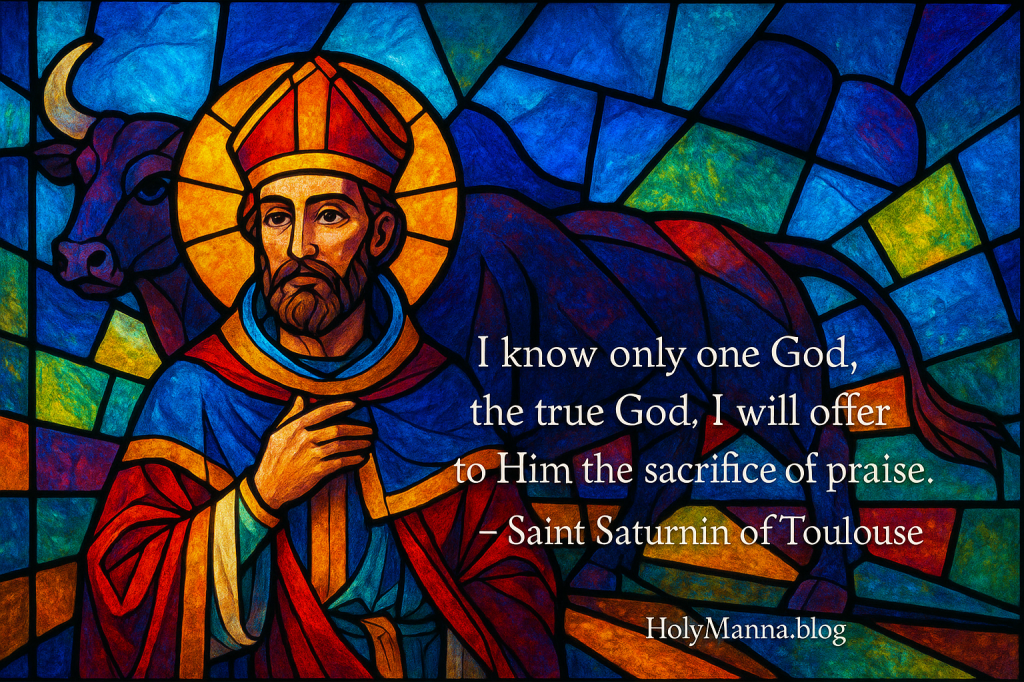
A Bishop Dragged by a Bull
Saint Saturnin of Toulouse, also known as Saint Sernin, stands as one of the earliest missionary bishops who helped anchor Christianity in Roman Gaul. He served as the first bishop of Toulouse in the mid third century and is remembered as a fearless evangelizer, a defender of the true God in a pagan world, and a martyr who confirmed his preaching with the ultimate witness of his blood. His legacy lives on in the devotion of the faithful, the basilica that bears his name, and the enduring inspiration his courage continues to offer. The Catechism of the Catholic Church teaches that martyrdom is the supreme act of love (CCC 2473–2474), and Saturnin’s life reveals the depth of that truth in a vivid and unforgettable way.
From Greece to Gaul
Tradition places the origins of Saint Saturnin in the Greek world, possibly in Patras, sometime in the early third century. While details of his youth remain unclear, the Church holds that his missionary calling was unmistakable. During the pontificate of Pope Saint Fabian, seven bishops were sent to evangelize Gaul, and Saturnin was entrusted with the city of Toulouse. Rooted in the apostolic mission described in CCC 1555–1561, he preached Christ in a land dominated by pagan temples and imperial religion.
In a culture unfamiliar with the Gospel, Saturnin established a small but faithful Christian community. Ancient sources describe him as a preacher whose holiness, courage, and possible miracles drew converts and challenged pagan practices. His presence among the idols was said to silence pagan oracles, emphasizing the truth that Christ is Lord and that the powers of darkness cannot endure the light of the Gospel.
Silenced Oracles and Steadfast Faith
Early Christian writings about Saint Saturnin highlight the dramatic spiritual conflict of his ministry. As he passed by the Capitol of Toulouse, where sacrifices and divinations took place, the pagan idols reportedly fell silent. The local priests noticed that the oracles no longer spoke and blamed the Christian bishop whose holiness disrupted their rituals. This tradition emphasizes the Church’s belief that evil flees from the presence of Christ and from those who bear His grace through a life of faith.
Saint Saturnin is also remembered for converting many through his preaching and sacramental ministry. Although not all specific miracles are preserved in detail, he is consistently portrayed as a man whose words and actions drew people to Christ. The most striking miracle, however, was not a supernatural event recorded in a single moment but the miracle of unwavering conviction. When dragged before a pagan altar and ordered to offer sacrifice, he responded with unwavering clarity, proclaiming, “I know only one God, the true God. I will offer to Him the sacrifice of praise.” His words summarize the heart of Catholic worship expressed in CCC 1356–1362: one God, one Lord, and one true sacrifice.
Tied to a Bull
Saint Saturnin lived under the constant threat of persecution, especially during the harsh measures enacted under the emperor Decius. One day, as a bull was being prepared for sacrifice at the Capitol, the pagan priests seized Saturnin and accused him of silencing their gods. They dragged him into the temple and demanded that he perform a pagan sacrifice. The bishop refused without hesitation because he knew that such an act would betray Christ and deny the truth he had lived to proclaim.
Enraged by his refusal, the crowd tied Saturnin’s feet to the bull’s rope and drove the animal down the steep steps of the Capitol. As the bull ran, his body was brutally torn against the stones until he died. In this violent and heartbreaking scene, the Church sees not defeat but victory. Martyrdom unites the Christian to the Cross of Christ, and according to CCC 2473, the martyr bears witness to the truth “unto death.” Two Christian women retrieved his broken body at great personal risk, lovingly burying him so that his relics would not be desecrated.
Hidden Relics and Public Glory
For years, Saint Saturnin’s grave was hidden to protect it from desecration. Over time, however, the faithful discovered the location of his burial and began to honor him more openly. Various bishops of Toulouse worked to build shrines over the site, and eventually a grand basilica arose in his honor. The Basilica of Saint Sernin became not only a home for his relics but also one of the great pilgrimage churches of the medieval world.
Pilgrims who visited his tomb reported healings, conversions, and spiritual protection through his intercession. This long tradition reflects what the Church teaches about the communion of saints in CCC 956–957, where the faithful on earth, the souls in purgatory, and the saints in heaven are united in Christ. The miracles attributed to Saint Saturnin after his death affirm the living presence of God working through His saints across centuries.
Living Like an “Apostle to the Gauls”
Saint Saturnin’s world was shaped by persecution, misunderstanding, and pressure to conform. Many believers today face similar pressures, even if expressed in different forms. His life encourages all Christians to root themselves deeply in the Gospel and to remain faithful in every circumstance.
His missionary zeal reminds believers that the Church is not a passive institution but one always sent forth to evangelize. According to CCC 863, every baptized person shares in this mission. Saturnin shows how courage, clarity, and charity can transform even hostile surroundings.
His refusal to worship idols challenges modern disciples to examine the “soft idols” that compete for their loyalty. These may include comfort, reputation, entertainment, or social acceptance. His powerful words, “I know only one God, the true God. I will offer to Him the sacrifice of praise,” call each reader to the same steadfast love of God.
Finally, his martyrdom shows that suffering for the faith is never meaningless. Even small sacrifices offered in love become a participation in Christ’s saving work. When faced with ridicule, inconvenience, or moral conflict, Christians today can draw strength from his fearless witness.
Faith can be lived out simply and concretely by speaking about Jesus openly, living sacramental lives, avoiding what contradicts the Gospel, and asking the saints for their help. Saint Saturnin’s courage offers a timeless reminder that Christ is worth every sacrifice and that authentic faith transforms the world.
Engage with Us!
Share your thoughts and reflections in the comments below. The witness of Saint Saturnin becomes even more powerful when the faithful reflect together on how to live out the Gospel with bravery and love.
- Where do you feel the most pressure to fit into the culture rather than openly live your Catholic faith, and how does the example of Saint Saturnin help you in that area?
- How do his bold words about the one true God challenge you to confront any areas of compromise or spiritual hesitation?
- What is one practical step you can take this week to share your faith more confidently?
- How does the Church’s teaching on the communion of saints shape the way you understand the power of relics, shrines, and intercession?
May the example and intercession of Saint Saturnin of Toulouse strengthen every reader to live a life of deep faith, courageous witness, and steadfast love, doing everything with the love and mercy that Jesus taught in the Gospel.
Saint Saturnin of Toulouse, pray for us!
Follow us on Instagram and Facebook for more insights and reflections on living a faith-filled life.

 Holy Manna!
Leave a comment