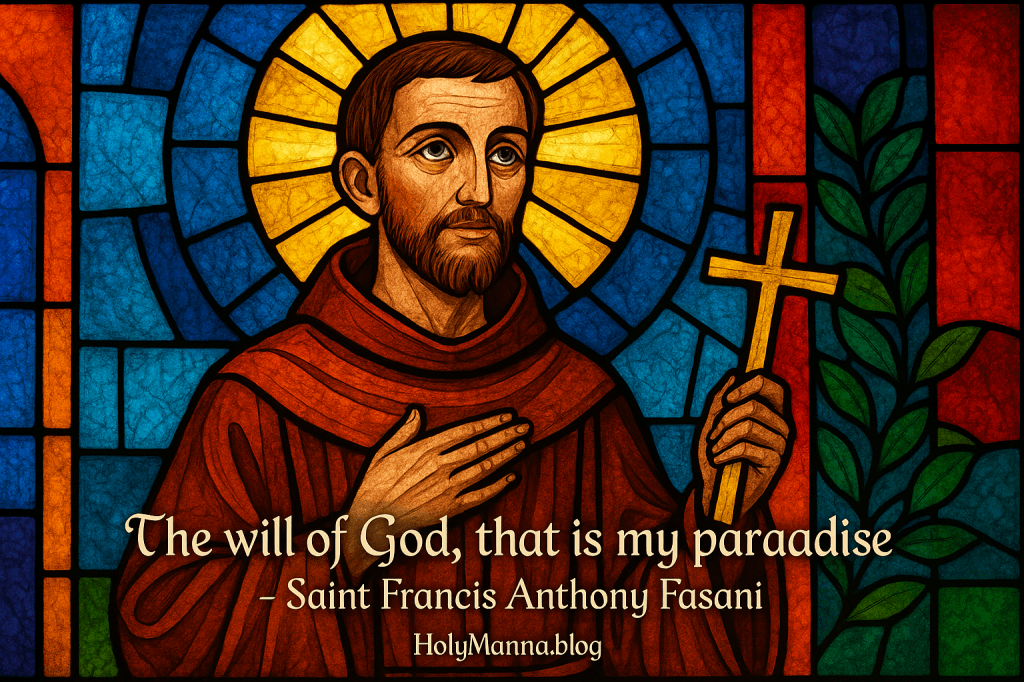
A Hidden Fire of Mercy
Saint Francis Anthony Fasani is one of those quiet, luminous souls whose holiness radiated through simple acts of mercy, Eucharistic devotion, and a life hidden in humility. A Conventual Franciscan priest from southern Italy, he became known in his hometown of Lucera as “Padre Maestro,” meaning Father Master, because of his wisdom, learning, and spiritual fatherhood. For decades he preached parish missions, heard confessions for endless hours, consoled the sick, supported prisoners facing execution, and ignited in ordinary people a deeper love for Our Lady and the Eucharist. When he died in 1742, the children of Lucera ran through the streets crying, “The saint is dead!” His reputation for holiness was immediate and sincere, and his example continues to mirror the Church’s teachings in The Catechism of the Catholic Church on charity, the sacraments, and the universal call to holiness.
From Giovanniello to Padre Maestro
Francis Anthony Fasani was born Giovanniello on August 6, 1681, in Lucera in southern Italy. His parents, Giuseppe Fasani and Isabella della Monaca, raised him in modest means, and after his father’s early death, his stepfather helped ensure the boy received a solid education with the Conventual Franciscans. From his youth he displayed a strong moral character, a sharp mind, and a tender spiritual sensitivity. Under the Franciscans’ guidance, he began to understand God’s call in his life.
He entered the Conventual Franciscan novitiate at Monte Sant’Angelo in 1695, taking the religious names Francis and Anthony in honor of Saints Francis of Assisi and Anthony of Padua. He professed his vows in 1696. After completing studies in philosophy and theology at various Franciscan houses, he continued his formation in Assisi, not far from the tomb of Saint Francis, and was ordained a priest in 1705. In 1709 he earned a doctorate in theology at the College of Saint Bonaventure in Rome, which earned him the affectionate title “Padre Maestro,” used by locals for the rest of his life.
Though his life did not feature a dramatic conversion from sin, he lived what The Catechism calls the “ongoing conversion” that deepens faith after Baptism. He became known especially for his Eucharistic devotion, tender love for Our Lady Immaculate, and tireless commitment to the confessional, where countless souls found forgiveness and peace.
Mystic of the Confessional and the Altar
After his studies, Saint Francis Anthony spent nearly his entire priesthood in his hometown of Lucera, serving as teacher, novice master, guardian, provincial minister, confessor, and pastor. His leadership was consistently marked by humility, gentleness, and unwavering fidelity to the Franciscan Rule. He lived as a man consumed by prayer, often moved to tears before the Blessed Sacrament and known to cry out phrases such as “O Highest Love, Immense Love, Eternal Love, Infinite Love.” Contemporaries claimed that he sometimes appeared to levitate during deep prayer.
His preaching was simple, direct, and filled with Scripture. Witnesses recalled that he spoke in a familiar and compelling way, filled with love for God and neighbor. His words moved many to conversion, aligning beautifully with The Catechism’s teaching that preaching invites every soul to holiness and repentance. He was especially revered as a confessor. People traveled from near and far to seek him, drawn by his remarkable gentleness. One witness described the patience and serenity on his face as he heard confessions, and his explanation for this mercy remains one of his most beautiful quotations: “I was indulgent, I do not deny it; but it was You who taught me to be so.”
His Eucharistic devotion formed the core of his life. He celebrated Mass with deep reverence, and he promoted frequent Holy Communion long before it became common practice. This devotion reflects the Church’s teaching that the Eucharist is the “source and summit” of Christian life, as found in CCC 1324. He also poured himself out for the poor, distributing alms by hand every day and trusting completely in Divine Providence. He comforted the sick and elderly, tended to orphans, and took special pastoral care of prisoners, including those condemned to death. He accompanied the condemned to their final moments with prayer and compassion, embodying Jesus’ love for the most forgotten.
Although he did not work spectacular miracles in the way some wonderworkers did, his life was surrounded by accounts of divine intervention. People spoke of conversions through his preaching, unexpected help for the poor, and mystical gifts in prayer. God worked quietly but powerfully through him.
His Hidden Hardships and Holy Death
Though not a martyr in the strict sense, Saint Francis Anthony lived a “white martyrdom” through daily self-denial, penance, and unwavering fidelity to God’s calling. He embraced mortifications, practiced long hours of Eucharistic adoration, and carried the weight of multiple responsibilities with humility. His work with prisoners facing execution demanded profound emotional endurance. Few spiritual tasks are more difficult than preparing a soul to meet God under such circumstances.
As he grew older and illness began to weaken him, he accepted his suffering with serenity. In his final days he repeated one of his favorite expressions, “The will of God, that is my paradise.” On November 29, 1742, he died in Lucera, strengthened by the sacraments and wrapped in devotion to the Immaculate Virgin Mary. His funeral drew the entire city, and many considered him a saint even before the Church officially recognized him.
“The Saint Is Dead”
The reaction to his death was immediate and heartfelt. Children ran through the streets shouting, “The saint is dead!” The people of Lucera instinctively recognized the holiness of their gentle pastor. He was buried in the Church of Saint Francis in Lucera, where his remains are still venerated. His tomb quickly became a place of pilgrimage and prayer.
Within a few years, the bishop of Lucera initiated a formal investigation into his life and virtues. Stories of healings and favors through his intercession spread quickly. Two miracles attributed to him were approved for his beatification in 1951, and a third one was recognized in 1985, leading to his canonization by Pope Saint John Paul II in 1986. Today he is honored as the patron of Lucera, and pilgrims continue to visit his shrine to seek spiritual and physical healing. His writings, including meditations and Marian devotions, still inspire those who want to grow in humility, charity, and Eucharistic love.
Learning Mercy from Padre Maestro
Saint Francis Anthony Fasani offers a model of holiness that is both accessible and deeply challenging. He shows what life looks like when the Eucharist truly becomes the heart of one’s identity, not merely a weekly obligation. His devotion to the Blessed Sacrament calls every Catholic to center life around the Mass, Eucharistic adoration, and a deeper reverence for Jesus’ real presence.
His example in the confessional demonstrates how powerful mercy can be when it is offered without judgment or harshness. Confession was not merely a duty for him; it was a mission to reveal the Father’s love to wounded souls. His tenderness reflects the heart of CCC 1440–1442, which teaches that in the Sacrament of Penance, Christ himself reconciles the sinner to God.
Finally, his love for the poor and forgotten echoes the Church’s teaching that charity is at the core of Christian discipleship. His daily acts of service encourage everyone to look for the “poor” in their own surroundings, whether those who suffer materially, emotionally, or spiritually. A life shaped by Eucharistic devotion, sacramental mercy, and humble charity is a life that looks remarkably Christ-like.
Saint Francis Anthony’s beloved prayer, “The will of God, that is my paradise,” offers a powerful reminder that true happiness is found in surrender, not control. Whether facing illness, stress, confusion, or disappointment, this simple prayer can help anchor the soul in peace.
Engage with Us!
Share your thoughts or any experiences you have with this saint or with themes from his life in the comments below. Your reflection might help someone else grow in faith.
- Where is Jesus inviting you to show more mercy, especially toward people who test your patience?
- How can you make the Eucharist more central to the rhythm of your daily and weekly life?
- Who are the “poor” that God is placing in your path today, and what step can you take to serve them with tenderness?
May Saint Francis Anthony Fasani inspire you to live a life overflowing with faith, compassion, and surrender. May his witness help you love the Eucharist, embrace mercy, and serve others with the heart of Christ. May everything you do be rooted in the love and mercy that Jesus has taught in the Gospel.
Saint Francis Anthony Fasani, pray for us!
Follow us on Instagram and Facebook for more insights and reflections on living a faith-filled life.

 Holy Manna!
Leave a comment